


Yesterday we went up to the Hispanic Society for a tour of the museum. It’s Memorial Day weekend so it was even a stretch for me to make. Because my friend Robert had an opening in East Hampton I was calculating when I could hop on the Jitney after the tour. But you know it was going to be kind of insane out there a holiday weekend and also re one’s projects since I’m “the director” it seems I should be loyal always and then see who else comes. So it was me, Lydia Stephanie and Christine, and Stephanie didn’t really want to come inside. She was out there pacing her thing on the plaza. I mean I suppose the tour wasn’t actually relevant to our project except that exegesis always seems like the most natural approach –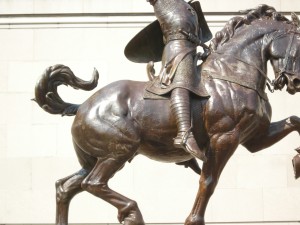 you should go as far with knowledge as you can. All the kinds of knowledge in all directions. Certainly in love you want to know everything, everything about a person’s life, their body and so on. The young woman who gave the tour inside the museum whipped us around the lower and upper galleries inviting (cleverly I thought) one guy on the tour to tell us what he saw, what he thought about each piece bringing in the fringes that way. I might’ve been wrong but it seemed to me that though broadly sexist it was practically sexist to invite the dude to look and then everyone else would. The women would look. Women always look. That’s what we do. I have so much more to say about women and men and looking and Martin Earl ‘s post last week which I liked a lot but I’ll stay on topic here. I learned a lot from the tour. Our guide was smart, just in terms of the information she gave us. It was broad (there’s that word again) but smart around the edges. She didn’t talk down to us but gave a generalist tour with enough details for the expert. She cut the details in a way that indicated more. I’m not the expert but am a Sor Juana Inez de la Cruz fan (17th c. poet nun of New Spain AKA Mexico). I’ve read Paz’s biography which led you through the Bourbon’s and the Hapsburg’s I think. We learned from Paz about the great Spanish empire. We learned from our tour guide about the Moorish one which held sway over Spain for 700 years ending in 1492, a date amazing to our American minds. Then she showed us an early portrait of the Duke of Alba who a knight of Flanders known for being fierce in the wars with the Dutch who you know in response to the Inquisition and everything became the engine of tolerance and modernism which initially colonized America, AKA New York, a whole other topic I won’t go into here. But the historical neighborliness of the Dutch and the Spanish is such a piece of cultural intellectual history that I get excited every time the wings of any information touch upon it. Maybe I’m going crazy or getting old but suddenly (over the past 20 years) the sweep of history and empire and the spread of culture seems like such an amazing flow, the strange trickles and rivulets of influence and accident and violent take over and defeat. We wound up our tour looking at a portrait of the last Hapsburg. The royalty of Europe was so inbred by this point that the poor guy couldn’t chew. You could see his funny jaw. It seemed so weird since they were breeding horses and dogs and would breed out obvious weaknesses and deformities in them but when they came to royalty it was so important to keep it in the family that it didn’t matter that the family was becoming idiotic. I wondered why they didn’t have surrogates. Couldn’t you just breed rulers with other people’s bodies. I mean cleansing the family, not the race. Why would you fold another bad chewer in. It was all about the title our tour guide said. To marry a Hapsburg meant you would be the Duke of blah bah and your child would wind up being the King of France. It meant territory, space power. That’s what’s in a name, a title. The human is not an animal. The human is abstract. The human is a brokered deal at the level of history. My word count is up to 726. I wanted to wrap it around to poetry, the one poem I’ve written lately that doesn’t have a title, only something to hold it. YOUR NAME it says on top but that’s not right. Uncannily in poetry though the title is on top it’s really throughout. Kind of absent till the end sometimes. The ruling title the one that sets the subject out right away dies an early and awkward death you know like the bad jaw. The title must be knowing but full I think of noblesse oblige. Like it gets it all and even at the end it makes you feel smart. You endure something. I mean I want it like that. But is anyone smart like that in America. I mean now. When it seems for example like our empire’s falling apart. Don’t you think.
Eileen Myles was born in Cambridge, Massachusetts, and was educated at the University of Massachusetts...
Read Full Biography