
POET

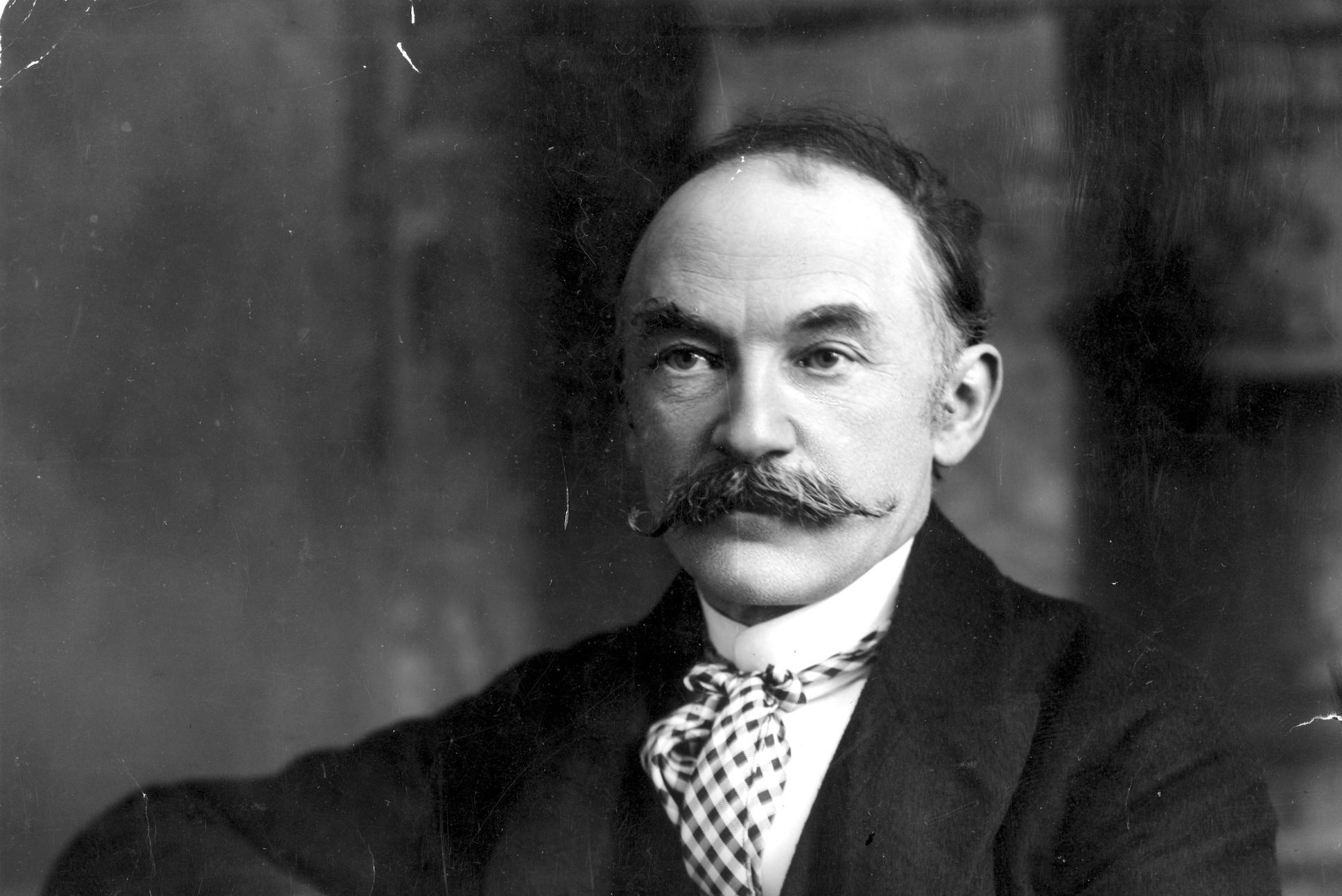
Thomas Hardy (1840 - 1928)

BIOGRAPHY

Thomas  Hardy

Thomas Hardy was both a great poet and a great novelist. Although, as Laurence Lerner and John Holstrom point out in Thomas Hardy and His Readers, Hardy "was a classic of the English novel long before he died," he was not celebrated as a poet of the very first rank until after his death. Helmut E. Gerber's brief synopsis, in the first volume of Thomas Hardy: An Annotated Bibliography of Writings about Him, gives some indication of the evolution of Hardy's reputation: "In the first period, 1871-1896, Hardy established himself with critics and general readers as an important novelist, but recurring storms of controversy made his life difficult at times. During the second, 1897-1928, Hardy the poet and dramatist lost some of this 'celebrity,' but by the time of his death in 1928 he had gained a measure of national respect tendered to few English authors of the last one hundred years. The third period, 1929-1939, was a time of falling reputation for Hardy. In the fourth, 1940-1969, beginning with a centenary celebration curtailed by the incipient World War, the rediscovery of much that had been undervalued and the reassessment of Hardy the man and artist proceeded without pause."

This brief summary, however, only partially suggests the controversy that has enveloped judgments of Hardy's works, both his poetry and prose. If there is at present a "Hardy industry" producing dozens of books and hundreds of articles, it arose, in part, as Jean Brooks suggests in Thomas Hardy: The Poetic Structure, because Hardy's "place in literature has always been controversial, [and] constant reassessment is essential to keep the balance between modern and historical perspective." Lerner and Holstrom's collection of reviews written about Hardy's works during the author's lifetime demonstrates the kinds of responses his novels engendered initially. But characteristics of Hardy's works that may have disturbed his contemporaries prompting an anonymous reviewer of Hardy's novel Jude the Obscure (1895) to entitle his article "Jude the Obscene"—may not trouble modern readers. As Albert J. Guerard indicates in Thomas Hardy: "We are in fact attracted by much that made the post-Victorian realist uneasy." Even today, however, Hardy's works evoke an especially powerful subjective response in critics. Brooks believes that the "strong disagreements about what is 'good' or 'bad' in Hardy's work prove only the relativity of judgement and the vitality of the author." As Donald Davie suggests in Thomas Hardy and British Poetry, "Each reader finds in the poems what he brings to them; what he finds there is his own pattern of preoccupations and preferences. If this is true of every poet to some degree, of Hardy it is exceptionally true."

The variety of opinions about Hardy's works has been expressed by several of the most famous modern writers; Lerner and Holstrom record that Henry James, writing about Tess of the d'Urbervilles (1891) to Robert Louis Stevenson, asserted: Tess "is vile. The pretense of 'sexuality' is only equalled by the absence of it, and the abomination of the language by the author's reputation for style." In After Strange Gods T. S. Eliot commented: "[Hardy] seems to me to have written as nearly for the sake of 'self-expression' as a man well can; and the self which he had to express does not strike me as a particularly wholesome or edifying matter of communication." By contrast D. H. Lawrence, in his perceptive "Study of Thomas Hardy" included in Phoenix: The Posthumous Papers of D. H. Lawrence, claimed that the writer's "feeling, his instinct, his sensuous understanding is ... very great and deep, deeper than that, perhaps, of any other English novelist." Moreover, Virginia Woolf, in The Second Common Reader, declared: "Thus it is no mere transcript of life at a certain time and place that Hardy has given us. It is a vision of the world and of man's lot as they revealed themselves to a powerful imagination, a profound and poetic genius, a gentle and humane soul." Quite clearly, then, the quality of Hardy's writing has been variously assessed; but as Irving Howe notes in Thomas Hardy, any "critic can, and often does, see all that is wrong with Hardy's poetry but whatever it was that makes for his strange greatness is hard to describe."

The variation in responses to Hardy's work is due in part to the writer's extraordinarily prolific output. In the twenty-six years between 1871 and 1897, he wrote fourteen novels, three volumes of short stories, and several poems that would be published later. Not even illness curtailed his productivity: A Laodicean (1881) was dictated to his wife when Hardy was bedridden with what Michael Millgate in Thomas Hardy: A Biography speculates was kidney stones complicated by typhoid fever. From 1898 until his death in 1928 Hardy published eight volumes of poetry; about one thousand poems were published in his lifetime. Moreover, between 1903 and 1908 Hardy published The Dynasts— a huge poetic drama in 3 parts, 19 acts, and 130 scenes. In a canon of this size, some works will not measure up to the highest standard. Indeed, only five or six of the novels and some frequently anthologized poems are familiar to most American readers.

Although criticism of Hardy's works varies considerably, certain subjects recur in commentary discussing both the novels and the poems. First, there is the question of Hardy's style. Eliot's opinion of the writer's techniques has been discussed since it was first published in 1934's After Strange Gods: "[Hardy] was indifferent even to the prescripts of good writing: he wrote sometimes overpoweringly well, but always very carelessly; at times his style touches sublimity without ever having passed through the stage of being good." Hardy insisted that he purposely created the strange effects that critics have labeled as lapses. His technique, Hardy explained in his autobiography, engendered in critics "the inevitable ascription to ignorance of what was really choice after full knowledge. That the author [Hardy] loved the art of concealing art was undiscerned." Brooks notes: "Time has revealed Hardy's antirealistic devices to be imaginative truths about cosmic Absurdity rather than the author's incompetence."

Second, Hardy's subjects have drawn much critical attention. Many of his early critics disapproved of certain topics or motifs that run throughout Hardy's novels, poems, and stories. Guerard identifies some of these: "The inventiveness and improbability, the symbolic use of reappearance and coincidence, the wanderings of a macabre imagination, the suggestions of supernatural agency; the frank acknowledgement that love is basically sexual and marriage usually unhappy; the demons of plot, irony and myth." The contemporary reader, on the other hand, may not be disturbed by these particular issues but may find others more difficult to accept.

In Hardy's time, as now, readers complained of what they perceived in the author's tone and stance as pessimism, a word he especially disliked to have applied to his works. This complaint charges that the novels are too gloomy and that most end unhappily. Although modern readers would phrase their responses differently, an anonymous 1892 reviewer of Tess of the d'Urbervilles expressed feelings that are echoed today: "Nor do we believe that any person reads novels to reform himself—he reads them for pleasure.... In this view the story of Tess appeals to human sympathy very strongly and directly; it harrows our hearts, it arouses our anger, it fills us with indignation, and it leaves us depressed and sorrowful.... No way out of shame and sin has been shown us, and we already knew the way to death.... A sense of this superb workmanship is the only pure pleasure the book affords; every other effect is as black as night, as cheerless as a tomb, as hopeless as the scaffold."

Hardy's long career spanned the Victorian and the modern eras. He described himself in "In Ten Ebris II" as a poet "who holds that if way to the Better there be, it exacts a full look at the Worst" and during his nearly eighty-eight years he lived through too many upheavals—among them the Boer War and World War I—to have become optimistic with age. Nor did he seem by nature to be cheerful. J. Hillis Miller, who in Thomas Hardy: Distance and Desire sees the writer as a "spectator," suggests, "The tone of voice natural to a spectator who sees things from such a position imparts its slightly acerb flavor throughout his work as a compound of irony, cold detachment, using reminiscent bitterness, an odd kind of sympathy which might be called 'pity at a distance,' and, mixed with these, a curious joy, a grim satisfaction that things have, as was foreseen, come out for the worst in this worst of all possible worlds." Miller believes that Hardy's stance had its roots in his early childhood, reflecting what many contemporary critics have come to recognize: in spite of Hardy's frequent denials, his works are strongly autobiographical and reveal events and feelings of his youth and early manhood.

Born in 1840 in the English village of Higher Bockhampton in the county of Dorset, Hardy died in 1928 at Max Gate, a house he built for himself and his first wife, Emma Lavinia Gifford, in Dorchester, a few miles from his birthplace. As a youth, Hardy traversed the distance on foot between Bockhampton and Dorchester, where he attended school; as an adult he frequently traveled from Dorchester to Bockhampton to visit his family, especially his mother, Jemima Hand Hardy, whom Robert Gittings in Young Thomas Hardy calls the real guiding star of his early life. Until he was in his seventies, Hardy usually stayed from April to July of each year in London, where he attended the theater, concerts, operas, his clubs, and the many gatherings of his literary associates and aristocratic friends. But Dorset was his home; his family, the people of his childhood, his memories, the land itself with heath and river—all these made him a rooted man.

Living in Dorset, one of the poorest and most backward of the counties, Hardy was exposed to patterns of rural life little changed in hundreds of years, which he described in his essay "The Dorsetshire Labourer" (1883) and explored through the rustic characters in many of his novels. A local dialect similar to German was spoken in the vicinity at least by the older inhabitants. Stonehenge was only the most famous of the many remains of the past with which the English south abounded. There Hardy could explore and contemplate Druid and Roman, ancient and medieval ruins.

For Hardy, the Napoleonic Wars constituted the great event of the historical past; Dorset tradition, which he imbibed, told of the fear of Bonaparte's invasion of England. Hardy's novel The Trumpet Major (1880) and his epical, poetical drama The Dynasts reflect a lifetime of involvement with this historical material. The author interviewed elderly soldiers who had fought in the Napoleonic campaigns so that, as Richard H. Taylor notes in his introduction to The Personal Notebooks of Thomas Hardy, "impressions of the Napoleonic era were passed down to Hardy by word of mouth"; Hardy also visited the field of the battle of Waterloo, where Napoleon's forces were defeated.

But if Hardy were alive to the past, he was also sensitive to the future, at least as a writer; scores of younger authors, including William Butler Yeats, Siegfried Sassoon, and Virginia Woolf, visited him, and he discussed poetry with Ezra Pound. Furthermore, Hardy spoke eloquently against some of the horrors of his present, notably the Boer War and World War I, in such works as "Drummer Hodge" and "In Time of 'The Breaking of Nations,'" to name only the best known of his many war poems.

Strongly identifying himself and his work with Dorset, Hardy saw himself as a successor to the Dorset dialect poet William Barnes, who had been a friend and mentor. Moreover, Hardy called his novels the Wessex Novels, after one of the kingdoms of Anglo-Saxon Britain. He provided a map of the area, with the names of the villages and towns he coined to represent actual places—for example, Hardy's fictional Casterbridge is Dorchester, Budmouth is Weymouth, and Melchester is Salisbury—and he helped his friend Hermann Lea to locate scenes from the novels for Lea's book Thomas Hardy's Wessex, published in 1925. Interest in Hardy country has remained high, and the literary pilgrims to Dorset have contributed to what Gerber, in the introduction to the first volume of his bibliography, calls the "'Hardy of Wessex' cult."

In spite of what turned out to be a highly productive career as both novelist and poet, Hardy had not decided initially to become a writer. After his schooling he was apprenticed, at the age of sixteen, to the Dorchester architect John Hicks. In Hardy's choice of architecture, he seemed to have continued in the line of work pursued by his father and grandfather; both men were stonemasons and builders. Like his father, too, Hardy played the violin and accompanied the senior Thomas Hardy at country dances.

During the years of his apprenticeship Hardy was not only studying architecture and playing the violin but satisfying his curiosity in other ways. At sixteen he took pains to witness the hanging of a young woman. His description of her rain-drenched body dangling from the rope had, according to Gittings, "distinctly sexual overtones." The incident satisfied voyeuristic tendencies and echoed in his writing. Guerard suggests that Hardy's presentation of almost pathologically unaggressive male characters reveals "unconscious autobiography" and equates the "unaggressive spectator" with the "neurotic voyeur." Hardy recreated the spectacle of the execution in his conclusion for Tess of the d'Urbervilles in which Tess is hanged; and the event remained vivid in Hardy's memory: Gittings notes in Thomas Hardy's Later Years that when the writer was in his eighties, "his mind and his tongue reverted to some of the less seemly obsessional topics of his youth. One was the hanging and public execution of women."

Hardy's other interests during the time of his apprenticeship seem to have been decidedly intellectual in nature. He awakened early in the morning to read Latin or Greek before his walk to John Hicks's office, a pattern of study his fictional character Jude was also to follow in Jude the Obscure. Hardy was aided in his studies by his friend Horatio Mosley, known as Horace Moule, eight years his senior. As H. C. Webster notes in On a Darkling Plain, Hardy's friendship with Moule "was primarily responsible for his early contact with the thought of his time." As a result he read the Origin of Species by Charles Darwin, whose funeral Hardy was to attend, and Herbert Spencer's First Principles, John Stuart Mill's On Liberty, and Ernest Renan's and John Colenso's biblical criticism. Moule, however, was a deeply troubled man; his suicide in 1873 was a "cataclysmic event" in Hardy's life, according to Gittings in Young Thomas Hardy: following Moule's death Hardy was unable to portray in his novels "a man who was not, in some way, maimed by fate."

After his apprenticeship to Hicks ended in 1862, Hardy was employed by Arthur Blomfield, a distinguished London architect, and spent the next five years in London continuing his extensive reading and his architectural work but also availing himself of the opportunities that London afforded to a young man of literary, musical, and artistic talents. But London could also satisfy Hardy's taste for the bizarre and macabre. One day when he was overseeing the removal of coffins from the graveyard of Old St. Pancras Churchyard prior to church restoration, Hardy observed an open coffin with one skeletal body and two skeletal heads, a sight which made a vivid impression on him and subsequently on his writing. Richard C. Carpenter, in a 1960 Modern Fiction Studies essay, traces the grotesque in Hardy's novels- "the kind of situation, scene, or image which yokes man and his environment together in strange relationships." The "gurgoyle" that spouts torrents of water and washes away the flowers planted on a freshly dug grave in Far from the Madding Crowd (1874) or the clergyman who is late to perform a wedding ceremony and is found wandering in a graveyard because he thought he was to officiate at a funeral in Two on a Tower (1882) are only two of many examples of Hardy's use of the grotesque, what can be called his nightmare vision.

Much is known about the places Hardy visited and what he observed during these London years and the years immediately afterward when he returned to Dorset because of ill health and continued his architectural work there. Much is also known about his intellectual growth, about the books he read. In Thomas Hardy: A Study of His Writings and Their Background, William R. Rutland cites the Bible, the Romantic poets—especially Percy Bysshe Shelley, John Keats, and William Wordsworth—and the Dorset poet William Barnes as early influences on Hardy. Adding to the writers whom he read under Moule's tutelage during the years of his apprenticeship, Hardy turned to the classics, reading Homer, Sophocles, Euripides, and Aeschylus, whose recurring theme "call no man happy while he lives" Rutland believes to have had a strong influence on the development of Hardy's "twilight view" of life. Hardy also studied Virgil, Horace, and Catullus among the Latin writers.

Many critics point to an influence of German philosopher Arthur Schopenhauer on Hardy, although Hardy himself dismissed such speculation; both critics and the author are partially correct. Hardy was forty-three in 1883 when Schopenhauer's The World as Will and Idea was first translated and published in English, and the English writer had already published nine novels. Naturally, his views, his stance, his cast of mind were by then well developed. On the other hand, Schopenhauer's and other German philosophic works were almost certainly absorbed and incorporated in Hardy's view. Indeed, Rutland shows how Hardy grappled with the German philosophers and demonstrates their influence on the evolution of The Dynasts. Nonetheless, as Miller notes in Thomas Hardy: Distance and Desire: "[It] is impossible to demonstrate, however, that any one of these sources is uniquely important in determining Hardy's view of life. He read many of the writers who formulated the late Victorian outlook, and his notions were undoubtedly also acquired in part from newspapers, periodicals and other such reading." No matter how "philosophic" his novels seem, Hardy was not a philosopher, as he clearly revealed in his preface to Jude the Obscure: "Like former productions of this pen, Jude the Obscure is simply an endeavour to give shape and coherence to a series of seemings, or personal impressions, the question of their consistency or their discordance, of their permanence of their transitoriness, being regarded as not of the first moment." John Holloway notes in The Victorian Sage: Studies in Argument that Hardy's novels and works in general are impressionistic; they are not philosophic documents, not arguments.

In spite of the destruction of many of Hardy's notebooks, critics can trace his intellectual growth and development. About his private life, however, the writer was extremely reticent, indeed, secretive. Gittings says in Young Thomas Hardy that Hardy was "determined to set up a barrier against biography." The two-volume official biography—The Early Life of Thomas Hardy, published in 1928, and The Later Years of Thomas Hardy, published in 1930—listed Hardy's second wife, Florence, whom he married in 1914 after the death of his first wife, Emma, as the author of the two volumes, commonly labeled "The Life." However, in 1954 Richard L. Purdy, in Thomas Hardy: A Bibliographic Study, revealed that the majority of "The Life" had actually been composed by Hardy himself. Although Florence added the last four chapters and some other material after Hardy's death, "The Life" is, with some qualifications, an autobiography written in the third person.

Autobiographical and biographical material is of great significance to an understanding of Hardy's work because it has become increasingly clear that, in spite of the writer's denials, his novels are very strongly autobiographical. His poems, on the other hand, have always been more intimately and directly connected with their author; the subjects alone make this link inevitable. The great poems of 1912 to 1913 were written after the death of Emma on November 27, 1912. Some of these works are dated as early as December, 1912, a month after her death, and others were composed in March of the following year, after Hardy had visited St. Juliot, Cornwall, where he first met Emma. Some poems bear initials identifying the person or persons referred to; certain travel poems clearly mark places Hardy visited; several poems are dedicated to writers Hardy knew, such as George Meredith, Algernon Charles Swinburne, and Leslie Stephen; and among his greatest works are occasional poems—for example, "The Convergence of the Twain" on the sinking of the Titanic in 1912—and his war poetry.

Moving beyond obvious connections between the author's life and his verse, scholarship of the 1960s and 1970s has ever more explicitly revealed the autobiographical basis for much of the poetry. Davie notes that "whatever the rights or wrongs of using biographical information to assist explication of other poets, in the case of an author so secretive as Hardy it has already proved itself indispensable." The writer's extraordinary ability to retain a moment, an impression, a seemingly trivial event in his memory for forty years and then to bring it forth in verse is attested to by J. O. Bailey in The Poetry of Thomas Hardy. Bailey writes that Hardy seemed "to think of the past as present and of the dead in their graves as somehow alive." As Kenneth Marsden declares in The Poems of Thomas Hardy, the writer's "chief resource [was] memory and his chief modes, meditation and reminiscence."

Hardy's extraordinary memory of events of the past should not obscure the fact that, as Gittings notes in Young Thomas Hardy, "if one were to believe 'The Life,' Hardy had no contact at all with young women from the time he was sixteen to the age of twenty-nine, when he met his first wife." Lack of first-hand information about his relationships with women has encouraged speculation and conjecture. In Providence and Mr. Hardy, Lois Deacon and Terry Coleman contend that Hardy was in love with his cousin Tryphena and had a child with her. Gittings—as well as other biographers—agrees that Tryphena was very important to Hardy, but does not support the theory about the child; he does believe that Hardy loved not only Tryphena, but two of her sisters as well, and that this situation was reflected in his novel The Well-Beloved (1897), in which the hero is in love with a woman, her daughter, and her granddaughter at intervals of twenty years.

In spite of Hardy's apparent attraction to other women throughout the years, Emma Lavinia Gifford, Hardy's first wife, was the most significant of his attachments, both for his life and for his art. Hardy met Emma in 1870 when he was sent to St. Juliot, Cornwall, to plan and oversee a church restoration. It was to the early days of their courtship that the poet so frequently turned in the memorial verses which Carl J. Weber in Hardy of Wessex declares may "outlive anything else that Hardy has done." Emma strongly supported Hardy's decision to give up architecture and turn to writing, for at the time they first met, he had a number of poems to his credit and was working on his first novel.

Hardy's career as a novelist technically began in the 1860s. His first novel, The Poor Man and the Lady, was completed in 1867 but was never published, although George Meredith, who read it for the publishing house of Chapman & Hall, recognized the writer's talents. Sections of it, however, were cannibalized for use in Desperate Remedies, published anonymously in 1871 after Hardy helped defray the costs by giving the publisher Tinsley seventy-five pounds. This book is a love story and mystery thriller. Howe says that the novel reveals a "repeated upsurge of barely controlled psychic materials." Hardy, in years to come, learned to control and to refine his material, but even in this apprentice work certain characteristics of his best novels are found. H. C. Duffin, in Thomas Hardy: A Study of the Wessex Novels, the Poems and "The Dynasts," notes the erotic situation around which almost all Hardy's novels are built, a situation also reflected in most of his short stories and many of his poems. As Pierre d'Exideuil suggests in The Human Pair in the Works of Thomas Hardy, the writer "sees in love at once the creative and motor force, [and] accords it first place among human preoccupations." Lawrence, in his study of Hardy, describes this theme as the characters' "struggle into love."

In Desperate Remedies the heroine Cytherea Graye has two suitors—Edward Springrove, whom she loves, and Aeneas Manston, to whom she is strongly attracted. This situation, a heroine with two, or perhaps three, lovers occurs frequently in Hardy's works. One of the writer's earliest admirers, Havelock Ellis, noted in an 1883 Westminster Review article this "persistent repetition of the same situations."

Although Desperate Remedies seemed barely under the author's control, Hardy's next novel, Under the Greenwood Tree (1872), is a model of form. Taking its title, as Geoffrey Grigson explains in his introduction to the 1974 Macmillan edition of the novel, "from the broadside ballad of 'Under the Greenwood Tree,' in which countrymen and country girls ... have rural fun under the greenwood tree," the narrative is composed of four parts representing the seasonal divisions of the year. In Douglas Brown's view expressed in his Thomas Hardy, the value of the agricultural life is here elaborated by the novelist for the first time. Although "the old, stable order is passing," Brown notes, the "loss, the dismay, is not yet tragic, and the deliberate framing of the tale to suggest hope balances the insistence upon dying traditions." The love story, in which the heroine, Fancy Day, is attracted to two men, is only in part a private affair, for the novel conveys a constant sense of community. As Perry Meisel suggests in Thomas Hardy: The Return of the Repressed, the love story is symbolic of broader social forces. The theme of betrayal, which came to dominate Hardy's work, is sounded here, but Under the Greenwood Tree is his sunniest novel.

His next novel, A Pair of Blue Eyes, published in 1873, is of special interest because it presents a slightly fictionalized account of Hardy's first meeting with Emma. But the best of his early novels, and the one that has received the greatest critical attention and acclaim, is Far from the Madding Crowd. However, as astute a reviewer as Henry James, whose Nation article is reprinted in Lerner and Holstrom's collection, was not favorably disposed: "Everything human in the book strikes us as factitious and insubstantial; the only things we believe in are the sheep and the dogs."

The publishing history of Far from the Madding Crowd is significant. During the nineteenth century novels tended to be serialized in magazines before being published in volume form. Magazine editors were highly concerned that nothing in the serial version of the novel be offensive to their primarily female readers or to an editor's idea of what material was appropriate for women. Hardy, as well as William Makepeace Thackeray, Charles Dickens, and other writers, submitted to this procedure. In the case of Far from the Madding Crowd, Hardy was asked for a novel by Leslie Stephen, editor of Cornhill, a prestigious magazine whose first editor was Thackeray. Stephen's invitation to Hardy was, according to Millgate, an "extraordinary moment for a hitherto unknown writer." Moreover, Stephen—editor of the Dictionary of National Biography and the father of Virginia Woolf—eventually became Hardy's close friend and admired associate. Stephen's influence on the writer was greater than that of any other contemporary, according to Millgate, and one of Hardy's loveliest poems is the sonnet he wrote on Stephen's death, "The Schreckhorn."

The problems of censorship implicit in serialization for a family magazine did not disappear simply because Hardy and Stephen were friends, although the difficulties were eased. Stephen suggested changes which the novelist made, knowing that when the book was published in volume form he would be able to restore the original version if he chose. In Thomas Hardy from Serial to Novel, Mary Ellen Chase traces some of the changes appearing in the serial publication, alterations which, on occasion, completely undermined the novel in question.

Although Hardy gave vent to his frustration with censorship in his essay "Candour in English Fiction" (1890), the problem was one that continued to plague him: "What this practically amounts to is that the patrons of literature,... acting under the censorship of prudery, rigorously exclude from the pages they regulate subjects that have been made, by general approval of the best judges, the bases of the finest imaginative compositions since literature rose to the dignity of an art." Sensible and intelligent readers and critics certainly understood the seriousness with which Hardy wrote, yet some prepared to burn Hardy's books on the grounds that they pandered to lascivious tastes, degraded the institution of marriage, or were antireligious. As virtually all Hardy biographers note, he was extremely sensitive to criticism and very vulnerable to attacks, even by readers who appeared to be deranged.

Far from the Madding Crowd is called by Dale Kramer in Thomas Hardy: The Forms of Tragedy "the non-tragic predecessor." The novel ends happily when the steadfast hero, Gabriel Oak, marries Bathsheba Everdene, the woman he has loved and served for many years, although the darker side of life is never at far remove. Once again the heroine is given a choice of men—Oak, Farmer Boldwood, and Sergeant Troy—who are very different from one another. Kramer declares that this situation is based on the idea of dichotomy: "The assumption of the aesthetic in the novel is that any and all reactions to situations will be between two extremes, or on one of two extremes." Brown also responds to this division, but sees it in terms of Bathsheba's major choice between Troy, who is an outsider, and Oak, who knows such enduring things as the land, his sheep, the weather, the cycle of the seasons: "value inheres in the persistence itself. Oak embodies that persistence." Hardy's skill in describing the countryside, the farms, and the setting of the novel is emphasized by Joseph W. Beach in The Technique of Thomas Hardy: "we know by evidence of all our senses that we are dealing here with 'substantial things.'"

Bathsheba is the most memorable of the heroines of Hardy's early novels, and he lavished care on his portrayal of her. However, in her flightiness, her inability to run her farm without Gabriel Oak's help, her general dependence on men, and her attraction to Sergeant Troy—who is handsome, dashing, and skilled with his sword, but a womanizer—some critics have seen a depreciation of women. J. I. M. Stewart writes in Thomas Hardy: A Critical Biography, "If Hardy does shake a slightly obsessed fist in Far from the Madding Crowd it is neither at Crass Causality nor at the decay of the times but at Woman"; Hardy is afflicted, Stewart suggests, by "sexual pessimism and [an] inclination to misogyny."

Hardy's women have fascinated critics of the novels. Samuel C. Chew suggests in Thomas Hardy: Poet and Novelist that "Hardy's women are all of one type, differing only in degree." Although many other critics hold similar views, few state them so absolutely. Guerard, for example, sees Hardy's women as "charming, impulsive, and dangerously contradictory"; they fall into several categories ranging from those who are fickle to those who are pure. Howe notes that Hardy liked women and that he was "thoroughly traditional in celebrating the maternal, the protective, the fecund, the tender, the lifegiving." Lascelles Abercrombie declares in Thomas Hardy: A Critical Study that for the writer the "first requirement of feminine nature seems to be, on the whole, the maintenance of personal integrity (this desire typifying itself in purity, chastity, virginity)." With the exception of Arabella Donn in Jude the Obscure and a few less important characters, most of Hardy's women are young and sexually inexperienced, of marriageable age, and eager to attach themselves to some man. Since most either have no parents or highly unreliable ones, the heroines are looking, as Ruth Milberg-Kaye writes in Thomas Hardy—Myths of Sexuality, for "substitutes for the fathers they miss, and most discover that the ideal Hardy hero is a perfect paternal substitute, although not an adequate lover."

Hardy's men, on the other hand, fall into two general categories: the dependable, enduring, somewhat stolid, and sexually unaggressive men, such as Gabriel Oak, who tend to idealize women; and the rakish, devilish, sexually aggressive users of women, such as Sergeant Troy, to whom the heroines are inevitably attracted. Howe suggests that although Hardy valued the virtues associated with passivity, his creativity was stirred by assertiveness. Guerard feels that Hardy liked pathologically unaggressive men: "Those who do seem normally aggressive, or of normal sexuality, are either grotesquely unreal" or are rakes or stage villains. Lawrence suggests that this division of character represents a split between the spirit and the flesh and that Hardy believed "that which is physical, of the body, is weak, despicable, bad"; at the same time, according to Lawrence, Hardy maintains an "unconscious adherence to the flesh."

The composition of Hardy's Far from the Madding Crowd, Millgate contends, can be seen in retrospect as "marking the end of the earliest, happiest, and in certain respects most generously creative period in his career." Webster notes that from 1878 on Hardy "became increasingly melancholic." With the exception of The Trumpet Major, the novels that followed are darker, more ironic, bitter, tragic. During the years between 1874, which saw the publication of Far from the Madding Crowd, and 1886, when The Mayor of Casterbridge appeared, Hardy wrote one of his best-known works, The Return of the Native (1878), and a number of lesser-known novels that are useful in tracing Hardy's development as a writer but of somewhat limited interest to a general readership.

Unlike the other novels written during this second period, The Return of the Native breaks new ground. In it Hardy described the various forces—personal and elemental—that seem to be beyond the characters' control. He wrote of the destructive relationship between a mother, Mrs. Yeobright, who, according to Millgate, resembles Jemima Hardy, and her son, Clym Yeobright; this sort of attachment Hardy never explored in writing again in any detail. He portrayed sexual involvements—Clym and Eustacia Vye, Damon Wildeve and Eustacia Vye—that are resolved only when the lovers, Wildeve and Eustacia, drown. He showed the power of the land itself, Egdon Heath, which, according to Brown, "nourishes the very vitality and stability it would threaten to destroy." A growing sense that man is driven by impulses that are not under rational control asserts itself more strongly here than in Hardy's previous novels; Beach describes this theme as the "tragedy of irreconcilable ideals": "What happens is subordinate to what is felt." Webster believes that The Return of the Native represents a "sudden break from the effort to balance social and cosmic evils." These dichotomies are still present in The Return of the Native, but, as Ian Gregor notes in The Great Web: The Form of Hardy's Major Fiction, they are now somewhat different: "The characters tend to perceive they are acting in two plots, one of their own devising, one of vast impersonal forces, but in this novel they see no relationship between the two."

Even the ending of the novel is problematic. For one thing, the marriage of Diggory Venn to Clym's cousin Thomasin—Wildeve's widow—was not a conclusion Hardy wanted; he claimed that it was contrived to satisfy readers' desire for a happy ending. Of more importance, however, is the ambiguity of Hardy's view of his protagonist Clym Yeobright at the end of The Return of the Native. Has Clym achieved a modest success or is he a minor failure? Has he gained wisdom or is he deluded? Are such terms meaningful in these circumstances? These are questions with which critics have grappled.

Although in The Return of the Native Hardy explores what Millgate suggests is a "road he had not taken," in the novel he returns to his childhood, to the memories of his mother, and to Egdon Heath, the expanse of heathland between Dorchester and Warham. In The Mayor of Casterbridge (1886), on the other hand, Hardy treats the Dorchester of the 1820s, thirty years and more before his youth and years of apprenticeship there. While writing this novel Hardy returned both to the actual Dorchester that was to be his home until his death, and to Casterbridge, the fictional Dorchester of his imagination; the novelist prepared by reading the Dorset County Chronicle for 1826, the era portrayed in The Mayor of Casterbridge. He noted in the novel's preface three historical events which came together for him in the composition of the novel: "They were the sale of a wife by her husband, the uncertain harvests which immediately preceded the repeal of the Corn Laws, and the visit of a Royal personage to the aforesaid part of England."

But in The Mayor of Casterbridge Hardy also developed themes already in evidence in The Return of the Native. Starting from the German Romantic poet Novalis's dictum "Character is fate," Hardy traced in the person of Michael Henchard the rise to and fall from power of a man who, from the very beginning of the novel, carries the seeds of destruction within himself. His tragic plight, according to Brooks, is threefold: "cosmic (representative of man's predicament in an uncaring universe), social (showing the plight of a rural community when old methods are swept away by new) and personal."

Of central interest to critics of The Mayor of Casterbridge is the character of Henchard, a man capable in a moment of drunken abandon of selling his wife and young daughter, Elizabeth-Jane, to the highest bidder; in repentance for his inhumanity, Henchard vows to give up alcohol for twenty-one years, and with the strength gained from guilt and sobriety, he goes on to become mayor in the town of Casterbridge, only to be supplanted by a Scotsman named Donald Farfrae. Judgments of Henchard range from that of Beach, who believes that Henchard's vanity is everyman's vanity and that to condemn him is to condemn ourselves, to that of Miller, who speculates that Henchard's soul casts a shadow between himself and all others he meets.

The unique position of The Mayor of Casterbridge in Hardy's canon is suggested by the writer's preface to the novel: "The story is more particularly a study of one man's deeds and character than, perhaps, any other of those included in my Exhibition of Wessex life." Gregor believes the Mayor to be a "rare novel" in the history of English fiction because "it must be one of the very few major novels ... where sexual relationships are not, in one way or another, the dominant element."

Critics view the novel as reflecting change. For Kramer, one feature of The Mayor of Casterbridge is "the presentation of an individual struggle as but one occurrence of timeless rhythm, the cycle of change within the organization of society." Farfrae, who supplants Henchard, can, Kramer suggests, "be toppled by a man" just as he upset Henchard. Brown, on the other hand, sees the conflict between the two men as the "struggle between the native countryman and the alien invader." Gregor believes that the conflict is both public and private and "finds dramatic expression in the idea of generation," which connotes both history as well as development. Gregor finds change, the movement from youth to adulthood and maturity, emphasized in the novel's final sentence: "And in being forced to class herself [Elizabeth-Jane] among the fortunate she did not cease to wonder at the persistence of the unforeseen, when the one to whom such unbroken tranquillity had been accorded in the adult stage was she whose youth had seemed to teach that happiness was but the occasional episode in a general drama of pain." Although both Roy Morrell, in Thomas Hardy: The Will and the Way, and Gregor stress the importance of reading this sentence in its entirety, its final part—"happiness was but the occasional episode in a general drama of pain"—has been frequently used as a clear and simple thematic expression of Hardy's view of the human condition.

Webster declares that the novels written after The Mayor of Casterbridge come "closer to striking a mean between what is comprehensible (natural law) and what is incomprehensible ('Chance')" because they are more balanced between optimism and pessimism than the earlier works. Certainly The Woodlanders, published in 1887, does fit Webster's characterization. In his 1960 Modern Fiction Studies essay, Robert Y. Drake, Jr., describes The Woodlanders as a "traditional pastoral" and states that the novel ends on a happy note. Little in the novel is determined by forces outside the characters; what happens to them is, for the most part, not a matter of chance, but of choice.

In The Woodlanders the heroine, Grace Melbury, marries Edred Fitzpiers, a doctor who is above her in station, rather than the man who has loved her for years, Giles Winterbourne. Fitzpiers falls in love with Grace when he sees her face in a mirror. He explains that love is innate; all it needs is a face—an image—on which to be projected. Fitzpiers says: "I am in love with something in my own head, and no thing-in-itself outside it at all." Many of Hardy's characters, especially the men, fall in love in this way, reflecting a tendency toward idealization that Miller has studied in Hardy's novels. The Woodlanders suggests, however, that "loving kindness, unlike love," is based upon understanding people's "true shape": "The woman herself [Grace Melbury] was a conjectural creature who had little to do with the outlines presented;... a shape in the gloom, whose true quality could only be approximated by putting together a movement now and a glance then, in that patient attention which nothing but watchful loving-kindness ever troubles itself to give."

This conflict between the self-involvement of love and the generosity of loving-kindness is most fully worked out in Hardy's next novel, Tess of the d'Urbervilles (1891), which bears the subtitle A Pure Woman Faithfully Presented. Tess Durbeyfield, the novel's title character, has left her lover, Alec d'Urberville, and borne him a child who dies; some years later, she is deserted by her husband, Angel Clare, when she tells him about her former lover. Throughout the novel, each of her lovers sees Tess as a projection of himself and makes no attempt to see her as she is.

Hardy's attempts to allow the reader to see Tess as she is and as no one in the novel is able to see her—may account for the diversity of critical views about the character. P. N. Furbank, in spite of his enthusiasm for the novel, suggests in his introduction to the 1974 Macmillan edition that "Tess is so many things that we may forget what she is not—I mean, a rounded character in the nineteenth-century novelist's sense. She is so vivid to us, we know so exactly what she looks like and what her voice sounds like, that we credit her with more coherence as a character than she possesses." Milberg-Kaye contends that there is "something of a made-up quality about her.... She is incomplete, made up of bits and pieces, because Hardy wanted to do more with her and have her stand for more than his representation of her warrants." Another way of looking at this problem is suggested by Bernard J. Paris who, in an essay collected in The Victorian Experience, observes that Hardy seems "particularly blind to the contribution which their [the characters'] neuroses make to their unhappy lives." And a number of critics have identified masochistic impulses in Tess.

Tess is drawn to two men who are very different from one another. Alex d'Urberville is, as Guerard notes, a stage villain, and Angel Clare, as his name implies, is spiritual to a fault; according to Lawrence, Hardy himself was "something of an Angel Clare." Angel, however, unlike Alec, is able to mature and develop. In Ethical Perspectives in the Novels of Thomas Hardy, Virginia R. Hyman declares that during Angel's reunion with Tess his perception of her "utter reliance upon him arouses his own feelings, which are, at last, adequate to the situation: 'Tenderness was absolutely dominant in him at last.'" He is now able to protect Tess, although what she has done—her murder of Alec—is far worse than what he had deserted her for in the past—her affair with Alec. Although Angel supports her, the law finds her guilty, and Tess is hanged. In the last paragraph of the novel, Hardy writes: "'Justice' was done, and the President of the Immortals, in Aeschylean phrase, had ended his sport with Tess." Hardy's involvement with Tess (he called her "my" Tess, and Paris says that her creator was in love with her), the intensity with which she is portrayed, and the sympathy Hardy evokes for her plight create the novel's special quality. Stewart declares that "Tess of the d'Urbervilles is not merely an emotional novel; it is one of the greatest distillations of emotion into art that English literature can show."

Tess of the d'Urbervilles initially aroused much strong opposition, but the truly vitriolic responses were reserved for Jude the Obscure. Titles of review articles, as reprinted in Lerner and Holstrom's collection, included not only "Jude the Obscene" but also "Hardy the Degenerate." However, writers Havelock Ellis and H. G. Wells were strong supporters, recognizing the novel's great powers. Hardy responded briefly to his severe critics in the 1912 preface to Jude the Obscure and ironically noted an unexpected consequence of the attacks: "the experience completely curing me of further interest in novel-writing."

Much critical discussion of the novel centers on the three major characters—Jude Fawley, Sue Bridehead, and Arabella Donn. Stewart contends that in this "innovatory novel" there is much literary stereotype—an honorable man, Jude, falls for an earthy, sexual woman, Arabella; disgusted by her, he turns to her opposite, a spiritual type, Sue. In his afterword to the New American Library edition of the novel, A. Alvarez suggests that the women are projections of Jude's inner needs. Jude and Sue, on the other hand, were seen by Hardy as counterparts, images of one another.

As Frank R. Giordano, Jr., notes in his 1972 Studies in the Novel essay, Jude the Obscure is a Bildungsroman, a novel of development. It is the only novel of Hardy's that traces, albeit briefly, a child's development from youth to adulthood. The reader follows Jude's study of the classics, his desire to go to Christminster (Oxford), his attraction to Arabella, his yearning for Sue, and, after Sue's departure, his self-destructive urges and early death. Lawrence writes that Jude becomes "exhausted in vitality, bewildered, aimless, lost, pathetically nonproductive." And Stewart says that perhaps "no work of the English imagination since Samson Agonistes at once suggests so much power and so much fatigue." When he finished Jude the Obscure in 1895, Hardy seems to have come to the end of what he had to say in the novel and to have explored all the problems he felt were within the scope of his fiction. Liberated from the novel, he turned to poetry, devoting considerable effort to The Dynasts.

According to John Wain's introduction to the 1965 St. Martin's Press edition of the dramatic poem, in composing The Dynasts Hardy took "one of those sudden jumps which characterize the man of genius.... He wrote his huge work in accordance with conventions of an art that had not yet been invented: the art of cinema." The Dynasts, following this view, is "neither a poem, nor a play, nor a story. It is a shooting-script." Walter F. Wright suggests in The Shaping of "The Dynasts" that the work "epitomizes his [Hardy's] world view after he had secured from the philosophers the metaphorical structure for expressing what he had long felt to be true."

In The Dynasts Hardy confronted the problem of reconciling determinism and man's capacity for making moral choices, as Wright points out. What, in short, is Hardy's philosophy? Bailey describes three stages in the writer's philosophic development: the first, influenced by Darwin, expressed the view that "natural law rules the world"; the second, influenced by Schopenhauer, "tended to personify natural law as the Universal Will or an Unconscious Mind capable of being waked to consciousness through human agency"; and the third, Hardy's "evolutionary meliorism," presented the hope that human action could make life better.

But how is the Universal Will or the Immanent Will, which is unconscious, to become conscious? As Rutland notes, there is conflict between the "limited and fallible, but conscious and directed, will of the individual towards ordered well being; and the unlimited and all-powerful but unconscious and senseless, urge of an 'Immanent Will' to continuing but purposeless existence." Hardy's answer to this problem is to be found in the concluding verses of The Dynasts, which Bailey calls a "paean of hope": "But—a stirring thrills the air / Like to sounds of joyance there / That the rages / Of the ages / Shall be cancelled, and deliverance offered from the darts that were, / Consciousness the Will informing, till It fashion all things fair!" A work of such size and scope as The Dynasts, which was published in three parts over five years, engendered varied, and sometimes bewildered, responses. But by 1908, with the publication of the third part, most reviewers were enthusiastic.

In his remaining years, Hardy turned almost exclusively to poetry. Samuel Hynes, in The Pattern of Hardy's Poetry, points to two productive poetic periods: the 1860s, and 1910 to 1920. In the latter period, Hardy most fully developed his poetic talents. He published eight volumes of poetry, beginning in 1898 with Wessex Poems, containing lyrics dating from the 1860s, and ending with Winter Words, published in 1928 and including poems written during the last year of his life.

When Hardy died in 1928, his ashes were deposited in the Poets' Corner of Westminster Abbey and his heart, having been removed before cremation, was interred in the graveyard at Stinsford Church where his parents, grandparents, and his first wife were buried. Although his family were understandably distressed by these somewhat bizarre arrangements, this double burial—a reflection of the duality of the public and the private man—seems quite fitting for Thomas Hardy.

CAREER

Writer. Worked as an architect in Dorchester and London, beginning as an apprentice.

BIBLIOGRAPHY

NOVELS

  • Desperate Remedies (anonymously; three volumes), Tinsley Brothers, 1871, revised one volume edition, Henry Holt & Company, 1874, recent edition, St. Martin's, 1977.
  • Under the Greenwood Tree: A Rural Painting of the Dutch School (anonymously; two volumes), Tinsley Brothers, 1872, one volume edition, Holt & Williams, 1873, recent edition, Oxford University Press, 1986.
  • A Pair of Blue Eyes (first published serially in Tinsley's Magazine, September, 1872-July, 1873), three volumes, Tinsley Brothers, 1873, one volume edition, Holt & Williams, 1873, revised edition, Macmillan, 1919, recent edition, Penguin Books, 1986.
  • Far from the Madding Crowd (first published serially in Cornhill Magazine, January, 1874-December, 1874), two volumes, Smith, Elder & Company, 1874, one volume edition, Henry Holt & Company, 1874, revised edition, Smith, Elder, & Company, 1875, recent edition, Norton, 1986.
  • The Hand of Ethelberta (first published serially in Cornhill Magazine, July, 1875-May, 1876), two volumes, Smith, Elder & Company, 1876, one volume edition, Henry Holt & Company, 1876, revised edition, Osgood, McIlvaine & Company, 1896, recent edition, St. Martin's, 1978.
  • The Return of the Native (first published serially in Belgravia, January, 1878-December, 1878), three volumes, Smith, Elder & Company, 1878, one volume edition, Henry Holt & Company, 1878, revised edition, Osgood McIlvaine & Company, 1895, recent edition, Garland Publishing, 1986.
  • The Trumpet-Major: A Tale (first published serially in Good Words, January, 1880-December, 1880), three volumes, Smith, Elder & Company, 1880, one volume edition, Henry Holt & Company, 1880, recent edition, Penguin Books, 1985.
  • A Laodicean (first published serially in Harper's New Monthly Magazine, December, 1880-December, 1881), Harper & Brothers, 1881, three volume edition, Sampson Low, Marston, Searle & Rivington, 1881, recent edition, St. Martin's, 1978.
  • Two on a Tower: A Romance (first published serially in Atlantic Monthly, May, 1882-December, 1882), three volumes, Sampson Low, Marston, Searle & Rivington, 1882, one volume edition, Henry Holt & Company, 1882, revised edition, Sampson Low, Marston, Searle & Rivington, 1883, recent edition, Macmillan, 1976.
  • The Romantic Adventures of a Milkmaid (also see below; first published serially in Graphic, summer, 1883), Harper & Brothers, 1883.
  • The Mayor of Casterbridge (first published serially in Graphic, January 2, 1886-May 15, 1886), two volumes, Smith, Elder & Company, 1886, revised one volume edition, Henry Holt & Company, 1886, recent edition, Chelsea House, 1987, 2nd edition, W. W. Norton (New York, NY), 2001.
  • The Woodlanders (first published serially in Macmillan's Magazine, May, 1886-April, 1887), three volumes, Macmillan, 1887, one volume edition, Harper & Brothers, 1887, recent edition, Oxford University Press, 1985.
  • Tess of the d'Urbervilles: A Pure Woman Faithfully Presented (first published serially in Graphic, July 4, 1891-December 26, 1891), three volumes, Osgood, McIlvaine Company, 1891, one volume edition, Harper & Brothers, 1892, revised editions, Osgood, McIlvaine & Company, 1892, 1895, recent edition, Buccaneer Books, 1987.
  • Jude the Obscure (first published serially in Harper's New Monthly Magazine, December, 1894-November, 1895), Harper & Brothers, 1896, revised edition, Macmillan, 1902, recent edition, Chelsea House, 1987, 2nd edition, W. W. Norton (New York, NY), 1999, revised edition, Oxford University Press (New York, NY), 2002.
  • The Well-Beloved: A Sketch of Temperament (first published serially in Illustrated London News, October 1, 1892-December 17, 1892), Harper & Brothers, 1897, recent edition, St. Martin's, 1978.
  • An Indiscretion in the Life of an Heiress (first published in New Quarterly Magazine, July, 1878), privately printed, 1934.

Also author of unpublished novel The Poor Man and the Lady.

SHORT STORY COLLECTIONS

  • Wessex Tales, two volumes, Macmillan, 1888, one volume edition, Harper & Brothers, 1888, revised edition, Osgood, McIlvaine & Company, 1896, 2nd revised edition, Macmillan, 1912, recent edition, Franklin Library, 1982.
  • A Group of Noble Dames, Harper & Brothers, 1891, recent edition, St. Martin's, 1957.
  • Life's Little Ironies, Harper & Brothers, 1894, revised edition, Macmillan, 1912, recent edition, Academy Chicago Publishers, 1985.
  • A Changed Man, The Waiting Supper, and Other Tales, Harper & Brothers, 1913, recent edition, Academy Chicago Publishers, 1986.
  • Old Mrs. Chundle and Other Stories, with The Tragedy of the Famous Queen of Cornwall, St. Martin's, 1977.
  • An Indiscretion in the Life of an Heiress and Other Stories, Oxford University Press (New York, NY), 1994.
  • "The Fiddler of the Reels" and Other Stories, Dover Publications (Mineola, NY), 1997.
  • The Complete Stories, edited by N. Page, J.M. Dent (London, England), 1997.
  • The Withered Arm and Other Stories, 1874-1888, edited with an introduction and notes by Kristin Brady, Penguin Books (New York, NY), 1999.

POETRY

  • (And illustrator) Wessex Poems and Other Verses, Harper & Brothers, 1898.
  • Poems of the Past and the Present, Harper & Brothers, 1901.
  • Time's Laughingstocks and Other Verses, Macmillan, 1909.
  • Satires of Circumstance, Macmillan, 1914.
  • Moments of Vision and Miscellaneous Verses, Macmillan, 1917.
  • Late Lyrics and Earlier With Many Other Verses, Macmillan, 1922.
  • Human Shows, Far Phantasies, Songs, and Trifles, Macmillan, 1925.
  • Winter Words in Various Moods and Metres, Macmillan, 1928.

POETRY—OMNIBUS EDITIONS

  • Selected Poems, Macmillan, 1916.
  • Collected Poems, Macmillan, 1919, enlarged edition, 1930, Macmillan, 1931.
  • Chosen Poems, Macmillan, 1929.
  • The Complete Poems, Macmillan, 1976, Macmillan, 1978.
  • The Variorum Edition of the Complete Poems of Thomas Hardy, Macmillan, 1979.
  • 1982-85 The Complete Poetical Works of Thomas Hardy, Oxford University Press.
  • Thomas Hardy: Selected Poetry, Oxford University Press (New York City), 1996.
  • Thomas Hardy: Selected Poetry and Nonfictional Prose, St. Martin's Press (New York, NY), 1996.
  • Selected Poems, edited with an introduction and notes by Robert Mezey, Penguin Books (New York, NY), 1998.
  • Thomas Hardy: The Complete Poems, edited by James Gibson, Palgrave (New York, NY), 2001.

PLAYS

  • The Mistress of the Farm (adapted from Far from the Madding Crowd; first produced as Far from the Madding Crowd in Liverpool at the Prince of Wales Theatre, February 27, 1882, produced in the West End at the Globe Theatre, April 29, 1882), privately printed, c. 1879.
  • The Three Wayfarers (one act; first produced in London at Terry's Theatre, June 3, 1893), Harper & Brothers, 1893, revised edition, Fountain Press, 1930, recent edition, Scholars' Facsimiles and Reprints, 1979.
  • Tess of the d'Urbervilles (five acts; adapted from the novel of the same name), first produced in New York at the Fifth Avenue Theatre, March 2, 1897; later published in Tess in the Theatre, edited by Marguerite Roberts, University of Toronto Press, 1950.
  • The Dynasts (nineteen acts; selected revised scenes first produced in London at Kingsway Theatre, November 25, 1914), Macmillan, Volume 1, 1904, Volume 2, 1905, Volume 3, 1908, one volume edition, 1910, recent edition, 1978.
  • (Adapter) The Play of "Saint George," privately printed, 1921.
  • The Famous Tragedy of the Queen of Cornwall (one-act; first produced in Dorchester, England, November, 1923), Macmillan, 1923, revised edition, 1924, recent edition, Folcroft, 1980.

OTHER

  • (With wife, Florence Emily Hardy) The Early Life of Thomas Hardy, 1840-1891 (autobiography), Macmillan, 1928.
  • (With F. Hardy) The Later Years of Thomas Hardy, 1892-1928 (autobiography), Macmillan, 1930.
  • Thomas Hardy's Personal Writings: Prefaces, Literary Opinions, Reminiscences, University of Kansas, 1966.
  • The Literary Notes of Thomas Hardy, Acta Universitatis Gothoburgensis, 1974.
  • The Personal Notebooks of Thomas Hardy, Macmillan, 1978, Columbia University Press, 1979.
  • The Collected Letters of Thomas Hardy, edited by Richard L. Purdy and Michael Millgate, Oxford University Press, Volume 1, 1978, Volume 2, 1980, Volume 3, 1982, Volume 4, 1984, Volume 5, 1985, Volume 6, 1987, Volume 7, 1988.
  • Thomas Hardy's Christmas, compiled by John Chandler, A. Sutton, 1997.
  • Thomas Hardy's Public Voice: The Essays, Speeches, and Miscellaneous Prose, edited by Michael Millgate, Oxford University Press (New York, NY), 2001.

Also author of nonfiction prose works such as "Candour in English Fiction," 1890.

COLLECTED WORKS

  • The Penguin Thomas Hardy, Penguin Books, 1983.
  • The Works of Thomas Hardy in Prose: With Prefaces and Notes, eighteen volumes, AMS Press, 1984.
  • Works of Thomas Hardy, Smith Publications, 1989.
  • The Essential Hardy, edited by Joseph Brodsky, Ecco Press (Hopewell, NJ), 1995.

A previously unpublished notebook featuring Hardy's notes about real-life events that served as inspiration for some of his novels was published in 2003 by Ashgate (Hampshire, United Kingdom) as Thomas Hardy's 'Facts' Notebook, edited by William Greenslade.

Report a Problem