
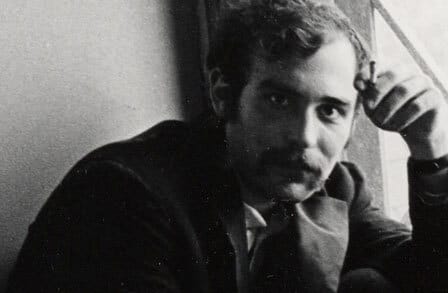
POET
Lawrence Raab (1946 - )
BIOGRAPHY

Free-verse poet Lawrence Raab has published six volumes of his work, which uses simple, everyday language to explore a wide range of large, complicated issues. In What We Don't Know about Each Other, for instance, observations of the natural world, including dogs, birds, and trees, lead to speculations about the supernatural, such as angels, ghosts, and extraterrestrial life. "While such topics prompt mediocre poets into clichés, Raab's highly lyrical meditations are so concrete that readers are sucked into his magical netherworld," remarked a Publishers Weekly reviewer. Poetry contributor Thomas M. Disch found the collection, and Raab's body of work, not to his liking. Raab's "language is as flat as Kansas in August," Disch commented, although he allowed that Raab had received so much acclaim that his "esthetic respectability is an established fact."
The Probable World again shows Raab using unpretentious language to discuss "big ideas," a phrase that provides the title of a poem in which he notes, "We watch the news, we read the papers, afraid, sometimes, of what we understand." In a poem about spirituality, he looks for guidance but finds none: "Week by week we were on our own." And he contemplates death by writing, "Think of the truck out of control. . . . Think of the terrorist planting his bomb. Not one of us is spared such imaginings." A Publishers Weekly critic thought Raab failed to fully exploit his "potentially volatile subjects," saying the collection had "only occasionally compelling narrative motifs" and a verse style that is "neither formally demanding nor linguistically playful." Booklist contributor Donna Seaman, however, praised this volume's poems as "simultaneously gentle and robust," filled with "down-to-earth wisdom and quiet passion." Matthew Flamm, writing in the New York Times Book Review, found in the collection "transcendent moments . . . in language that's plain as day." Raab is "a graceful writer," with "no interest in stylistic variation," Flamm commented, adding, "But he does have a voice that puzzles over everything, and that rescues The Probable World from monotony."
CAREER
American University, Washington, DC, instructor in English, 1970-71; New York State Council for the Arts, Syracuse, instructor at poetry workshop for children, 1972; University of Michigan, Ann Arbor, lecturer in English, autumn, 1974; Bread Loaf Writer's Conference, Middlebury, VT, staff assistant, 1974-76; Williams College, Williamstown, MA, lecturer in English (Morris Professor of Rhetoric), 1976—. Has given poetry readings at colleges and universities throughout the United States.
BIBLIOGRAPHY
POETRY
- Mysteries of the Horizon, Doubleday (New York, NY), 1972.
- The Collector of Cold Weather, Ecco Press (New York, NY), 1976.
- Other Children, Carnegie-Mellon University Press (Pittsburgh, PA), 1986.
- What We Don't Know about Each Other, Penguin Books (New York, NY), 1993.
- (With Stephen Dunn) Winter at the Caspian Sea, Palanquin Press (Aiken, SC), 1999.
- The Probable World, Penguin Books (New York, NY), 2000.
- Visible Signs: New and Selected Poems, Penguin Poets (New York, NY), 2003.
Work represented in anthologies, including The Norton Anthology of Poetry, third edition, Norton, 1983; The Best American Poetry 1992, edited by Charles Simic, Collier, 1992; The Best American Poetry 1993, edited by Louise Gluck, Scribner/Collier, 1993; A Book of Luminous Things, edited by Czeslaw Milosz, Harcourt, 1996; and The Best American Poetry 2000, edited by Rita Dove, Collier, 2000. Author of film scripts The Distances, 1967, and Or I'll Come to You, 1968. Also author of The Birds (adaptation of a play by Aristophanes), first produced in Ann Arbor, MI, at Power Center, April, 1975. Also author ofDracula (libretto for an opera adapted from the novel by Bram Stoker), as yet unpublished and unproduced. Contributor of poems, essays, reviews, and translations from the French, to literary journals, including Poetry, Paris Review, Kayak, Shenandoah, and Prairie Schooner, and to popular magazines, including New Yorker, Atlantic Monthly, and American Scholar. Editor of Frontiers, 1967 and 1968; member of editorial board of Alkahest, 1968.
FURTHER READINGS
PERIODICALS
- Booklist, March 15, 2000, Donna Seaman, review of The Probable World, p. 1319.
- New York Times Book Review, July 23, 2000, Matthew Flamm, review of The Probable World, p. 16.
- Poetry, February, 1994, Thomas M. Disch, review of What We Don't Know about Each Other, p. 285.
- Publishers Weekly, June 14, 1993, review of What We Don't Know about Each Other, p. 66; April 17, 2000, review of The Probable World, p. 72.
- Wall Street Journal, April 21, 2000, David Lehman, review of The Probable World.
MORE INFORMATION
POEMS
= First appeared in Poetry magazine.


