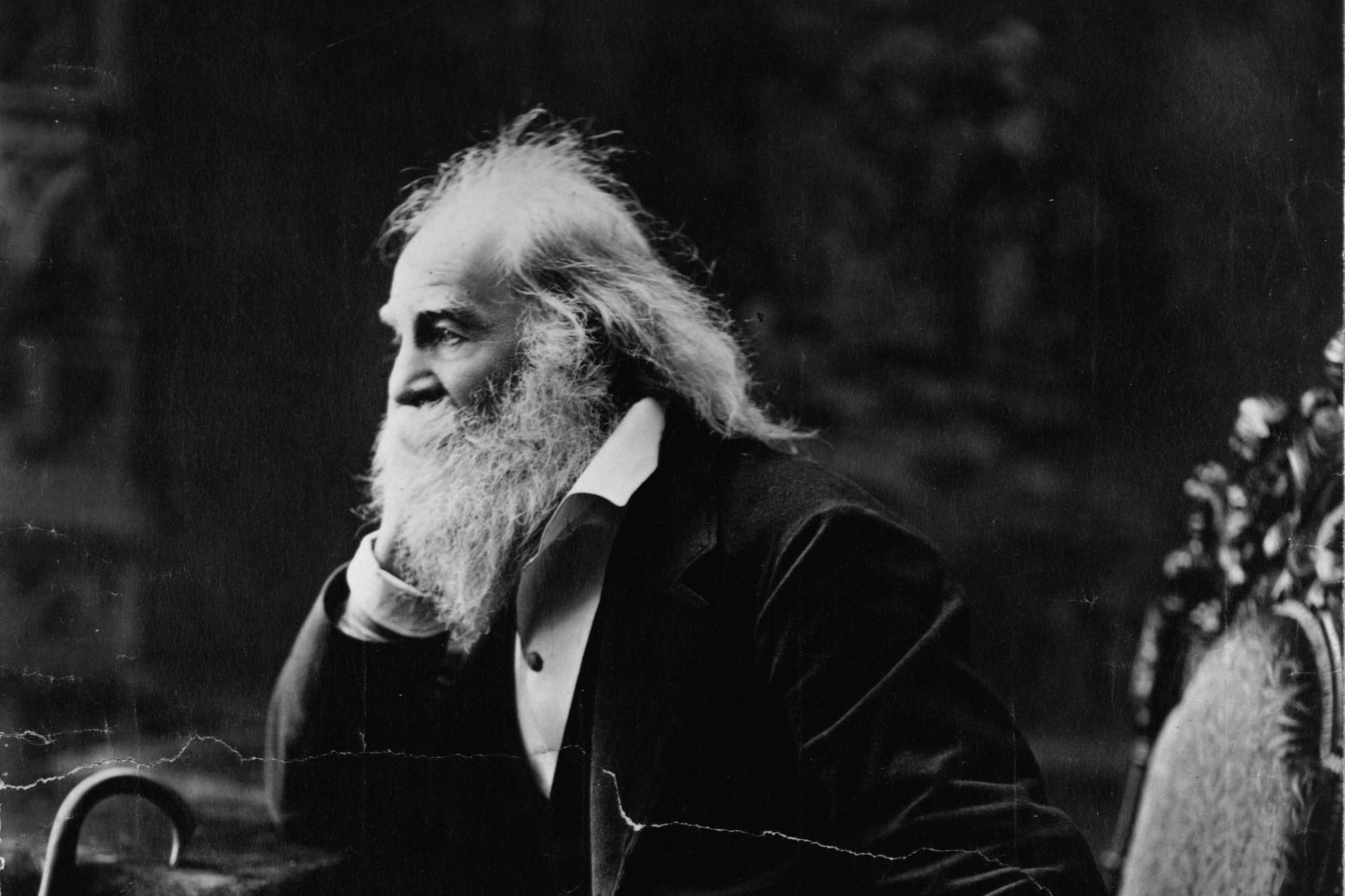
POET
Walt Whitman (1819 - 1892)
BIOGRAPHY
Widely considered the most influential and innovative poet of America, Walt Whitman was born in West Hills, a village near Hempstead, Long Island, on 31 May 1819 to Walter and Louisa Van Velsor Whitman. His father had been born just after the end of the American Revolution and had known and admired Thomas Paine. Walt Whitman was, thus, part of the first generation of Americans who were born in the newly formed United States. Pride in the emergent nation was rampant, and Walter Sr.—after giving his first son, Jesse (born in 1818), his own father's name, his second son his own name, his daughter Mary (born in 1822) the name of his wife's grandmothers, and his daughter Hannah (born in 1823) the name of his own mother—turned to the heroes of the Revolution and the War of 1812 for the names of three of his other sons: Andrew Jackson (born in 1827), George Washington (born in 1829), and Thomas Jefferson (born in 1833). Only the youngest son, Edward (born in 1835), who was mentally and physically handicapped, carried a name that tied him to neither the family's nor the country's history.
Trained as a carpenter but struggling to find work, Walter Sr. had taken up farming by the time Whitman was born. When Whitman was almost four, his father moved the family to Brooklyn, across from "Mannahatta," as Whitman later called New York in his celebratory writings about the city. One of Whitman's favorite stories about his childhood concerned the time the Marquis de Lafayette visited New York and, selecting the six-year-old Walt from the crowd, lifted him up and carried him. Whitman came to view this event as a kind of laying on of hands: the French hero of the American Revolution anointing the future poet of democracy in the energetic city of immigrants where the nation was being invented day by day.
Whitman's father was of English stock and his mother of Dutch and Welsh descent. The combination led to what Whitman always considered a fertile tension in the children between a smoldering, brooding Puritanical temperament and a sunnier, outgoing Dutch disposition. Whitman's father was stern and hot-tempered, perhaps an alcoholic; Whitman respected but never felt a great deal of affection for him. On the other hand, a special bond existed between Whitman and his mother, and the long correspondence between them records a kind of partnership in attempting to deal with the family crises that mounted in later years.
The Whitmans moved around Brooklyn frequently as Walter Sr. tried, mostly unsuccessfully, to cash in on the city's quick growth by speculating in real estate— buying an empty lot, building a house, moving the family into it, then trying to sell it at a profit and start the process over again. Whitman frequently rode the ferries back and forth across the East River to New York City, an experience that is reflected in his 1856 poem "Crossing Brooklyn Ferry." The daily commute suggested to him the passage from life to death and back to life and also the passage from poet to reader to poet via the vehicle of the poem.
One of Whitman's greatest poems, "Out of the Cradle Endlessly Rocking," is, on one level, a reminiscence of his boyhood visits to the Long Island farm of his grandparents Major Cornelius Van Velsor and Amy Williams Van Velsor and of how his desire to be a poet arose in that landscape. Whitman's experiences as a young man alternated between the city and the Long Island countryside, and he was attracted to both ways of life. His poetry is often marked by shifts between rural and urban settings.
Whitman's formal education consisted of six years in the Brooklyn public schools (which was far more schooling than either of his parents had received). At eleven he began working as an office boy for some prominent Brooklyn lawyers; they gave him a subscription to a circulating library, where his self-education began. Whitman absorbed an eclectic and wide-ranging education by reading the works of Sir Walter Scott, James Fenimore Cooper, and other romance novelists; attending the theater, where he fell in love with William Shakespeare's plays, especially Richard III; hearing lectures by such speakers as Frances Wright, the Scottish radical emancipationist and women's rights advocate; visiting museums; and engaging everyone he met in conversation and debate. He always recalled the first great lecture he heard, when he was ten: it was given by the radical Quaker leader Elias Hicks, an acquaintance of Whitman's father and a close friend of Whitman's grandfather Jesse. While most other major writers of his time received highly structured classical educations at private institutions, Whitman forged his own rough and informal curriculum of literature, theater, history, geography, music, religion, and archaeology.
In the summer of 1831 Whitman became an apprentice printer on the Long Island Patriot, a liberal working-class newspaper in Brooklyn. He soon began contributing to the newspaper and experiencing the exhilaration of getting his own words published. In 1832 he moved to the Long Island Star, also in Brooklyn. The rest of his family moved back to the Hempstead area in 1833, leaving the fourteen-year-old Whitman alone in the city. His first signed article, in the upscale New York Mirror in 1834, expressed amazement that people were still alive who could remember "the present great metropolitan city as a little dorp or village; all fresh and green as it was, from its beginning" and told of a slave, "Negro Harry," who at his death in 1758 at age 120 could remember New York "when there were but three houses in it." Late in his life Whitman could still recall the excitement of seeing this article in print: "How it made my heart double-beat to see my piece on the pretty white paper, in nice type."
By the time he was sixteen Whitman was a journeyman printer and compositor, working in various printing shops in New York City; he always retained a typesetter's concern for how his words looked on a page, the typeface in which they appeared, and the effects of various spatial arrangements. But then two of New York's worst fires wiped out the major printing and business centers of the city, and Whitman joined his family at Hempstead in 1836.
Rebelling at his father's attempts to get him to work on the new family farm, Whitman spent the next five years teaching school in at least ten Long Island towns. Rooming in the homes of his students, he taught three-month terms to classes that sometimes held more than eighty students ranging in age from five to fifteen for up to nine hours a day for little pay. He recorded his disdain for the unenlightened country people among whom he lived during this time in a series of letters, discovered in the 1980s, to a friend, Abraham Leech: "Never before have I entertained so low an idea of the beauty and perfection of man's nature, never have I seen humanity in so degraded a shape, as here," he wrote from Woodbury on 11 August 1840. "Ignorance, vulgarity, rudeness, conceit, and dulness are the reigning gods of this deuced sink of despair."
The little that is known of Whitman's teaching, most of which comes from recollections by a few former students, suggests that he employed what were then progressive techniques: encouraging students to think aloud rather than simply recite, involving them in educational games, joining them in baseball and card games, and refusing to resort to corporal punishment. He used his own poems, which were rhymed, conventional verses that indicated nothing of the innovative poetry to come, as texts in his classroom. One of the poems in the first edition of Leaves of Grass (1855), titled "There Was a Child Went Forth" in later editions, can be read as a statement of Whitman's educational philosophy: it celebrates unrestricted extracurricular learning, an openness to experience and ideas that allows for endless absorption of variety and difference--the kind of education Whitman had given himself. He was always suspicious of classrooms, and his great poem "Song of Myself" is generated by a child's question, "What is the grass?" Whitman spends the rest of the poem ruminating about this question as he discovers the complex in the seemingly simple, the cosmos in himself--an attitude that is possible only when one puts "creeds and schools in abeyance."
Whitman kept active intellectually during his teaching years by taking part in debating societies and political campaigns. Inspired by Wright, who came to the United States to support Martin Van Buren in the presidential election of 1836, he became an industrious worker for the Democratic Party and campaigned for Van Buren's successful candidacy.
Whitman interrupted his teaching in 1838 to try his luck at starting his own newspaper, The Long Islander, to cover the towns around Huntington. He bought a press and type and hired his brother George as his assistant; but the paper failed within a year, and he reluctantly returned to the classroom. Two years later he abruptly quit teaching for good. A persistent rumor is that Whitman committed sodomy with one of his students in Southold and was run out of town in disgrace, never to return; but it is not possible to prove that he ever taught there, and he did visit Southold in later years: in the late 1840s and again in the early 1860s he wrote some journalistic pieces about the town that carry no hint that he had had a bad experience there. It is far more likely that Whitman gave up teaching simply because he was temperamentally unsuited for it.
Whitman returned to New York City and began writing fiction. About twenty newspapers and magazines published his stories between 1840 and 1845, including the American Review (later renamed the American Whig Review) and the Democratic Review, one of the nation's most prestigious literary magazines. His first published story, "Death in the School-Room (A Fact)," which appeared in the Democratic Review, grew out of his teaching experience and includes direct editorializing: the narrator hopes that soon the "many ingenious methods of child-torture will be gaz'd upon as a scorned memento of an ignorant, cruel, and exploded doctrine." The tale has a surprise ending: the teacher flogs a student he thinks is sleeping, only to make the macabre discovery that he has been beating a corpse. "The Shadow and the Light of a Young Man's Soul," published in the Union Magazine for June 1848, offers a barely fictionalized autobiography: the hero, Archibald Dean, leaves New York because of the great fire to take charge of a small district school, a move that makes him feel "as though the last float-plank which buoyed him up on hope and happiness, was sinking, and he with it." Other stories are concerned with friendships between older and younger men, the latter of whom are frequently weak or in need of defense because they are misunderstood by, and at odds with, authority figures.
Whitman published five stories in the Democratic Review between January and September 1842. That year Park Benjamin, editor of the New York paper The New World, decided that Whitman was the perfect candidate to write a novel to capitalize on the booming temperance movement. Whitman had worked as a printer for Benjamin in 1841; the two had quarreled, leading Whitman to write "Bamboozle and Benjamin" (New York Aurora, 24 March 1842), an article attacking the irascible editor whose practice of rapidly printing advance copies of novels, typically by English writers, threatened the development of native authors and the profits of American publishing houses. But both men were willing to overlook past differences to seize a good financial opportunity.
In an extra number in November 1842 Benjamin's New World published Whitman's Franklin Evans; or The Inebriate: A Tale of the Times, about a country boy who, after falling prey to drink in the big city, causes the deaths of three women. The work, in its fascination with "fatal pleasure"--Evans's name for the strong attraction most men feel for sinful experience, be it drink or sex-- is typical of the temperance literature of the time in bringing in sensationalism under a moral guise. Whitman's treatment of sex, however, is unpersuasive and seems to confirm a remark he had made two years earlier: that he knew nothing about women either by "experience or observation." The novel is, nonetheless, one of the earliest explorations in American literature of the theme of miscegenation. It succeeded despite being a patched-together concoction of new writing and previously composed stories; around twenty thousand copies were sold--more than of anything else Whitman published in his lifetime. In his old age he described Franklin Evans to his friend Horace Traubel as "damned rot-- rot of the worst sort" and claimed that he completed it in three days, composing some of it in the reading room of Tammany Hall, inspired by gin cocktails (on another occasion he said that he was buoyed by a bottle of port). He began another temperance novel, "The Madman," within months of finishing Franklin Evans, though he soon abandoned the project. Earlier he had published two stories -- "Wild Frank's Return" (in the Democratic Review, November 1841) and "The Child's Champion" (in the New World, also in November 1841) -- that also turn on the consequences of excessive drinking. His later poetry refers again and again to the awful "law of drunkards," "the livid faces of drunkards," "those drunkards and gluttons of so many generations," the "drunkard's breath," the "drunkard's stagger," and "the old drunkard staggering home."
In 1842-1843 Whitman, like many journalists of the period, moved in and out of positions on an array of newspapers, including the New York Aurora, the New York Evening Tattler, the New York Statesman, and the New York Sunday Times. He cultivated a fashionable appearance: William Cauldwell, an apprentice who knew him as lead editor at the Aurora, said that Whitman "usually wore a frock coat and high hat, carried a small cane, and the lapel of his coat was almost invariably ornamented with a boutonniere." His editorial topics ranged from criticism of police roundups of prostitutes to denunciation of Bishop John Hughes for trying to use public funds to support parochial schools.
Whitman left Manhattan in 1845 for steadier work in the somewhat less competitive journalistic environment of Brooklyn. Though he is often regarded as a New York writer, his residence and professional career in the city thus actually ended a decade before the first appearance of Leaves of Grass. He continued to shuttle back and forth to Manhattan via the Fulton ferry and drew on the city for the subject matter of his writing.
Opera was one of the attractions that encouraged Whitman's frequent returns to New York City. He began attending performances, often accompanied by his brother Jeff, in 1846, a practice that was disrupted only by the onset of the Civil War (and even during the war he went to the opera whenever he got back to New York). The coloratura soprano Marietta Alboni sent him into raptures, and his poem "To a Certain Cantatrice" addresses her as the equal of any hero. He once said after attending an opera that the experience was powerful enough to initiate a new era in a person's development. Opera provides both structure and contextual clues to the meaning of "Out of the Cradle Endlessly Rocking."
From September 1845 to March 1846 Whitman composed two or three editorials a week for the Long Island Star; from 5 March 1846 to 18 January 1848 he served as editor of the Brooklyn Eagle. He published little of his own poetry or fiction during these years, but he introduced literary reviewing to the Eagle and commented, if often superficially, on writers such as Thomas Carlyle and Ralph Waldo Emerson. He also wrote editorials on issues such as street lighting, politics, and banking. But he claimed that what he valued most was not the ability to promote his opinions but the "curious kind of sympathy . . . that arises in the mind of a newspaper conductor with the public he serves. He gets to love them."
Whitman was adamant in his editorials that slavery not be allowed into the new western territories, because he feared that whites would not migrate to areas where their labor was devalued by competition from slaves. He expressed outrage at practices that furthered slavery, such as laws that made possible the importation of slaves by way of Brazil. Like Abraham Lincoln, he consistently opposed slavery, even though he knew--again like Lincoln--that the more extreme abolitionists threatened the Union itself. He finally lost his position as editor of the Eagle because the publisher, Isaac Van Anden, sided with conservative proslavery Democrats.
On 9 February 1846 Whitman met J. E. McClure during intermission at the Broadway Theatre in New York. McClure and his partner, A. H. Hayes, were planning to launch a paper, the Crescent, in New Orleans. On the spot McClure hired Whitman to edit the paper and provided him with an advance to cover his travel expenses to New Orleans. Whitman's brother Jeff went with him to work as an office boy on the paper. The journey by train, steamboat, and stagecoach was Whitman's first excursion outside the New York City--Brooklyn--Long Island area.
In New Orleans, Whitman wandered around the French Quarter and the old French market, attracted by "the Indian and negro hucksters with their wares" and the "great Creole mulatto woman" who sold him the best coffee he had ever tasted. He enjoyed "exquisite wines, and the perfect and mild French brandy" in "splendid and roomy bars" that were packed with soldiers who had recently returned from the war with Mexico, many of them recovering from wounds. He was entranced by the mix of languages--French, Spanish, and English--in the cosmopolitan city and began to see the possibilities of a distinctive American culture emerging from the melding of races and backgrounds. But the city was not without its horrors: slaves were auctioned within an easy walk of where the Whitman brothers were lodging at the Tremont House. Whitman never forgot the experience of seeing humans on the selling block, and he kept a poster of a slave auction in his room for many years as a reminder that such dehumanizing events occurred in the United States. He later incorporated a slave auction into his poem "I Sing the Body Electric."
One experience that Whitman did not have in New Orleans was the romance with a beautiful Creole woman that was first imagined by his biographer Henry Bryan Binns in 1905 and elaborated on by others who were eager to identify heterosexual desires in the poet. The published versions of his poem "Once I Pass'd Through a Populous City" seem to recount a romance with a woman, though the manuscript reveals that he initially wrote it with a male lover in mind.
Whitman thought that New Orleans agreed with him better than New York, but Jeff suffered from dysentery and homesickness. Furthermore, the Crescent owners exhibited what Whitman called a "singular sort of coldness" toward their new editor; they probably feared that he would embarrass them because of his unorthodox ideas, especially about slavery. Whitman's sojourn in New Orleans lasted only three months, but it produced a few lively sketches of life in the city and at least one poem. In "Sailing the Mississippi at Midnight" the steamboat journey becomes a symbolic journey of life:
Vast and starless, the pall of heaven
Laps on the trailing pall below;
And forward, forward, in solemn darkness,
As if to the sea of the lost we go.
Whitman wrote such conventional poems, often echoing William Cullen Bryant and, at times, Percy Bysshe Shelley and John Keats, through much of the 1840s. Bryant and the "graveyard school" of English poetry probably had the most important impact on his sensibility, as can be seen in his pre-Leaves of Grass poems "Our Future Lot," "Ambition," "The Winding-Up," "The Love that is Hereafter," and "Death of the Nature-Lover." The poetry of these years is artificial in diction and didactic in purpose, rarely inspired or innovative. By the end of the decade, however, Whitman had undertaken serious self-education in the art of poetry, which he conducted in a typically unorthodox way: he clipped essays about and reviews of leading British and American writers. His marginalia in these articles demonstrate that he was learning to write not in the manner of his predecessors but against them.
The mystery about Whitman in the late 1840s is the speed of his transformation from an unoriginal and conventional poet. He abruptly abandoned conventional rhyme and meter and began finding beauty in the commonplace but expressing it in an uncommon way. His earliest known notebook may have been started as early as 1847, though much of it probably dates from the early 1850s. This extraordinary document includes early articulations of some of Whitman's most compelling ideas. Passages on "Dilation," on "True noble expanding American character," and on the "soul enfolding orbs" are memorable prose statements that express the newly expansive sense of self that Whitman was discovering, and one finds him here setting the tone and expressing the ideas that allowed for the writing of Leaves of Grass.
On 16 July 1849 the publisher Lorenzo Fowler of the Brooklyn firm Fowler and Wells performed a phrenological analysis of Whitman that resulted in a flattering--and in some ways quite accurate--description of his character. In addition to bolstering Whitman's self-confidence, the reading of the bumps on his skull gave him some key vocabulary, such as "amativeness" and "adhesiveness," phrenological terms delineating forms of sexual affection, for Leaves of Grass.
At this time of poetic transformation Whitman's politics--especially his racial attitudes--also underwent a profound alteration. Blacks become central to his poetry and to his understanding of democracy. Notebook passages assert that the poet has the "divine grammar of all tongues, and says indifferently and alike How are you friend? to the President in the midst of his cabinet, and Good day my brother, to Sambo among the hoes of the sugar field." His first notebook lines written in the free-verse manner of Leaves of Grass focus on the fundamental issue dividing the United States, seeking to bind opposed categories, to link black and white, and to join master and slave:
I am the poet of the body
And I am the poet of the soul
And I am
I go with the slaves of the earth equally with the masters
And I will stand between the masters and the slaves,
Entering into both so that both will understand me alike.
The audacity of the final line remains striking. While most people were lining up on one side or another, Whitman placed himself in the space--sometimes violent, sometimes erotic, always volatile--between master and slave. His extreme political despair led him to replace what he named the "scum" of corrupt American politics in the 1850s with his own persona: a shaman, a culture healer, an all-encompassing "I."
That "I" became the main character of Leaves of Grass, the explosive book of twelve untitled poems that Whitman wrote in the early 1850s and for which he set some of the type in the print shop of James and Andrew Rome, designed the cover, and oversaw all other details. When Whitman wrote "I, now thirty-six years old, in perfect health, begin," he announced a new identity for himself, and his novitiate came at a quite advanced age for a poet. Keats had died ten years before reaching that age; George Gordon, Lord Byron had died at exactly that age; William Wordsworth and Samuel Taylor Coleridge had produced Lyrical Ballads (1798) in their twenties; Bryant had written "Thanatopsis" (published 1817), his best-known poem, while still in his teens; and most other great Romantic poets Whitman admired had done their most memorable work early in their adult lives. In contrast, by the time Whitman reached his mid thirties he seemed destined, if he were to achieve fame in any field, to do so as a journalist or, perhaps, as a writer of fiction; no one could have guessed that he would suddenly begin to produce work that has led many to view him as America's greatest and most revolutionary poet.
The mystery that has intrigued biographers and critics over the years has been what prompted the transformation: did Whitman undergo a spiritual illumination that opened the floodgates of a radical new kind of poetry, or was this poetry the result of a carefully calculated strategy to blend journalism, oratory, popular music, and other cultural forces into an innovative American voice like the one for which Emerson had called in "The Poet" in his Essays: Second Series (1844) "Our log-rolling, our stumps and their politics, our fisheries, our Negroes, and Indians, our boasts, and our repudiations, the wrath of rogues, and the pusillanimity of honest men, the Northern trade, the Southern planting, the Western clearing, Oregon and Texas, are yet unsung," Emerson wrote. "Yet America is a poem in our eyes; its ample geography dazzles the imagination, and it will not wait long for metres." Whitman began writing poetry that seemed to record everything for which Emerson had called, and he began his preface to the first edition of Leaves of Grass by paraphrasing Emerson: "The United States themselves are essentially the greatest poem."
The romantic view of Whitman is that he was suddenly and impulsively inspired to write the poems that transformed American poetry; the more pragmatic view holds that he devoted himself in the five years before the publication of Leaves of Grass to a disciplined series of experiments that gradually led to the intricate structuring of his singular style. The evidence supports both theories. Few manuscripts for the poems in the first edition of Leaves of Grass remain, leading many to believe that they emerged in a fury of inspiration. On the other hand, the manuscripts that do exist indicate that Whitman meticulously worked and reworked his poems and carefully oversaw every aspect of the production of his book, issuing detailed instructions to the typesetters. Whitman seems, then, to have been both inspired poet and skilled craftsman, at once under the spell of his newly discovered and intoxicating free-verse style but also remaining in control of it. For the rest of his life he added, deleted, fused, separated, and rearranged poems as he produced six distinct editions of Leaves of Grass. Emerson once described Whitman's poetry as "a remarkable mixture of the Bhagvat Ghita [sic] and the New York Herald, " and that odd joining of the scriptural and the vernacular, the transcendent and the mundane, captures the simultaneously magical and commonplace, sublime and prosaic quality of Whitman's work. It was work produced by a poet who was both sage and huckster and who was concerned as much with the sales and reviews of his book as with the state of the human soul.
Whitman paid the costs of production of the 795 copies of the book out of his own pocket; he had them bound at various times as his finances permitted. He always recalled the book as appearing, fittingly, on the Fourth of July--a kind of literary Independence Day. His joy at getting the book published was, however, diminished by the death of his father on 11 July. Though Whitman and Walter Sr. had never been particularly close, they had only recently traveled together to the old Whitman homestead in West Hills. His father's death, along with his older brother Jesse's absence in the merchant marine--and, later, Jesse's mental instability--meant that Whitman had to become the substitute father for the family. Because of Walter Sr.'s drinking and growing depression, Whitman had already taken on some adult responsibilities--buying boots for his brothers, for instance, and holding the title to the family house as early as 1847.
Even with these growing family burdens, however, Whitman managed to concentrate on his new book. Just as he had overseen all the details of its composition and printing, he supervised its distribution by Fowler and Wells and tried to control its reception. Whitman later claimed that the first edition sold out, but, in fact, the sales were poor. He sent copies to several well-known writers--including John Greenleaf Whittier, who, legend has it, threw it into the fire--but the only one who responded was Emerson, who recognized in Whitman's work the spirit, tone, and style for which he had called. "I greet you at the beginning of a great career," Emerson wrote on 21 July, noting that Leaves of Grass "meets the demand I am always making of what seemed the sterile & stingy Nature, as if too much handiwork or too much lymph in the temperament were making our western wits fat & mean." Whitman's poetry, Emerson believed, would get the country into shape, helping to work off its excess of aristocratic fat.
Whitman's poetry in the book is cast in unrhymed long lines with no identifiable meter; the voice is haranguing, mundane, and prophetic, a combination of oratory, journalism, and the Bible--an absorptive and accepting voice that wants to catalogue the vast diversity of the country and hold it all in a unified identity. "Do I contradict myself?" Whitman asks confidently toward the end of the long poem he later titled "Song of Myself." "Very well then . . . . I contradict myself; / I am large . . . . I contain multitudes." This new voice spoke confidently of union at a time of division, and it spoke with the assurance that everything, no matter how degraded, could be celebrated as part of itself: "What is commonest and cheapest and nearest and easiest is Me." Whitman's work echoes with the speech of the American urban working class and reaches deep into the various corners of nineteenth-century culture, reverberating with the nation's stormy politics, its motley music, its new technologies, its fascination with science, and its evolving pride in an American language that was forming as a tongue distinct from British English.
Whitman did not put his name on the title page of the book--an unconventional act suggesting that the author believed that he spoke not for himself but for America. (His name did not appear on a title page of Leaves of Grass until the 1876 "Author's Edition," and then only because he signed each copy as it was sold.) But opposite the title page was a portrait of Whitman, an engraving by Samuel Hollyer from a daguerreotype taken by the photographer Gabriel Harrison in the summer of 1854. The most famous frontispiece in literary history, it shows Whitman from head to just above the knees; he is dressed in workman's clothes, shirt open, hat cocked to the side, standing insouciantly and fixing the reader with a challenging stare. It is a pose that indicates Whitman's redefinition of the role of poet as the democratic spokesperson who no longer speaks only from the intellect and with the formality of tradition and education; the new poet pictured in Whitman's book speaks from and with the whole body and writes outside, in nature, not in the library. Whitman called his work "al fresco" poetry, indicating that it was written outside the bounds of convention and tradition.
Within a few months of the publication of the first edition of Leaves of Grass Whitman was at work on the second. While in the first edition he had allowed his long lines to stretch across the page by printing the book on large paper, the second edition was what he later, in conversation with Traubel, called his "chunky fat book," his earliest attempt to offer the reader what he thought of as the "ideal pleasure": "to put a book in your pocket and [go] off to the seashore or the forest." On the spine of this edition, which was published and distributed by Fowler and Wells (though the firm carefully distanced itself from the book by proclaiming that "the author is still his own publisher"), Whitman emblazoned one of the first "blurbs" in American publishing history: without asking Emerson's permission, he printed in gold the opening words of Emerson's letter to him: "I greet you at the beginning of a great career," followed by Emerson's name. He also appended to the volume several reviews of the first edition, including three he wrote himself along with a few negative ones, under the heading "Leaves-Droppings." At the end of the book he printed Emerson's entire letter (again, without permission) and a long reply--a kind of apologia for his poetry--addressed to "Master." Although he sometimes downplayed the influence of Emerson on his work, at this time, he later recalled, he had "Emerson-on-the-brain."
With four times as many pages as the first edition, the 1856 Leaves of Grass added twenty new poems-- including the powerful "Sun-Down Poem," later called "Crossing Brooklyn Ferry" --to the twelve in the 1855 edition. The original twelve had been untitled in 1855, but Whitman was doing all he could to make the new edition look and feel different: small pages instead of large, a fat book instead of a thin one, and long titles for the poems instead of none at all. The untitled introductory poem from the first edition that was eventually named "Song of Myself" was called "Poem of Walt Whitman, an American" in 1856; and the poem that later became "This Compost" appeared as "Poem of Wonder at the Resurrection of The Wheat." Some titles, like the poems themselves, incorporated rolling catalogues: the poem that was later titled "To a Foil'd European Revolutionaire" appeared in 1856 as "Liberty Poem for Asia, Africa, Europe, America, Australia, Cuba, and The Archipelagoes of the Sea." As if to counter criticism that he was not really writing poetry at all--the review in Life Illustrated (28 July 1855), for example, called Whitman's work "lines of rhythmical prose, or a series of utterances (we know not what else to call them)"--Whitman put the word "Poem" in the title of all thirty-two pieces in the 1856 edition. But despite his efforts to remake his book, the results were the same: sales of the thousand copies that were printed were even poorer than for the first edition.
In May 1857 Whitman went to work for the Brooklyn Daily Times, a Free Soil newspaper; in the summer of 1859, once again, a disagreement with the newspaper's owner led to his dismissal. Meanwhile, he was forging literary connections. Emerson had come to visit at the end of 1855--they had gone back to Emerson's room at the elegant Astor Hotel, where Whitman, dressed as informally as in his frontispiece portrait, was denied admission. It was the first of many meetings the two men had over the next twenty-five years, as their relationship turned into one of grudging mutual respect mixed with suspicion. In 1856 Henry David Thoreau and Bronson Alcott visited Whitman's home; in his journal Alcott described Thoreau and Whitman as each "surveying the other curiously, like two beasts, each wondering what the other would do." Whitman also befriended visual artists such as the sculptor Henry Kirke Brown, the painter Elihu Vedder, and the photographer Gabriel Harrison. He got to know several women's rights activists and feminist writers, some of whom became ardent readers and supporters of Leaves of Grass; he became particularly close to Abby Price, Paulina Wright Davis, Sarah Tyndale, and Sara Payson Willis. (Under the pseudonym Fanny Fern, Willis wrote a popular newspaper column and many books, including Fern Leaves from Fanny's Portfolio [1853]--the cover of which Whitman had imitated for the first edition of Leaves of Grass.) Their radical ideas about sexual equality had a growing impact on Whitman's poetry. He also knew many abolitionist writers, including Moncure Conway, and wrote vitriolic attacks on the Fugitive Slave Law and the moral bankruptcy of American politics, notably the pamphlet The Eighteenth Presidency! (1928). But these pieces were not published in Whitman's lifetime and remain vestiges of a career-- stump speaker and political pundit--with which he flirted but that he never pursued.
Whitman also began in the late 1850s to become a regular at Pfaff's saloon, a favorite gathering place for bohemian artists in New York. There Whitman the former temperance writer began a couple of years of unemployed carousing. At Pfaff's he mingled with figures such as Henry Clapp, the influential editor of the antiestablishment Saturday Press, who helped publicize Whitman's work in many ways, including publishing an early version of "Out of the Cradle Endlessly Rocking" on 24 December 1859. At Pfaff's, Whitman also became friends with many writers, some well known at the time, including Ada Clare, Fitz-James O'Brien, George Arnold, and Edmund Clarence Stedman. There, too, he met the young William Dean Howells; Howells recalled many years later that Whitman had already become something of a celebrity, even if his fame was largely the infamy resulting from what many considered to be his obscene writings ("foul work" filled with "libidinousness," scolded The Christian Examiner in November 1856). Whitman and Clare, the "queen of Bohemia" (she had an illegitimate child and proudly proclaimed herself an unmarried mother), became two of the most notorious figures at the beer hall, flouting convention and decorum.
Also at Pfaff's, Whitman joined the "Fred Gray Association," a group of young men anxious to explore new possibilities of male-male affection. It may have been at Pfaff's that Whitman met Fred Vaughan, a young Irish stage driver and an intriguing mystery figure to Whitman biographers. Whitman and Vaughan clearly had an intense relationship at this time, but Vaughan soon married; he went on to have four children and only sporadically kept in touch with Whitman. The sequence of homoerotic love poems called "Live Oak, with Moss" that became the heart of the "Calamus" cluster in the 1860 edition of Leaves of Grass record despair over the failure of the relationship.
Within a year of the appearance of the 1856 edition Whitman had written nearly seventy new poems. He continued to have them set in type by the Rome brothers and other printer friends; apparently he assumed that he would inevitably be publishing them himself, since no commercial publisher had indicated an interest in his book. But there was another reason Whitman set his poems in type: he always preferred to deal with his work in printed form rather than in manuscript and often made revisions directly on the printed versions of his poems. For him poetry was a public act, and until a poem was in print he did not truly consider it a poem. Manuscripts were never sacred to Whitman, who often discarded them.
In February 1860 Whitman received a letter from William Thayer and Charles Eldridge, whose aggressive new Boston publishing house specialized in abolitionist literature; they wanted to publish the next edition of Leaves of Grass. Whitman readily agreed, and Thayer and Eldridge invested heavily in the stereotype plates for Whitman's idiosyncratic book: more than 450 pages of varied typefaces and odd decorative motifs. Whitman traveled to Boston in March to oversee the printing.
Whitman is a major part of the reason that America's literary center moved to New York in the second half of the nineteenth century; but in 1860 the superiority of Boston was evident in its influential publishing houses; its important journals, including the new Atlantic Monthly; and its venerable authors, including Henry Wadsworth Longfellow, whom Whitman met while he was in town. And, of course, Boston was the city of Emerson, who came to see Whitman shortly after his arrival. As they strolled together on the Boston Common, Emerson tried to persuade Whitman to remove from his book the new "Enfans d'Adam" cluster of poems (after 1860 Whitman dropped the French version of the name and called the cluster "Children of Adam"), which portrayed the human body more explicitly and in more direct sexual terms than any previous American poems had. Whitman believed, as he later recalled, "that the sexual passion in itself, while normal and unperverted, is inherently legitimate, creditable, not necessarily an improper theme for poet." "That," insisted Whitman, "is what I felt in my inmost brain and heart, when I only answer'd Emerson's vehement arguments with silence, under the old elms of Boston Common," he wrote in "A Memorandum at a Venture" (1882). The body was Whitman's theme, and he would not shy away from any part of it: the genitals and the armpits were as essential to the fullness of identity as the brain and the soul, just as in a democracy the poorest and most despised citizens were as important as the rich and famous. So he ignored Emerson's advice and published the "Enfans d'Adam" poems in the 1860 edition along with the "Calamus" cluster; the first cluster celebrated male-female sexual relations, the second the love of men for men. Leaves of Grass did not set out to shock but to make the reader more aware of the body that he or she inhabited, to convince the reader that the body and the soul were conjoined and inseparable-- just as Whitman's ideas were physically embodied in the ink and paper that the reader held in his or her hands.
Whitman called the "Calamus" poems his most political work--"The special meaning of the Calamus cluster," he wrote in the preface to the 1876 edition, "mainly resides in its Political significance"--since in these poems he was advocating a new kind of intense affection between males and thereby countering the masculine competitiveness encouraged by the developing democratic society and the emerging capitalistic economy. Whitman was inventing a language of homosexuality, and the Calamus poems became influential in the development of gay literature. On their first appearance, however, these poems did not cause as much sensation as "Enfans d'Adam"/"Children of Adam," because their sensuality was confined to handholding, hugging, and kissing; the "children of Adam" poems evoked a more explicit genital sexuality. Only later in the century, when homosexuality began to be regarded in medical and psychological circles as aberrant, did the "Calamus" poems begin to be read by some as dangerous and "abnormal" and by others as brave early expressions of gay identity.
Whitman's remade self-image is evident in the frontispiece for the 1860 edition. It was the only time Whitman used this portrait, an engraving based on a painting by his friend Charles Hine. Whitman's friends called it the "Byronic portrait," and Whitman--with coiffure and cravat--does look more like the conventional image of a poet than he ever did before or after.
With the 1860 edition of Leaves of Grass Whitman began the incessant rearranging of his poems in various groupings that often alter their meaning and significance. In addition to "Calamus" and "Enfans d'Adam," this edition included the clusters "Chants Democratic and Native American" and "Messenger Leaves" and one with the same title as the book: "Leaves of Grass." The 1860 edition also included the first book publications of "Starting from Paumanok," here called "Proto-Leaf," and "Out of the Cradle Endlessly Rocking," here called "A Word Out of the Sea," along with more than 120 other new poems. Whitman revised many of his older poems, including "Song of Myself," which is here titled "Walt Whitman." He also numbered the verses throughout the book, creating a biblical effect: he conceived of his project as the construction of a "New Bible," a new covenant that would convert America into a true democracy.
The first printing of one thousand copies of the 1860 edition was quickly exhausted, and Thayer and Eldridge promptly ordered an additional printing of at least one thousand and perhaps as many as three thousand or four thousand copies. The edition received many reviews, most of them positive--particularly those by women, who were more exhilarated than offended by Whitman's candid images of sex and the body and welcomed his attempt to sing "The Female equally with the Male," as he put it in the poem "One's-Self I Sing."
Whitman's stay in Boston--the first extended period he had been away from New York since his trip to New Orleans twelve years earlier--was a transforming experience. He was surprised to see African Americans treated much more fairly and as equals than they were in New York: they shared tables with whites at restaurants, worked next to whites in printing offices, and served on juries. He met some abolitionist writers who became close friends and supporters, including William Douglas O'Connor and John Townsend Trowbridge, both of whom later wrote at length about him.
When Whitman returned to New York at the end of May, his mood was ebullient. He was a recognized author: the Boston papers had run feature stories about his visit to the city, and photographers had asked to take his picture--not only did he have a growing notoriety, but he also was a striking physical specimen: more than six feet in height--especially tall for the time--with long, already graying hair and beard. All summer he read reviews of his work in prominent newspapers and journals. And in November his young publishers announced that his new book of poems, to be titled "Banner at Day-Break," was forthcoming.
But the deteriorating national situation made any business investment risky, and Thayer and Eldridge compounded the problem with some bad business decisions. At the beginning of 1861 they declared bankruptcy and sold the plates of Leaves of Grass to the Boston publisher Richard Worthington. Worthington continued to publish pirated copies of the 1860 edition for decades. The large number of copies that Thayer and Eldridge had printed, combined with Worthington's piracy, made the 1860 edition the most widely available version of Leaves of Grass for the next twenty years and diluted the impact, as well as depressing the sales, of Whitman's own new editions.
In February 1861 Whitman saw Lincoln pass through New York on the way to his inauguration. In April, on the way home from an opera performance, he bought a newspaper and read that Southern forces had fired on Fort Sumter. Whitman, like many others, thought that the struggle would be over in sixty days or so. A few days after the firing on Fort Sumter, Whitman recorded in his journal his resolution "to inaugurate for myself a pure perfect sweet, cleanblooded robust body by ignoring all drinks but water and pure milk--and all fat meats late suppers--a great body--a purged, cleansed, spiritualised invigorated body." It was as if he sensed the need to break out of his newfound complacency, to cease his Pfaff's beer-hall habits and bohemian ways, and to prepare himself for the challenges that faced the divided nation.
Whitman's brother George immediately enlisted in the Union army; his accounts of his experiences provided Whitman with many insights into the nature of the war and into soldiers' feelings. Whitman's chronically ill brother Andrew also enlisted but served for only three months in 1862. His other brothers--the hot-tempered Jesse; the recently married Jeff, on whom fell the burden of caring for the extended family, including his own infant daughter; and the mentally feeble Eddy--did not serve. Nor did Whitman, who was in his early forties when the war began.
During the first year and a half of the Civil War, Whitman remained in the New York City area, writing a series of twenty-five lengthy articles, titled "Brooklyniana," about the history of Brooklyn for the Brooklyn Daily Standard. He had been visiting Broadway Hospital for several years, comforting injured stage drivers and ferryboat workers (serious injuries were common in the chaotic New York transportation industry at the time). While he enjoyed his friendships with literary figures, his true preference in companions was always for working-class men, especially those who worked on the omnibuses and ferries--"all my ferry friends," as he called them in his autobiographical work "Specimen Days," published along with other miscellaneous prose writings in the volume Specimen Days & Collect (1882). He reveled in the process of travel, instead of worrying about destinations: "I cross'd and recross'd, merely for pleasure," he wrote of his trips on the ferry. He remembered fondly the "immense qualities, largely animal" of the colorful omnibus drivers, whom, he said, he enjoyed "for comradeship, and sometimes affection" as he rode "the whole length of Broadway" listening to the stories of the driver and conductor or "declaiming some stormy passage" from one of his favorite Shakespeare plays.
As the Civil War began taking its toll, wounded soldiers joined the transportation workers as patients Whitman saw on his frequent rounds. The soldiers came from all over the country, and their reminiscences of home taught Whitman about the breadth and diversity of the growing nation. He developed an idiosyncratic style of informal personal nursing, writing down stories the patients told him, giving them small gifts, writing letters for them, and holding and kissing them. His purpose, he wrote, was "just to help cheer and change a little the monotony of their sickness and confinement," though he found that the soldiers' effect on him was as rewarding as his on them: the wounded and maimed young men aroused in him "friendly interest and sympathy," and he said some of "the most agreeable evenings of my life" were spent in hospitals. He wrote about the soldiers in a series, "City Photographs," for the New York Leader in 1862.
Whitman once said that if he had not become a writer, he would have been a doctor. He developed close friendships with many of the physicians at Broadway Hospital, even occasionally assisting them in surgery. His fascination with the body, so evident in his poetry, was intricately bound to his attraction to medicine and to the hospitals, where he learned to face bodily disfigurations and gained the ability to see beyond wounds and illness to the human personalities that persisted through the pain and humiliation.
With the nation locked in an extended war, all of Whitman's deepest concerns and beliefs were under attack. Leaves of Grass had been built on a faith in union, wholeness, the ability of a self and a nation to contain contradictions and absorb diversity; now the United States had come apart, and Whitman's project was in danger of becoming an anachronism. Leaves of Grass had been built, too, on a belief in the power of affection to overcome division and competition; his "Calamus" vision was of a "continent indissoluble" with "inseparable cities" all joined by "the life-long love of comrades." But now fathers were killing sons, sons, fathers; brothers, brothers. Whitman's prospects for his "new Bible" that would bind a nation, build an affectionate democracy, and guide a citizenry to celebrate its unified diversity were shattered in the fratricidal conflict that engulfed America.
In December 1862 the name "G. W. Whitmore" appeared in the newspaper casualty roster from Fredericksburg. Fearful that the name was a garbled version of George Washington Whitman, Whitman immediately set out for Virginia to try to find his brother. His pocket was picked on the crowded platform as he changed trains in Philadelphia, leaving him penniless for the rest of his journey to Washington. There he encountered O'Connor, the abolitionist writer he had met in Boston, who loaned him money. After futilely searching for George in the nearly forty Washington hospitals, Whitman took a government boat and an army-controlled train to the battlefield at Fredericksburg to see if George was still there. He found George's unit and discovered that his brother had received only a superficial facial wound. But Whitman's relief turned to horror when, as he wrote in his journal, outside a mansion converted into a field hospital he came upon "a heap of amputated feet, legs, arms, hands, &c., a full load for a one-horse cart." They were "human fragments, cut, bloody, black and blue, swelled and sickening." Nearby were "several dead bodies . . . each cover'd with its brown woolen blanket." The sight continued to haunt this poet who had so confidently celebrated the physical body--who had claimed that the soul existed only in the body, that the arms and legs were extensions of the soul, the legs moving the soul through the world and the hands allowing it to express itself. The young American males on whom he had staked the future of democracy were being dismembered.
After telegraphing his family that he had found George, Whitman decided to stay with his brother for a few days instead of returning to New York. He assisted in the burial of the dead still lying on the battlefield, where eighteen thousand Northern and Southern troops had been killed or wounded on 13 December (the next day Robert E. Lee, sickened by the carnage, had declined to attack General Ambrose Burnside's Union troops, even though they were in a vulnerable position).
Although Whitman had already written some of the poems that he eventually published in his Civil War collection, Drum-Taps (1865)--notably the "recruitment" poems, such as "Beat! Beat! Drums!" and "First O Songs for Prelude," that evoked the frightening yet exhilarating energy of cities arming for battle--only after he encountered the horrifying aftereffects of a real battle did the powerful war poems begin to emerge. In the journal he kept at George's camp, Whitman noted a "sight at daybreak--in a camp in front of the hospital tent on a stretcher, (three dead men lying,) each with a blanket spread over him--I lift up one and look at the young man's face, calm and yellow,--'tis strange! (Young man: I think this face of yours the face of my dead Christ!)" This journal sketch, like many others, was gradually transformed into a poem that later appeared in Drum-Taps:
A sight in camp in the daybreak gray and dim,
As from my tent I emerge so early sleepless,
As slow I walk in the cool fresh air the path near by the hospital tent,
Three forms I see on stretchers lying, brought out there untended lying,
Over each the blanket spread, ample brownish woolen blanket,
Gray and heavy blanket, folding, covering all.
. . . . . . . . . . . . . . . . . . . . . . . . . . . . . . . . . . . .
Then to the third--a face nor child nor old, very calm, as of beautiful yellow-white ivory;
Young man I think I know you--I think this face is the face of the Christ himself,
Dead and divine and brother of all, and here he lies again.
The journal entry and poem offer a glimpse into how Whitman began restructuring his poetic project after the Civil War began. He was still writing a "new Bible," reexperiencing the Crucifixion in Fredericksburg. But this crucifixion does not redeem sinners and create an atonement with God so much as it posits divinity in everyone and mourns senseless loss: the death of this one young man amid the thousands of deaths is as significant as any death in history. And the massive slaughter of young soldier-Christs, he thought, would create for all who survived the war an obligation to construct a nation worthy of their great sacrifice.
During the time he spent with George's unit Whitman often went into the makeshift hospital outside of which he had seen the pile of amputated limbs. "I do not see that I do much good to these wounded and dying," he wrote in his journal, "but I cannot leave them." He found himself particularly attracted to a nineteen-year-old Confederate from Mississippi whose leg had been amputated. Whitman visited him regularly in the battlefield hospital and continued to visit him after the soldier was transferred to a Washington hospital. "Our affection is an affair quite romantic," he wrote. The intimate expressions of manly friendship that he had described in the "Calamus" cluster in 1860 became generalized in the poet's many close relationships with injured soldiers over the next three years. Letters from these soldiers clearly indicate the intensity of the love that they felt for Whitman, and Whitman's letters demonstrate that the affection was reciprocated. The language of this correspondence is partly that of lovers, partly that of friends, partly that of son to father and father to son--many of the letters to Whitman are addressed to "Dear Father"-- and partly that of calm, wise, old counselor to confused, scared, and half-literate young men.
It is not known when Whitman decided to stay in Washington, D.C. Like virtually all of the abrupt changes in his life--quitting teaching, going to New Orleans and to Boston, and, years later, deciding overnight to settle in Camden, New Jersey--this one came with no planning, advance notice, or preparation. He was a profoundly unsettled person, who seemed able to shuck obligations and relationships without much regret; in "Song of the Open Road" he said, "The long brown path before me leading wherever I choose. . . . I will scatter myself among men and women as I go."
Allons! We must not stop here,
However sweet these laid-up stores, however convenient this dwelling we cannot remain here,
However shelter'd this port and however calm these waters we must not anchor here,
However welcome the hospitality that surrounds us we are permitted to receive it but a little while.
Perhaps the decision was made while he was nursing the wounded and developing his relationship with the Mississippi soldier in the field hospital: that was when he wrote to his mother that he might seek employment in Washington and to Emerson to ask for letters of recommendation to the secretary of state and the secretary of the treasury. It may have been made on the trip back to Washington in early January 1863, when he was put in charge of a trainload of casualties who were being transferred to hospitals in the capital. While the wounded were being moved to a steamboat for the trip up the Potomac, Whitman wandered among them, comforting them and writing down and promising to send their messages to their families. Perhaps by the time he got to Washington, determined to stay a few days to visit wounded soldiers from Brooklyn, he knew at some level that he would have to remain there for the duration of the war.
Whitman's Boston connections served him well in Washington: he got the letters of introduction from Emerson, a room in O'Connor's boardinghouse, and, through Eldridge, the publisher of the 1860 Leaves of Grass who was serving as assistant to the army paymaster, a part-time job as a copyist in the paymaster's office. O'Connor and his wife, Nellie, provided Whitman's meals, and the poet began receiving contributions from his brother Jeff and others in Brooklyn who heard of his work in the hospitals. Whitman used his funds to buy candy, tobacco, flavored syrup, and books for the wounded soldiers, and he soon became a familiar figure in the hospitals. Prematurely gray and looking a decade or two older than his forty-three years, Whitman must have seemed to the soldiers--many of whom were still in their teens--a tattered Saint Nick handing out treats and bringing good cheer. Though he admired the Christian Commission, an agency organized by several churches that recruited volunteers to help in the hospitals, Whitman acted independently. He had nothing but contempt for the U. S. Sanitary Commission, the government body charged with nursing the soldiers back to health and returning them to battle: these functionaries kept their distance from the soldiers and worked primarily for pay. Whitman always insisted that he gained more from the soldiers than they received from him; he considered his years of hospital service "the greatest privilege and satisfaction . . . and, of course, the most profound lesson of my life," he wrote in "Specimen Days."
The nation's capital was in a chaotic state in 1863, with unpaved streets and many half-completed government buildings, including the Capitol itself. Lincoln insisted that construction proceed at full pace, and some of the newly constructed buildings were almost immediately turned into hospitals. The U.S. Patent Office became a hospital in 1863, and Whitman noted the irony of the "rows of sick, badly wounded and dying soldiers" surrounding the "glass cases" displaying the inventions that had created modern warfare."
Whitman's job in the paymaster's office occasionally required him to go on trips to visit troops, as when he traveled to Analostan Island in July 1863 to help issue paychecks to the First Regiment U.S. Colored Troops. He was "well pleas'd" with their professional conduct and strong demeanor, and he was struck by the names of the black soldiers as the roll was called--George Washington, John Quincy Adams, Daniel Webster, James Madison, John Brown. The heritage of the United States, Whitman realized, was being carried forward by a much more diverse citizenry: the African American soldiers, like Whitman's own brothers, bore the names of the nation's proud past. The war, for all of its destruction, was clearing the space for a broader American identity.
Meanwhile, the news from Whitman's family was not good: Andrew was extremely ill; Jesse was increasingly violent and had even threatened Jeff's daughter; and his sister Hannah was being abused by her husband. At his mother's plea, Whitman went back to New York for a visit toward the end of 1863. There he saw Andrew for the last time: Andrew died on 3 December, leaving behind two children and a pregnant alcoholic wife who later became a prostitute. The family problems were of deep concern to Whitman, but he felt compelled to return to his soldier friends in Washington, to whom he wrote regularly during the weeks he was in New York.
One day while heading to the hospitals Whitman met John Burroughs, an aspiring young writer who had started frequenting Pfaff's beer hall in New York a couple of years previously in the hope of meeting Whitman. The encounter led to one of the most enduring friendships of Whitman's life; he spent most Sundays at the home of Burroughs and Burroughs's wife, Ursula, who also became one of his closest friends. Burroughs and O'Connor later wrote--with a good deal of help from Whitman himself--some of the earliest lengthy treatments of the poet, and despite some arguments with Whitman over the years, both remained unwavering supporters.
Whitman also met the photographer Alexander Gardner, whose pictures record the striking toll the war took on Whitman's appearance. The photographs show a tired, somber, yet determined Whitman, who seems to be absorbing the soldiers' pain. The war was taking a toll on other faces: Whitman often watched Lincoln's carriage pass by, and he noted in his journal that the president "looks more careworn even than usual--his face with deep cut lines." Whitman repeated the description in a 30 June 1863 letter to his mother and in "'Tis But Ten Years Since" in the New York Graphic (28 February 1874).
One day Whitman ran into another Boston acquaintance, the publisher James Redpath, who organized a fund-raising campaign for the poet's hospital work. Redpath, who had published Louisa May Alcott's account of her Civil War nursing, Hospital Sketches (1863), considered but finally decided against publishing the sketches Whitman was writing about his war experiences, a book Whitman called "Memor
BIBLIOGRAPHY
BOOKS
- Franklin Evans; or The Inebriate: A Tale of the Times (New York: J. Winchester, 1842).
- Leaves of Grass, anonymous (Brooklyn, N.Y.: Fowler & Wells, 1855; revised second edition, 1856; revised third edition, Boston: Thayer & Eldridge, 1860- 1861 [i.e., 1860]; revised fourth edition, New York: William E. Chapin, 1867; revised fifth edition, Washington, D.C.: J. S. Redfield, 1871; revised "Author's Edition," Camden, N.J., 1876; revised sixth edition, Boston: James R. Osgood, 1881-1882 [i.e., 1881]; republished, Philadelphia: Rees Welsh, 1882); revised and enlarged as Leaves of Grass: Including Sands at Seventy . . . 1st Annex, Good-Bye My Fancy . . . 2d Annex, A Backward Glance o'er Travel'd Roads, and Portrait from Life (Philadelphia: David McKay, 1892).
- Drum-Taps (New York: Peter Eckler, 1865).
- Poems by Walt Whitman, edited by William Michael Rossetti (London: John Camden Hotten, 1868).
- Democratic Vistas (Washington, D.C. [i.e., New York]: J. S. Redfield, 1871).
- After All, Not to Create Only (Boston: Roberts, 1871).
- Passage to India (Washington, D.C. [i.e., New York]: J. S. Redfield, 1871).
- As a Strong Bird on Pinions Free. And Other Poems (Washington, D.C.: J. S. Redfield, 1872).
- Memoranda During the War (Camden, N.J.: The Author, 1875-1876 [i.e., 1876]).
- Two Rivulets, including Democratic Vistas, Centennial Songs, and Passage to India (Camden, N.J.: The Author, 1876).
- Specimen Days & Collect (Philadelphia: Rees Welsh, 1882-1883 [i.e., 1882]).
- Specimen Days in America (London: Walter Scott, 1887).
- Complete Poems & Prose of Walt Whitman, 1855-1888: Authenticated & Personal Book (Handled by W. W.), Portraits from Life, Autograph (Camden, N.J.: Whitman, 1888).
- Democratic Vistas, and Other Papers (London: Walter Scott, 1888).
- November Boughs (Philadelphia: David McKay, 1888).
- Good-Bye My Fancy: 2d Annex to Leaves of Grass, anonymous (Philadelphia: David McKay, 1891).
- Complete Prose Works (Philadelphia: David McKay, 1891).
- Calamus: A Series of Letters Written during the Years 1868-1880 by Walt Whitman to a Young Friend (Peter Doyle), edited by Richard Maurice Bucke (Boston: Laurens Maynard, 1897).
- The Wound Dresser: A Series of Letters Written from the Hospitals in Washington during the War of the Rebellion, edited by Bucke (Boston: Small, Maynard, 1898).
- Notes and Fragments, edited by Bucke (London, Ont.: Printed for the editor by A. Talbot & Co., 1899).
- The Complete Writings of Walt Whitman, 10 volumes, edited by Bucke, Thomas B. Harned, and Horace L. Traubel (New York: Putnam, 1902).
- An American Primer, edited by Traubel (Boston: Small, Maynard, 1904).
- Walt Whitman's Diary in Canada, edited by William Sloane Kennedy (Boston: Small, Maynard, 1904).
- Lafayette in Brooklyn (New York: George D. Smith, 1905).
- Criticism: An Essay (Newark, N.J.: Carteret Book Club, 1913).
- The Gathering of the Forces: Editorials, Essays, Literary and Dramatic Reviews and Other Material Written by Walt Whitman as Editor of the Brooklyn Daily Eagle in 1846 and 1847, 2 volumes, edited by Cleveland Rodgers and John Black (New York: Putnam, 1920).
- The Uncollected Poetry and Prose of Walt Whitman, 2 volumes, edited by Emory Holloway (Garden City, N.Y.: Doubleday, Page, 1921).
- The Half-Breed and Other Stories, edited by Thomas Ollive Mabbott (New York: Columbia University Press, 1927).
- Pictures: An Unpublished Poem, edited by Holloway (New York: June House, 1927).
- The Eighteenth Presidency! (Montpelier, France: Causse, Graille & Castelnau, 1928).
- Walt Whitman's Workshop, edited by Clifton Joseph Furness (Cambridge, Mass.: Harvard University Press, 1928).
- A Child's Reminiscence, edited by Mabbott and Rollo G. Silver (Seattle: University of Washington Book Store, 1930).
- I Sit and Look Out: Editorials from the Brooklyn Daily Times, edited by Holloway and Vernolian Schwarz (New York: Columbia University Press, 1932).
- Walt Whitman and the Civil War: A Collection of Original Articles and Manuscripts, edited by Charles I. Glicksberg (Philadelphia: University of Pennsylvania Press, 1933).
- New York Dissected, by Walt Whitman: A Sheaf of Recently Discovered Newspaper Articles by the Author of Leaves of Grass, edited by Holloway and Ralph Adimari (New York: Rufus Rockwell Wilson, 1936).
- Walt Whitman's Backward Glances, edited by Sculley Bradley and John A. Stevenson (Philadelphia: University of Pennsylvania Press, 1947).
- Faint Clews and Indirections: Manuscripts of Walt Whitman and His Family, edited by Silver and Clarence Gohdes (Durham, N.C.: Duke University Press, 1949).
- Walt Whitman of the New York Aurora, edited by Joseph Jay Rubin and Charles H. Brown (State College, Pa.: Bald Eagle Press, 1950).
- Walt Whitman Looks at the Schools, edited by Florence Bernstein Freedman (New York: Columbia University Press, 1950).
- Whitman's Manuscripts: Leaves of Grass (1860): A Parallel Text, edited by Fredson Bowers (Chicago: University of Chicago Press, 1955).
- An 1855-56 Notebook toward the Second Edition of Leaves of Grass, edited by Harold W. Blodgett and William White (Carbondale: Southern Illinois University Press, 1959).
- Walt Whitman's Civil War, edited by Walter Lowenfels (New York: Knopf, 1960).
- "Kentucky"--Walt Whitman's Uncompleted Poem, edited by Harry W. Warfel (Lexington: University of Kentucky Library Associates, 1960).
- The People and John Quincy Adams, edited by White (Berkeley Heights, N.J.: Oriole Press, 1961).
- The Collected Writings of Walt Whitman, 21 volumes to date, edited by Gay Wilson Allen and others (New York: New York University Press, 1961-1984; New York: Peter Lang, 1998-)--comprises The Correspondence of Walt Whitman, 6 volumes, edited by Edwin Haviland Miller (New York: New York University Press, 1961-1977); The Early Poems and the Fiction, edited by Thomas L. Brasher (New York: New York University Press, 1963); Prose Works 1892: Specimen Days; Collect and Other Prose, 2 volumes, edited by Floyd Stovall (New York: New York University Press, 1963, 1964); Leaves of Grass: Comprehensive Reader's Edition, edited by Blodgett and Sculley Bradley (New York: New York University Press, 1965); Daybooks and Notebooks, 3 volumes, edited by William White (New York: New York University Press, 1977); Notebooks and Unpublished Prose Manuscripts, 6 volumes, edited by Edward F. Grier (New York: New York University Press, 1984); The Journalism, volume 1: 1834-1846, edited by Herbert Bergman, Douglas A. Noverr, and Edward J. Recchia (New York: Peter Lang, 1998).
- Walt Whitman's Memoranda during the War; and, Death of Abraham Lincoln: Reproduced in Facsimile, edited by Roy P. Basler (Bloomington: Indiana University Press, 1962).
- Walt Whitman's Blue Book: The 1860-61 Leaves of Grass, Containing His Manuscript Additions and Revisions, 2 volumes, edited by Arthur Golden (New York: New York Public Library, 1968).
- Walt Whitman's Autograph Revision of the Analysis of Leaves of Grass (for Dr. R. M. Bucke's Walt Whitman), edited by Quentin Anderson and Stephen Railton (New York: New York University Press, 1974).
- The Walt Whitman Archive: A Facsimile of the Poet's Manuscripts, 3 volumes, edited by Joel Myerson (New York: Garland, 1993).
- The Sacrificial Years: A Chronicle of Walt Whitman's Experiences in the Civil War, edited by John Harmon McElroy (Boston: David R. Godine, 1999).
Editions
- Leaves of Grass: The Poems of Walt Whitman, edited by Ernest Rhys (London: Walter Scott, 1886).
- The Eighteenth Presidency! edited by Edward F. Grier (Lawrence: University of Kansas Press, 1956).
LETTERS
- Letters Written by Walt Whitman to His Mother from 1866 to 1872, edited by Thomas B. Harned (New York: Putnam, 1902).
- The Letters of Anne Gilchrist and Walt Whitman, edited by Harned (New York: Doran, 1918).
- Whitman and Rolleston: A Correspondence, edited by Horst Frenz (Bloomington: Indiana University Press, 1951).
- The Correspondence of Walt Whitman, 6 volumes, edited by Edwin Haviland Miller (New York: New York University Press, 1961-1977).
- Selected Letters of Walt Whitman, edited by Miller (Iowa City: University of Iowa Press, 1990).
- The Correspondence of Walt Whitman: A Second Supplement with a Revised Calendar of Letters Written to Whitman, edited by Miller (Iowa City: Walt Whitman Quarterly Review Press, 1991).
- "The Correspondence of Walt Whitman: A Third Supplement with Addenda to the Calender of Letters Written to Whitman," edited by Ted Genoways, Walt Whitman Quarterly Review, 18 (Summer-Fall 2000): 1-59.
"
See also the Whitman entries in DLB 3: Antebellum Writers in New York and the South; DLB 64: American Literary Critics and Scholars, 1850-1880, and DLB 224: Walt Whitman: A Documentary Volume.
The largest collection of manuscripts, proofs, and printed works relating to Walt Whitman is at the Library of Congress. Other significant collections are at the Duke University Library, the Harry Ransom Humanities Research Center at the University of Texas at Austin, and the Clifton Waller Barrett Library of American Literature in Special Collections at the University of Virginia Library.
FURTHER READINGS
Bibliographies:
- Emory Holloway and Henry S. Saunders, "Whitman," in The Cambridge History of American Literature, volume 2, edited by William P. Trent and others (New York: Putnam, 1918), pp. 551-581.
- Frank Shay, The Bibliography of Walt Whitman (New York: Friedmans, 1920).
- Carolyn Wells and Alfred F. Goldsmith, A Concise Bibliography of the Works of Walt Whitman (Boston: Houghton Mifflin, 1922).
- Gay Wilson Allen, Twenty-Five Years of Walt Whitman Bibliography: 1918-1942 (Boston: F. W. Faxon, 1943).
- Allen, Walt Whitman Handbook (Chicago: Packard, 1946).
- Library of Congress, Walt Whitman: A Catalog Based upon the Collections of the Library of Congress (Washington, D.C.: Government Printing Office, 1955).
- Evie Allison Allen, "A Checklist of Whitman Publications 1945-1960," in Walt Whitman as Man, Poet, and Legend, by Gay Wilson Allen (Carbondale: Southern Illinois University Press, 1961), pp. 179- 260.
- James T. Tanner, Walt Whitman: A Supplementary Bibliography 1961-1967 (Kent, Ohio: Kent State University Press, 1968).
- William White, Walt Whitman's Journalism: A Bibliography (Detroit: Wayne State University Press, 1969).
- Roger Asselineau, "Walt Whitman," in Eight American Authors, edited by James Woodress, revised edition (New York: Norton, 1971), pp. 225-272.
- Gay Wilson Allen, The New Walt Whitman Handbook (New York: New York University Press, 1975).
- Gloria A. Francis and Artem Lozynsky, Whitman at Auction, 1899-1972 (Detroit: Gale, 1978).
- Jeanetta Boswell, Walt Whitman and the Critics: A Checklist of Criticism, 1900-1978 (Metuchen, N.J.: Scarecrow Press, 1980).
- Scott Giantvalley, Walt Whitman, 1838-1939: A Reference Guide (Boston: G. K. Hall, 1981).
- Donald D. Kummings, Walt Whitman, 1940-1975: A Reference Guide (Boston: G. K. Hall, 1982).
- Ed Folsom, "Whitman: A Current Bibliography," Walt Whitman Quarterly Review (1983-); reformatted as an annual on-line bibliography, in The Walt Whitman Hypertext Archive, edited by Kenneth M. Price and Folsom, http://jefferson.village.virginia.edu/whitman/ (1995-).
- Michael Winship, "Walt Whitman, 1819-1892," in Bibliography of American Literature, volume 9, edited by Winship and Jacob Blanck (New Haven: Yale University Press, 1991), pp. 28-103.
- Joel Myerson, Walt Whitman: A Descriptive Bibliography (Pittsburgh: University of Pittsburgh Press, 1993).
Biographies:
- William Douglas O'Connor, The Good Gray Poet: A Vindication (New York: Bunce & Huntington, 1866).
- John Burroughs, Notes on Walt Whitman as Poet and Person (New York: American News, 1867).
- Richard Maurice Bucke, Walt Whitman (Philadelphia: McKay, 1883).
- William Clarke, Walt Whitman (London: Swan Sonnenschein, 1892).
- Thomas Donaldson, Walt Whitman, the Man (New York: Harper, 1896).
- William Sloane Kennedy, Reminiscences of Walt Whitman (London: Alexander Gardner, 1896).
- Elizabeth Porter Gould, Anne Gilchrist and Walt Whitman (Philadelphia: McKay, 1900).
- Henry Bryan Binns, A Life of Walt Whitman (London: Methuen, 1905).
- Edward Carpenter, Days with Walt Whitman (London: George Allen, 1906).
- Bliss Perry, Walt Whitman (Boston: Houghton, Mifflin, 1906).
- Horace Traubel, With Walt Whitman in Camden, March 28-July 14, 1888 (Boston: Small, Maynard, 1906).
- Traubel, With Walt Whitman in Camden, July 16-October 31, 1888 (New York: Appleton, 1908).
- James Thomson, Walt Whitman: The Man and the Poet (London: Dobell, 1910).
- W. C. Rivers, Walt Whitman's Anomaly (London: George Allen, 1913).
- Traubel, With Walt Whitman in Camden, November 1, 1888-January 20, 1889 (New York: Kennerley, 1914).
- Walt Whitman, as Man, Poet and Friend, edited by Charles N. Elliot (Boston: Badger, 1915).
- John Johnston and J. W. Wallace, Visits to Walt Whitman in 1890-1891 by Two Lancashire Friends (New York: Egmont Arens, 1918).
- Leon Bazalgette, Walt Whitman, translated by Ellen Fitzgerald (Garden City, N.Y.: Doubleday, Page, 1920).
- Elizabeth Leavitt Keller, Walt Whitman in Mickle Street (New York: Kennerley, 1921).
- John Bailey, Walt Whitman (New York: Macmillan, 1926).
- Emory Holloway, Whitman: An Interpretation in Narrative (New York: Knopf, 1926).
- Cameron Rogers, The Magnificent Idler: The Story of Walt Whitman (Garden City, N.Y.: Doubleday, Page, 1926).
- Harrison S. Morris, Walt Whitman: A Brief Biography with Reminiscences (Cambridge, Mass.: Harvard University Press, 1929).
- Clara Barrus, Whitman and Burroughs: Comrades (Boston: Houghton Mifflin, 1931).
- Edgar Lee Masters, Whitman (New York: Scribners, 1937).
- Babette Deutsch, Walt Whitman: Builder for America (New York: Messner, 1941).
- Frances Winwar, American Giant: Walt Whitman and His Times (New York: Harper, 1941).
- Hugh I'Anson Faussett, Walt Whitman: Poet of Democracy (New Haven: Yale University Press, 1942).
- Henry Seidel Canby, Walt Whitman: An American (Boston: Houghton Mifflin, 1943).
- Frederik Schyberg, Walt Whitman, translated by Evie Allison Allen (New York: Columbia University Press, 1951).
- Gay Wilson Allen, The Solitary Singer: A Critical Biography of Walt Whitman (New York: Macmillan, 1955; revised edition, New York: New York University Press, 1967).
- Traubel, With Walt Whitman in Camden, January 21- April 7, 1889, edited by Sculley Bradley (Carbondale: Southern Illinois University Press, 1959).
- Roger Asselineau, The Evolution of Walt Whitman: The Creation of a Personality (Cambridge, Mass.: Harvard University Press, 1960).
- Holloway, Free and Lonesome Heart: The Secret of Walt Whitman (New York: Vantage, 1960).
- Gay Wilson Allen, Walt Whitman (New York: Grove, 1961).
- James E. Miller Jr., Walt Whitman (New York: Twayne, 1962; revised, 1990).
- Traubel, With Walt Whitman in Camden, April 8-September 14, 1889, edited by Gertrude Traubel (Carbondale: Southern Illinois University Press, 1964).
- Adrien Stoutenburg and Laura Nelson Baker, Listen America: A Life of Walt Whitman (New York: Scribners, 1968).
- Barbara Marinacci, O Wondrous Singer! An Introduction to Walt Whitman (New York: Dodd, Mead, 1970).
- Thomas L. Brasher, Whitman as Editor of the Brooklyn Daily Eagle (Detroit: Wayne State University Press, 1973).
- Justin Kaplan, Walt Whitman: A Life (New York: Simon & Schuster, 1980).
- Walter H. Eitner, Walt Whitman's Western Jaunt (Lawrence: Regents Press of Kansas, 1981).
- Traubel, With Walt Whitman in Camden, September 15, 1889-July 6, 1890, edited by Gertrude Traubel and William White (Carbondale: Southern Illinois University Press, 1982).
- Paul Zweig, Walt Whitman: The Making of the Poet (New York: Basic Books, 1984).
- Whitman in His Own Time, edited by Joel Myerson (Detroit: Omnigraphics, 1991).
- Philip Callow, From Noon to Starry Night: A Life of Walt Whitman (Chicago: Ivan R. Dee, 1992).
- Traubel, With Walt Whitman in Camden, July 7, 1890- February 10, 1891, edited by Jeanne Chapman and Robert MacIsaac (Carbondale: Southern Illinois University Press, 1992).
- Philip W. Leon, Walt Whitman and Sir William Osler: A Poet and His Physician (Toronto: ECW, 1995).
- Catherine Reef, Walt Whitman (New York: Clarion, 1995).
- David S. Reynolds, Walt Whitman's America: A Cultural Biography (New York: Knopf, 1995).
- Traubel, With Walt Whitman in Camden, February 11, 1891-September 30, 1891, edited by Chapman and MacIsaac (Oregon House, Cal.: W. L. Bentley, 1996).
- Traubel, With Walt Whitman in Camden, October 1, 1891-April 3, 1892, edited by Chapman and MacIsaac (Oregon House, Cal.: W. L. Bentley, 1996).
- Gary Schmidgall, Walt Whitman: A Gay Life (New York: Dutton, 1997).
- Joann P. Krieg, A Whitman Chronology (Iowa City: University of Iowa Press, 1998).
- Jerome Loving, Walt Whitman: The Song of Himself (Berkeley: University of California Press, 1999).
- Roy Morris Jr., The Better Angel: Walt Whitman in the Civil War (New York: Oxford University Press, 2000).
References:
- Philip Akers, The Principle of Life: A New Concept of Reality Based on Walt Whitman's Leaves of Grass (New York: Vantage, 1991).
- Marion Walker Alcaro, Walt Whitman's Mrs. G: A Biography of Anne Gilchrist (Rutherford, N.J.: Fairleigh Dickinson University Press, 1991).
- Gay Wilson Allen, The New Walt Whitman Handbook (New York: New York University Press, 1975).
- Allen, A Reader's Guide to Walt Whitman (New York: Farrar, Straus & Giroux, 1970).
- Allen, Walt Whitman as Man, Poet, and Legend (Carbondale: Southern Illinois University Press, 1961).
- Allen, ed., Walt Whitman Abroad: Critical Essays from Germany, France, Scandinavia, Russia, Italy, Spain, and Latin America, Israel, Japan, and India (Syracuse, N.Y.: Syracuse University Press, 1955).
- Allen and Ed Folsom, eds., Walt Whitman and the World (Iowa City: University of Iowa Press, 1995).
- Newton Arvin, Whitman (New York: Macmillan, 1938).
- Harold Aspiz, Walt Whitman and the Body Beautiful (Urbana: University of Illinois Press, 1980).
- Roger Asselineau, The Evolution of Walt Whitman: The Creation of a Book (Cambridge, Mass.: Harvard University Press, 1962).
- Asselineau and William White, eds., Walt Whitman in Europe Today: A Collection of Essays (Detroit: Wayne State University Press, 1972).
- Mark Bauerlein, Whitman and the American Idiom (Baton Rouge: Louisiana State University Press, 1991).
- Christopher Beach, The Politics of Distinction: Whitman and the Discourses of Nineteenth-Century America (Athens: University of Georgia Press, 1996).
- Joseph Beaver, Walt Whitman: Poet of Science (New York: King's Crown Press, 1951).
- Joan D. Berbrich, Three Voices from Paumanok: The Influence of Long Island on James Fenimore Cooper, William Cullen Bryant, Walt Whitman (Port Washington, N.Y.: Ira J. Friedman, 1969).
- Dennis Berthold and Kenneth M. Price, eds., Dear Brother Walt: The Letters of Thomas Jefferson Whitman (Kent, Ohio: Kent State University Press, 1984).
- Henry Bryan Binns, Walt Whitman & His Poetry (London: Harrap, 1915).
- Stephen A. Black, Whitman's Journey into Chaos (Princeton: Princeton University Press, 1975).
- Harold Blodgett, Walt Whitman in England (Ithaca, N.Y.: Cornell University Press, 1934).
- Harold Bloom, ed., Walt Whitman (New York: Chelsea House, 1985).
- Helena Born, Whitman's Ideal Democracy (Boston: Everett, 1902).
- Arthur E. Briggs, Walt Whitman: Thinker and Artist (New York: Philosophical Library, 1952).
- Richard Maurice Bucke, Cosmic Consciousness (New York: Dutton, 1923).
- Bucke, Horace Traubel, and Thomas B. Harned, eds., In Re Walt Whitman (Philadelphia: McKay, 1893).
- John Burroughs, Whitman: A Study (Boston: Houghton, Mifflin, 1896).
- Edwin H. Cady and Louis J. Budd, eds., On Whitman: The Best from American Literature (Durham, N.C.: Duke University Press, 1987).
- Marina Camboni, ed., Utopia in the Present Tense: Walt Whitman and the Language of the New World (Rome: Il Calamo, 1994).
- E. Fred Carlisle, The Uncertain Self: Whitman's Drama of Identity (East Lansing: Michigan State University Press, 1973).
- Edward Carpenter, Some Friends of Walt Whitman: A Study in Sex-Psychology (London, 1924).
- George Rice Carpenter, Walt Whitman (New York: Macmillan, 1909).
- David Cavitch, My Soul and I: The Inner Life of Walt Whitman (Boston: Beacon, 1985).
- Sherry Ceniza, Walt Whitman and Nineteenth-Century Women Reformers (Tuscaloosa: University of Alabama Press, 1998).
- V. K. Chari, Whitman in the Light of Vedantic Mysticism: An Interpretation (Lincoln: University of Nebraska Press, 1965).
- Richard Chase, Walt Whitman (Minneapolis: University of Minnesota Press, 1961).
- Chase, Walt Whitman Reconsidered (New York: Sloane, 1955).
- Leadie M. Clark, Walt Whitman's Conception of the American Common Man (New York: Philosophical Library, 1955).
- Graham Clarke, Walt Whitman: The Poem as Private History (London: Vision, 1991).
- Keith V. Comer, Strange Meetings: Walt Whitman, Wilfred Owen and the Poetry of War (Lund, Sweden: Lund University Press, 1996).
- Thomas Edward Crawley, The Structure of Leaves of Grass (Austin: University of Texas Press, 1970).
- Hans-Günther Cwojdrak, Walt Whitman: Dichter und Demokrat Amerikas (Hamburg: Phönix-Verlag, 1946).
- Robert Leigh Davis, Whitman and the Romance of Medicine (Berkeley: University of California Press, 1997).
- Basil de Selincourt, Walt Whitman: A Critical Study (London: Secker, 1914).
- James Dougherty, Walt Whitman and the Citizen's Eye (Baton Rouge: Louisiana State University Press, 1993).
- Geoffrey Dutton, Whitman (New York: Grove, 1961).
- Edwin Harold Eby, A Concordance of Walt Whitman's Leaves of Grass and Selected Prose Writings, 5 volumes (Seattle: University of Washington Press, 1949-1955).
- Betsy Erkkila, Walt Whitman among the French (Princeton: Princeton University Press, 1980).
- Erkkila, Whitman the Political Poet (New York: Oxford University Press, 1989).
- Erkkila and Jay Grossman, eds., Breaking Bounds: Whitman and American Cultural Studies (New York: Oxford University Press, 1996).
- Robert D. Faner, Walt Whitman and Opera (Philadelphia: University of Pennsylvania Press, 1951).
- Ed Folsom, Walt Whitman's Native Representations (Cambridge: Cambridge University Press, 1994).
- Folsom, ed., Walt Whitman: The Centennial Essays (Iowa City: University of Iowa Press, 1994).
- Folsom, Jim Perlman, and Dan Campion, eds., Walt Whitman: The Measure of His Song (Minneapolis: Holy Cow! 1981; revised edition, Duluth, Minn.: Holy Cow! 1998).
- Byrne R. S. Fone, Masculine Landscapes: Walt Whitman and the Homoerotic Text (Carbondale: Southern Illinois University Press, 1992).
- Florence Bernstein Freedman, William Douglas O'Connor: Walt Whitman's Chosen Knight (Athens: Ohio University Press, 1985).
- José Gabriel, Walt Whitman: La Voz Democrática de América (Montevideo, Uruguay: Deibo, 1944).
- Kenneth F. Gambone, ed., Remembering Walt Whitman (N.p.: Walnut Leaf, 1992).
- William Gay, Walt Whitman: His Relation to Science and Philosophy (Melbourne, Australia: Firth & M'Cutcheon, 1895).
- Arthur Golden, ed., Walt Whitman: A Collection of Criticism (New York: McGraw-Hill, 1974).
- Mauricio González de la Garza, Walt Whitman: Racista, Imperialista, Antimexicano (Mexico City: Colección Malaga, 1971).
- Douglas Grant, Walt Whitman and His English Admirers (Leeds, U.K.: Leeds University Press, 1962).
- Ezra Greenspan, Walt Whitman and the American Reader (Cambridge: Cambridge University Press, 1990).
- Greenspan, ed., The Cambridge Companion to Walt Whitman (Cambridge: Cambridge University Press, 1995).
- Walter Grünzweig, Constructing the German Walt Whitman (Iowa City: University of Iowa Press, 1995).
- Grünzweig, Walt Whitmann: Die deutschsprachige Rezeption als interkulturelles Phänomen (Munich: Fink, 1991).
- William N. Guthrie, Walt Whitman, Camden Sage (Cincinnati: Robert Clarke, 1897).
- Jessica Haigney, Walt Whitman and the French Impressionists (Lewiston, Me.: Edwin Mellen Press, 1990).
- Will Hayes, Walt Whitman: The Prophet of the New Era (London: C. W. Daniel, 1921).
- Ronald Hayman, Arguing with Walt Whitman (London: Covent Garden Press, 1971).
- Milton Hindus, ed., Leaves of Grass: One Hundred Years After (Stanford, Cal.: Stanford University Press, 1955).
- Hindus, ed., Walt Whitman: The Critical Heritage (London: Routledge & Kegan Paul, 1971).
- C. Carroll Hollis, Language and Style in Leaves of Grass (Baton Rouge: Louisiana State University Press, 1983).
- Guiyou Huang, Whitmanism, Imagism, and Modernism in China and America (Selinsgrove, Pa.: Susquehanna University Press, 1997).
- George B. Hutchinson, The Ecstatic Whitman: Literary Shamanism and the Crisis of the Union (Columbus: Ohio State University Press, 1986).
- Matthew F. Ignoffo, What the War Did to Whitman (New York: Vantage, 1975).
- William Sloane Kennedy, The Fight of a Book for the World (West Yarmouth, Mass.: Stonecroft Press, 1926).
- M. Jimmie Killingsworth, The Growth of Leaves of Grass: The Organic Tradition in Whitman Studies (Columbia, S.C.: Camden House, 1993).
- Killingsworth, Whitman's Poetry of the Body: Sexuality, Politics, and the Text (Chapel Hill: University of North Carolina Press, 1989).
- Martin Klammer, Whitman, Slavery, and the Emergence of Leaves of Grass (University Park: Pennsylvania State University Press, 1995).
- Bettina L. Knapp, Walt Whitman (New York: Continuum, 1993).
- George Knox and Henry Lawton, eds., The Whitman-Hartmann Controversy: Including Conversations with Walt Whitman and Other Essays (Bern: Herbert Lang, 1976).
- Lawrence Kramer, ed., Walt Whitman and Modern Music (New York: Garland 2000).
- Joann P. Krieg, Whitman and the Irish (Iowa City: University of Iowa Press, 2000).
- Krieg, ed., Walt Whitman: Here and Now (Westport, Conn.: Greenwood Press, 1985).
- David Kuebrich, Minor Prophecy: Walt Whitman's New American Religion (Bloomington: Indiana University Press, 1989).
- Donald D. Kummings, ed., Approaches to Teaching Whitman's Leaves of Grass (New York: Modern Language Association, 1990).
- Kummings and J. R. LeMaster, eds., Walt Whitman: An Encyclopedia (New York: Garland, 1998).
- Kerry C. Larson, Whitman's Drama of Consensus (Chicago: University of Chicago Press, 1988).
- Harry Law-Robertson, Walt Whitman in Deutschland (Giessen: Munchowsche Universitäts, 1935).
- R. W. B. Lewis, ed., The Presence of Walt Whitman (New York: Columbia University Press, 1962).
- Haniel Long, Walt Whitman and the Springs of Courage (Santa Fe, N.Mex.: Writers' Editions, 1938).
- Jerome Loving, Emerson, Whitman, and the American Muse (Chapel Hill: University of North Carolina Press, 1982).
- Loving, Walt Whitman's Champion: William Douglas O'Connor (College Station: Texas A&M University Press, 1978).
- Loving, ed., Civil War Letters of George Washington Whitman (Durham, N.C.: Duke University Press, 1975).
- Artem Lozynsky, ed., Richard Maurice Bucke, Medical Mystic: Letters of Dr. Bucke to Walt Whitman and His Friends (Detroit: Wayne State University Press, 1977).
- Luke Mancuso, The Strange Sad War Revolving: Walt Whitman, Reconstruction, and the Emergence of Black Citizenship, 1865-1876 (Columbia, S.C.: Camden House, 1997).
- Ivan Marki, The Trial of the Poet: An Interpretation of the First Edition of Leaves of Grass (New York: Columbia University Press, 1976).
- Robert K. Martin, ed., The Continuing Presence of Walt Whitman: The Life after the Life (Iowa City: University of Iowa Press, 1992).
- F. O. Matthiessen, American Renaissance: Art and Expression in the Age of Emerson and Whitman (New York: Oxford University Press, 1941).
- Maurice Mendelson, Life and Work of Walt Whitman: A Soviet View (Moscow: Progress Publishers, 1976).
- Charles R. Metzger, Thoreau and Whitman: A Study of Their Aesthetics (Seattle: University of Washington Press, 1961).
- Diane Wood Middlebrook, Walt Whitman and Wallace Stevens (Ithaca, N.Y.: Cornell University Press, 1974).
- Edwin Haviland Miller, Walt Whitman's Poetry: A Psychological Journey (Boston: Houghton Mifflin, 1968).
- Miller, Walt Whitman's "Song of Myself": A Mosaic of Interpretations (Iowa City: University of Iowa Press, 1989).
- Miller, ed., The Artistic Legacy of Walt Whitman: A Tribute to Gay Wilson Allen (New York: New York University Press, 1970).
- Miller, ed., A Century of Whitman Criticism (Bloomington: Indiana University Press, 1969).
- James E. Miller Jr., A Critical Guide to Leaves of Grass (Chicago: University of Chicago Press, 1955).
- Miller, Leaves of Grass: America's Lyric-Epic of Self and Democracy (New York: Twayne, 1992).
- Miller, Karl Shapiro, and Bernice Slote, Start with the Sun: Studies in the Whitman Tradition (Lincoln: University of Nebraska Press, 1960).
- Katherine Molinoff, Some Notes on Whitman's Family: Mary Elizabeth Whitman, Edward Whitman, Andrew and Jesse Whitman, Hannah Louisa Whitman (Brooklyn, N.Y.: Printed for the author, 1941).
- Michael Moon, Disseminating Whitman: Revision and Corporeality in Leaves of Grass (Cambridge, Mass.: Harvard University Press, 1991).
- S. Musgrove, T. S. Eliot and Whitman (Wellington: New Zealand University Press, 1952).
- O. K. Nambiar, Walt Whitman and Yoga (Bangalore, India: Jeevan, 1966).
- Tenney Nathanson, Whitman's Presence: Body, Voice, and Writing in Leaves of Grass (New York: New York University Press, 1992).
- James Nolan, Poet-Chief: The Native American Poetics of Walt Whitman and Pablo Neruda (Albuquerque: University of New Mexico Press, 1994).
- Ron Padgett, ed., The Teachers & Writers Guide to Walt Whitman (New York: Teachers and Writers Collaborative, 1991).
- Roy Harvey Pearce, ed., Whitman: A Collection of Critical Essays (Englewood Cliffs, N.J.: Prentice-Hall, 1962).
- Isaac Hull Platt, Walt Whitman (Boston: Small, Maynard, 1904).
- Vivian Pollak, The Erotic Whitman (Berkeley: University of California Press, 2000).
- Kenneth M. Price, Whitman and Tradition: The Poet in His Century (New Haven: Yale University Press, 1990).
- Price, ed., Walt Whitman: The Contemporary Reviews (Cambridge: Cambridge University Press, 1996).
- T. R. Rajasekharaiah, The Roots of Leaves of Grass: Eastern Sources of Walt Whitman's Poetry (Rutherford, N.J.: Fairleigh Dickinson University Press, 1970).
- Hans Reisiger, Walt Whitman (Berlin: Suhrkamp, 1946).
- Nathan Resnick, Walt Whitman and the Authorship of the Good Gray Poet (Brooklyn, N.Y.: Long Island University Press, 1948).
- David Reynolds, ed., A Historical Guide to Walt Whitman (New York: Oxford University Press, 2000).
- Richard H. Rupp, ed., Critics on Whitman (Coral Gables, Fla.: University of Miami Press, 1972).
- John E. Schwiebert, The Frailest Leaves: Whitman's Poetic Technique and Style in the Short Poem (New York: Peter Lang, 1992).
- Esther Shephard, Walt Whitman's Pose (New York: Harcourt, Brace, 1938).
- Charley Shively, ed., Calamus Lovers: Walt Whitman's Working Class Camerados (San Francisco: Gay Sunshine, 1987).
- Shively, ed., Drum Beats: Walt Whitman's Civil War Boy Lovers (San Francisco: Gay Sunshine, 1989).
- Geoffrey M. Sill, ed., Walt Whitman of Mickle Street: A Centennial Collection (Knoxville: University of Tennessee Press, 1994).
- Sill and Roberta K. Tarbell, eds., Walt Whitman and the Visual Arts (New Brunswick, N.J.: Rutgers University Press, 1992).
- Jan Christian Smuts, Walt Whitman: A Study of the Evolution of a Personality, edited by Alan L. McLeod (Detroit: Wayne State University Press, 1973).
- John Snyder, The Dear Love of Man: Tragic and Lyric Communion in Walt Whitman (The Hague: Mouton, 1975).
- Floyd Stovall, The Foreground of Leaves of Grass (Charlottesville: University Press of Virginia, 1974).
- John Addington Symonds, Walt Whitman: A Study (London: Routledge, 1893).
- M. Wynn Thomas, The Lunar Light of Whitman's Poetry (Cambridge, Mass.: Harvard University Press, 1987).
- Erik Ingvar Thurin, Whitman between Impressionism and Expressionism (Lewisburg, Pa.: Bucknell University Press, 1995).
- Oscar L. Triggs, Browning and Whitman: A Study in Democracy (Chicago: University of Chicago Press, 1893).
- W. H. Trimble, Walt Whitman and Leaves of Grass (London: Watts, 1905).
- John Townsend Trowbridge, My Own Story (Boston: Houghton, Mifflin, 1903).
- Randall H. Waldron, ed., Mattie: The Letters of Martha Mitchell Whitman (New York: New York University Press, 1977).
- William English Walling, Whitman and Traubel (New York: Boni, 1916).
- James Perrin Warren, Walt Whitman's Language Experiment (University Park: Pennsylvania State University Press, 1990).
- Howard Waskow, Whitman: Explorations in Form (Chicago: University of Chicago Press, 1966).
- Charles B. Willard, Whitman's American Fame (Providence, R.I.: Brown University Press, 1950).
- James Woodress, ed., Critical Essays on Walt Whitman (Boston: G. K. Hall, 1983).
MORE INFORMATION
POEMS
"Are you the new person drawn toward me?"
"Out of the rolling ocean the crowd"
A March in the Ranks Hard-Prest, and the Road Unknown
As I Ebb’d with the Ocean of Life
Come Up from the Fields Father
I Saw in Louisiana A Live-Oak Growing
Out of the Cradle Endlessly Rocking
Vigil Strange I Kept on the Field one Night
When I Heard at the Close of the Day
When I Heard the Learn’d Astronomer
AUDIO
Poetry Off the Shelf
Democracy in America
Walt Whitman and the politics of the Civil War.
Looking for God with A.R. Ammons
Paul Giamatti reads "A Noiseless Patient Spider" by Walt Whitman and Charlotte Maier reads "Hymn" by A.R. Ammons.
Reconcilable Differences
Eleannor Wilner on Whitman; David St. John on Larry Levis.
Was Whitman Really Gay?
A bar fight in the East Village settles it.
Audio Poems
A Passage to India
By Walt Whitman
ARTICLES ABOUT WALT WHITMAN
For the Sake of People’s Poetry
by June Jordan
Walt Whitman and the Rest of Us.
Whitman Really Slept Here
by Rachel Aviv
Disciples of Walt want an obscure Brooklyn building to be recognized as an historic landmark.
The Poem Is Not a Closed System
by Rebecca Seiferle
Eight great poem-cycles that anthologies always miss.
Walt Whitman: “Time to Come”
by David Baker
The young poet shows the first stirrings of genius.
Walt Whitman: “A Passage to India”
by Robin Ekiss
Exploring the spiritual in the great master's ode to architecture.