


You Can't Come Halfway Home From the Bar
One writer's obsession with a little known poet leads him on a bizarre odyssey to the Russian River Valley.


Introduction
After the Beats came the Russian River Poets. Before Kurt Cobain, there was Jeffrey Miller.
were you ever driving at 3 in the morning down some 2 lane road in upstate new york & it was raining & the only thing you can get on the radio is some station out of memphis or someplace which comes in perfectly clear & plays great music like life is but a dream du wop du wop & you just turn it up & say to yourself “what the fuck, what the fuck?” well that’s how I feel walking to the post office.
—Jeffrey Miller, The First One’s Free
I didn’t know exactly what I was looking for last December, when I took off from New York City for the little redwood town of Monte Rio, California, hidden in the backroads of the Russian River Valley an hour or so north of San Francisco. My flight got in late, and as I veered onto Highway 1 and wound my way up the inky black coastline, I switched on the Velvet Underground and tried to figure it all out.
On July 29, 1977—30 years before my visit—a young poet you’ve probably never heard of died a terrible death here on his 29th birthday. His name was Jeffrey Miller.
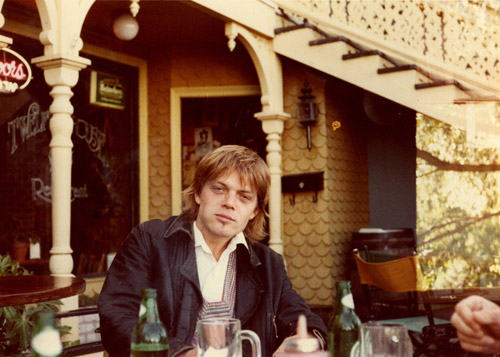
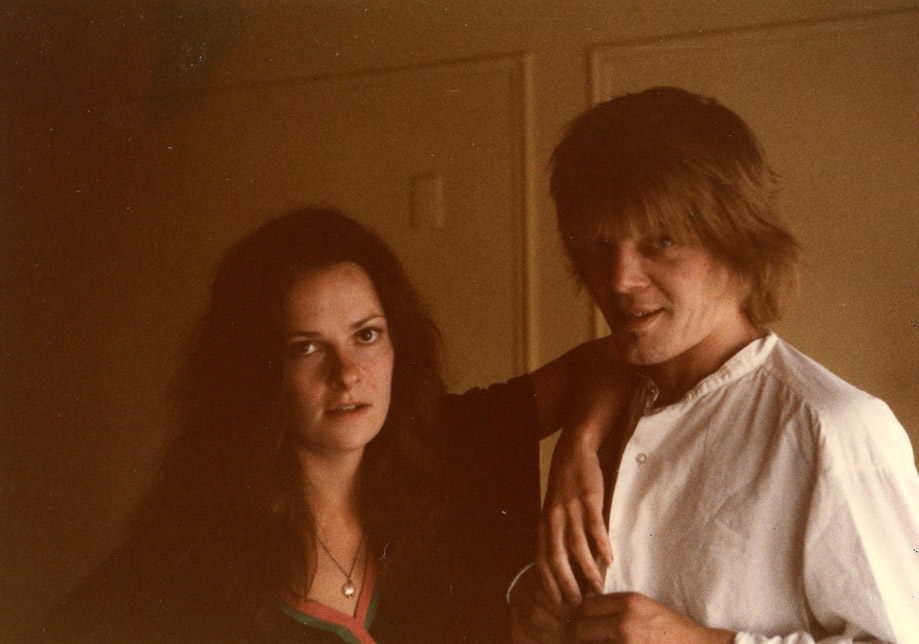
Jeffrey enjoying a beer on the patio of The Twelfth House Restaurant. (Sonoma County California, 1975. Courtesy of Michele Neff)
I was raised on stories about Jeffrey. Before his death he’d been the love of my Aunt Michele’s life, as she was his—inescapably, and sometimes toxically. Since high school they’d spent years dancing in and out of love—crying, laughing, fucking, fighting, drinking, and smoking their way around the country, from Michigan to Cape Cod and finally Monte Rio. They had a circle of poet friends. They lived in a shack with a woodstove and no electricity—the mere sight of which, according to family legend, drove my Buick-executive grandfather to tears. To me, a weird kid with anti-establishment sentiments growing up among the manicured golf courses of Naples, Florida, this all sounded about as righteous as it gets.
I wasn’t the first to be seduced by Jeffrey’s story. Andrei Codrescu, the Romanian poet, novelist, and NPR commentator, befriended Jeffrey when the two of them lived out a bohemian fantasy along the banks of the Russian River in the ’70s. “Young poets fall in love with his work all the time,” Codrescu wrote me when I contacted him. “I get letters and pictures (!) from young women in Hawaii who know his poems by heart, and on and on. That Jeffrey is a full-time job 30 years after he died. You’d think he was Kurt Cobain, which in some ways he was, only funnier and a better poet.”
The poet Joanne Kyger still remembers the day she met Jeffrey outside a bar in Bolinas, the coastal outpost that Zen poets such as she and Gary Snyder call home. She turned up in Monte Rio decades later for a memorial reading dedicated to Jeffrey in the local theater. Codrescu threw the event—more of a reunion, really—after he published The Heart Is a Quarter Pounder (Farfalla Press, 2005), a posthumous collection of Jeffrey’s verse. Codrescu had published Jeffrey’s work before, just a year after his death, in the now completely unavailable The First One’s Free (Left Coast Press, 1978). I used to thumb through that faded old yellow paperback in middle school, when I first came across it among the floor-to-ceiling bookshelves that lined the walls of our den. His poetry had a way not just of dragging you into his world but, I guess more importantly to me then, out of your own. I remember staring at the black-and-white image on the cover, of Jeffrey in an old picture frame, and wondering what his world was like.
What I didn’t realize was how long I’d wonder.
EVERYBODY KNOWS THIS IS NOWHERE
Down by the river
was it bombs or kisses? It took me weeks
to get those
broken kites out of my mouth
sticks poked holes in my brain & the moon boomed in,
internal hatpin
milking The Zombie's eyeball.
Actually,
I'm not so big on torture,
preferring the euphoric touch
where the string's end gets tied to a toothache
& bells spit out a bloody yippee
whenever you sneak out
& slam the door.
—in the empty bowl of a has been
—in the sticky distance of a drowning fly swims
toward that lone Cheerio,
—in a wink, tossed across a crowded party & demolishing
the polite wall of chatter
—here on The Lush West Coast
where passion's a crime against nature,
you stuck your tongue out
& I felt infinity
—filling my ear
like rock & roll
Backed up, as the poetry eventually was, by the stories my aunt would tell me after enough Chardonnay, the Russian River poetry scene grew into an all-out private obsession. Jeffrey, or at least the myth of Jeffrey, secretly became the single biggest reason I wanted to be a writer myself—and I’d always imagined that someday I’d make a pilgrimage to the lost paradise of Monte Rio to see what I could glean from the vestiges. Jeffrey lost his life on the night of his 29th birthday. I’d recently celebrated my own, so I decided it was as good a time as any to finally take that trip. But there was something else pulling me out there, too—something I’d always sensed but which Codrescu finally put words to: Jeffrey, he said, wrote like he was already dead. His death seemed preordained somehow, almost mystical—a down-to-the-crossroads arrangement made all the more prophetic by the disembodied quality of his verse.
“After he died I was struck by this weird light,” Codrescu told me, “like a lot of his poems were written from the other side, and he was leaving them behind for others to read them. Very few poets have that. Really, only the great ones.”
And so it was that I found myself slithering up a lonely ribbon of the Pacific Coast Highway to the strains of “Here She Comes Now,” veering east into a wall of fog at the Russian River delta, to chase the ghost of a long-dead idol.
* * *
Monte Rio is little more than a cluster of clapboard buildings, a supermarket, and a gloriously run-down watering hole called The Pink Elephant. The town movie theater is housed in a big Quonset hut painted with outdoorsy murals. There’s a Northern Exposure charm to the place that’s more Fairbanks than Bay Area.
There’s something eerie about the place as well. In winter it rains almost daily, and a haunted, shifting mist metastasizes and lingers like a specter at night. The redwoods form a dense green canopy. Moss covers ubiquitous “winding road” signs, and retaining walls frame vistas of battered old cars and wooden houses. The Russian River is more like a sheet of slow-moving silt. Everything seems stuck in suspended animation.
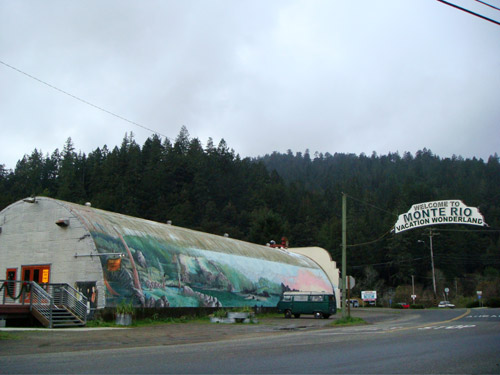
Monte Rio's welcome sign and the Rio Theater, 2007. (author's photo)
When Monte Rio’s logging days were over around the turn of the century, it morphed into a blue-collar getaway—a sort of Catskills for the NoCal set. But by the time Jeffrey and Codrescu arrived in the ’70s, San Francisco’s counterculture had gained a northern foothold here, and the weirdness was in full swing. The local kids paid for everything in food stamps, occasionally storming the town’s only grocery store for beers and fleeing across the river to crack them open under big, shady trees. The Hells Angels rumbled through town on weekend runs, juiced up on amphetamines. There were town drunks and lumberjacks, Quaalude pushers and oblivion-powder purveyors. And then there were the limousines of incognito bigwigs (and, not uncommonly, their hookers) on their way up to the Bohemian Grove—that infamous 2,700-acre compound where Bilderbergs, CEOs, and high-profile statesmen (Nixon, Reagan, and Kissinger among them) retreat for secret meetings in redwood encampments, don hooded robes, and gather for lakeside effigy-burning ceremonies around an enormous stone owl. On the other side of town, an heiress named Mary Hayssen ran a commune with drifters from the Angels of Light, San Francisco’s gay performing arts troupe. It was an unlikely and glorious assemblage of variegated freaks in a part of the world that freaks made famous—sparser than San Francisco, certainly, but also totally unplagued by the buzz-harsh urban realities that by then had ripped the daisy from the city’s hair.
And that didn’t even include the poets.
If Bolinas, the coastal outpost 40 miles south of Monte Rio that Snyder and Kyger called home, could be thought of as the proverbial “Garden” of the West Coast literary scene, then Monte Rio was its dive bar. It was ragtag and gritty—a matter of pride for those who came to be known as the Russian River poets (a demarcation more of shared geography than of style). One of them was Hunce Voelker, a gay filmmaker and biographer of the poet Hart Crane, who had a three-story wooden A-frame on the north side of a redwood in nearby Rio Nido—replete with moat, drawbridge, and a pair of penis-shaped fountains that spurted water from their concrete tips. He’d relied on a steady stream of drifter labor to construct his creaky wonderland. A lone bull he’d named Ocean Peace (and who was also, he’d decided, gay) wandered the property.
Pat Nolan, a reticent Montreal transplant who edited a literary magazine called The End, lived there, too, with his poet wife, Gail King. Codrescu landed there in 1974, bringing his peculiar brand of Transylvanian surrealism and wry irreverence with him. His poetry collection License to Carry a Gun (1970) had won him a $5,000 NEA grant. He used it for a down payment on a little house up the hill from Main Street and set off to work on a memoir.
At 11 a.m. on a gray Monte Rio morning, Pat Nolan met me at my little riverside hotel, sporting a thick ponytail and a faded jean jacket, to take me on the Jeffrey Miller “death tour.” My fellow travelers included graduate students, people who’d come across Jeffrey’s barely available poetry and felt the weird gravity of his death the way I did, and a Romanian film crew who’d been sold on Codrescu’s myth about Jeffrey, thinking they were on the trail of the poetic equivalent of James Dean.
“It’s that Jimi Hendrix/Janis Joplin thing, I guess,” Nolan said. “Young guy with lots of promise bites the dust.” We got into my rented red Chevy subcompact and followed the river into town.
The big event in Monte Rio back in the ’70s was the mail. In the morning, Codrescu and Nolan would wander down to the concrete post office to retrieve it and then head over to a greasy spoon called the Knotty Room to go through their letters. One day an envelope of poems showed up in Nolan’s mailbox from someone named Jeffrey Miller, who’d written at the behest of one of his college professors back in Michigan. They’d never seen anything quite like them.
“His poems captured the kind of rock ’n’ roll fervor that infected everything in those days,” Nolan said. “Incredibly hip, witty, sardonic, surreal, and seized with savage energy.” They wrote Jeffrey back with an invitation to come to Monte Rio anytime.
The two are still in disagreement about the exact day the newest, youngest member of the Russian River scene showed up on their doorstep—“a flinty-eyed poet with spiky blond hair and a wicked smirk,” as Nolan remembers it. But they agree on one thing: there was something special about the 23-year-old Jeffrey who rolled into town alone in the summer of ’75—steeped in Iggy Pop and Ted Berrigan—with a few boxes of belongings, a couple packs of Marlboro reds, and, as Codrescu describes it, “this crazy idea we all had at the time that you could still make a living as a poet.” Before long he was part of the Knotty Room roundtable, bullshitting between drags about the nature of truth and beauty and, probably just as often, the relative merits of various rock bands and the acquisition of illicit substances. He and Codrescu were instant friends, taking long walks and lingering at the local dive bars, where they’d do their best to parlay their poetic condition into rounds of free drinks. My aunt showed up later that year.
“I guess we really did have a scene,” Codrescu said. “There was some kind of sharing and battle of egos—and poets being poets, you always wanted to be better than somebody else.” They held readings in winter at an old abandoned roadhouse along the river, where the poets recited by lantern light and the only entrance fee was a bundle of firewood, since the place had no electricity. On the weekends they’d make the drive to San Francisco to read at bookstores and coffee houses. Jeffrey’s first real gig there was at a cafe called 80 Langton Street.
“He spent the whole day preparing,” his friend Bruce Cheney recalled in The Heart Is a Quarter Pounder. “Not by practicing poems, but by pasting fake brick wallpaper on all his clothes so he’d blend in with the wall.”
Those days were an odd era of in-between-ness—sandwiched, as they were, between the fallout of the Love Generation and the sometimes directionless soul-searching that came after it. “The war in Southeast Asia had just ended, but the stream of casualties was still coming in,” Codrescu wrote in his memoir, An Involuntary Genius in America’s Shoes (Black Sparrow Press, 2001). “The tatters of the Love Utopia hung sadly from soon-to-be-ravaged AIDS bodies. Anger was building in every layer of America, looking for release.” The punk scene was just beginning to burn a hole in the San Francisco skyline—which was fine with the Russian River poets. That raw energy and acetylene irreverence were sensibilities they shared with their mohawked brethren. They even had some common enemies. The foundation laid by their heroes from the New York School—the Frank O’Haras and Ted Berrigans—was under attack, as they saw it, by an encroaching tidal wave of intolerable dullness: the Language Poets.
“These guys did their best to make everything boring really fast,” Codrescu said. “The stuff they did was just so sexless and not very alive. That pissed us all off. We discussed it to no end.” Lining up their defenses, they chose Jeffrey to head up the First International Punk Poetry Festival, though he’d die before he was able to play that role. It was an obvious choice: Jeffrey’s verse had the kind of humor and grotesquery that recalled Hunter S. Thompson at his best:
MY BOTTLE OPENER IS M I A
my bottle opener is M I A & I’m searching
the beer is lined up on the table & it’s not american
beer which can be opened with a soft american twist
no this is Mexican Beer in thick brown bottles
if a whore smashed a GI in the face with one of these
blood would splash out maybe his eye would hang
he could show his grandkids the scar & say get me a beer
if it was american beer the kid could open the bottle
but this is Mexican Beer & i’m in my kitchen, a jungle,
searching, because you need an opener for these babies
they’re like hand grenades without a pin to pull
& I’m no pacifist i’m just on my own side
But to anyone who knew him back then, poetry wasn’t Jeffrey’s only obsession.
* * *
HANDCUFFED TO THE ONE I LOVE
Which came first, the chicken
or The Shake & Bake? It’s a rough job
being a poet during these modern times, folderol
it’s a snap, Exhibit A: me. Each day, stepping
into nothing like it was my pants, I’m tickled
pink, a dog about to piss the length
of The Great Wall of China. We’re buddies,
me and the huge terrier. We boat calm as tourists along
the captured and monotonous ocean.
Like heroin down a motel toilet
Jeffrey and Michele lived in a wooden shack by the edge of Mary Hayssen’s commune land, at the top of a steep, muddy slope surrounded by redwoods of an unsettling scale. The hull of a massive ark—the abandoned project of some long-gone hippie—lay decaying at the bottom of the hill. Jeffrey christened it the SS Tutti Fruiti.
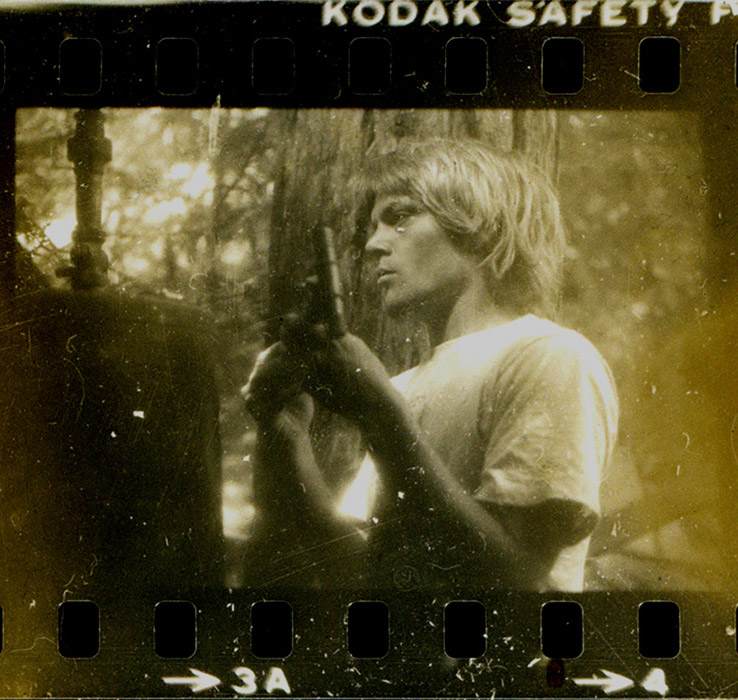
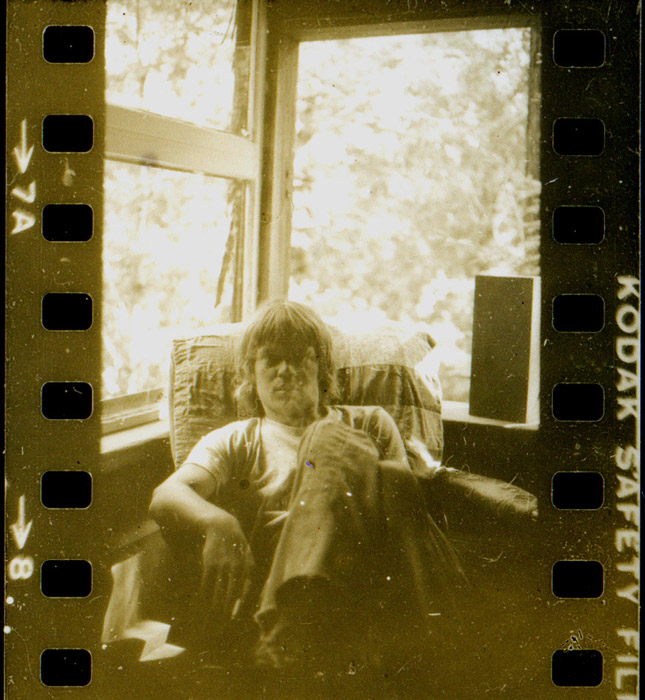
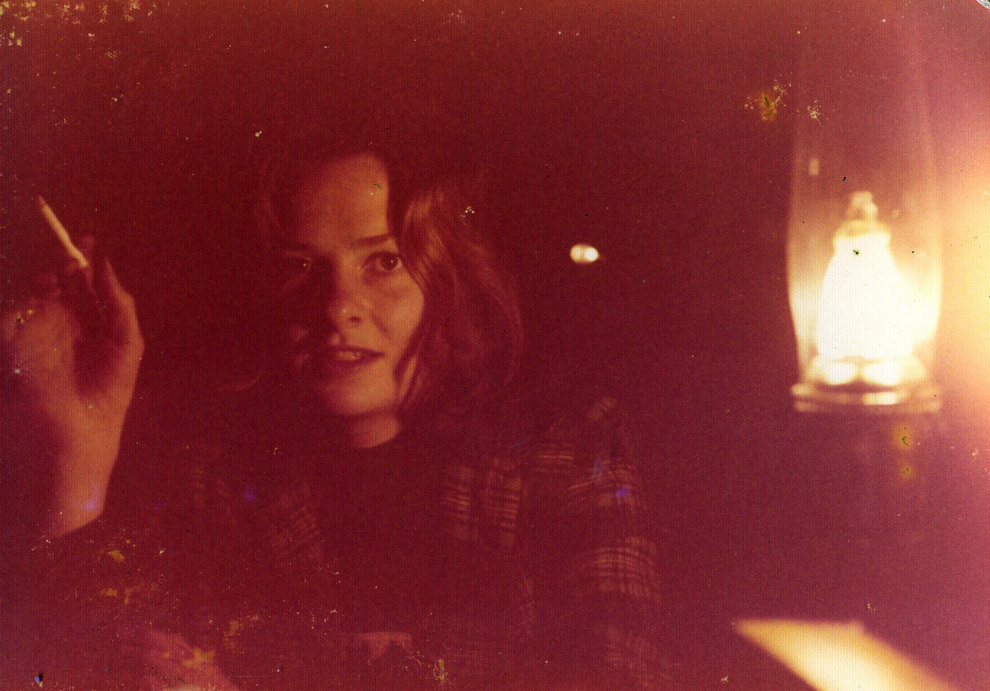
The shack itself was austere, with a big Plexiglas window and a woodstove in the kitchen next to a redwood burl table. It had a loft bed up top and a big, heavy door made out of 2x4s that led to the room where Jeffrey did his writing, perched above a drizzling creek. Outside, he’d planted a little patch of grass he called “Larry the Lawn,” a fruit tree he nicknamed “Paul Pear,” and a crop of marijuana that remained nameless but nevertheless essential to the relentless pursuit of poetry and recreation. Out-of-focus snapshots from back then show Jeffrey and Michele looking groggy and in love—leaning on the hulks of beater cars, drinking beer, lounging on balconies, and hanging out with friends in various stages of pre-, post-, and full-on party. In one picture, Jeffrey reposes, bleary-eyed, in ripped jeans and a pair of Converse All-Stars laced three eyes down from the top. His hair is strawlike. My aunt leans against his knee with her face half-hidden, giving the camera a look that’s at once drowsy and intense. Golden sunlight casts parallelograms on the wall.
“He would watch me sleep,” my aunt told me later. “No one will ever love me the way he did.”
They kept two Plymouth Valiants in the yard—one with a bad engine and a perfect exterior, the other with the perfect motor in a ravaged body. The organ transplant never quite materialized. “Jeffrey’s utopian mechanics were mainly in his head,” Codrescu wrote in his memoir. “But like most Americans he needed a piece of hardware to refer to, just in case.” Jeffrey worked odd jobs, painting houses and cutting down trees. The trees out west scared the hell out of him, Codrescu recalls, their branches alone wider than the trunks he sawed through in New England. Michele worked as a waitress at a restaurant 10 miles west of Monte Rio in Jenner-by-the-Sea, where the Russian River spilled out into the Pacific. At night, her pockets loaded with quarters, she’d drive through the fog back to the cabin, where Jeffrey would be waiting for her.
There were always parties—at Hunce’s penis-themed wonderland, at Mary’s commune with the drag queens and roving bands of truth-seeking San Francisco defectors, at Codrescu’s place, the local bars, or in the cabin over cheap wine and candlelight. There were dalliances on both sides.
There was also, as there had always been here, fighting. Jeffrey wasn’t all wit and charm. He had a confrontational side, too. Growing up in Grand Blanc, the upper-middle-class suburb of Flint, Michigan, where he had met my aunt in high school, he took his parents’ divorce pretty badly. When his schoolteacher mother remarried, Jeffrey apparently became so bitter and uncontrollable that he had to live with his grandmother until he finished high school. At times he went so far as to toss rocks at the windows of his mother’s house. Codrescu told me about at least one occasion when Jeffrey attacked Codrescu’s writing so viciously—so fundamentally—that it left him hurt and reeling for years. My mother remembers him picking fights over things as minor as the choice of radio station in the car—painting a portrait of him, three decades later, as someone as consumed with adopting the mantle of disaffected poet as with advancing the art itself. His mercurial tendencies, combined with my aunt’s general aimlessness and dependency on him back then, sometimes resulted in disaster. There are family allegations that one of their arguments ended with Jeffrey striking my aunt in my parents’ driveway—on my parents’ wedding day—and for a brief period, my uncle wanted Jeffrey’s head.
Jeffrey and Michele were one of those couples who were perpetually breaking up and getting back together. Michele recalls walking out on him more than a few times, making it all the way down the driveway and into the car, and slamming the thing into reverse—at which point Jeffrey would throw himself onto the hood to keep her from leaving. She’d turn on the windshield wipers to dislodge him. This was usually when things would end in laughter.
“I’d try to leave him all the time, the little fucker,” she told me later. “And he’d try to leave me, too. But there was just something about it—we couldn’t do it.” In the odd times that she made it farther than the driveway—in some cases all the way back home—there would be letters with paragraphs like this one:
The scar on Michele’s mouth is unbelievable. The rich & beautiful want to buy it from her, they’ll pay anything & maybe she has her price, it’s a mystery. The scar is a delicate surprise, like sitting alone by a quiet lake at midnight & having the mysterious women step into sight carrying a silver tray with a slice of heat lightning on it. . . .
“I don’t think I loved him that much,” my aunt told me when she showed me that letter recently.
In the syrupy swelter of late summer Florida twilights, my aunt talked a lot about the love between her and Jeffrey—addictive as it was dysfunctional, intense as it was infuriating. She’d always tried to draw comparisons between what she had and my own relationships. It was a nice thought. But the truth is I never felt as if I had a love like that. I still don’t. In some sense, it feels as though it’s too late. A love like that depends on the strange electrical passion of just being young.
I was coming to Monte Rio on the heels of another failed relationship—my last grab as a twentysomething at a completely ill-advised, intense, and impractical love. It didn’t end well. If coming to Monte Rio was a way of mourning what my aunt and Jeffrey had, it was also a way of mourning what I never did.
Writers talk a lot about authenticity—the need to get at some semblance of truth within the gorgeous mess of the human condition. This isn’t bullshit. I like to think it’s what stitches our whole tattered community together. To that end, Jeffrey’s life and work became a sort of superlative for me—the metaphorical stand-in for “what’s real.” And his early death only magnified it. Death is an incomplete circuit, an electric potential. It is the origin of fear and obsession. And whatever form it takes, it tends to be all-consuming. I had mine in Jeffrey. And Jeffrey, it turns out, had his in his brother, Kurt.
“Jeffrey was a little bit mad,” my aunt told me. “He really was. After his brother died, that really did him.”
* * *
Sometime in the summer of 1970, when Jeffrey was 22, his 19-year-old brother Kurt packed up a canvas bag and set out from their hometown of Grand Blanc, Michigan, to hitchhike down to Florida to meet up with his girlfriend.
He never made it.
Fishermen found Kurt in a canal a few days later, stabbed to death. Nobody ever tracked down the perpetrators or learned the circumstances of his murder. The family hired a private investigator, but he came up empty. Jeffrey was devastated and haunted by his brother’s death. Memories of Kurt crept into his poems and his nightmares. Codrescu still remembers the night that Jeffrey told him about the murder. It was late, and they were driving up Highway 1 on their way to Mendocino.
“I carry him inside,” Codrescu remembers him saying. “I’m afraid of becoming too open for fear of becoming transparent. If I do, everyone will see that I’m crying inside. And what kind of shit is that?” That story, Codrescu wrote later, never left him.
“It stayed with me like a chill, blowing cold air over my body.”
I am not being totally honest.
There is another reason I sought out Jeffrey that gray November weekend, which had less to do with Jeffrey’s life in particular and more to do with death in general. Earlier that year, in February, I was diagnosed with cancer. In March I had a one-and-a-half-centimeter bronchial carcinoid tumor removed from my right lung, along with a pretty hefty portion of the upper lobe. As far as cancer goes, I am one of the lucky ones. My prognosis is good. But my outlook, at least in the figurative sense, was not. After surgery I felt as though I’d been cleaved into two parts—reborn as the AD version of a BC self. Having cancer was, in many ways, like taking a long nap and waking up feeling old and sad. I was a windblown gamete, dislodged from my lighter half. Jeffrey had his death gamete, too, in his brother—a specter that chased him around and showed its face on those late-night traverses down the same roads I was driving three decades later, alone. I’m not saying I went to Monte Rio to try to make some sense out of why death caught up with him and narrowly missed me. But I could no longer deny that the trip was becoming a meditation on death.
In the months leading up to his death, Jeffrey had started easing up on the drinking—filling vodka bottles with mineral water to keep up appearances. He seemed less spiteful, more content; he and my aunt weren’t fighting as much. His poetry was changing, too.
“The last couple poems in The First One’s Free show the direction he was going,” Nolan told me. “It was really open, free-form style rather than these tight little lyrics—some of it bordering on surrealism.” And if turning 30 marks some kind of symbolic passage into the realm of adulthood, Jeffrey tried to co-opt it early: he lied about his age. The night of his 29th birthday—the night he died—everyone but his closest friends thought Jeffrey was actually a year older. Maybe Jeffrey said he was 30 because he could rid himself of the imperatives of being young—because after 30, certain irresponsible behaviors are no longer endearing. They become, at least as I’ve come to find out, vaguely pathetic—the puerile antics of an aging poseur groping for the vestiges of his already-lost youth.
“To a lot of those poets,” my mom would tell me later. “Being old was pretty much the same thing as being dead.”
I’d started feeling that way even before I had my ass handed to me in February in the form of a cancer diagnosis. With age, you lose freedom. But you also lose the imperative to abuse it. In the community of Russian River poets that weighed its success, at least in part, against the behavior of rock ’n’ roll stars, there had to be something vaguely liberating about that. Whatever the reasons—symbolic or otherwise—Jeffrey was turning some kind of corner. But it was a corner he would never quite make.
* * *
The last great party of the Russian River poetry scene went off without a hitch. My aunt was back in Michigan for the summer, staying with her parents and saving up money for her return. Codrescu’s wife, Alice, was gone, too—off visiting relatives. So the men were alone, and the heat was infernal. Codrescu took Jeffrey for some drinks while the rest of the Russian River freak contingent rolled into Codrescu’s place to set up Jeffrey’s surprise 29th birthday party. When they’d rolled up the driveway, Jeffrey hadn’t even noticed the cars—they’d caught him totally off-guard. And he was thrilled.
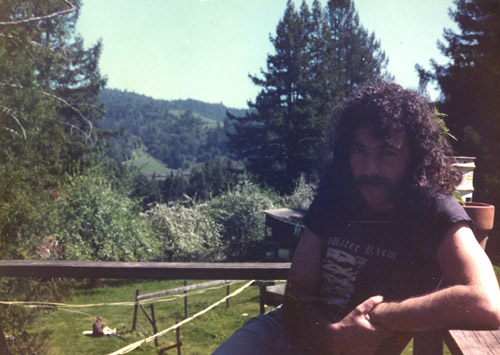
Andrei Codrescu in Monte Rio, California, 1975. (Courtesy of Michele Neff)
Whatever attempts they’d all been making to cut back on the booze and the Quaaludes, it was understood that this night would be a notable—maybe even historic—exception. They baked a big cake that ended up flying around the room to a soundtrack of Iggy Pop, the Stones, the MC5, and the Velvet Underground. People danced wildly. People who didn’t dance danced wildly. There was noise, madness—amphetamines and vodka. At one point in the hellish summer heat, a water fight broke out and a wet T-shirt contest ensued. Pat Nolan was there. A big, gregarious transsexual named Tammy showed up, along with most of the Angels of Light, Mary the heiress, and—for reasons no one can quite remember—an actual gay bank robber.
At around 2 AM, the party started winding down.
“Let’s go to the Kountry Kitchen for a drink!” Codrescu remembers Jeffrey saying.
“In a while,” he said.
“Come now!” Jeff persisted. But Codrescu dug in his heels. So Jeffrey bid him farewell, taking off with a group of like-minded and similarly intoxicated friends. The last pack of lingerers.
Too drunk to dislodge his old Ford from the gravel on the steep incline, Jeffrey finally opted to do something he’d sworn he’d never do: get into the car with his most dangerous pal, a big Italian whom Codrescu had taken to calling Demon. Demon was an outsider to the poetry scene. He’d moved out to California after Jeffrey to work odd handyman jobs, and he’d brought his pretty blond girlfriend with him. Days earlier, Demon—who back then was known for transmogrifying into an angry and reckless drunk, even by their standards—had scared the shit out of Jeffrey by driving at speeds that wouldn’t be advisable even when sober.
“Fuck that,” Jeffrey had said afterward. “Never again.” Faced with no other way to the bar, though, Jeffrey relented. He crawled into Demon’s topless VW, with Demon’s wife on one side and their friend Glenn on the other. Demon drove, with Tammy in the passenger seat. The five of them stopped off for that last drink at the Kountry Kitchen, then got back on the road to take the dangerous series of curves leading up to Jeffrey’s shack. It was only a two-mile drive. Somewhere on that dark highway, though, Demon missed one of those curves, and the little VW skidded into the trunk of an enormous redwood.
Jeffrey died instantly, his heart impaled on the jagged metal of the roof’s armature. Glenn died with him that night. Demon’s wife went to the hospital in critical condition. Demon and Tammy walked away unharmed.
The next morning, my mother remembers having the most vivid premonition she’s ever had. The telephone rang.
“Jeffrey’s dead,” she remembers thinking. When she picked up the phone, it was Codrescu’s wife, Alice. “Jeffrey’s dead,” she said.
I was actually there when they gave my aunt the news—though I was barely eight months old. Michele was out shopping with my grandmother. We all headed out to the driveway—me in my mother’s arms—to meet them when they came home. Michele’s reaction is something my mom still doesn’t like to talk about.
They scattered half of Jeffrey’s ashes in the Pacific near Goat Rock in Jenner-by-the-Sea, and the other half from a little boat under the San Francisco Bay Bridge. Codrescu read from the Tibetan Book of the Dead. A double rainbow materialized in the mist.
“Our whole community came together like a flock of birds,” Codrescu wrote later. “Everyone touched constantly, a calming laying-on of hands. We kept vigil and slept together. Death is erotic.” When Codrescu talks about Jeffrey’s eerie talent for writing “like he’s already dead,” he isn’t being abstract. A few poems, like this one, literally made Codrescu shiver:
DEPRESSED & HORNY
Behind every car wreck there’s a beautiful dish
& buying her drinks is smashing your head on the windshield
such a long throat, what a curve
swallowing me up foot first. I didn’t wanna go
out of the house but it was so quiet & violent (like a tree)
& I need a liquid light on my teeth, cool white
cue ball, parlor games. If you feel mixed up
you should try and drive a 52 Ford Station Wagon 50 miles
an hour down the road to my house. That will set
you straight to pursue the things in life that interest me
Later, when Codrescu and the rest of the Russian River poets embarked on the task of sifting through Jeffrey’s old writings to figure out which ones to include in his postmortem anthology, they would all have a momentous freak-out at something else they stumbled upon. It was a two-line poem, written in pencil, which read in its entirety this:
you can’t come
half-way home from the bar
* * *
HEEBIE JEEBIES
When the late show ends
a minor character’s riding off, into the sunset
with the girl
and the real hero’s upside-down
hunting snipes, in the pits of The
Heebie Jeebies. Floating between a nightmare and
slippery stairs our boy recited
“news for the deaf.”
A test pattern of sanity
The night before his death, Jeffrey and my aunt had gotten into an argument on the telephone. The life of the poet girlfriend was wearing on her. But Jeffrey had new plans. He wanted to go to Paris. At some point, my aunt brought up when she’d be coming back to Monte Rio, and Jeffrey told her not to bother. It was the first time he’d ever been anything less than thrilled at the prospect of her return. They eventually hung up on each other, and that night my aunt started a letter to him that she’d never finish. Her reaction, as my mother remembers it, “was something along the lines of what do I do now?”
Codrescu spoke often of the thin membrane separating the land of the living and the realm of the dead in the year after the accident. “Of all my dead friends, this one is the most alive,” he said. “I sense the dead pretty well, and Jeffrey definitely has a presence that is very vivid.” In his memoir, he remembers the days after Jeffrey’s death this way:
The mourning went on a long time. The spirit world went crazy. Animals died. I woke up in the middle of the night and heard Jeff’s voice distinctly. “I understand well how Michele feels,” he said.
I was beginning to feel like I did, too. My whole quest to get into Jeffrey’s world had grown into something far more consuming than I’d ever expected. It followed me when I left Monte Rio, and I was finding it increasingly difficult to concentrate on anything else until I felt that I’d resolved everything. I asked Codrescu to tell me more about Demon, and what followed was an exchange that I still wish I’d never initiated.
“He played college football at Notre Dame and was Jeff’s most non-poet apish friend,” Codrescu told me. “Jeff had a thing for the wife, who was in the backseat when the guy drove the car into a tree. Demon looked into the mirror and saw something and drove into the tree. He told me as much when I saw him at the memorial reading in 2005.”
“So wait. You’re saying he deliberately drove into that tree? Because he witnessed some kind of inappropriate exchange or contact between Jeffrey and said ogre’s wife? Or am I inventing plot twists here?”
“Yes, you heard me right. ‘Inappropriate exchange’? C’mon, how euphemistic can we get? He had his hand under her panties, she had his hand on his dick, and Glenn (who also died and was gay) had his hands all over, and Tammy, who was in the front passenger seat and ambimultisexual, had his long arm-paws all over the back seat. The only person nobody wanted to touch was poor Demon, and he killed them all.”
“Christ,” I said, “I am probably going to have to talk to this guy."
There were probably times in my life when a revelation has shocked me more, but I sure as shit couldn’t think of any at the time. Journalists don’t regret their persistence too often. This was one of those times. What the hell was this project turning into? A murder mystery? Whatever it was, the justice part had long ago played itself out: Demon did time in prison for vehicular manslaughter.
* * *
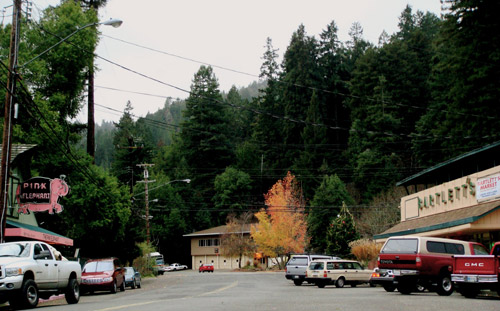
Main Street in Monte Rio, 2007. The Pink Elephant Bar, where the Russian River poets used to drink, is still there—on the left. (Courtesy of the author)
Everything burns in Monte Rio. This was a hard proposition for me to swallow in December, when everything is a sopping-wet terrarium. But the extreme of the rainy season here, Nolan told me as we headed back into town in my rental car, is more than outdone by the blazing hot, tinder-dry summers. I told him I wanted to see the Knotty Room, but the place had burned to the ground on a rainless summer almost three decades ago, taking the rest of the block with it. An old dive bar they’d all frequented called the Palm Beach Club went soon after that—and years later, Codrescu’s house met a fiery end, too.
We saw the weedy lot where Codrescu’s house once stood, across the street from the abandoned Monte Rio school. My insides did a dark little dance when he took me to the curve where Demon lost control of the little VW.
“That’s the death tree,” Nolan said as we passed it, a big, indifferent redwood cradled in a hairpin turn. But Codrescu insists the real one was actually cut down after the accident. The only thing still standing, then, was the Kountry Kitchen—the bar where Jeffrey stopped off to have his last drink. It’d been turned into a quaint little eatery called Café les Jumelles, where tables of old ladies in fleece picked bacon from their teeth and didn’t talk. We went down the dirt road where Mary’s commune used to be, now home to a burgeoning population of migrant workers, and saw the incline to the place where Jeffrey and Michele’s cabin no longer stood. There was something all too fitting about being brought somewhere so personally sacred, only to find out that the landmarks were all either too flammable, dangerous, or poorly constructed to hold up to posterity. The “tour” was more like a procession of empty spaces.
Back at the hotel, Nolan and I sat in my rental car, parked in a gravel lot downstream from Bohemian Grove. I told him I still wanted to talk to Demon. That’s when I learned his real name. When I heard it, it was like a dark incantation. Nolan told me he’d left him a message that I would be coming, but he hadn’t heard back. It was clear that Nolan didn’t harbor the same open contempt for Demon that Codrescu does. And whatever psychology may or may not have been at the root of that long-ago tragedy—which in one way or another ruined the lives of everyone in that car—Demon, Nolan figures, has suffered enough.
“You’ve got to understand—he’s really sick of all this Jeffrey stuff,” Nolan said. “They’ve got grandkids now.” We stayed there for a while under the redwoods, Bob Dylan’s “4th Time Around” playing softly on the stereo. There was something in his reticence that I couldn’t quite figure out—something like suspicion or annoyance, maybe, at all this persistent fascination with a poet whose premature death had imbued him with unjust immortality.
“Look,” he said finally. “Everybody’s trying to lay the guilt they feel about Jeffrey on someone else. But we were all drunk that night. And Jeffrey—if he wouldn’t have died then, he would have died soon anyway.”
* * *
I'm a street-walking cheetah
with a heart full of napalm
I'm a runaway son of the nuclear A-bomb
I am the world's forgotten boy
The one who searches and destroys
Honey gotta help me please
Somebody gotta save my soul
Baby detonate for me
—Iggy & the Stooges, Search and Destroy
The next day, I took Jeffrey’s last drive alone. It was drizzly and the sky was the color of clay. I kept going past the “death tree” through a mountain panorama, took a right up the Cazadero Highway, and disappeared into a redwood canopy that led to the base of his old driveway (just two minutes farther!). I parked the car at the foot of the hill, right across from where the rotting hull of the Tutti Fruiti once stood. There was a sizable house up there now. But I knew what I had to do. I couldn’t go home feeling this empty. Somebody was vacuuming the deck when she spotted me. The vacuum turned off.
“Hello?” she yelled. In the middle of this particular nowhere, it was clear they were not accustomed to unannounced visitors.
“Hi,” I said back. I wasn’t sure how to broach this one. “Uh . . . I’m Michele Neff’s nephew? She used to live here with Jeffrey Miller back in the ’70s?” There was a pause.
“Hang on,” she said. A couple minutes later, a man in a hooded sweatshirt appeared in the driveway and started descending the hill. I was happy to see that he wasn’t armed.
“I’m Randy Halstead,” he said, and stuck out his hand. He had kind eyes and reddish brown hair. “You look like you’ve come a long way.”
The Halsteads, it turned out, had known Jeffrey and Michele back in the ’70s when they used to live down the road. Their new house was at the top of the driveway, on the right—a modest two-story affair they’d built after Jeffrey died and they took over the land. Above that were rain-soaked gardens framed in menacing redwoods. I told Halstead I was sorry for bothering him, but I was hoping to get a better look at the place where the cabin once stood. I told him it was a sacred journey of sorts.
“Sure,” he said. He walked me up through the gardens to a flat piece of grassland by a fencepost with a horseshoe nailed into it. The creek that had flowed under Jeffrey’s writing room still trickled down the side of the hill. I was surprised to see the big square of Plexiglas, which had once served as the shack’s window, in the grass by the ladder that had led to Jeffrey and Michele’s loft bed. Next to it, capsized in the undergrowth, lay what was left of their kitchen table. Seeing it was like standing over a corpse. Here was Michele and Jeffrey’s life together, reduced to odd bits of scrap lumber and soaking up another season’s worth of rain. I was standing on the detritus of a dream. I started to feel something like grief. But that’s when Halstead pointed out the tree.
“That’s Paul Pear over there,” he said. He was pointing at the thick trunk of a hearty-looking pear tree—leafless in November but covered in wild, glistening shoots that jutted from every branch. My aunt had told me about this tree. Jeffrey had planted it when they lived there. In the shadows of the great, haunted redwoods, it never bore any fruit. But ten years ago, as if suddenly possessed by some strange druidic magic, it finally delivered—and since then, the Halstead family has been taking in late-summer armloads of juicy Bosc pears. Before they finished their house, he told me, he and his wife had lived in that cabin too. When their first son was born, they converted Jeffrey’s old room into a nursery, and he’d spent the first five years of his life there. We talked about the simple pleasures of open space and limitless sky, about the great human folly of confusing complexity with fulfillment—the kind of conversation that gets my ass kicked among friends in New York City. Standing there in the cabin’s void, if only for a moment, all that grief started to feel more like renewal.
That night I drove to nearby Guerneville to check my voicemail messages. My hotel room had no telephone, and cell phone signals couldn’t penetrate the hills of Monte Rio. There was a message from my aunt. My grandfather—the same one who’d owned the hardware store where Jeffrey worked as a boy—was gone. He’d passed away in his sleep over the weekend.
Death was in the air like moisture.
* * *
A month after I left Monte Rio, I went back home to Florida. My aunt invited me over for dinner. She had a video she wanted to show me of Jeffrey that Hunce Voelker had made from an old 8mm film he’d shot in 1976. All the Russian River poets made appearances, in fact, and Voelker had shot them in a clever way: none of them was allowed to read his or her poems in front of the camera; instead, they stared into the lens—smoking, grinning, or nervously looking around—as they were being filmed. They read their own poems later, and Voelker dubbed their voices over their fidgety images. The effect was disarming. Human beings—particularly young poets full of nicotine, booze, and promise—have a tough time sitting still.
It was the first time I’d actually heard Jeffrey’s voice—the first time I could actually watch the weird force animated. When he came on, I was struck by something: I could have predicted every bit of it. The voice—laid-back and self-assured, with the hint of some geographically unspecific drawl—was exactly what I'd thought it would be. The smirk, beamed out between drags on a Marlboro, lingered just as I thought it would. His hair was like some familiar wild animal. For some reason, he'd used some makeup to blacken circles around his eyes.
Driving back through my aunt’s subdivision—down roads that wound by design rather than necessity—my head drifted to California again, the way it had 20 years before when I first came across that copy of The First One’s Free. I felt the sensation of having completed a kind of enormous, invisible circle in time. But under the blurry blue moonlight, where the big Australian pines surrounding the golf course were easy substitutes for the redwoods of the Russian River Valley, that circle somehow felt more like a spiral. If I’d gone out there in search of reality, to rob the myth of some of its power, then I had failed completely. I was more in its grasp than ever. But somehow, it all seemed okay. Because those spirals are probably what keep writers going—that weird centripetal force that, for better or worse, feeds our imaginations. I had grown to accept the fact that I would always share that orbit with the late Jeffrey Miller. The streets were deserted. A mist formed on the golf courses. I was driving west and listening to the Velvet Underground again.