


You've Come a Long Way, Baby
Human. Animal. Gay. Straight. Poetry.
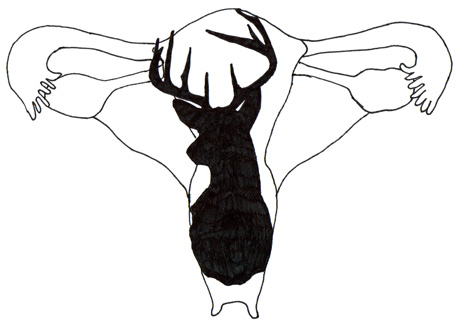 Original illustration by Paul Killebrew
CA Conrad came over to my apartment in Manhattan’s East Village one afternoon in April. I’d admired his poems for years, having met him on another afternoon in New York when he sought me out of enthusiasm for my work. Conrad always seeks out his favorite writers. It seemed a very traditional and direct method of establishing lineage.
The founder of the Jargon Society, Jonathan Williams, died in early 2008. His death provoked a different press, Chax, to publish Conrad’s opus, The Book of Frank, which Conrad had been working on (and reading from) for 15 years.
Conrad’s work has been coming into greater prominence in the past few years due to the publication of Deviant Propulsion, his first full collection, and also his presence on PhillySound, a blog he runs with his friends that is full of new poems, Conrad’s enthusiasms for other poets, political messages and analysis, and poetry exercises. His “(Soma)tic” poetics have a quickening effect on poets at all moments in their “careers.”
I’ve grown to love CA Conrad—the man, the work, and all he attempts and represents—because he always argues (from the inside of his poems) for a poetry of radical inclusivity while keeping a very queer shoulder to the wheel. His kind of queerness strikes me as nonpolarizing, not intentionally but because of the fullness of his exposition, a kind of gigantism that seems to me to be most deeply informed by love, and a tenderness for the ravages and tumult of existence. I made a plan to talk with him on the occasion of The Book of Frank coming into print, and I’m glad I’ve procrastinated finishing this piece so that it didn’t come out in June, where queers belong. Conrad and his creations, I hope you’ll agree, belong everywhere. I’ve never seen him occupy a room—especially one he reads his work in—where he hasn’t affected a sea change in most of its inhabitants by the time he’s done. Sex, increasingly an undesirable subject in the poetry world, is so frequently glowingly present in the structure of this new book. One poem describes getting a ride hitchhiking in a truck covered in semen stains. His poems bring us into that world:
“Looking for these?”
the driver asks
pointing to
eager swimmers
long-since dried on
radio
ashtray
cup holder.
***
Eileen Myles: Sex is problematic. I mean, isn’t it? In the world, and definitely the poetry world. Yet it’s everywhere in the world of your poems. Sex is the desire to survive—not just to multiply, but to be. Yet a queer person is always told to ACT LIKE US—for your own good—so you won’t bring all this grief upon yourself. Be like this, and not that. This kind persuasion goes beyond simply telling us what we should do and look like, but informs us of what we should read and write. It gets under your skin. There’s a threat inside of it. People are all afraid of what they will become . . .
CA Conrad: I feel like I was created. I just wanted to have my life, but once straight people found out I was gay, I became the fag, you know what I mean?
EM: You’re a character that the culture created.
CA: But I’m at this age where I’m like—that was great. Thank you. It got me the hell out of there, and now I don't have to stay here and work in the coffin factory with everyone else in this shit-hole town.
EM: Yeah, well, queer people need to transport themselves to survive, and like anything getting transported, it eventually gets caught, seen. I think we do what we do in our work to subvert that capture. But yours just saves my life, your excess. I think about when somebody asked Bob Creeley how he became a poet, he said, “Well, one night in college I found myself on some other street, and I decided to spend my life there.” You began your life there: CAConrad, “whose childhood included selling cut flowers along the highway for his mother and helping her shoplift.” Those facts of your existence change the story so radically, you know. What Blake was to the 19th century, you’re being to the 21st. Kind of an outsider shaking his fist at capitalism and the ludicrousness of it by examining its smallest unit, which is an individual, or the family. Does that resonate for you at all?
CA: Well, it’s humbling to hear that from you.
EM: Yeah [breathes a deep sigh of relief].
CA: You know, a big secret to the beginning of The Book of Frank is that it’s kind of autobiographical. But it’s almost irrelevant that it is.
EM: That it’s autobiographical?
CA: OK. Yeah. Well, some people have problems with the characters in the beginning. Which is fine. I’m writing what I’m writing. . . .
EM: What does that mean, that people are having problems with the characters?
CA: People come up to me after readings and ask, “Why are all the women like this?” And I say, “Because that’s my mother.” I mean, my mother is not this sacred text that everybody likes to pull from for their mothers, or whatever. My mother’s my mother. I mean, I lived in a car for half a year with her and it was not fun, you know? I would sell flowers for her on the side of the highway because she had a police record and couldn't find work, and it was a full-time job. Child labor laws meant nothing to her, and I really had to rebel once I got older.
EM: I suppose the puzzle worth talking about might be how you got from there to here. Not in a cheesy way, but how did the poems happen? You’re somebody for whom doors, I think, are opening now [pats book].
CA: Well, strange as it may sound, the thing I’m most grateful for is being queer. If I had not been queer, I might have stayed out there in rural Pennsylvania. Those years were really painful. I was in high school at the beginning of AIDS, and it was hitting the newspapers, and I was out with my boyfriend, and it was a daily assault, you know.
EM: When did you start writing these poems? How and why?
CA: About 15 years ago.
EM: Uh-huh. I’m being like your lawyer. What was your poetry history to that moment? In terms of what you were writing, what you were reading?
CA: I could trace it back to when I was selling those stupid flowers—all I did was read. I was sitting out there in forced isolation. I started keeping a journal.
EM: You’re killing time, right?
CA: I’m 13, I’m very restless, and I have to be at the mouth of the turnpike exit . . . literally in the middle of nowhere. There’s nowhere to go. I mean, there’s a field behind me with a big, beautiful tree in it, but that’s it.
But one day this buck, this deer with a full set of antlers, ran across the highway, and a tractor trailer hit it, and it went down into this very deep ditch, maybe about 100 yards from where I was. The truck driver checked to see if I was OK, then left. But over the weeks I would go and watch this deer decompose, and that kind of sent my mind into this idea where death and impermanence really settled into me at that time.
There were these rats burrowing under the pelt, and everything kind of sickened and grossed me out in a way. And it sort of got conflated with my home environment, which was very bad. I was already sort of a big basket case because of what was going on with my mother’s new husband and my sister. . . .
EM: Well, like incest?
CA: He never touched her. My sister was six. He would come home drunk, and she would be in a closet. I’d be sitting in front of her closet with a small rifle I’d been given when I was nine.
EM: That’s so great.
CA: I would be waiting and he would be at the door, saying things. . . . “Show me your pussy, show me your pretty pussy. . . .” I didn’t even know what he meant, but I knew it was really bad, and my mother didn’t do anything. My mother smacked me when I tried to tell her what was going on.
EM: I know that one.
CA: All the adults were just absent.
EM: It’s so clear that the kids are alive—know what’s going on, and the adults are kind of these blowy, absent creatures.
CA: Yeah, that’s it. One of the Frank poems is about the father giving the child to the pornographer. Allowing it to happen and being confused, acting confused, you know? My father knew. I told him what we were going through, and he just left us in this situation. . . . So I came to the city, and that changed everything.
EM: What was the city?
CA: 1986 in Philadelphia was a dream for me. You could live on nothing, and then spend all your time in the library, and I had this coke dealer boyfriend who exposed me to this whole other world. We went to a bar called the Bacchanal. My boyfriend was selling drugs there, and I would hang out with all the artists and the Polish philosophers and Gil Ott. He was this amazing poet who had a magazine called Paper Air.
EM: A straight guy?
CA: Straight guy. Uh-huh. He was publishing people like Charles Bernstein and Bob Perelman . . . you know, all these guys. And at the same time I was living in a city where it was very anti-that. He was sort of an island.
EM: I’m grabbing a pen. Keep talking.
CA: I mean, Gil Ott wasn’t a teacher so much as an anti-mentor. He didn’t believe in any of the usual mentorship stuff, which was great.
EM: So, so . . . how do you describe the shape of these poems? What invented a Frank poem?
CA: Well, this is the secret part . . . related to autobiography, because I was in therapy. . . .
EM: This is very Anne Sexton.
CA: I didn’t mean it to be! Though I loved her as a kid. For the record, I dislike the confessional poets, every suicidal one of them. My work is not about wallowing in posttraumatic stress disorder, it’s about posttraumatic stress growth. But it’s interesting how Sexton has been disappearing from the bigger academic world of poetry, and her friends Plath and Lowell and Berryman, they’re all sort of amped up now.
EM: Why do you think that is?
CA: I think it’s class. It’s pedigree. She’s the only one of them without a college degree.
EM: Well, also, she’s messy—and allegorical. With all those witches and fairy tales. Kind of Kathy Acker–like. . . .
CA: What I find ironic is that for Jerome Rothenberg and Pierre Joris, of that whole group, Sexton’s the only one they chose to put in Poems for the Millennium. Which was very exciting to see, because that anthology was kind of all about “who shifted the paradigm” kind of thing. And they chose the The Jesus Papers. Seeing those stand alone in an anthology was kind of remarkable, I think. And that’s why . . . and that’s why I made it third person, the whole Book of Frank. It can be anyone’s story now.
EM: Yeah.
CA: The quote from my grandmother at the front of The Book of Frank is very important to me, though: “Well of course they’re staring, we’re very interesting.”
She said this to me when people were staring and whispering, probably saying, “There’s that whore Carla’s bastard son,” or whatever. I told my grandmother it was bothering me how mean people were acting, and she [gave me] this sentence, which has remained a source of strength I can always find when I need it. But I don’t want the biography part to be taken seriously when people read the book. I want them to have their own experience.
EM: I think they always do.
CA: The facts are I became macrobiotic and was getting physically healthy, but still just an absolute emotional mess. And then I met somebody who turned me on to this thing called RC counseling, reevaluation co-counseling. It was one-on-one, and you got to switch roles, therapist and patient. . . .
EM: That seems like a grid for all the switching in the book. It’s a nonliterary . . .
CA: Well, maybe. Even when I was macrobiotic I was still wanting to do drugs at first. But it wasn't until I was completely clean for a couple years that The Book of Frank started to come out of me. Drugs were more of a block to my creative powers than anything.
EM: You wanted to talk about these things in some way?
CA: I wanted to talk about them, and I didn’t want to be a confessional poet.
EM: Because it had been done? Because that wasn’t aesthetically . . . ?
CA: No, and I’m going to be very clear about this. I was not being influenced by the Language poets when they were against the personal “I,” because I actually think that they use the personal “I,” especially when they say they don’t anyway.
EM: They’re all influenced by New York School poets, but it’s like which New York School poets? Everyone was in Bernadette Mayer’s workshop. But it’s like the unmentionable, like a lineage suppression. I never had sex with that person!
CA: Yeah, that’s a good way of putting it.
EM: You know? But, go ahead.
CA: I think a lot of it was embarrassment, too. The Book of Frank came from me wanting to write about my past in some way but not be open about it. I just really wanted to create a fictitious character.
EM: You know, when you talk about creating a character, where I go is animation. I mean, that’s what I feel in this book, that each of these poems seems like moments in movies.
CA: Movies were queer; there’s a queer way to find yourself in the movies. Frank is a movie theater himself at one point. I want poetry to be the world film can’t access but thinks it can. Film wants to dictate images, where poems give the reader’s mind the space to create their own world, their own film.
EM: Did you see the movie Teeth, by any chance?
CA: No.
EM: It’s really funny. Roy Lichtenstein’s son made it, but it’s a sexy, funny teen horror movie about vagina dentata. You put a vagina on the first page of your book:
when Frank was born
Father inspected the small package
the nurse handed him“but where’s my daughter’s cunt?
my daughter has no cunt!”
It really determines whether people will keep reading or not. I mean, for some people a cunt on page one is inconceivable. You’re in this morass. And you do it well. It’s a good poem. What’s really funny and wonderful about how you violate the mild terms of readership is that you take the thing as we know it, and then show it in all these completely excessive ways—and then you go even further. You go one step further so that it becomes something else. So, if I’m a man and this is my fear, the giant pussy, I’ll step back and make it instead the absence in my son, or else “Frank saw a giant eat a park bench with her vagina. . . .” Somehow the absurdity of the fear of the word or the power of the thing becomes something that males and females can both stand outside of, enjoyably even. That seems massively queer to me. Wizardry, kind of. Both staring at the horror and restoring magical powers to the female.
CA: Well, can I tell you, one vagina poem that upsets people, women, the most is the one about Frank eating his wife’s bloody tampons.
EM: Yes. And why are women upset?
CA: Well, they think that I’m being a misogynist.
EM: I don’t buy that, but why does he want to eat it?
CA: They felt I was being like Andrew Dice Clay. A male pig, you know? The background of that poem is that I had been visiting friends in Cornwall, where I discovered that our American neo-pagan concept of Christians taking women’s power was way off, meaning that the Druids and other male-dominated pagan groups did it first. The power of women terrifies men, especially when men want the control. But the Christians did put a serious nail into it, and we, of course, still live with this. I mean, look at Joan of Arc. She refused to say the Lord’s Prayer, practiced the ancient shaman rite of transvestism, and she was having psychic visions. She terrified the state. But my point was Frank’s eating her . . .
EM: Blood.
CA: . . . her blood.
EM: He wants it.
CA: He wants it.
EM: Right.
CA: And she’s doing everything she can to keep him from getting it.
EM: Right.
CA: And he’s still going to get it.
EM: Because why? Because why? Because it’s hers?
CA: Because it’s hers. It’s her power. It’s her . . .
EM: I think it’s sort of generational that women are being outraged at your use of their blood. Your poem is a war. He’s not being a pig. It’s something else entirely. The women horrified don’t know Germaine Greer: “If you’ve never tasted your own menstrual blood”—that was the key phrase. If you haven’t tasted that, well, then you’ve got a long way to go, baby.
CA: Oh.
EM: Advertising took it up as a congratulations, not a challenge:
“You’ve come a long way, Baby!”
CA: Virginia Slims.
EM: Right, the subversion is all we know. With a tune and an ad campaign that we now associate with how insipid feminism was . . .
CA: Right.
EM: It meant, “Women, try drinking your own blood,” and that meaning’s gone.
CA: I had no idea that that’s where that comes . . .
EM: But the taboo your book violates the most are the hierarchies and boundaries between things. Human over animal, man over woman, parent over child, straight over gay, alive over the whole unclear rest of the universe. The hideous secret of your work, which seems so very pagan, is on the deepest level how very fluid things and categories are.
CA: Well, as a vegetarian for the last 20 years, I want us to understand we’re animals. We have the power to cut meat out, even if it’s just to some degree, at least; do you know what I mean? Leonardo da Vinci was talking about this 500 years ago. He said he hoped that one day human beings will understand that killing an animal is like killing another human being. But we’re also living in a time where we’re just killing other human beings so much that, I don’t know, there’s just so much violence.
EM: The violence is a good connection to the measure of your message. How economical your poems are, how short, how quick they are. How did you come to that . . .
CA: I was in correspondence with Cid Corman, who was living in Kyoto, Japan, and he turned me on to a lot of Japanese poets, especially this anthology of 20th-century Japanese haiku poets who were really radical and had completely broken the form. But, you know, actually Corman hated these poems because he hated surrealism. And he was actually trying hard to convince me to stop it.
EM: Stop this project?
CA: Yeah, and I have such a problem with authority. I would go head-to-head with Corman about it. He would say, it’s just fantasy. And I . . .
EM: What’s that “just” mean?
CA: Well, I think it’s just . . . he really wanted me to do what he told me to do, and what he was telling me to do, and I didn’t want to do. And I would write back and say, listen, I’m going to continue this anyway.
EM: There’s just so much power in that rebellion, you know, and you can’t give that to people. When you tell them to rebel, it’s like they think you mean take your clothes off and go wild at the party. And then come back from that into responsibility. Not that going wild ever is the responsibility itself. Seeing wild. Needing seeing wild to survive.
CA: And you’re right, it can’t be given to you because some people, if you oppress them, they’ll just clam up forever. I’ve been very influenced by looking very closely at the murderers of queers, you know, looking very closely at the murderers of Matthew Shepard, for instance, and how Aaron McKinney, that very same night after torturing Shepard, went out and deliberately got in a fight and got beaten up by another man and then wound up four rooms away from Matthew Shepard in the same hospital.
EM: Wow. Wow. Wow.
CA: So it’s sort of like the sexual tension gets transferred, because it’s really about sexual tension.
EM: Yeah.
CA: Many men I’ve heard of who are in prison for killing gay men had sex with them.
EM: First?
CA: Yeah, and there’s a documentary about it, seven men interviewed.
EM: One of the most shocking poems in here for me is the chocolate man.
CA: Oh, well, that’s . . . yeah. The chocolate man is saying no and . . .
EM: Mouthing and dying and being devoured and Jesus, I mean, it’s very sexual.
CA: Yeah, I mean, it’s a violation poem. . . .
EM: Totally.
CA: And in some ways . . .
EM: A sweet, a sweet violation, and . . .
CA: It kills him.
EM: Your Matthew Shepard story reminded me of it, because we’re the murderers too. It’s not like we don’t understand it. We understand it all too well. The impulse to violate is a kind of reproduction of memory, to murder a queer is a queer act for sure, to kill a woman is feminine somehow, isn’t it?
CA: Well, what do we deserve? An old boyfriend of mine was tortured and murdered by homophobes in Tennessee, and that was very real and terrifying. And then there are gays who demand their right to join the military, put a rainbow sticker on a machine gun, I guess. Well, I don’t think so, but every one of us is complicit; our taxes buy the bullets and bombs to kill hundreds of thousands of real, breathing, human lives in Iraq and Afghanistan. In the end we would be nothing but surprised at what we really deserve.
EM: Our little bit of ignorance is one way that we know.
CAConrad has been writing poems since 1975 and working with (Soma)tic poetry rituals since the early 2000s. As a young poet, they lived in Philadelphia, where they lost many loved ones during the early years of the AIDS crisis, as documented in the essay “SIN BUG: AIDS, Poetry, and Queer Resilience in Philadelphia.” The center of the Philadelphia poetry community at the time included Etheridge Knight...
Eileen Myles was born in Cambridge, Massachusetts, and was educated at the University of Massachusetts-Boston. They moved to New York City in 1974 to be a poet, and subsequently a novelist, art journalist, and writer of libretti. They gravitated to the St. Mark’s Poetry Project, where they studied with Ted Berrigan, Alice Notley, Paul Violi, and Bill Zavatsky. From 1984 to 1986, Myles was the artistic...