


24/7 Relentless Careerism
How you can become the most important poet in America overnight.
Introduction
“Let’s just begin by saying that there are more poets than ever before in the history of literature—and therefore more magazines, reading series, and tiny publishers. There are probably 800 or so active writing programs in the United States alone. I could have looked up the actual number, but facts don’t actually matter. If I say that Obama is a strong and effective president over and over again, it makes him a strong and effective president. Be louder and say simple things over and over again, and you will triumph in any debate or forum.”—Jim Behrle discusses how you can become the most important poet in America overnight.
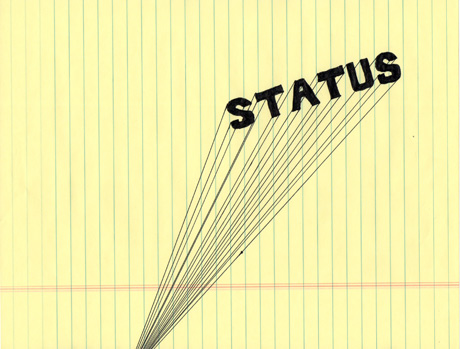 Original illustration by Paul Killebrew.
[Editor's note: This talk was originally delivered in slightly different form at the St. Mark's Poetry Project on January 25, 2010.]
Let’s just begin by saying that there are more poets than ever before in the history of literature—and therefore more magazines, reading series, and tiny publishers. There are probably 800 or so active writing programs in the United States alone. I could have looked up the actual number, but facts don’t actually matter. If I say that Obama is a strong and effective president over and over again, it makes him a strong and effective president. Be louder and say simple things over and over again, and you will triumph in any debate or forum.
Now, you might think that because there are more poets than ever, there might be more opportunities for poets than ever. And you’d be correct. If your fondest wish is to become the next totally obscure minor poet on the block, well, you’re probably already successful at that. This literary landscape has proven itself infinitely capable of absorbing countless interchangeable artists, all doing roughly the same thing in relative anonymity: just happily plucking away until death at the grindstone, making no great cultural headway, bouncing poems off their friends and an audience of about 40 people. A totally fine little life for an artist, to be sure. No grand expectations from the world to sit up and listen. One can live out one’s days quite satisfied to create something enjoyed by a genial cult. But that’s not why any of us are here tonight. We’re here to conquer American Poetry and suck it dry of all glory and juice.
So those 800 writing programs churning out, say, 25 students apiece each year are actually factories sending more enemies to the front lines. These soldiers, filled with ambition—and now out $30K apiece—believe that they’ve paid their dues to the kingdom. And each one of them believes himself the true heir to all the masters. That his face belongs on the Poetic Mount Rushmore. And that yours doesn’t.
Even within the elite enclaves of poetic communities—like this New York City Poetry Project Scene—there is a constant battle to stay afloat while pushing others beneath the bubbling surf. Because there is so little at stake, all battles must be fought to the death. And because there are so few spots available, the survival instinct takes over. You’d think that only 10 or 20 poets ever walked these corridors, to hear young poets nowadays tell the tale. But what of the other faceless thousands who have ventured through, poems in hand, waiting for their slice of the spotlight? Forgotten, erased, remembered only as a rat turd upon some dusty archived sheet? This is not the glory we poets were imagining when we first fell in love with the idea of entering the art.
Fame has come to some who haunt this spot. I remember Peter Jennings interviewing bereft East Village poets upon the death of Allen Ginsberg almost 15 years ago. But now, who remembers Peter Jennings? Allen’s work has languished without his fame around to bolster it. And no poet in America holds any distinction as a cultural force.
Frank O’Hara enjoyed a brief spike in sales when a book of his was mentioned on Mad Men. And then he returned to the abyss. One of the best-selling poets of the last 25 years is named Jewel—she used to be a singer too. Her publicist called me back when I booked author events in Boston. They wanted me to organize something at the Hatch Shell alongside the Charles River, where tens of thousands go to watch the Boston Pops celebrate the Fourth of July. Their proposal was that an established poet such as Robert Pinsky would interview Jewel onstage about her processes and inspirations, what made her tick as a poet. This is, sadly, a true story. They would have Jewel pre-sign copies of her poetry book and then maybe shake hands with a snaking, unimaginably long line of admirers that would no doubt shut down the city entirely. As far as I know, this event never came to be—not because it couldn’t be successful or it was preposterous, but because Jewel refused to play guitar or sing any songs during it. She wanted to be taken seriously as a poet, I was told. More books of her poetry have been sold since her first book’s publication than, most likely, all other poetry books published during those years combined. Is that serious enough for you?
So one path to supremacy in the art might be to learn guitar and to transfer your consciousness into a pert and perky, snaggle-toothed young blond. But barring this, what else is possible?
We could simply write poems in solitude all our days and hope that sometime after our death, our genius is discovered and unleashed upon the world. That is the path of the True Genius; they come along every once in a while, like albino roses or rabbits with antlers. But poets like us need to manufacture genius, to create something codifiable and iconic. And then create it over and over and over again. Cheap gimmickry works best: lowercase letters for e.e. cummings, death death death suicide poems by Sylvia Plath. Suicide is career gold for the poet. Sadly, the poet isn’t around to reap any benefits from it; so use this as a last resort, and beforehand write tons of poems about how maybe you’re thinking about it. Poetry’s greatest audience is depressed high schoolers, and there’s nothing they love thinking about more than offing themselves.
Most of the True Genius poets can’t tie their own shoes. They are beautiful creatures—too beautiful to exist on earth and, for example, eat soup. What makes the Manufactured Geniuses alluring is their ability to interact with humanity—to get the things they want from people. This is crucial to existence in an art community. Asking for what you want is the first and only step toward getting what you want: I think you should review my book. I think you should give me a reading. I think you should give me the Bollingen Prize. The more you repeat requests such as these, the more reasonable-sounding they become. And the better the chances of someone giving you everything you want.
This talk was originally titled “You Can Be the Next John Ashbery”—a common dream among the experimental set. Ashbery represents, to that cross section of artists, a pinnacle. Jovial, often buzzed from merlot, Ashbery has been peddling his obtuse work for centuries and now seems to rule from atop the anthill. He has never had to sacrifice sense into his art to obtain anything. Awards, acclaim, floozies: they are all his for the taking. But I personally decided that I found this dream too modest. Although it seems like America is hostile to all things poetic, even though it seems that there is no room whatsoever in the American mind-set for anything complicated or difficult, plain as it may be that Americans have no time or energy to devote to real art—I know deep in my soul that the time is right for the poet to once again take his place in the firmament next to other oddities of popular culture: mimes, boxers, racehorses, mind readers, and babies trapped in wells.
When I speak of Relentless 24/7 Careerism, I would like you to think of a whirring buzz saw cutting away at chilly permafrost. Before there was such a time as now, in which poetry is a profession with codes of behavior, cushy jobs, and an understandable path through life, the poet was alone: smoking marijuana, sleeping with friends’ spouses, unable to see the big picture or to plan with any certainty what tomorrow might bring.
We no longer live in those dark times. Now the path of the poet is worn and true. She simply reads a bunch of poems, writes poems, gets some kind of writing degree, writes more poems, publishes books, teaches poetry, writes a selected and a collected poems, lives long enough to win a bunch of awards, and ideally has a rest stop along the New Jersey Turnpike named after her someday. The student becomes the teacher to create more students, who then become teachers and lift the poet higher and higher, pressed against the firmament, no doubt someday blocking out the sun. It is a simple dream, like Amway or any other kind of ruthless pyramid scheme, like the Mafia. The question remains: how does one become a general in this army, as opposed to just a dues-paying pawn?
You might think the answer is to write great poems. The cream rises to the top, right? In my experience, no. The most famous poets are not the most gifted, the most daring, or the most geniusy. Fame and poetry mix best through steady mediocrity, the creation of a “poetic voice” and a concrete underpinning of institutional power. You ought to write poems that scare or challenge no one, poems that are speckled with the kind of folksy charm people like in politicians. Be experimental in name only. All those French poets everyone claims to love, who wrote about cow’s uteruses or what-have-you, died in the gutter with massive cases of chlamydia—certainly not the kind of romantic death that contemporary poets ought to strive to emulate.
No, writing great poems is not a prerequisite to being a famous poet. It might be a hindrance. Write one great poem and people will say, “Why are all of that poet’s other poems not as good as the great poem?” Write two great poems and they’ll say, “Fluke! Look at these other 1,000 very ordinary poems!” And so on. There’s no pleasing these haters. That is why you must destroy them with your steady success: that ever-spinning blade that cracks the ice. Be cautious before all else! Caution leads to eventual greatness.
How can you become the most important poet in America by tomorrow? It’s not as hard as you think. Poets used to have to pass out poetry-reading flyers by hand, one at a time, or publish poems one at a time in magazines, slowly building a career. But technology has changed all that. Now you can spam every poet in America with every new poem. Start a fan page for yourself and your books on Facebook. Blog about your every thought—they don’t even have to be astute thoughts. Most poets in America have boring office jobs in which they are screwing around on the Internet most of the time. Just mention the names of as many contemporary poets as you can in all your blog posts. You will catch all the self-googlers self-googling. Self-promotion is the only kind of promotion left. Without poetry reviewers to rely on, only you can spread the word about your product. And if you spread it suddenly, relentlessly, brutally, then you’ll have name recognition from here to Hawaii . . . and that’s all you need, because there are two kinds of poets: those you’ve heard of and those you haven’t. Almost all of us fall into the latter category, but not you! If only you take my advice.
Your interactions with other poets should always be filled with code phrases: “What are you reading?” “What are you working on?” “When’s your next book coming out?” This allows you to follow up with what you’ve been up to and when your next book will be coming out. And you should always be working on something. Whether it’s an epic poem about the life of Bill Buckner or a poem to go along with every Beatles song ever written, the gimmick is the poem. Without some kind of angle or catchy theme, your poem might as well be called “Ignore Me.” America hates poems; the best way to be an important poet is to eschew poetry almost entirely.
If, as Charles Olson argued, a poem is an exchange of energy between the writer and the reader, then we can imagine the relationship between poets as a constant exchange of power. Institutional power, fame, importance—these are constantly at stake in every interaction between poets. Since very few non-poets read poetry, it makes sense that our audience is 98 percent poets. And poets are more easily manipulated than most artists. Our art is based on the most subjective of terms—it rises and falls based on nothing tangible. One minute you’re Mark Van Doren, the most important poet in the world. The next you’re Yvor Winters, mostly forgotten. Does anyone in this room know who the current U.S. poet laureate is? [Five hands rise, and a few call out the name Kay Ryan.] I’m sure she’s a very nice woman, but even this position of stature is no more enduring.
So how does the ambitious poet with dreams of chairing a department or being published by a huge New York press deal with the sort of intrinsic anonymity that comes with being a poet, subject to the cruel twists of fate of the tests of time? Thankfully, there are more poets than ever before. Most have paid cash money to identify themselves as such. Every interaction you have with another poet must leave you triumphant and must leave them fearing and adoring you. It’s not enough to merely have poets like you—like is not a strong enough emotion to propel you anywhere, except maybe to bed. Fear is one of humanity’s great motivators. Fear equals Respect. And Success. Most poets are desperate for any kind of foothold in the genre, any sign at all that they are making progress upward toward their dreams of tweed, tenure, and cultural domination. It is a good exercise to be constantly visualizing yourself in granite on some kind of Mount Rushmore of poetic immortals. You, William Carlos Williams, Emily Dickinson, and Maya Angelou. You, Charles Olson, Lorine Niedecker, and Elizabeth Bishop. Or fancy European writers, if dominating America isn’t good enough for you. I applaud your ambition in all its forms, I ask you to turn it out overtly upon the world. It cannot be held back, nor should it be. Poets will see this swagger in you, this furious halo of anger and hunger, and it will overwhelm them. They will have little choice but to supplicate.
Relentlessness does not come easily to poets. They are generally a stoned and timid bunch, playing with their beards or sitting mousily with hands and ankles crossed. Poets do very little 24/7, except perhaps worry that they’re not as widely popular as they should be. Worry does come naturally to the poet—it must be suppressed with booze or sex (or in my case, in which neither of those is a possibility, baseball). And how does one imagine a career being built out of all of these weirds used weirdly? There are many paths through the art. Having enough money to sit in a log cabin all day watching foxes make out, with berries on one’s breath. Having an entire university beneath one’s command. Ability to drag friends in for a little merlot and sloppy sex with students.
But you’re saying to yourself, “Behrle, you said I can become the most important poet in America overnight.” So let’s get back to that overnight part. You may have big plans for tomorrow afternoon. Limousines may need to be rented. Attending this speech is obviously a good start. We must usher in an age in which we more overtly ask for and attain the things we want. It might have been OK to once sit back in this room and dream only of the next poem and which of your friends’ spouses you were going to sleep with or how much marijuana you had at home. Those times are over. Poets must get serious, must get organized, must get five stars on all their books on goodreads.com. Anything with reviews of four stars or less will most likely be pulped and disappear forever from consciousness.
You may be expecting me to encourage you to create some kind of fake writing movement, since those were popular all last century. But who wants to share the spotlight with anyone else? Fake art movements usually involve one really famous person and then a bunch of hangers-on. Like Josie and the Pussycats. Or Jackson Pollock and a bunch of people who drank with Jackson Pollock. Imagine how much better off Josie would have been minus those Pussycats hogging all her fame. Poetry movements usually include a bunch of interchangeable poets with little fame trying to create something famous (or fame-worthy) by pooling their efforts, like all the little lion robots that slam into each other to form Voltron. What ends up happening is that Voltron gets a bum leg and back problems, because some of those lions are lame poets. And then Voltron is defeated and the fake art movement turns into just a bunch of bitter old poets. Not so glorious. I mean, sure, your movement can get a special issue of Poetry magazine, but wouldn’t you rather have an entire issue of Poetry magazine dedicated to you? With you smiling out from the cover? Never take your eyes off the prize, and when you have a chance to do so, beat down all competition with the mallet made famous by Whack-a-Mole.
Jay Leno, not Conan O’Brien, is the future. Why? Because Leno is more devious, sinister, and craven. These are things to aspire to be. Jay Leno would reach through your skin and deep into your stomach to fetch an undigested Skittle if he were hungry for one. That’s the spirit of Ruthless 24/7 Careerism in a strawberry shell. Make a deal with Russia to not invade Russia and then, when Russia least expects it, invade Russia.
Your friends are really just contacts, and you have to think of them that way. If dropping their name isn’t worth anything, you may have to ditch them. But not before you have sucked them dry of anything that can help you get to number one. And once you get to number one you can get new friends, like Brad Pitt and Beyoncé. But let’s not get ahead of ourselves. What is the secret to changing your status as a poet tonight, minutes after you sprint home from this hall? And I will be available for questions after this important speech, but really, shouldn’t you be asking yourself tough questions? Questions like “Am I doing enough to conquer American poetry?” Ask them to a mirror. Or have a pig hand-puppet ask them to you. Are you doing enough? Do you want it enough? Are you willing to kill and be killed for it?
Tonight you can go home, pour yourself a cup of peppermint tea, and then start contacting your contacts, one by one: via smoke signals, IM, Facebook poking, whatever. Ask them, “What are you doing to help me become the most important poet in America? Have you reviewed my book, oh contact you? Can you get me a reading at the 92nd Street Y? Or on the International Space Station?” Have your contacts written critical essays extolling your virtues as an artist or created weekend symposia dedicated to the greater understanding of your work? If not, shouldn’t they, you know, get busy on that?
We might believe that what the media term “buzz” gets created organically—that everyone just starts tweeting about Jersey Shore episodes on their own, without any prompting. But it actually takes a concerted effort across a spectrum of sources to create the phenomena we have come to know and love. I learned this in the publicity office of a big-time Manhattan publisher, where most of my time was spent on my knees. It takes time, effort, and Altoids to generate buzz. And when it appears that others are talking about you, it is easier for you to talk about yourself. “Did you see that exposé about me in Popular Mechanics? I mean, really!”
Negative publicity works just as well. Having the right people hate you is better than having the wrong people like you. Controversy is rare in poetry because poets usually just drink and bottle up whatever is bothering them. If we all just spent a year or two yelling at other poets, we might be better off and have cleaner colons.
So, tonight, get your bass electrified. It’s not bad to also start e-mailing complete strangers who you think have some kind of power and can help you. Send them a poem. Tell them that they’re cute and that you love their poems. That always works; they will roll over and show you their belly.
Friend every poet you can on Facebook, goodreads.com, porn sites—everywhere. You might also want to start Wikipedia.org sites for yourself and your books, but eventually your followers will do that for you. Start imagining everyone else as your unpaid work-study students.
Ultimately, you are responsible for your own obscurity as an artist, and you have only yourself to blame if no one knows who you are. So whine about teachers giving students awards or grants all you want. Grant writing is more important than poem writing, and until you master those intricacies, you will be down and out in the city of your choosing. No one really cares if your poems are any good. That’s beside the point. What’s more crucial in everyone else’s eyes is how much power you have and how it can help them. So use your power wisely.
It’s probably better if your poems are middle-of-the-road or below average: that’s what will attract other middle-of-the-road and below-average poets to fall in line behind you. That’s what will make you their demigod: because you work tirelessly on your own behalf, and people feel that they can ride your coattails to the diner for a little chow. Because you are overtly ambitious in a way they too can admire, being ambitious but maybe more timid. Everyone is overqualified to be a poet. In the 20th century, all you needed to identify yourself as a poet was a quill and a funny hat that could draw the attention of your village-folk hither whilst you prattled on about the fate of dying birds or how happy your marriage is.
Some people think ’tis wise to create power couples to help them gain notoriety. Beware! Share the spotlight with no one! For perhaps they will crush you. And you will be stuck working for them: washing their cars in the rain, doing their dry-cleaning in the rain. That would be like the Bee Gees writing a folk song. You’d be like hunh? Your contacts must work for you, not the other way around.
I hope I’ve exposed some of the machinations behind the facade of poetry and the illusions of a poetic community. One experiences the goodness of poetry only through one’s own work, and feels the warm bosoms of community only if the work serves the bosoms and the bosoms’ interests. I did not become a poet to belong to something bigger than myself, to feel connected to other people, or to find a human substitute for the sublime. I’m here for the fame, the money, and (if there are brownies) the brownies. The need for sex, love, friendship; the desire to create something unique: these pale for me—and, in my experience, for all poets—against the need to make poetry work for me. Poetry substitutes for religion for many of us. And who wants to worship a god that isn’t actually just oneself? Who’s got that kind of time?
You’ll know you’re the most important poet in America, whether it happens on Tuesday, Wednesday, or sometime next week. I’ve got big hopes for members of this crowd to join me on Mount Rushmore alongside Jewel.
Although perhaps only Maya Angelou truly lives the dream of being the most important poet in America. What was the name of the poet who, one year ago, read a poem at President Obama’s inauguration? [A few people name Elizabeth Alexander.] No one knows. But Maya Angelou wrote Clinton’s first inauguration poem and segued that into a dream we all dream. If she comes to speak at a university or college, a car must pick her up at the airport—a car with no poets aboard. I've heard this is literally written into her contract. Whoever is driving, he or she does so without speaking to Maya Angelou. The contract is very specific. She travels to the venue and away without having to read anyone’s poems or comment on any manuscripts. She is driven back to the airport by maybe the same deaf-mute non-poet. And then she is gone, check in hand. That is the dream—a poet so important and renowned that she literally is not contractually obligated to deal with poets or poetry whatsoever.
It is a sweet, sweet dream.
By tomorrow you might have 2,000 Facebook friends; that’s a start. But how do you turn Facebook friends into Facebook fans? That’s the key. Let your buzz saw whir. Attach yourself to famous people, and dismiss anything else—your ability to say no to people is more important than your ability to say yes.
I thank you for braving tonight’s monsoon to be here in the historic East Village, a quaint reminder of how poetry used to be. You’d have to be a millionaire to live in this neighborhood now—poets have been priced out. Mostly because poets were too lazy and not willing to do what it takes to become millionaires. Don’t fall into their despair cocoon.
I’m ending this talk now, but I do not want your applause tonight. Save your applause for yourself; never waste a single clap on someone else. Applause is really just the sound of asking for someone else’s applause. And when you’re number one, you no longer need affirmation. Your silent, chilled fear of me and what I represent will be thanks enough. That’s the kind of applause that never ends.
(Editions Louis Wain) and IT SERVES ME RIGHT TO SUFFER (Hotel Poetry).
Photo credit: Greg Fuchs