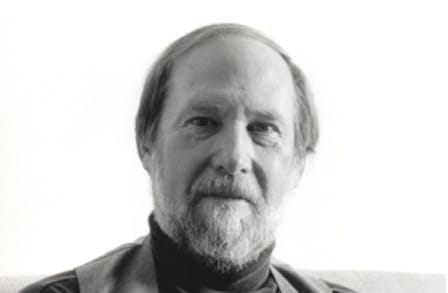
Stephen Dunn
Matt Valentine Poet Stephen Dunn's biography is largely typical of life in post-World War II America: he was raised in the suburbs, attended college, served in the armed forces, played professional sports, and worked in advertising, all before attending Syracuse to study writing with Philip Booth, Donald Justice, and W. D. Snodgrass. As a result, Dunn writes poetry that reflects the social, cultural, psychological, and philosophical territory of the American middle class; his poems are considered intelligent and given neither to postmodern pessimism nor contemporary experimental excess. In his lyrical poems, Dunn is often his own protagonist, narrating the regular episodes of his growth both as an individual and as part of a married couple. His poetry is concerned with the anxieties, fears, joys, and problems of how to co-exist in the world with all those who are part of our daily lives.
Dunn's poems, remarked David Baker in a review of the collection Loosestrife for Poetry magazine, are of a type "which, by lesser poets, often shakes me with tedium these days: plain-spoken, in an easy-going method of personal anecdote, homely in its formal strategies, wistful in tone. His strategies may seem initially easy to imitate. How many pale emulators are there, whose work says little more than 'Hey, I'm a guy, I understand sports, not women, and I have feelings too'?" Unlike them, however, Dunn "is wonderful at what he does," Baker commented, adding that the poet uses "powerful and astute ironies," bringing reports "from the nearly paralyzed districts of American suburbia and middle-age."
When Looking for Holes in the Ceiling was published in 1974, Robert Wilson praised it in New Letters as a "crash course in survival" and as "poems which strike a blow for life" in the midst of the prevailing confessional tone and suicidal themes of the time, prevalent in the poetry of such writers as Sylvia Plath, Anne Sexton, and John Berryman. Dunn does not provide "ready-made answers" for those "seeking survival in comfortable images," Wilson pointed out, but offers, through the "vitality of poetry," the insight that life can be positive despite the concerns, doubts, and ruminations that are a part of existence. According to Wilson, Looking for Holes in the Ceiling displays Dunn's spare style, evocative imagery, and conversational voice, which have been compared to the kind of plain, common-sense American dialect advocated by American poet William Carlos Williams.
In Full of Lust and Good Usage, Dunn continues his direct and personal poetry in what Cheryl Walker in Parnassus called "a man's book" that is written with a "certain sense of ease," showing he is on "good terms with the universe." One dominant motif in this book is familial relationships. Ronald Wallace, writing in Chowder Review, also saw "the stuff of everyday life: small towns, houses, sidewalks, landlords, truck stops." Full of Lust and Good Usage is, said Wallace, "a good book, distinguished by [Dunn's] lean, honed lines, and the articulate music of his voice."
Dunn followed Full of Lust and Good Usage with A Circus of Needs. Peter Stitt, writing in Georgia Review, found the collection to be "especially pleasing for the steady progress it shows in Dunn's career." In addition to the typical "poems that sound almost like parables," Stitt praised Dunn for poems that present "the mundane, the real world in which we live, work, and suffer." Stephen Yenser in the Yale Review called Dunn "a remarkably resourceful poet" who writes "explicitly personal poems . . . ranging from the chiefly anecdotal to the chiefly meditative." These poems were characterized by Dave Smith in American Poetry Review as peopled by "figures . . . bound into the archetype of the gambler. They are diverse, tight-rope walkers, adventurers, acolytes, and always lovers." With this collection, "rich with paradox and passion," Smith noted that Dunn "has become a philosophical poet of weight."
Dunn's next offering, Work and Love, received mixed critical responses. While Robert Shaw, writing in Poetry, found that the book contained "poems which are more often mildly likeable than they are moving or memorable," a critic for the Virginia Quarterly Review termed the book "surely . . . Dunn's finest," and praised the book for exploring how people are defined and affected by their jobs. Dunn called the poems in this volume "poems in his own voice," which continue his examination of male-female relationships and other familial themes typical of his earlier work.
Local Time, chosen for the National Poetry Series by Dave Smith, presents Dunn, according to Andy Brumer in New York Times Book Review, as "everybody's friendly neighbor. He is what mothers want their sons to be. He is good, and his obsession with moral and ethical propriety both distinguishes his poetry and slightly alienates those . . . who cannot quite resolve problems with gentleness and understanding." This book continues to explore Dunn's motif of the modern marriage: how a marriage grows, and how couples grow together. Dunn also explores other contemporary (often suburban) concerns such as safety; the same person who has been mugged in "Round Trip" considers, in "Local Time," how "The house had double locks / but in the dark a wrong person / would understand: the windows / were made of glass." It is poems like these that led J. P. White in Poetry to write that Local Time offers "language . . . [that] is always accessible and friendly" as well as a "moral quest—a desire to test limits and walk hard edges—that [is] inviting and authentic."
Steve Kronen in Kenyon Review wrote that Between Angels "seems a culmination of Dunn's powers, wise in its insights, exquisitely modulated in its execution," developing the themes of "our human vulnerability and our quiet everyday tenacity, perhaps courage, in the face of those vulnerabilities." The book includes considerations of ten eternal verities, with poems entitled "Loneliness," "Sadness," "Happiness," "Cleanliness," and "Sweetness." The title poem continues the common Dunn themes of middle-class life and loving. Stephen Dobyns in the New York Times Book Review described this as a collection of poems in which "clarity is a virtue and strongly felt emotion is a reason for being," and Alfred Corn, in Poetry, commended Dunn for being "a poet primarily personal and, in a valuable sense, realistic," a writer who "has the rare gift of seeming trustworthy."
Landscape at the End of the Century is written in three sections, the first of which, according to Steven Cramer in Poetry, "grapples with what it means to be a citizen—of a family, of a neighborhood, of a nation." In the second section, Dunn's focus is on domestic subjects: the politics of communications between men and women, elegies to adolescence, and what Cramer identified as "the routine mysteries of marriage." Section three is a fourteen-page work entitled "Loves," an inventory of loving, luck, risk, intimacy, integrity, jazz, spontaneity, and inexhaustibility. Cramer praised the entire work, noting that "few poets write as unaffectedly about our middle class impulses to be decent—at times heroic—and our countervailing slippages toward apathy or self-interest."
Walking Light: Essays and Memoirs is an assortment of essays addressed to the literary establishment about the craft of poetry and other topics. He followed the memoir with New and Selected Poems: 1974-1994. Anthony Libby, writing about the collection in the New York Times Book Review, noted that Dunn "is the American male as sensitive guy, full of love for women and the exquisite world." David Wojahn, in Poetry, called Dunn "one of our most prolific and consistent poets," who is "level-headed, witty, conversational in his diction, and willing to see in domestic life his means of attaining and imparting wisdom." The book opens with several new works, including "The Snowmass Cycle," a sequence of eight meditative poems which Judith Kitchen in Georgia Review identified as "written in self-imposed solitude." The poems in this collection, however, "give a clear retrospective," Kitchen wrote, that allows "individual pieces to stand out." Deeming the poet a "spokesperson for the suburban middle class," Kitchen concluded that Dunn "continues to remind us that there is dignity in the mundane."
Loosestrife, in the opinion of Poetry contributor David Baker, is "darker" than Dunn's other collections. Baker noted that loosestrife is a flowering plant that overruns other vegetation in its path, and its invasiveness relates to the themes of the poems: "Dunn's terror is of a similar invasion into privacy and coherence." These themes are played out in poems with subjects as diverse as burglarized homes and inquiries into a lover's private thoughts. Dunn's next volume, Riffs & Reciprocities: Prose Pairs, represents another kind of departure. In this book he writes prose poems on pairs of topics, some of which seem closely related—frivolity and seriousness, democracy and rights, suicides and funerals—and others that require more of a stretch, such as passion and paradox or indifference and anonymity. "Dunn's metaphysical improvisations offer personalized, operational definitions of the concepts that circumscribe our lives," commented Fred Muratori in Library Journal. And a Publishers Weekly critic remarked, "To say this is a highly entertaining book is not to diminish its poetic value."
Different Hours, the collection for which Dunn won the Pulitzer Prize, finds him writing the type of poetry most associated with him—observational, in unadorned language, dealing with various facets of everyday life, such as dining out, playing pickup basketball, aging, remembering one's youth. To a Publishers Weekly reviewer, Dunn's work in Different Hours was "predictable" and sometimes even "stale," with turns of phrase like "the chosen gloomy beauty of a tourist town" and "it's tempting to believe / we lived in simpler times." G. E. Murray, however, writing in Southern Review, thought that "Dunn's conversational style" was "no doubt hard-earned but in its effect so casual, apropos and compelling that it quietly surrounds the reader with recognitions that both inform and surprise." Dunn offers "graceful, fearless insights" into life, finding "joy in despair, high hopes in the face of defeat," Murray maintained, concluding, "Balancing a wry and altogether individual sensibility with and against an unobtrusive technical control, his latest collection is full of cautious smiles, acquaintance with disappointment, and, as always, a delightfully taut lyricism. Dunn is a force to be embraced." After winning the Pulitzer, Dunn told Kelly Heyboer, a reporter for the Newark, New Jersey, Star-Ledger, that Different Hours "is a book that I do believe is my best. Among other things it has taken on aging and mortality in a way that my other books have not."
Career
Williamsport Billies, Williamsport, PA, professional basketball player, 1962-63; National Biscuit Co., New York, NY, copywriter, 1963-66; Ziff-Davis Publishing Co., New York, NY, assistant editor, 1967-68; Southwestern State University, Marshall, MN, assistant professor of creative writing, 1970-73; Syracuse University, Syracuse, NY, lecturer in poetry, 1973-74; Richard Stockton College, Pomona, NJ, professor of creative writing, 1974—. Visiting professor, University of Washington, 1980; adjunct professor, Columbia University, 1983-87, University of Michigan, 2000. Director of Associated Writing Programs Poetry Series, 1980-82.
Bibliography
POETRY
- Five Impersonations, Ox Head Press (Marsall, MN), 1971.
- Looking for Holes in the Ceiling, University of Massachusetts Press (Amherst, MA), 1974.
- Full of Lust and Good Usage, Carnegie-Mellon University Press (Pittsburgh, PA), 1976.
- A Circus of Needs, Carnegie-Mellon University Press (Pittsburgh, PA), 1978.
- Work and Love, Carnegie-Mellon University Press (Pittsburgh, PA), 1981.
- Not Dancing, Carnegie-Mellon University Press (Pittsburgh, PA), 1984.
- Local Time, Quill/Morrow (New York, NY), 1986.
- Between Angels, Norton (New York, NY), 1989.
- Landscape at the End of the Century, Norton (New York, NY), 1991.
- New and Selected Poems: 1974-1994, Norton (New York, NY), 1994.
- Loosestrife, Norton (New York, NY), 1996.
- Riffs & Reciprocities: Prose Pairs, Norton (New York, NY), 1998.
- Different Hours, Norton (New York, NY), 2000.
- Everything Else in the World, Norton (New York, NY), 2006.
SOUND RECORDINGS
- Stephen Dunn, New Letters (Kansas City, MO), 1980.
- Stephen Dunn Reads His Poetry and Is Interviewed by Grace Cavalieri, recorded at the Library of Congress, Washington, DC, for broadcast on "The Poet and the Poem" radio program, 1994.
- Marilyn Nelson Waniek and Stephen Dunn Reading Their Poems, sponsored by the Gertrude Clarke Whittall Poetry and Literature Fund, Library of Congress (Washington, DC), 1994.
- Riffs & Reciprocities: Prose Pairs, Norton (New York, NY), 1998.
OTHER
- Walking Light: Essays and Memoirs (autobiography), Norton (New York, NY), 1993, revised edition, BOA Editions (Rochester, NY), 2001.
- (Author of foreword) Juanita Tobin, Ransom Street Quartet: Poems and Stories, Parkway (Boone, NC), 1995.
Contributor to literary journals, including American Poetry Review, Antaeus, Boulevard, Georgia Review, Paris Review, Poetry, Virginia Quarterly Review, and others.
Further Reading
PERIODICALS
- American Book Review, September-October, 1982, p. 16; June, 1991, p. 31.
- American Poetry Review, June, 1979, pp. 29-33; March, 1987, p. 22.
- Bloomsbury Review, November, 1993, p. 13.
- Booklist, February 1, 1982, p. 694; June, 1986, p. 1430; May 1, 1989, p. 1506; April 15, 1991, p. 1616; May 1, 1994, p. 1577.
- British Book News, January, 1985, p. 25.
- Chowder Review, 1977, pp. 74-76; spring-summer, 1979, pp. 41-45.
- Georgia Review, fall, 1977, pp. 764-766; fall, 1979, pp. 699-706; fall, 1989, p. 589; fall, 1991, p. 601; summer, 1995, p. 509-511.
- Hudson Review, summer, 1979, pp. 252-268; winter, 1984, p. 657; autumn, 1986, p. 503.
- Kenyon Review, spring, 1991, pp. 161-168.
- Library Journal, March 1, 1986, p. 98; May 1, 1989, p. 80; March 15, 1991, p. 93; April 1, 1993, p. 98; March 1, 1994, p. 90; May 15, 1998, Fred Muratori, review of Riffs & Reciprocities: Prose Pairs, p. 88.
- Los Angeles Times Book Review, May 11, 1986, p. 1.
- Missouri Review, spring, 1991, p. 130.
- New England Review, spring, 1985, p. 147.
- New Letters, June, 1975, pp. 103-107.
- New Republic, June 2, 1986, p. 39.
- New York Review of Books, October 23, 1986, p. 47.
- New York Times Book Review, July 6, 1986, p. 23; January 28, 1990, p. 26; January 15, 1995, p. 15; February 12, 1995, p. 39.
- North American Review, March, 1985, p. 65.
- Parnassus, fall-winter, 1977, pp. 198-207.
- Poetry, December, 1982, pp. 170-181; December, 1986, pp. 171-172; January, 1990, pp. 289-291; November, 1991, p. 111-116; January, 1995, p. 219-224; December, 1999, Bruce F. Murphy, review of Riffs & Reciprocities, p. 145; August, 1997, David Baker, review of Loosestrife, p. 288.
- Publishers Weekly, January 31, 1986, p. 362; March 3, 1989, p. 94; March 23, 1990, p. 74; February 22, 1991, p. 206; March 29, 1993, p. 42; March 28, 1994, p. 88; March 30, 1998, review of Riffs & Reciprocities, p. 78; November 20, 2000, review of Different Hours, p. 66.
- Sewanee Review, April, 1994, pp. 3637.
- Southern Review, winter, 1994, p. 165; spring, 2001, G. E. Murphy, "The Collective Unconscious," p. 404.
- Star-Ledger (Newark, NJ), April 17, 2001, Kelly Heyboer, "For a Poet and a Biographer, the Word is Elation," p. 10; April 22, 2001, Deborah Jerome-Cohen, "Prize Writers: Stephen Dunn," p. 1.
- Times Literary Supplement, January 11, 1985, p. 35.
- Virginia Quarterly Review, autumn, 1982, p. 135; autumn, 1986, p. 134; autumn, 1989, p. 13; autumn, 1994, p. 133.
- Western Humanities Review, summer, 1985, pp. 162-164.
- Yale Review, summer, 1979, pp. 557-577.
Discover this poet’s context and related poetry, articles, and media.
Poems By STEPHEN DUNN
Poet Categorization
LIFE SPAN 1939–
If you disagree with this poet's categorization, make a suggestion.


Dismantling the House