
Harriet

Annie Finch

Face Forward: The Poets House Annual Showcase of Poetry Books

For a poet, in April, in New York, there’s a lot going on!  One of the most exciting National Poetry Month events held every year is the Poets House Annual Showcase of the year’s poetry books.  It’s an astonishing event. This year, at the 17th annual showcase, 2,400 books of poetry are displayed at the Jefferson Market Library on 6th Avenue near 10th Street.
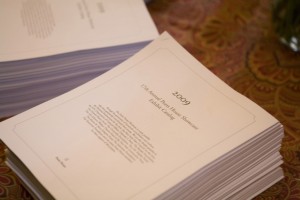
phshowcase-09-catalogue

The 2009 Annual Showcase Catalog

Walking through the display, one notices a lot of excitement, a definite buzz. “I mean, you could spend weeks here!”  “I want the collected poems of Eavan Boland!” “Wow, they got a good turnout!”

phshowcase-09-more-visitors-crowd

Poets and Guests at the Poets House Annual Showcase

Poets House director Lee Briccetti says the event is very important to poets.  “This is the one place poets can have their books displayed face forward; that never happens in a bookstore.  Libraries come to look at the annual harvest.  There’s no other place you can see it.”  The Showcase is a unique moment, the only time that poetry books are organized by publisher without other books mixed in, as they would be at a bookfair. The catalog alone, organized by publishers and indexed by poet at the back, is a great resource (and as Lee points out, the names of the publishers alone can sound like a poem!). It goes online with annotations, on a website that Poets House says is accessed by one million people, and provides a permanent record of the year’s poetry publishing, a kind of time capsule.
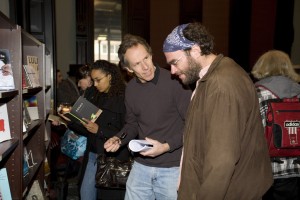
phshowcase-09-wave-books-ed-joshua-beckman

Wave Books publisher Charlie Wright with Wave Books editor and poet Joshua Beckman

Staff at Poets House say that poets always ask them about the Showcase; it is something of a signature event.  Poets (among this year’s opening-day attendees are Joshua Beckman, Serge Gavronsky, Suzanne Grinnell, Hettie Jones, Chelsea Minnis, Stephen Sandy, and Stephanie Strickland) have come from as far away as Arizona, Colorado, Seattle, or Vermont to be at the opening.  Some people treat it as a reunion and meet here every year.  And it attracts poets from all aesthetic perspectives.  Lee Briccetti sums it up:  it’s “a book party for the whole field.”

This year, I’m one of the poets making the trek. I’ve seen the showcase before (it used to be on display for a month in the old Poets House; for the past few years at Jefferson Market, while a new Poets House is being built, it has lasted only a week), but this the first showcase opening reception I’ve attended. And I’m going to meet a new book of my own here, seeing it for the first time:  the Dusie Kollektiv chapbook Shadow-Bird, produced by the highly talented poet, publisher, and designer Anna Moschovakis of Ugly Duckling Presse just in time to submit for today’s event.  I’m very excited—maybe not just as excited as a first-time author, but still very excited, and I am reassured by Poets House staff that this is not unusual. According to Mike Romanos, organizer of this year’s showcase, “People take pictures in front of their books.  It’s a really big deal for them to see their books.  Even the bigger name poets, they really take pride in it!”

phshowcase-09-stephanie-strickland

Stephanie Strickland

I ask Mike and Jane Preston—the person who helped Lee Briccetti get the showcase off the ground and ran it for the first five years—whether they think the popularity of the showcase reflects poets’ desire for readers, or whether there is something else at work. The answer is adamant:  “no, it’s not that they want readers. It’s that they want to be here with the others.  They always say, “I’m so glad my book is here at Poets House.”” Jane sums it up with a metaphor: “It’s about being part of the community, the fabric. It’s wonderful for us to create that fabric—to be the loom.”

Even on my expectant way over to the D shelf, I can’t help being woven into this vast loom of poetry, and I start indulging in some tentative browsing.  I expect I’ll recognize many names and I do; on the very first shelf I encounter a book by a former student, nestled next to Best Gay Poetry 2008 which is perched next to several chapbooks and a CD.  Familiar names don’t have as much impact in the spiralling chaos of juxtapositions that is one of the hallmarks of this alphabetically-arranged exhibit.  For some reason, the fact that it is publishers being alphabetized rather than poets seems to emphasize the clashes even more.  So Harry Abrams, publisher of the Academy of American Poets’ mega-seller anthology A Poem in Your Pocket, shares a shelf with Richard Herd, publisher of three broadsides of his own work, and Harvard University Press, publisher of a new edition of Boethius’ Consolations of Philosophy, and Hollowdeck Press, publisher of one volume by Lisa Berman.
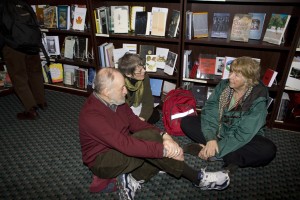
phshowcase-09-floor-sitters

After a dozen shelves or so, a kind of ennui sets in.  How could ANYONE ever begin to browse all these books, let alone read them?  And yet, when I look up, I suddenly notice that, everywhere, people are doing just that.  Everywhere people are sitting, standing, squatting, and crouching, completely engrossed in books of poetry:  it’s a browser’s paradise.  And many of the browsers are poets.  Soon enough, I’m approached by someone I’d seen at a reading the night before, who wants to show me her new book from Maverick Duck Press.  The title is Maarchen, which the poet, Susan Maurer, reminds me means “Fairy Tale” in German.  I look at it and admire the beautiful first line of one of the poems.  Before I know it, I am meeting more and more poets.  Patricia Carragon, who runs the monthly Brownstone Poetry Series in Brooklyn Heights and publishes the readers each year in a volume called the Brownstone Poetry Anthology.  Kurt Boone, who works as a bike messenger and tells me he has just been profiled in the New York Times in honor of his new book, On the Subway (Tasora Press).  Holly Rose Diane Shaw, who belongs to a poetry group that meets weekly right here in the Jefferson Library.  “And the heart-shaped book is mine also,” she tells me. “Those are love poems.  This one is called Beyond Blossoms.”  I ask her the name of the publisher.  “It’s self-published.  It doesn’t have a name,” she replies.  I tell her that sometimes people make up a name for their own presses:  “like, maybe, Holly Rose Press.”  “I hadn’t thought of that!  Ok, let’s do that.  We’ve invented it right here!”

phshowcase-09-signer

Book Collector and Poets House Volunteer

At that point, I decide that this wonderful moment in the loom of poetry really needs to be recorded for posterity.  I go over to the Dusie Kollektiv display and pick up Shadow-Bird for the first time. Ugly Duckling Presse has done an astounding job. I am pleased as punch, and I take a copy and pose for a group photo with my new poet-friends, each of us with book clutched proudly, tightly, exuberantly up for the camera.  (Note: since the official photographer had gone, a friend of  self-confessed technophobe Holly Rose took this precious photo. He swore repeatedly that he would email it to me as soon as he got home, but no dice.  There are currently about eight people trying to track that photo down!  Meanwhile, I post here an official Poets House photo of me proudly clutching Shadow-Bird, with an equally and understandably proud Lee Briccetti.)

phshowcase-09-leeanniebetter

P.S.  A Note on Numbers:

The number of books on display at the 2009 Showcase, 2400 books, is double the number it was even ten years ago; one figure I’m given is that poetry publishing has increased 400% since the 1990’s. Eliot Weinberger did some research and estimated there were about 200 books of poetry published a year during the 1940s.  Poets House staff is unsure how much of the increase is due to the much greater number of books being published, and how much is due to the fact that the Showcase is also displaying a much higher percentage of the books published.  Jane Preston says that at the beginning she’d have to sell publishers on the idea, calling them and explaining the whole story.  Now, she and Mike agree that “pretty much everybody says yes.”

Standing among this richness of poetry publication, it’s practically surreal to remember the highly-publicized recent NEA survey showing a precipitous decline in poetry reading.   The staff of Poets House say they don’t find these figures reflected in their experience of the poetry world. Lee explains, “that’s not what we’ve experienced.  Our numbers are going up and up. I think there’s more poetry reading than ever before, but they’re not reading the same things. Poetry operates in a different way than other kinds of books.  It’s informal—there’s more hand to hand distribution.”

And given the remarkable mix of micro and macro publishing documented and preserved at the Poets House Showcase, it does seem clear that poetry today has a vibrant life of its own that may not be entirely detectable by standard measurements but that is, by any measure,  irrepressible, authentic, and utterly necessary.
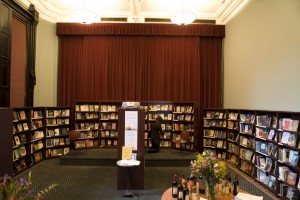
phshowcase-09-before-the-crowd1

Bookmark and Share

15 Comments for “Face Forward: The Poets House Annual Showcase of Poetry Books”

  1. Annie,

    Thanks for this fabulous bit of reportage, and the photos too. 2400 books – that seems like an outlandish figure. I can’t imagine such I thing. Lee Briccetti should receive some sort of decoration. I like how you describe your sudden onset of browser’s block (quickly overcome, it seems). The first thing I do when I return to the states to visit my parents, who live on the coast south of Boston, is to make a trek into Cambridge to Grollier’s (is it still there?…it always seemed on the verge of closing, and I haven’t been to the states for two years). I always get a kind of shock when I walk in, moving from the tables to the shelves, and back to the tables. The closest thing I have like that is The Village Voice, in Paris, not exactly next door to Coimbra! I’ve never understood Portuguese bookstores, since they don’t order things alphabetically (or they might, sometimes by last name, other times by first name) – most often it’s by categories, but categories which are so arcane that even the bookshop employees are flummoxed when you ask them if they have something. Of course I like reading Portuguese (I translate the stuff all day long after all) but I really miss New York bookstores, browsing, windowshopping, the whole bit…browsing in one’s mother tongue….so thanks for this.

    And many congratulations on your new book Shadow-Bird. It looks lovely. Looks hand-stiched…can’t wait to see what’s inside.

    Martin

    Posted By: mearl on April 17, 2009 at 11:15 am
    Report this comment
  2. grolier’s is open–but the homeless bookseller out front in harvard square is packing up.

    Posted By: james stotts on April 17, 2009 at 11:21 am
    Report this comment
  3. how does a poetry community, with anecdotes, figure out that more and more people are reading poetry? these polls that people seem to misunderstand in a lot of ways (they had a huge sample size, and they didn’t track sales or knowledge or enthusiasm, but simply if people had read any poetry at all in a given amount of time) are as hard to dismiss as they are hard to really get worked up about, anyway.

    the real measures–could you find what you wanted (ugly duckling presse always has something i want)?, was the poetry as good as you could hope for?

    Posted By: james stotts on April 17, 2009 at 11:30 am
    Report this comment
  4. Whoa, what a disgraceful shame about the book peddler! That is terrible!

    The Grolier Poetry Bookshop is a much happier story, not only open but apparently very healthy.

    Was the poetry as good as I could hope for. . . Hmmmm . . .When you are talking about a whole year’s worth of poetry publishing, you are asking a very large question. And I guess the only realistic answer when there are 2400 books in the room, from pretty much everyone publishing poetry in the country, is yes, of course, absolutely, the poetry is as good as one could hope for at such an event.

    Because of course, one great thing about this event is that it doesn’t try to be all things to all poets. Its clear and valuable mission is simply to be inclusive without evaluation.

    In fact, the organization by publisher does make it easy to find what you are looking for, to figure out which publishers publish the kind of poetry you want to read. So in a nutshell, if what one is looking for isn’t there, that is in no way the fault of Poets’ House….

    Nothing could or should ever replace the Showcase, but in view of James’ comment, it is interesting to imagine similar, smaller events that would do a more active job of curating the books of poetry for particular tastes.

    Posted By: Annie Finch on April 17, 2009 at 3:45 pm
    Report this comment
  5. Thanks, Annie. And congratulations on Shadow-Bird. I wish I’d had my act together to buy a subscription so I had it now-ish!

    Posted By: Catherine Halley on April 17, 2009 at 5:06 pm
    Report this comment
  6. 2400 poetry books are published every year?
    That’s probably more than the number of poetry books that are BOUGHT in a year!

    Why do we go on?

    Posted By: Gail White on April 20, 2009 at 8:19 am
    Report this comment
  7. Gail,

    Well, we need more critics.

    It’s a simple as that.

    We should form a consortium of The One Hundred Critics. I think universitites could subsidize them, if they pooled their resources.

    Now, these 100 Poetry Critics, known as ‘the one hundred’ and featured on the cover of Time & Newsweek, perhaps, would reintroduce standards again into a dying art.

    All of a sudden 2,400 books does not seem so insurmountable.

    That’s only 24 books per critic, per year.

    24 per year. That’s it.

    There you go. The world of poetry is under control.

    Hell, give me 9 critics and the 10 of us will take care of 2400 books, easily. That’s 240 books per critic. I’m sure I can go through 240 books in an afternoon, or a weekend, let’s say, especially since by reading the first few poems in a book I would get a sense pretty quickly if there was something new and outstanding going on.

    Thomas

    Posted By: thomas brady on April 20, 2009 at 9:05 am
    Report this comment
  8. Great report, Annie. Thanks for the pix.

    Posted By: Jason Guriel on April 20, 2009 at 3:52 pm
    Report this comment
  9. Thanks, Annie, for this report. Although I was unable to attend, it felt good to know that my book was in good company. Lots of company, by the sound of it! And I agree that Poets House’s mission – to be inclusive rather than evaluative – is valuable in and of itself. Let’s let the readers make their own discoveries and discernments. One of the gifts of the showcase seems to be the thrill of discovery – it’s like an intuitive treasure hunt. I like it. Wish I could have been there.

    And congratulations on your latest achievement.

    Best,

    Mari

    Posted By: Mari L'Esperance on April 20, 2009 at 9:26 pm
    Report this comment
  10. ‘inclusive rather than evaluative’ sounds like a social mission at poetry’s expense. there’s a difference (pardon my french) between drowning in a sea of bad poetry, and the ocean in a teacup that a good poem is–a difference between reading poetry ad nauseam, and poetry that can be read ad infinitum.

    true, there’s great poetry that’s beyond most people’s ability to appreciate (we’ve all experienced it), and so a stratification and a diffractive radiation can sometimes spread us thin and gather us up in almost-isolated schools, and not be a bad sign for the state of poetry. but there’s also so much poetry out there, and so much of it bad and unreadable, and along with it a kind of glib, resentful eagerness to accept it all without being judgemental, to evaluate art by every other measure other than it’s aesthetic merit so as not to exclude or denigrate ‘lesser’ writers…well, the idea of so many poetry books could only be exciting if it meant the impossible: so many great poetry books. instead the showcase is all too possible, too successful, and entirely impotent to change people’s minds about poetry for the better (it probably turns more people off, who walk away silently, than it brings anybody in, which is the very definition of any trap’s failure).
    i’m sure i would have liked it, and probably went overboard buying books while i was there, and that a lot of them were probably great.

    Posted By: james stotts on April 21, 2009 at 6:36 am
    Report this comment
  11. Wow James, I think i’d be driven absolutely nuts by the idea of 2400 “great poetry books” published in one year (by great, meaning ones I’d want to read at length and in depth). A little great poetry can go a long way, one book or poem nourishing me for years.

    I do think you would have liked it, and found enough great things there.

    One thing: in the abstract, it’s one thing to talk about “a kind of glib, resentful eagerness to accept it all without being judgmental, to evaluate art by every other measure other than its [excuse me for correcting your apostrophe here] aesthetic merit so as not to exclude or denigrate ‘lesser’ writers.” I have certainly felt that way myself also.

    BUT, when you are actually THERE, and you see not only the books, in all their variety of formats and bindings and covers, and not only that but the POETS, in all their variety of backgrounds and expectations, you see that the world of poetry is so much wider than any of us can possibly encompass, especially those of us with MFA degrees or whatever who might spend a lot of time trying to encompass it or thinking we are encompassing it. In other words, it really is a WORLD, meaning “it takes all kinds,” “live and let live,” etc. etc. etc., and to begin to try to judge it or narrow it down just feels kind of irrelevant, like trying to decide that certain breeds of dogs shouldn’t exist or something. It had that effect on me anyway, in retrospect; seeing what 2400 books looks like made me more aware of the fact that each of us has a place in the scheme of poetry and we don’t really need to worry about the places of others. In retrospect I found it, paradoxically, relaxing.

    Posted By: Annie Finch on April 21, 2009 at 3:59 pm
    Report this comment
  12. it’s not that i mind the place of others, necessarily or consciously, anyway. although, when the inventory is so overwhelming i do sometimes wish that poets would make way for me (we all want our voice to be heard, and sometimes trick ourselves into thinking that that’s the important thing).

    what it is, is the anxiety that something might be happening that we can come to understand by looking at the phenomena, something that i have a feeling is a bad thing. the idea of seeing 2400 poetry books, or 4400, is a figure that’s dwarfed by any good university library or a main library in a major city. and a library has the added benefit of endowing the books with a sense of inheritance (as opposed to taking annual tally), of fostering community beyond marketing and without the intrusion of self-promoting artists.

    if it gets somebody to let go of the pretension that they can encompass it all with its overwhelming display, i guess i agree that’s a good thing–a socratic kind of humility–because of course we can’t really ‘keep our finger’ on american poetry, even if in our prime we can read a thousand pages an hour (i just heard h. bloom claim that capability for himself when he was in thirties; he’s some kind of otherworldly creature!)

    i’m certain i would have loved it. i can’t walk into a bookstore w/o my wife rolling her eyes and asking me to give her my wallet. when i see a book i want, i lose control, and it really is a crime how they (book publishers, bookstores) can coerce me out of $100 the way they do, and for books that i don’t know when i’ll ever be able to read, that might possibly be stolen over the internet, or checked out at the library.

    maybe i’m just jealous.

    Posted By: james stotts on April 21, 2009 at 4:56 pm
    Report this comment
  13. Don’t worry. You’ll be there someday.

    Posted By: Annie Finch on April 21, 2009 at 8:07 pm
    Report this comment
  14. Fun to see you at this event . Thanks for the mention of MAERCHEN and best of luck with your Dusie. Susan Maurer

    Posted By: Susan Maurer on April 23, 2009 at 2:21 pm
    Report this comment

Comments for this post are closed.

CONTRIBUTING WRITERS

Thom Donovan
Bhanu Kapil
Fred Moten
Craig Santos Perez
Sina Queyras
Sotère Torregian

STAFF WRITERS

Cathy Halley
Michael Marcinkowski
Travis Nichols
Fred Sasaki
Don Share

About Harriet

RECENT COMMENTS

  • Yes, I agree, Joshua. I understand that this is a big motivating factor for poets ... MORE »
    Sina Queyras | 03.19.10
  • One big reason to have a "career" here in the U.S. is health insurance. ... MORE »
    Joshua | 03.19.10
  • Thank you Henry. MORE »
    SherylLuna | 03.19.10
  • "there are many ways to be in the academy outside of teaching creative writing" So true. ... MORE »
    Brenda Schmidt | 03.19.10
  • Glad to be of help with your career - MORE »
    Henry Gould | 03.19.10

To Sonnet, to Son-net, Tuscon Net (55)
All sides now: a correspondence with Lisa... (4)
Who or what is a poet critic and why is the... (27)
Graphic Poetry Spotlight: Jai Arun Ravine’s... (3)
Beyond Careerism? (Redistributing Poetic... (30)

RECENT POSTS

MONTHLY ARCHIVE

CATEGORY ARCHIVE

PREVIOUS WRITERS

Subscribe to the RSS feed.
What is RSS?

IN THIS ISSUE: March 2010

Poetry Magazine

A selection of new work from Dorothea Grossman; new poems by Lavinia Greenlaw, David Yezzi, A.E. Stallings, Gerald Stern, and Dan Gerber; translations of Carlo Betocchi, and Mahmoud Darwish; an Editorial on Ruth Lilly; an exchange between Ilya Kaminsky and Adam Kirsch; an essay by Chen Li; and a review by Daisy Fried.

CHICAGO EVENTS

Poetry Off the Shelf: David Baker

Poetry Off the Shelf: David Baker Fri, March 26th, 6:00 PM
Open Books
213 West Institute Place
Free admission

MORE EVENTS »