
Among the gems in my late father’s library is a book published in 1923 under the title Parodies On Walt Whitman, published by American Library Service with a preface by Christopher Morley.
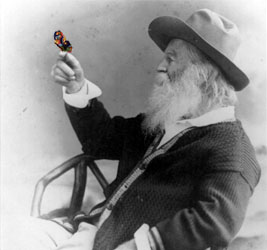
Chronologically arranged and covering a sixty five-year period starting in 1857, it’s a fascinating book from literary-historical, sociological, and psychological perspectives, not to mention its entertainment value, and it raises all kinds of questions:
Which kinds of poets are most open to parodies? Are ego and ambition a necesary requirement? Were the Whitman parodies funnier at the turn of the twentieth century, when he posed a threat to established poetics, than they are now? Is there any contemporary poet who could attract and sustain an entire book of parodies (Jorie Graham? Seamus Heaney? Charles Bernstein? It’s hard to imagine). Is openness to parody any sign of greatness? And, last but not least, is it true that, as Morley claims in his tactful preface, “Walt, who would seem to be the broadest target ever offered to the jester, comes off the field without even a smell of scorching on his garments”?
Some excerpts:
From “I Am Walt Whitman,” Anonymous (1868)
I am Walt Whitman.
You are an idiot.
O intellectual ingurtilations of creeds!
To such I am antiseptic.
I met a man.
Where?
In a gutter. We were at once friends.
O homogeneities of contemporaneous antiloxodromachy!
From “Covent Garden Market,” Julian Sturgis (1884)
Covent Garden Market.
Onions, potatoes, carrots, turnips, parsnips, asparagus French and English
(O bon jour, French asparagus, my brother!)Good vegetables and bad musty vegetables!
Good sellers and bad musty sellers!
I devour the bad musty vegetables.
O bouquets for misses, and for opera girls!
Empty wagons and full wagons, empty baskets and full baskets, empty people and full people!
O Covent Garden Market!
O dirt and smell and slime indescribable! I describe you all, I love you all, I wallow in you all, I too, am a vegetable. I am likewise an animal and an angel.
Cool and sweet is the dewy grass, and the shore of the sea. Cool and sweet is the crowded London street.
I strip myself naked in the grass, on the shore of the sea, in the crowded street. I am free and naked; the policemen run me in,
Them also do I call brothers!
From “After Walt Whitman,” Richard Grant White (1884)
O eternal circles, O squares, O triangles, O hypotenuses, O centres, circumferences, diameters, radiuses, arcs, sines, co-sines, tangents, parallelograms and parallelopipedons! O pipes that are not parallel, furnace pipes, sewer pipes, meerschaum pipes, briar-wood pipes, clay pipes! O matches, O fire, and coal-scuttle, and shovel, and tongs, and fender, and ashes, and dust, and dirt! O everything! O nothing!
O myself! O yourself!
O my eye!


There’s so much self-parody around that maybe parody has become redundant? Just kidding.
For additional reading:
The Brand-X Anthology of Poetry by William Zaranka
Martin Gardner’s Favorite Poetic Parodies
The Faber Book of Parodies
Parodies: An Anthology from Chaucer to Beerbohm – and After, by Dwight MacDonald
& the granddaddy of them all -
The Stuffed Owl: An Anthology of Bad Verse, by D.B. Wyndham Lewis
You may have a point there, Don. Irony has been a dominant poetic mode for so many decades now.
Thanks for the good bibliography. As a fan of the Stuffed Owl and Brand X, I’m very glad you’ve added it.
Thanks Annie.
Some of this made me laugh out loud, and I hope Whitman would have laughed at some of it too.
The Penguin Book of Imagist Poetry (ed. Peter Jones) has a few parodies by anon. Here’s one, “Epigram (after the Cretan)”, from 1921:
Little Caligula
Has tied one golden sandal
Around her pink ankle
Too tightly.
Heu! The discomfort,
The varicose veins . . .
Silver dust falls
Over the tepidarium . . .
Hoaxes have usually been better than outright parodies: see: “Spectra” for example. Great Post, Whitman had it comin’ (if he really did think he was the voice of the universe and all generations)
etc………
hahahahaha
LOL
The New Critics were a maddening bunch.
Cleanth Brooks claimed that:
“…in a succesful work, form and content cannot be separated.”
But we know that ’successful’ works can be parodied. To parody a work, form and content ARE separated; this is, in fact, how parodies operate; we take a famous work, keep the form, and add new content, thus quite easily doing what Brooks says CANNOT be done in a successful work.
Either Brooks is wrong, or any work that can be parodied is NOT successful.
Cleanth Brooks also wrote:
“…Form is meaning.”
Parodies prove that this is so. You cannot *parody* a work, and in the process *destroy its meaning,* unless you copy its *form.*
My feeling is that there is no masterpiece that cannot be parodied.
If my hunch is correct, the first statement above by Brooks is false, but the second statement by Brooks is true.
I think the main thing about parody is it has to be recognizable to work, thus the poet being parodied has to have a brand-name of a style that the parodist can immitate pitch-perfectly. (Kenneth Koch was the most brilliant parodist in recent memory… for instance of WCW and Frost.) So I don’t think it is about greatness or lack thereof. Billy Collins seems susceptible to parody–or at least I have seen a few BC parodies around–although don’t know if there is enough for an anthology! If there is a general lack of parody fodder it is perhaps because so many poets sound like each other. It might be easier to parody a “school” perhaps–a general New Formalist or Flarfist or Elliptical…
I think that parodies work best when aimed at sacred cows. The more sacred, the greater the likelihood the parody will have some legs. A parody of Seamus Heaney or Gwendolyn Brooks or even Sylvia Plath (The Sylvia Plath Cookbook: Fresh From the Oven) provides many more opportunities at parody. Billy Collins doesn‘t appear to take himself all that seriously so a parody of his work has somewhat limited appeal. For that matter, a parody of Garrison Keillor and Mother Theresa have loads of potential.
Very interesting thoughts, all. The idea that parody separates form from meaning, and the idea that a poet needs a distinctively noticeable style (ie form) to be truly parody-able seem to complement each other. And perhaps, poets with very distinctive styles are more likely to take themselves very seriously, thus making themselves “broad targets,” as Morley puts it.
What about Ashbery, though? He is both distinctive–one can recognize his style a mile off–and a sacred cow. But I haven’t seen anyone parodying him. Is it because people have been too busy imitating him for real?
I’ve never thought of style and form as synonyms. Style seems to be the operable concept here.
I’ve seen Ashbery parodies.
You begin by saying something quotidian, or, better,
banal, almost. A stale breeze blows open the screen
door, making somewhat strange. You’re not sure
what it is. A flat tone to be embraced like a sausage
casing, the bent windows fluttering, you skedaddle. The
breeze decides to stick around
of roses, sit down and have a drink. A long cool one,
natch. The refreshment is pale, scrubbed,
scrutable. Don’t forget to tip the server, placid
like a cow. Simile is like the blind guitarist who
plays everything by ear, like the drift of ice floe
“across” the Arctic, like a mummy. Blameless.
John,
I haven’t thought of form and style as synonyms either, but presumably, for the Cleanth Brooks quotation on form and meaning to be useful in this discussion, we need to think that by form he meant a group of stylistic choices.
Is this your own Ashbery parody?
I think the operative focus in an Ashbery parody should be that you are talking to someone about a place you’ve been to together and not really care if anyone overhears your conversation.
Mirrored Portrait of a Convexed Self
Convex Portrait in a Mirrored Self
Convex Self in a Portrait Mirror
Ashbery is, among other things, a comic poet – something better understood in the UK than in the US. I wonder how far one would get parodying a comic poet.
John,
That Ashbery ‘parody’ sounds EXACTLY like an Ashbery poem.
Is it true that Ashbery poems have no formal qualities, and therefore they are parody-proof?
Does this mean Ashbery poems are not literature and Ashbery is one gigantic hoax?
Or, is there a genius out there who CAN parody an Ashbery poem, and thus restore Ashbery’s literary reputation?
Thomas
If it’s a gigantic hoax, it’s a beautiful one. I hope for more.
Are we saying, then, that vulnerability to parody is the sine qua non for “literature?”
Hmmm. I always thought John Ashbery WAS a parody…of poetry.
I think poets with a certain vision are ripe for parody, especially when the parodist takes this vision to far. Geoffrey Hill would be a good target because there are so many things you would never think of him talking about. Ashbery? He’ll talk about anything, so he’s not so ripe. Also Penguin has been including parodies in it’s anthologies recently and I think this is a good thing.
John Crowe Ransom’s marvelous essay, “Poets Without Laurels” (1937) may hold the answer to the Ashbery question.
Ransom does a brilliant job, I think, of explaining modernism as the march of ‘purism’ or ‘puritanism’ through every Western institution; religion, for instance, since the Reformation, sheds its formal, material aspects, its trappings, until it reaches the purity of the Quaker or the Unitarian, where the *invisible essence* in one’s heart or in one’s actions replaces the pomp and circumstance of old religion.
With Ashbery the old, formal aspects of poetry completely disappear. Materially, Ashbery isn’t poetry.
Ashbery is poetry reduced to its invisible essence.
Or, modernist, purist, evolving attempt to do so, anyway.
You know, we actually contemplated a “parody issue” of the magazine. That contemplation quickly became painful.
I’m surprised that a fan of Poe would disparage Ashbery, though. And I’m not sure I’d characterize Ashbery as a modernist, though Brooks wouldn’t have liked him, I grant you!
Geoffrey Hill has a poem dedicated to Jimi Hendrix.
PARODY OF GENERIC AMERICAN POEM
The dead geraniums in the gutter, O my people
Torqued and variably-bladed unto cosmic tomorrows…
So have lettuce with your peanut butter, Jim -
That’s how we remember you, as you lay there
Very white and pretty defunct, next to Grant’s Tomb
Where we ate lunch with Lois Lane listening to divine
Lana on the radio, back in the glory days of Honda -
Remember? The derelict stars over San Francisco,
The great blasted Unicorn Tree outside Reno, Nevada,
Near the truck stop, where truckers stop, stopping their
Trucks to take a great American…
And the howl of the rabid coyote we heard that night,
When we were teenagers, near the junction of Route 40 &
Louisville Turnpike… yes, Jim – we won’t forget -
The dazzle of the precession of the Eunuchs over D.C.,
The ravine where we through the last of the sprinkle
Donuts! Pass that coffin, please, Herman! It’s
Getting Late!
Ransom felt the modern poet was asserting *pure aesthetics* against the old obligation to mix morals with aesthetics, and the modern example he cites is Wallace Stevens.
The moderns, of course, were made uneasy by the Romantics, and sought to distance themselves from them whenever they could. (Eliot and his friend Pound were infamous for hating on the Romantics.)
Ransom starts with Stevens, but what about “To Autumn” by Keats? Keats and the Romantics had already begun the Modernist quest to chuck moralizing from poetry. Ransom follows the modernist tendency to simply ignore the Romantics. They had to be thought of as ‘not modern.’
But “To Autumn” could be parodied, for it has form (beauty).
Ashbery goes further than Keats, or Stevens, by chucking not only morals, but aesthetics (form).
Ransom (and others) saw this as a natural evolution.
‘Beautiful prose without meaning’ is the *essence* of poetry, in terms of what Ransom anticipated in his 1937 essay (Ransom was also aware of/anticipated the lack of popular acclaim, the public disdain, of modern poetry) and what had already been seen in abstract art (’beautiful shapes/colors without meaning’).
Surely, Ashbery knew exactly what he was doing. He didn’t ‘luck’ into his ’style.’
But is ‘purist’ evolution a mere cult of style?
Or is this ‘purist’ evolution the true essence of art?
And, finally is this ‘evolution’ a running away from parody? Is that, beneath it all, the prime motivation?
Answer to your last question: no. Then again, being modern, sort of, I prefer parody to moralizing, though parody is a form of moralizing, now that I think about it.
Anyway, Ashbery’s work has “form,” and it’s silly to say it doesn’t. But why is John Ashbery always a lightning rod for everything? I’ve never understood this. Nobody has to like his poems; if one does, one doesn’t, presumably, have to defend liking them.
Me, I like Ashbery, Poe, Brooks, Hill, and everone else named in this thread. And I enjoy parodies, too, which is why I made a list of anthologies of them.
Henry: As a madman shakes a dead geranium… you rock!
Annie, when I sat down to comment, I thought I remembered having seen other Ashbery parodies, but then I couldn’t find any and posted my own, which began as a self-descriptive homage, and isn’t very funny or particularly good. I saw your comment but didn’t have time to reply until now, where I see Don has said what I had wanted to say — that Ashbery is a comic poet already, and tough to parody. Could one parody Ogden Nash? (John Hollander wrote an homage to Nash in “Rhyme’s Reason,” but it’s not really a parody.)
Were I to attempt another, I would focus more on Ashbery’s heralded juggling of lingos from the different social brows, which he then flattens into the same monochromatic murmur. Also on his habitual use of the antecedentless “it.” And maybe throw in a reference to European art history and 1940s pop culture.
John Ashbery
You came riding out of the sunset over the horizon,
deftly juggling lingos like an acrobatic stoic
encyclopaedist. The midsummer beer bash was going
full swing. The crickets hummed a familiar tune
out of Pergolesi. The aria of digestion
complicated by yeast and fermentation, it hoped
to get a rise but was wobbly. Someone left
the Marvel Comics collection out in the weather,
everything fades to have been something someone
else forgot and you never even heard of,
only half-overheard phonemes. The
phone rings and rings, voice mail is down,
nothing so vulgar as a direct quotation,
it wouldn’t be, it couldn’t be, it isn’t.
One wants to tut-tut but mustn’t.
Whether it ever was is something for the
editorialists, who need it. Sit down and have
a beefsteak, medium rare.
I think I introduced the topic of Ashbery because he has so much self-consciousness built in to his style that I wondered if that might parody-proof him. Apparently not!
Henry, while I was writing mine, you did it! (I was hoping you would!)
I got the aversion to moralizing in mine while Don and Thomas were discussing that too — I hurry to say so it doesn’t look like I was copying their thoughts on purpose!
Funny!
Ashbery is the lightning rod because he’s got the biggest rep.
To say that Ashbery’s poetry lacks either form (! this master of the double sestina!) or meaning is simply, & always, to indicate that you haven’t read much Ashbery, & what little you’ve read you’ve read carelessly.
And I also mentioned Ashbery because he is one of those poets who, as Alicia put it, has a recognizable style.
John, this one of yours really works I think. But am I alone in thinking that, while skillful and effective, it’s not hahaha “funny” to the extent that the Whitman ones are? I’m guessing that has more to do with the difference between Ashbery and Whitman than it does with your poem. Just as it’s funnier in the movies when the rich humorless businessperson slips on the banana peel than when a working person does, isn’t a parody funnier when the parodied poet’s style is not only recognizable, but also unself-conscious?
I would think the whole point of dong a parody is having someone else doing it. A parody issue of Poetry by the editors would be less parody than self-indulgent.
In other words, when the original has, as it were, farther to fall?
I’d love to see a parody issue of Poetry. Hey, I even have a parody of Robert Bly that’s been waiting 30 years to be submitted for that issue.
Whitman was self-conscious, but he lacked irony. Ashbery’s irony is built in; I sometimes think that he could have been the great late-20th century Romantic, but he stages his gorgeous purple passages (which the reviewers single out) in deflationary contexts. (Going by the stuff I’ve read, several dozen poems, only a small fraction of his enormous production, but the commentators point out his continuity of style too.)
Oh no, John – mine was a self-parody. I could never do Ashbery. The internal frame of the hermetic framing superstructure – I mean Ashbery’s brilliant multivalence & double-triple-tongue-in-quadruple-cheek – it is strictly inimitable. As we were saying, when evening comes, the durable plane trees will have their moment; and it is as it was before, when you were young, and the new spirit, or should I say sensibility, or sense, stirred somewhere, somehow – in the back of your mind, maybe, like that park near Neuilly (or was it upstate, Rensellaerville) and the summers lasted as if they were made of bronze; it was when the turmoil of the new century was brimming over with air flights and package tours; and it is as if the jonquils no longer shift & waft that emulsion of terror and joy we once felt, in those days, under the crotchety elms which I meantioned earlier; it’s like those times of early college dyas, when planets – Venus, or Mars – seem to hover closer to the earth, and the one you admired from afar walks a little more approximately close, and her hand lingers on your shoulder, your shoulder which feels like a smaller extension of that elm, which we mentioned earlier…
Go Henry go!
Jack, it wouldn’t have been a parody issue featuring parodies by the editors. We were contemplating a garden-variety parody issue, that’s all. I think even at that it would be self-indulgent, though it did cross our minds to have well-known poets parody other well-known poets. Anyhoo…
This thread reminds me of something my dad used to say–and I am certain he was quoting someone, but I don’t know whom–that one earmark of a great work is that it can withstand parody. I love the Whitman parodies and I love Whitman almost MORE for having read the parodies.
Parodies can point out flaws in originals or can celebrate their uniqueness. Hence, Ashbery (do his ironies become more treasured once you’ve read a parody? –or not?)…and others may withstand jokes concerning style, subject, etc.
or likewise (alternately?) “destroy its meaning” by attacking it with its own form.
Joshua has written a review of A Worldly Country in the form of an imitation: not sure it counts as a parody but it’s pretty successful.
Three entries down here: http://janedark.com/2008/05/
Sounds more like Joshua than Ashbery, that. Now imitations… that’s quite a different kettle of fish, no?
Ann: good points!
Since Ashbery parodies and homages are being mentioned, and since parody is really a subset of the subgenre of Imitation (I’ve got a brief essay on topic here: http://jacketmagazine.com/32/k-kent.shtml), I take the liberty to mention my own Ashbery imitation: a long poem in the recent Barbara Guest issue of the Chicago Review, which takes JA’s great “Into the Dusk Charged Air” as model–same number of sentences, same number of lines, same number of “rivers” named (except in my poem the rivers become mountain ranges).
I’ve also got a sestina (longer than a “double” one, actually, in my book Homage to the Last Avant-Garde), somewhat modeled on “Farm Implements and Rutabagas in a Landscape,” except the cartoon characters in Ashbery’s become the NY School poets themselves.
Kent
Don,
What is Ashbery’s “form?”
(I’m well aware of the ‘double sestinas,’ etc, but I speak of the ubiquitous ‘Ashbery poem,’ which is not a sestina)
Thomas
Annie,
The Ashbery parodies are NOT ‘ha ha’ funny because they are NOT parodies. They ARE, despite Henry’s modesty, Ashbery poems.
I like Don’s idea that parody is a form of moralizing.
IF Ashbery is a comic poet and he is writing parodies in the first place, I suppose this might be a good reason why he is parody-proof.
But what is Ashbery parodying, exactly? Serious, formal poetry? Or, is Ashbery parodying serious free verse? I don’t think Ashbery is parodying Pope. I think he is parodying late Keats, or Wallace Stevens, or T.S. Eliot. But is he *consciously* read as parody? And if not, is Ashbery really parody? For isn’t parody conscious?
Might Ransom’s thesis be nearer the mark, that Ashbery is writing, or attempting to write, ‘pure’ poetry, poetry without the trappings of poetry? And so it is not really parody, but it *cannot* be parodied, for it so pure, and therefore it has no formal qualities to latch onto, since parody is *always* separating out form from its usual content?
Thomas
Oh, he has written in many dozens of forms – more than the average MFA student, I’ll wager. I’ll start with the ghazal. To say nothing of his many nonce forms, but I know that many disbelieve in them; the ahistorical often rule. I’ll end here, for to continue would be… off-topic?
But I have been remiss in not mentioning Kent’s book, which is one for the ages!
THE POEM OF THE NAMES
by Frederick Seidel (after Kent Johnson, in the manner of Ron Silliman, while seated in a park designed by Frederick Law Olmsted, and mentioned by Cole Swensen, neigh Swenson, in a book which was much discussed, at an award ceremony for Ange Mlinko, who has just been granted her own statuette, on the NNW corner of Notre Dame, by Don Share, who shared the award with Frederick Seidel, who was recently recognized by Donald Hall (and Kent Johnson, who was standing in the Hallway) as a Mage Neglecto of Primo Degreeo, & whose Collected Pyumes have just yesterday been situated on the SSW corner of the Cathedral of Chartres, in Someplace, France, as a kind of American Flying Buttress (Laflyette, we were there!) – they are THAT SOLID – near the sidewalk where John Ashbery Once Dawdled (fictionally speaking) with Harry Matthews, not far from Les Cerises, not far from the Louvre, of Paris, France (Museum) – where Ted Berrigan, accompanied by his wife, Louise Niedecker (nee Erdrich) once snorted like an Irish poet (neigh, He-e-e-eany) from Cranston, which is a small city in Rhode Island, which is a small state near Massachusetts, where Chas. Olson once lived & muctified, and where Tom Clark once clerked, in a Law Office, before moving to San Francisco, which is a large city with about a zillion other Famous Poets, whose names, oddly enough, all begin with either the Aleph (as is, Aleph Baldwin) or Zed (as in Zechariah, of Biblical Fame) -
I’ll have to post the actual poem in a separate post, I think -
Love, it, Henry! Keep going!!
Re John’s mention of the Imagists, please take the following quiz to see if you can tell the parodies from the actual poems here:
http://reverent.org/poetry_or_parody.html
That’s pretty funny, Henry. But it’s Lorine, not Louise. Get your Names right, Gould.
Still, “muctified” is a fabulous word.
And thanks, Don, for the nice mention of Homage!
Kent
I suppose one could say that Robert Service is writing poetry that parodies ‘poetry that does NOT tell a story.’
When I read Service, I feel *exactly* the same kind of pleasure that I feel when I read Ashbery, a pleasure which tickles me inwardly (in the form of suppressed hilarity); I don’t know how else to explain it.
In both cases, I experience the audacity of a poet who I constantly feel, as I am reading, is ‘playing me,’ but since the artificiality of one is more intimately melancholy than the other, the one I wish to love I cannot, and the one I do not wish to love, I can.
W.H. Auden is proof that Service and Ashbery can live in the same person. Auden has an early sestina and some early obscure poems which feel like Ashbery. Yet Auden also wrote story-telling ballads that sound like Service.
The Canon ought to admit Service along with Ashbery, just to be fair to Auden.
Don,
Ashbery’s ‘forms’ evade the issue, I think. Those forms pre-existed Ashbery and do not make Ashbery the Ashbery we know, really. The poems we see in BAP, The New Yorker, etc etc for the last 30 years are, in the vast majority, without recognizable form. Perhaps I’m wrong.
Thomas
Henry Gould contains multi ‘tudes.
Hi Kent,
sorry for the mix-up – names can be confusing! I was actually referring to Ted Berrigan’s 17th wife, Louise N. Niedooker – a well-regarded, well-known, well-qualified, well-digging local poet from Eaat Junction, North Carolina. Louises’s’s’s poetry stems, primarily, from the Fledging Fugitive School of that region – & especially the work of Ronald Kipling, who was the bastard son of William Faulkner’s step-nephew, Donald Hall, a well-known Poet Laureate from the United States (which is a large country somewhere north northeast of East Junction, previously mentioned). Here’s an example of Kipling’s light verse (in a form which he called “Dropsickles”) :
CRAW-FISHIN’
Moon out, like a bare-bummed terrier;
Mosquitoes a-plenty, now it’s June;
Only the plunk of my derrier
On the hardwood maccoon
Of this ol’ rowboat, christened Donald Hall Magee…
And the silent skitter of the crayfish,
Almost as quiet
As my poem.
- Ronald Kipling, au bateau, East Junction, NC, June 10, 1957
well, since this has turned into a discussion of Ashbery’s comic poetry and iffy-formalisms I have to say that his poetry isn’t funny at all and is there anybody else out there who thinks that when Ahsbery tries to be funny (see “Farm impelements and Rutabagas in a Landscape” where he talks about Popeye scratching his balls or “Poem in Three Parts” that begins with a shock-gimmick: “Once I let a guy blow me”). Certainly I have no qualms with sexuality of any sort, but let’s ask ourselves if part of John’s elevated status has a little something to do with his piggy-backing critics who loved his chart-topper “Self-Portrait in a Convex Mirror” which is a masterful poem (and most of his stuff in Some Trees, SPCM, and Three Poems is fabulous).
But my general point is, yes he is comical but only when he isn’t writing his good stuff. His humor (in my opinion mind you) is just ech, coy and dry– wry; and this may just be a generation thing. But I am a great “fan” of his work, but sheesh will people quit lauding! The guy has a lot of bad poems as well… he ain’t that funny, certainly not as funny as Billy Collins.
Don,
GD these computers. They got no soul or inflection. Just these little marks on the screen. What I meant was:(inflection in voice gone quizzical and ending with the pitch up in a mock Valley Girl.) A parody issue of Poetry by the editors would be less parody than self-indulgent. Que?
Billy Collins is funny? Since when?
James Tate is funny.
Charlie Simic is hilarious.
D. A. Levy, a poetic comic genius.
I’m just going to go ahead & post this here.
Autumn Day
Goddamn, it’s about time. The summer was ginormous.
Lay your shadows on Sundial Mortgage Brokers,
and in the Meadowlands let the horses break wind.
Command the last fruits’ genes to be recombined;
give them two more days in climate-controlled ripening rooms,
urge them to Flavr Savr™ market readiness
and chase mosaic-virus resistance into the juice drink.
Whoever has no house now, tough titty.
Whoever’s alone will not hook up,
will stay online all night, posting Missed Connections,
and will wander restlessly up and down
the shitty streets when the leaflets blow.
SHAKSPERE-BACON’S CIPHER
I doubt it not – then more, far more;
In each old song bequeath’d – in every noble page or text,
(Different – something unreck’d before – some unsuspected
author,)
In every object, mountain, tree, and star – in every birth
and life,
As part of each – evolv’d from each – meaning, behind the
ostent,
A mystic cipher waits infolded.
- Walt Whitman, 1891
Thomas,
You might be interested in prize-winning essayist Ange Mlinko’s Nov. ‘07 essay on Ashbery, from “The Nation.” (Congrats Ange!)
“[H]e refuses to treat the poem as a definable entity with fixed formal coordinates. While committed to unmetrical, free-form stanzas and even unlineated poetry, he can toss off a double sestina or pages of rhymed quatrains. His dexterity renders moot poetry’s internecine battles over prosody.”
“[T]his poetry of America’s dreamlife, of eruptions and interruptions and daemonic demotic, has come to signify what poetry is in its pure state.”
“. . . his miniature narratives, which lovingly parody romances, travelogues, biographies.”
Ashbery can be very witty, and he does make me laugh. I don’t believe in “pure poetry”; or, if it exists, Ashbery’s work is too involved with aesthetic-historical allusiveness to be it. Mother Goose, many (most?) of whose poems were once topical, but whose allusions have faded away, is closer to pure poetry.
Michael and Don,
I agree halfway with both of you. Half of Joshua’s poem sounds like an Ashbery imitation, and I particularly admire the antecedentless “it”; half sounds like Joshua; the Joshua-half veers away from Ashbery to critique Ashbery; on its own terms, it works. Thanks for posting it, Michael.
James Tate parody
from his –Return to the City of White Donkeys–
Another Case of Mistaken Identity
When I came out of the pizza place there was a
man sitting in my car. “Excuse me,” I said. “But
you’re in my car.” “No I’m not,” he said. “It’s my
car. Bought and paid for.” I said, “No it’s not. It’s
mine. Now please get out.” “No,” he said. “It’s
mine. “Get out or I’ll call the police,” I said. “Go
ahead,” he said. “Call them and I’ll tell them you’re
trying to steal my car.” “Are you crazy?” I said.
”You’re the one that’s crazy,” he said. “I am not,”
I said. “You are too,” he said. “Look,” I said, “I’m
going to call the cops if you don’t get out.” “Go
ahead,” he said. “And I’ll tell them you’re trying
to carjack me. And that you exposed yourself to
me.” “I did not,” I said. “You did too. So what’s the
in the bag” he asked. “None of your business,”
I said. “Now get out of the car. “Pizza, I bet? I hope
you didn’t put onions on it. I hate onions. My wife
likes them,” he said. “Get out of the car. I’m warning
you,” I said. “I’m warning you,” he said. “Here. I’ll
hold the pizza if you’re going to sock me,” he said.
”I’m not going to sock you. I just want you to get
out of my car,” I said. “It’s my car,” he said. “Come
on. Give me the pizza. Hand it over. I’m already late.
The pizza’s getting cold. My is wife waiting. I told her
I’d be right back.” “Look,” I said. “It’s not your car
or your pizza or your wife.” “No?” he said. “Then who
do they belong to?” “They belong to me.” I said. “Check
the registration in the glove compartment. My name is
on it.” He opened the glove compartment and found
the registration. “Nope,” he said. “You’re not on it.”
”Let me see that,” I said. “Promise you won’t steal
it,” he said. “Just give it to me,” I said. “Promise,”
he said. “I promise,” I said. He handed the registration
to me. My name wasn’t on it. “See. I told you,” he said.
“Now give me the pizza. I’m late. And the keys.” I handed
him everything . “Thanks,” he said. “By the way, where
do I live? “ I told him my address and he drove away.
But the last laugh was on him. I didn’t have a wife
and the pizza was topped with onions.
“With Ashbery the old, formal aspects of poetry completely disappear. Materially, Ashbery isn’t poetry.
Ashbery is poetry reduced to its invisible essence.”
– Thomas Brady
Talk about throwing the baby out with the bathwater.
I seriously don’t understand why anyone pays Thomas the slightest attention. He’s always saying inane things like that. Materially, Ashbery is the best poet of the last fifty years.
JOHN ASHBERY PRAISE POEM
by Harold Gunwick
The earth is a large ball of material,
and there are other balls out there, but the earth
is, as they say, close to home – and on this ball
of earth, or soil, or tectonic plates, you will find
clusters of land masses covered with crosshatched lines.
Why? Well, that is what we call agriculture,
in our human world. Some of it involves pig farming.
But not all of it. And not all of it is farming.
There are cities : these are places, on earth
where people bunch close together, for warmth &
companionship, and also to show off – their
talents, I mean. It’s called civilization, kid.
On earth, there is this country, a special nation
called the United States, or the USA. The USA
sits astride two oceans, like what is described as
a Colossus! And on the Eastern Coast of the USA,
there is a grand city – maybe the grandest
on earth – called New York; and in New York
there is a park, called Central Park; and in
the park – right now – there is a lady named Gwen,
who is walking her dog. A dog she has named
John Ashbery. Why, you ask? Well, because
John Ashbery is considered (by the people
of the USA) to be the greatest living poet
in the whole grand world! Each day, when Gwen
enters Strawberry Fields (part of the park
named after John Lennon, musician) she lets
John Ashbery off his leash… & calls out, anxiously -
“John, John! Come back here, John!”
This is really the greatest tribute
which a poet could ever hope to receive.
I hope you understand my poem, Gwen -
and you too, world! Hurray, John Ashbery!
Immaterially?
So I guess what Ange is trying to say is that John Ashbery is in fact a rock god?
the new Jesus?
ps
Jack: (no Collins ain’t so funny… but he at least knows he is numpty-ish and relishes in it)
It strikes me that one quality of a successful parody might be that it it affectionate towards what it is parodying. That’s the feeling I get from the Whitman parodies quoted in the original post. It’s also a quality of the best parodies posted here by Henry, John, Jack, and others. It’s a sign of confidence and allows for the relaxation that makes space for surprise to enter.
On a related note, unlike Manoel, I find Ashbery’s lighter poems effective and memorable, in part because they show more self-restraint, more of a lighter touch, than his supposedly serious poems. I like the thought of him being received as a comic poet in the UK as Don describes. But Manoel, it’s nice to see the other position articulated. Certainly his important serious poems are engaging an entirely different scope of poetics. Personally, I always think it is Wordsworth he’s taking on . . .
Michael, I assume Thomas means—and I imagine you know he means—simply that many of Ashbery’s most influential poems are not written in metrical or rhythmical verse but in the cadences of prose. Of course, this is true of much recent poetry.
Whether free verse is considered poetry or not is a question of one’s definition of poetry, and thankfully not relevant to the theme of this particular discussion.
I understand that hyperbole can easily beget hyperbole, but still I’d appreciate your keeping a respectful tone towards everyone here, as it makes it much more comfortable for all to join in the conversation.
Speaking of “Pure Poetry,” to follow up on another digressive topic, it’s interesting how the definition of that phrase has changed. In George Moore’s anthology called Pure Poetry, edited around the turn of the 20th century, it meant pure sound. Now, based on comments by Thomas and on the quote John thoughtfully provided from Ange Mlinkos’ review, it seems to have changed 180 degrees and come to mean pure thought.
.
Annie Finch, I wonder about that essential quality. I’d say the opposite is true – that the essential quality of successful parody is, at bottom, malice, or mean-spiritedness. I think of those parodies of Southey and especially Wordsworth by Lewis Carroll: the one from (I think) Through the Looking Glass that parodies “Resolution and Independence”, for example. The parody there has a puncturing effect – Wordsworth’s poem is, for me anyway, permanently diminished. I’ve come across several commentators who have described Carroll’s parodies as affectionate, but they strike me as anything but. (They are funny, though.)
Perhaps it has something to do with bite: an affectionate parody has no bite to it.
Tim Upperton
Annie, that’s certainly not what I took Thomas to be saying. And if that’s what he was saying, it is utterly trivial and, as you note, true for a number of recent and not-so-recent poets. So Thomas’s statement is, on your strange rewriting, an assertion that no writer of free verse (at least of verse utilizing the rhythms of prose) is writing poetry. And you find it strange that Michael should react vehemently to this?
Malice and affection aren’t opposed.
Thanks for mentioning that anthology, Annie. I browsed it at a used bookstore recently and couldn’t remember who edited it. Thomas can speak for himself, of course, but I took him to say that “pure poetry” is not necessarily “pure thought,” but poetry purely about poetry. I took Ange (who can also speak for herself, of course) to be saying that Ashbery’s poetic of waking-dreaminess is what has made his stuff “come to signify poetry in its pure state.” Though later she talks about all of his parodies of traditional poetic genres, which supports Thomas’s observations, I thought. Perhaps the day-dreaminess is in itself a form, or dictates the form of each poem, the form of each being determined by [dreamy] intuition.
I don’t believe in “pure poetry,” but if I did, I’d lean more toward George Moore. Thanks again.
I disagree, John. Malice and affection are opposed, if either word is to mean anything. Which is not to say that many parodies aren’t affectionate – I think they are. But the more successful parodies, I think, have a kind of cold mockery at their heart that is very far from affectionate.
Hmmm. Teasing can be aggressive and affectionate — “malice” may be too strong for how I was trying to vibe it.
Lewis Carroll admired Longfellow — called him “the greatest living master of language” — and sent “Hiawatha” up in “Hiawatha Photographing.” Carroll mocks Longfellow without stint. I don’t find it cold, though, but you very well may.
I haven’t read Carroll’s parody of Longfellow – I’ll look it up. The examples I gave, though, were his parodies of Southey and Wordsworth, which to my mind are successful parodies, but belittling of their models.
I’m coming to this thread late — or did it just metastasize quickly? — but thanks, Annie, for the very funny examples way back in your initial post. The rest of the thread’s pretty good, too — especially the other parodies. Also, I would agree w/ John that the Mlinko piece on Ashbery, in The Nation, is worth checking out. I’m not a huge fan of Ashbery, but it was a good piece, and useful.
“I seriously don’t understand why anyone pays Thomas the slightest attention. He’s always saying inane things like that. Materially, Ashbery is the best poet of the last fifty years.”
Michael,
I haven’t the faintest idea why people pay attention to me, either.
Perhaps you need to step up your noble efforts?
Thomas
Heartfelt apologies for attempting paraphrases of anyone’s posts. It seemed useful on another thread recently but of course it is not a good practice, and I hereby forswear it.
I agree that malice and affection are not opposed, and appreciate the reminder of “Hiawatha’s Photographing” by Carroll, which seems to exemplify this truth.
Another wonderful Hiawatha parody is “Mud Soup” by Carolyn Kizer:
Sauté pork and add the veggies,
Add the garlic, cook ten minutes,
Add to lentils, add to ham bone;
Add the bayleaf, cloves in cheesecloth . . .
I don’t think the Whitman parodies at the top of this thread are affectionate, I find them quite hostile, as if the parodists found Whitman a silly, pompous freak.
Poetry which exhibits subjective, quirky personality traits is not going to be loved by everyone. The same witty, exuberant person can be adored by some, while others find them annoying.
There was a fair amount of hostility to Whitman in the 19th century, and to me, those parodies reflect that.
Imitation is flattery, but parody, I think, is ultimately a hostile gesture, or at least, a war-like, self-asserting one.
Was it Eliot who said, good poets borrow, great poets steal? Parody is where you steal, and wish to be caught, and when you are caught, you don’t care. Yet perhaps there are those who steal without hiding, in the open, and STILL do NOT get caught, and the reward for this is greatness.
If I could make a formula: Audacity in the face of ignorance = greatness.
Why not parody the Ashbery poem you can hear here:
http://www.poetryfoundation.org/journal/audioitem.html?id=1592
Poe’s “The Raven” is the most parodied work of all time, and was parodied within *hours* of its publication.
I suppose acts of malice sometimes occur in an overall context of affection. In relation to parody, though, it’s that puncturing effect I’m primarily aware of – that’s where a lot of the pleasure of the parody comes from, at the expense of the model. I enjoy seeing canonical figures (canonical or immediately identifiable poets are usually the targets) deflated, but afterwards I feel a kind of regret. Wordsworth’s “Resolution and Independence” is ripe for parody, but there’s a seriousness of purpose there that deserves respect – and in a parody, doesn’t get it. Of course Wordsworth survives such things, as Whitman does, but at a cost.
Here’s the parody of “Resolution and Independence” Tim mentions:
I’ll tell thee everything I can:
There’s little to relate.
I saw an aged aged man,
A-sitting on a gate.
“Who are you, aged man?” I said,
“And how is it you live?”
And his answer trickled through my head,
Like water through a sieve.
He said “I look for butterflies
That sleep among the wheat:
I make them into mutton-pies,
And sell them in the street.
I sell them unto men,” he said,
“Who sail on stormy seas;
And that’s the way I get my bread –
A trifle, if you please.”
But I was thinking of a plan
To dye one’s whiskers green,
And always use so large a fan
That they could not be seen.
So, having no reply to give
To what the old man said,
I cried “Come, tell me how you live!”
And thumped him on the head.
His accents mild took up the tale:
He said “I go my ways,
And when I find a mountain-rill,
I set it in a blaze;
And thence they make a stuff they call
Rowlands’ Macassar-Oil –
Yet twopence-halfpenny is all
They give me for my toil.”
But I was thinking of a way
To feed oneself on batter,
And so go on from day to day
Getting a little fatter.
I shook him well from side to side,
Until his face was blue:
“Come, tell me how you live,” I cried,
“And what it is you do!”
He said “I hunt for haddocks’ eyes
Among the heather bright,
And work them into waistcoat-buttons
In the silent night.
And these I do not sell for gold
Or coin of silvery shine,
But for a copper halfpenny,
And that will purchase nine.
“I sometimes dig for buttered rolls,
Or set limed twigs for crabs:
I sometimes search the grassy knolls
For wheels of Hansom-cabs.
And that’s the way” (he gave a wink)
“By which I get my wealth–
And very gladly will I drink
Your Honour’s noble health.”
I heard him then, for I had just
Completed my design
To keep the Menai bridge from rust
By boiling it in wine.
I thanked him much for telling me
The way he got his wealth,
But chiefly for his wish that he
Might drink my noble health.
And now, if e’er by chance I put
My fingers into glue,
Or madly squeeze a right-hand foot
Into a left-hand shoe,
Or if I drop upon my toe
A very heavy weight,
I weep, for it reminds me so
Of that old man I used to know–
Whose look was mild, whose speech was slow
Whose hair was whiter than the snow,
Whose face was very like a crow,
With eyes, like cinders, all aglow,
Who seemed distracted with his woe,
Who rocked his body to and fro,
And muttered mumblingly and low,
As if his mouth were full of dough,
Who snorted like a buffalo–
That summer evening long ago,
A-sitting on a gate.
Fans of the parody might like to see the book Romantic Parodies, 1797-1831, by David A. Kent, D. R. Ewen, who say that “Parody is power.” Check it out via Google Books:
http://books.google.com/books?id=4phonIFw_MIC&printsec=frontcover&dq=parody+Wordsworth+%E2%80%9CResolution+and+Independence%E2%80%9D&source=gbs_summary_r&cad=0#PPA5-IA2,M1
Why not parody the Ashbery poem you can hear here:
http://www.poetryfoundation.org/journal/audioitem.html?id=1592
Thanks, Don.
That was like being back in the second grade.
“Poetry can mean whatever you want…”
good grief.
That was too nice to parody.
If I parodied that, I’d never forgive myself.
Thomas
O, Poetry, *please* do a parody issue.
That Wordsworth had me in stitches.
GENERIC POEM PUBLISHED IN POETRY MAGAZINE, OCT 1978
When we have already said goodby
And the turnips she has boiled for me
Have already shed their royal purplE
Then, only then
She turns to me – hip thrown like
That boomerang we shared once, back & forth
Across the outback of Wesleyan campus green – and
Says : “Get lost, weasel
You would have been published by now
In Poetry Magazine, if you were a real poet
And not some slacker tit-grabbing frat boy from
Denver -”
The road out of Denver was cold that night
But the stars were chortling
With cosmic expansion &
Gaseous relief
>O, Poetry, *please* do a parody issue.
Including, perhaps, a parody of the comments section at Harriet…
Kent
Love it, Henry. I think you & Kent should guest-edit our parody issue. Thomas can be in charge of our special Poe feature, which will include a discussion guide aimed at keeping 2nd graders in stitches. I’m afraid we will have to kill the Ashbery tribute, however, because it would obviously stir up too much “controversy.” Is it ok if I make the case for Sidney Lanier, James Russell Lowell (whom Poe thought a “genius”), and Jones Very, whom Silliman says are the models for quietism? I don’t think we could parody the comments here, however. That would be in bad taste.
(I’m parodying myself, obviously.)
The parody police are looking for YOU…
Don, I appreciate the invitation, but unfortunately I will be away for the next year (sabbatical time) & perhaps for several years, or forever. I’ve been invited to present a series of readings/lectures along several smaller tributaries of the Amazon River (in conjunction with the Traveling Giant Styrofoam Charles Olson Statue Tour) on the “Eco-Construction of Poetic Vowel Systems Among Call-&-Response Marsupials in the Brazilian Jungle”.
I don’t plan to return. Interested search parties should contact :
Maria de Carvalho de Melo Neto Hatta Mariela da Sousa
12, Ponta da Seca
Sao Paulo 102220
Brasil
p.s. this poem (handwritten original) will be found on my body, if my body is ever found :
EYE-IN-HAND
Extended chords of summer bend
and sink toward autumn’s monotone. Eyes
nest in muffled twilight. No one will recognize
the haunted king now, camouflaged in his crown
of dried-up oak leaves. He gazes hypnotized
into a little mirror shaped like an almond
hidden in his palm; his eye meets its image
there (buried in a pond) and dives
(ghost-child) toward his autumn kingdom.
>The parody police are looking for YOU…
I hope so!
Kent
Don,
Poe “thought” JR Lowell a “genius?”
Poe must have been mistaken!
Of course poets in the 19th century like JR Lowell did tend to busy themselves with silly matters (ambassador to Spain) that poets today don’t bother about; I suppose extra responsiblities will inhibit the development of true genius…
But then Lowell *was* a Unitarian… as was Emerson. So Poe couldn’t have been far off the mark.
Lowell, in turn, “thought” Poe a bowl of fudge, an ingenious idea, no doubt.
Thomas