Harriet

Categories

Harriet
Contributors

Archive

Blogroll

Petra’s Poem, Life Lines, Lyric

By Annie Finch

The other day was a beautiful afternoon in Portland, the warmest in six months.  A little kid, about four, was walking a curb tight-rope style in the little park on Fore Street.  “Petra!” called her young mother.  “Be careful!”

images1

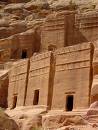
I had never heard that name before, except for the city in Jordan I visited at age of six when my parents brought us there,  each kid sleeping on a seat of the red-and-white volkswagon bus.

“Did you name her after the city?” I asked.  “No, I never heard of it,” she says, one eye on the child. “It’s a famous, ancient city in Jordan. It’s all carved out of red cliffs, sandstone. It was one of those ‘wonders of the world.’ ”   She doesn’t seem all that interested. “It’s really famous. There’s even a poem about it”—then I see her eyes go bright as I recite the famous line.  “It goes:  a rose-red city, half as old as time.”  Her eyes shine into mine.  “I’m going to look it up.”

So John William Burgon (1813-1888) added his bit of excitement to the world, and achieved what Frost said was his own whole intention:  to lodge a poem where it would be hard to get rid of.  This sort of memorability was the focus of the Academy of American Poets’ National Poetry Month campaign a few years back, called Life Lines.  I loved how Life Lines renewed attention to the essential usefulness of poetry in daily life, sometimes so easy to forget in these days of professionalized poetry.  As Johathan Culler wrote, in his recent essay “Why Lyric,”

“Lyric poems . . . ask to be learned by heart, taken in, introjected, or housed as bits of alterity that can be repeated, considered, treasured, or ironically cited. The force of poetry is linked to its ability to get itself remembered, like those bits of song that stick in your mind, you don’t know why.”

What poems have done that in your mind lately?

2009-05-01

Comments (62)

  • On May 1, 2009 at 4:16 pm Gary B. Fitzgerald wrote:

    Origin of the name Petra:

    The meaning of the name Petra is Rock

    The origin of the name Petra is Greek

    Feminine form of Peter, from the Late Latin Petrus, which is derived from petros (a stone) or petra (a rock).
    Report this comment

  • On May 1, 2009 at 5:35 pm Miriam Levine wrote:

    Well-shaped story. I admire how you persisted.
    Report this comment

  • On May 1, 2009 at 5:52 pm Henry Gould wrote:

    I remember my white-haired, 81-yr-old Mom telling me once, off-handedly, that she thought it was interesting how good poetry becomes natural, like the weather. Referring to Shakespeare, how his phrases became things people say, thoughtlessly, off-hand… the weather…

    - basically, Montale’s concept of the “second life of art”…

    (But your kid in Portland was likely named after Petra Kelly – who was not rose-red, but Green :

    http://en.wikipedia.org/wiki/Petra_Kelly )
    Report this comment

  • On May 1, 2009 at 6:02 pm Henry Gould wrote:

    p.s. forgot to mention how (in one way, anyway) poetry bcame to seem “natural” in my mother’s life. Her friend & neighbor in elementary school (in Minneapolis) was Longfellow’s great-granddaughter. The Longfellow clan took her along once, on summer vacation, to Maine. She had her first drink (sherry) in Longfellow’s house, in Portland, at age 13 (shocking experience – her parents were Iowa Quaker tee-totallers)… served by Longfellow’s youngest daughter (her friend’s grandmother – “laughing Allegra”).
    Report this comment

  • On May 1, 2009 at 6:06 pm A.W. wrote:

    Of course, Petra is most famous in the last 20 years as a shooting location in INDIANA JONES AND THE LAST CRUSADE: it’s the place where the Holy Grail is finally found.

    The woman’s eyes may have brightened a lot quicker if you had mentioned that.
    Report this comment

  • On May 1, 2009 at 9:35 pm Annie Finch wrote:

    Thanks for eye-opening thoughts and facts, oh harrieteers! As a Portlander, I am especially blown away by the tale of the elderly laughing Allegra in the Longfellow house. I’ve been in that house many times now, have even written a poem set there, and I can just picture it! And Longfellow is the originator of many of those “natural” bits of poetry. At his 200th birthday party, held next door to where Henry’s Mom drank sherry, the cake was decorated with a plethora of his “natural” phrases, from “ships that pass in the night” to “into each life some rain must fall.”
    Report this comment

  • On May 2, 2009 at 5:24 am john wrote:

    Someone has a good essay — is it Weinberger? don’t remember — sorry! — on Burgon’s line: That, at the time of its writing, “half as old as time” was fairly literal: That God was reckoned to have created the world roughly 6,000 years ago, and Petra was reckoned to have been about 3,000 years old. The line may have become more memorable as its literal intent became obscure and it got read as figurative.

    The Culler quote is interesting. If daily-life phrase-generation is the primary function of lyric, then the movies and popular song have become our primary lyric vehicles.
    Report this comment

  • On May 2, 2009 at 10:09 am Ben Friedlander wrote:

    Petra also shows up in Melville’s Clarel, especially in Canto 30 of Part Two, “Of Petra,” where Derwent (the character supposedly based on Hawthorne) asks Rolfe about it, calling it “The City Red in cloud-land.” Rolfe, an American adventurer (and supposedly a projection of Melville himself), has been there, and describes it as an apotheosis of eighteenth-century aesthetics: fabulously beautiful, but only reached after a rigorous journey; hewn from sublime landscape, haunted by a long-gone past (Petra was a part of the Edomite kingdom).

    “Mark’st thou the face of yon slabbed hight / Shouldered about by hights? what Door / Is that, sculptured in elfin freak? / The portal of the Prince o’ the Air? / Thence will the god emerge, and speak? / El Deir it is; and Petra’s there, / Down in her cleft. Mid such a scene / Of Nature’s terror, how serene / That ordered form. Nor less ’tis cut / Out of that terror–does abut / Thereon: that’s Art.”

    The canto ends with a wonderful exchange that highlights the differences between Melville and Hawthorne as Melville understood them. Derwent says, “That portal lures me.” Rolfe replies, “Nay, forebear; / A bootless journey…. / We’d knock. An echo. Knock again– / Ay, knock forever: none requite: / The live spring filters through cell, fane, / And tomb: a dream the Edomite!” To which Derwent happily replies “And dreamers all who dream of him– / Though Sinbad’s pleasant in the skim. / Paestum and Petra: good to use / For sedative when one would muse.”

    A perfect caricature: Melville the seeker, with a practical understanding of what’s involved in adventure and with a respect for dreams that assumes they’re inevitably tinged with melancholy. Hawthorne the storyteller, upholding adventure and dreams as ideals while relegating both, finally, to bedtime reverie.

    But Clarel is not the sort of poem to stick in one’s mind like a song.
    Report this comment

  • On May 2, 2009 at 10:40 am thomas brady wrote:

    Annie,

    I don’t know why your posts draw me in, but they do.

    Songs pop into my head far more often than lines of lyric poetry.

    The line is significant for me only when I am composing, for then the line becomes the germ of a new poem.

    I have read many a fine line of modern poetry and thought, ’this ought to stick in my head.’

    But it doesn’t.

    When a poem does drift suddenly into my thoughts as I am just walking dully along, it is usually in the form of a stanza, or the ruin of one I cannot fully remember, (once upon a midnight dreary, while I pondered, weak and weary, over many a…) for stanza has the momentum of song.

    What is the momentum of song? I think it is the mere physical fact of continuation. A folk song like ‘Michael Row’d the Boat Ashore’ can be sung endlessly as we keep adding on verses. It has a camp fire song flow that just keeps going, the way many pop hits on the radio ‘fade’ as they keep playing.

    The lyric poem, however, favored by the post-avants, or the professors trained in the New Criticism, features a hardness, and quite often, in order to be unique, and avoid the sing-songy feature that most serious poets abhor, it will have a definite beginning, middle, and end, and when it ends, it ends.

    Even one of those open-ended, insouciant, nonchalant, Ashbery poems which ends with a shrug, definitively ends–we don’t keep on ‘singing,‘ or have the urge to; there’s no momentum of song. And the intricacy and beauty of the modern lyric, by its very nature, demands we don’t give in to this momentum of song–which even the first quatrain of a sonnet possesses.

    The camp fire song which we sing over and over, drunkenly, until dawn, has a flow that gets into our heads, unlike the flint hard lyric whose rhythm never has a chance to grow into a stanza, which begins that rolling, repeating mechanism in our blood; the line, singular, hard, etched, and alone, is not welcomed in.

    Everybody: Michael Row’d the Boat Ashore…

    Thomas
    Report this comment

  • On May 2, 2009 at 5:25 pm Terreson wrote:

    Word origins are such fun. No sooner than I see the proper noun, Petra, than I suspected a pre-Christian provenance. Turns out I am right.

    Long before Christianity came on the scene, even before the invading Semites came onto the scene (in about 1,000 B.C.), there was an ancient town in present day Jordan whose name got translated into Greek by Alexander’s invaders. The town of Petra goes back at least to 1200 B.C., was a trading center, a crossroads in the spice trade, and, as such, in control of much commerce.

    Petra is not feminine for Peter. Petra is ancient Greek for phallus, pillar, rock. The medieval word, Latin derived, for Petra is Perron and it means the “Big Peter.”

    “Such stone pillars represented the phallic spirit of a god for many thousands of years. The pagan concept of the petra combined “father” and “rock,” in the same manner as the Biblical description of a paternal God as ‘the Rock that begat thee’ (Deuteronomy 32:12).”

    My source is none other than Barbara G. Walker.

    So there you have it. Petra means Peter which means cock which means phallus which means, in a certain context, the fructifying rock of God.

    I am going to make a calculated guess and say that the ancient town of Petra was given to phallus worship viewed as a fructifying principle. I am going to make a second guess and say that the inhabitants of Petra borrowed their religious notions from the even more ancient Egyptians’ reverence for Osiris who himself was a fructifying, procreating principle absolutely important to a people entirely reliant on the “sex” of the Nile delta’s innundation. And I am going to make a third calculated guess. The invading Isrealites felt they had no choice but to annihilate the townspeople of Petra whom they referred to as Edomites. They and their religious proclevities would have been viewed as competition.

    Can’t imaqine any of this matters.

    Terreson
    Report this comment

  • On May 3, 2009 at 12:05 am Annie FInch wrote:

    Wow, Terreson, it does matter. If your conjectures are right, and they seem quite plausible, then my timing was just right for the Beltane holiday, May 1, which also centers around the phallus. I’m delighted by all these possiblities. And Thomas, I think you have put your finger on the issue with the phrase, “which most serious poets abhor.” The key word in question seems to be “serious.” I guess that’s why the Academy’s Life Lines campaign struck me as significant–it seemed to engage head-on with what seems to have become a widespread and unexamined assumption that serious poetry and memorably sticky poetry are polar opposites.
    Report this comment

  • On May 3, 2009 at 9:09 am thomas brady wrote:

    Terreson,

    You’ve just given me an idea for a poem.

    It will begin,

    “O rock-hard penis!”

    A provocative opening, and then it will quickly appease the scholars as I mention the Israelites, Osiris, religious notions of the phallus, etc.

    But that first line is all I got right now.

    But it’s a start.

    Annie,

    Excuse my slight irreverance, but I think I’m trying to get at what Terreson meant with his offhand remark, “Can’t imagine any of this matters.” I think he was making a kind of modernist shrug, “I know my history, my religion, my Bullfinch, but hey, like a good modernist poet, I don’t take it TOO seriously; after all, we live in the present day, you know.”

    I may have totally misread Terreson (which means son of earth?) but I thought I’d take a stab at it.

    I think this has been a problem for poetry since the beginning of the 20th century, this back-and-forth between past and present; how much of the past should I mine? How seriously can I take this real old stuff? Etc. You look at that first Canto of Pound’s and it’s just horrible, really, this faux ‘ancient godly sea’ crap, which is so terribly affected, and then you have a poem like ‘Ulalume’ which has a reputation as an ‘artificial’ poem, but whose language, compared to Pound’s Cantos, is far more natural–the way we in the present actually talk. So Pound’s uneasy engagement with the past, which comes off as school-boy hackwork imitativeness, really points up the ‘modern’ problem. How do we, from our far position in the present, bring to the fore those ancient ecstacies–without sounding silly?

    Thomas
    Report this comment

  • On May 3, 2009 at 10:15 am Mary Meriam wrote:

    Thomas, check out the 4/27/09 NEW YORKER for an article by the fabulous Jill Lepore about your man, Poe.
    Report this comment

  • On May 3, 2009 at 11:09 am thomas brady wrote:

    Mary,

    My mother gave me a subscription to the ‘New Yorker’ for Christmas and I did see Jill Lepore’s small-minded attack on Poe a couple of weeks ago now, complete with a drawing to make Poe look like some horrible monster, and I posted a lengthy rebuttal on Harriet somewhere; I can’t remember which thread now; it might have been the Simone Weil thread; I can find it if you like. LePore calls Poe ‘deeply racist’ and the only example she provides to support this slur is the fact that Poe has an ex-slave speak like an ex-slave in his “Gold Bug.” I wonder if Jill Lepore has read the tale. Jupiter is a sympathetic character. Oh, yes, in Poe’s novel, there are dark-skinned island people who are not nice. Even most abolitionists in the 19th century were racist; there’s no evidence that Poe was racist, so it’s sort of a question of where does LePore’s sniper-instinct come from? I’m really not sure why Poe comes in for a wholesale beating every time he is examined in the mainstream literary press (New York Review, New Yorker, etc). This is more interesting to me than anything someone who is ignorant of Poe might say about him.

    Thomas
    Report this comment

  • On May 3, 2009 at 5:02 pm Terreson wrote:

    As Mr. Brady himself pointed out he has, in fact, misread my comment. But then sometimes a cigar is just a cigar.

    Terreson
    Report this comment

  • On May 3, 2009 at 7:02 pm thomas brady wrote:

    “A cigar is just a cigar.”

    How true. But I thought we were talking about, in your words, “phallus worship viewed as a fructifying principle.”

    There’s a bit more going on there than just “a cigar.”
    Report this comment

  • On May 3, 2009 at 9:43 pm Annie FInch wrote:

    The issue about how, how much, and how best our engagement with the past matters is an intriguing one. I happen to love that part of Canto I, and I am also a fan of Ulalume. I’m a sucker for the self-containedly wierd lyric beauty to which indulgence in the archaic can sometimes lead. And lately, I have given up trying to justify moments like that except to say that I like them. It seems that postmodernism may finally be giving us a way back into the past that is as much about pleasure as it is about anything else. There was a politically privileged elitism associated with the allusions of the High Modernist period that seemed to call for a corollary fragmentation to dispel their cultural power; but in the age of the Internet when knowledge is so freely available, perhaps archaism is less threatening than it used to be.
    Report this comment

  • On May 3, 2009 at 9:45 pm Annie FInch wrote:

    No-one has engaged with my question, which lines of poetry have stuck with you, in daily life situations specifically. I’m genuinely curious.
    Report this comment

    • On May 3, 2009 at 10:36 pm Former Berkeley Girl wrote:

      Hi Annie,

      Recently, I have been haunted by the lines, “the birds that once sang / do not sing to me anymore.” The only problem is that these lines are my mind’s corruption of Millay:

      “Nor knows what birds have vanished one by one,
      Yet knows its boughs more silent than before:
      I cannot say what loves have come and gone,
      I only know that summer sang in me
      A little while, that in me sings no more.”

      Cross-referenced, perhaps, with Wordsworth:

      “The things which I have seen I can now see no more.”

      Yet I am still stuck with the birds not singing to me anymore! Alas, and alack. Just thinking about the now-silent birds fills me with melancholy and nostalgia.

      Another line triggered by nostalgia (this one correctly remembered, I think): “Two girls barefoot never coming back,” the last line of “Growing Old in San Francisco” by Jack Gilbert. Ah, my dear departed childhood! I hardly knew ye.

      FBG
      Report this comment

    • On May 4, 2009 at 3:23 am Margo Berdeshevsky wrote:

      dear Annie,
      yes my head swims with many;stuck-in-my-head lines of late, and again:

      “…each of our truths must have a martyr”–Sontag

      “If you do not learn to hate/you will never be lonely/ enough to love easily/ nor will you always be brave/ although it does not grow any easier”–Lorde

      “Remember our sun/is not the most noteworthy star/only the nearest.”– Lorde

      “…but if it had to perish twice/I think I know enough of hate to say that ice is also great and would suffice”–Frost

      “I try to write every morning. I write on things that demand on my grief,pain, wonder, and awe” –Merwin

      “This is the field where grass joined hands,/ where no monument stands, and the only heroic thing is the sky.”–Stafford

      …”make me a willow cabin at your gate/halloo your name to the reverberate hills/ and make the babbling gossip of the air cry out, Olivia…” –Shakespeare

      …and that’s just on a Monday,
      all my best,
      margo
      Report this comment

    • On May 5, 2009 at 3:23 am john wrote:

      Thanks for opening your question up to include reading that’s older than “lately,” Annie. People may have been reluctant to answer originally because maybe it takes time for lines to stick and come out in daily life.

      And I should have put this in my reply to Don, but,

      “In the deserts of the heart
      Let the healing fountains start,”

      echoes Yeats and Arnold (though they aren’t so hopeful about fountains starting on demand). Interesting that a line illustrating the power of lyric to pervade daily life seems to be itself pervaded by other lines.

      “the foul rag and bone shop of the heart”
      – Yeats, “The Circus Animals’ Desertion”

      Youth rambles on life’s arid mount,
      And strikes the rock, and finds the vein,
      And brings the water from the fount,
      The fount which shall not flow again.
      – Arnold, “The Progress of Poesy”

      (Poor Arnold!)
      Report this comment

      • On May 5, 2009 at 9:59 am thomas brady wrote:

        John,

        Drinking is a prominent theme in poetry of a classic nature. Rock or water. Whiskey on the rocks with a little water. Intoxication. Springs in the desert.

        Here’s two poets who do it:

        William Ellery Channing (Emerson’s friend who Poe destroyed in a Review):

        A well is in the desert sand
        With purest water cold and clear,
        Where overjoyed at rest I stand,
        And drink the sound I hoped to hear.

        ‘Drink the sound I hoped to hear.’ That’s good stuff.

        And then, Harriet Monroe (founder of ‘Poetry’):

        Then halt not till thou seest the beacons flare
        Souls mad for truth have lit from peak to peak.
        Haste on to breathe the intoxicating air–
        Wine to the brave and poison to the weak–

        ‘Wine to the brave and poison to the weak’ She must have been one tough lady.

        Thomas
        Report this comment

  • On May 3, 2009 at 10:31 pm Gary B. Fitzgerald wrote:

    .

    “I know what I know…

    I’ll sing what I said,

    we come and we go…

    that’s a thing that I’ll keep in the back of my head.”

    – Paul Simon

    .
    Report this comment

  • On May 3, 2009 at 10:52 pm thomas brady wrote:

    Annie,

    I attempted to answer in this thread by saying song, and then stanzas from poems, stick with me more than single lines, or do you mean “lines” plural? I did mention lines from “The Raven,” but the other part of your question is important but difficult to answer: how do remembered lines nourish, inspire, or even become useful for those retaining them?

    Let me try and take a stab at that. A Pushkin love lyric once convinced me, or gave me ‘heart’ to forge ahead and seduce a woman whom I liked. These were not lines rolling around in my head, however. I read the poem, and struck by it, obeyed. I no longer recall the poem.

    I honestly think Shakespeare’s sonnets helped convince me, since I first read them and held them in my affection, to have children. But this is difficult to prove (even to myself) with any certainty. It may have been my desire to reproduce which made the sonnets attractive to me in the first place–the poems had no didactic effect on me whatsoever, and art never really does; I merely liked the iambic pentameter and the rhyme, though surely a great mind using harmonious expression makes his mind more convincing?

    I always liked, “Let us go then, you and I/when the evening is spread out against the sky…” and “As I walked out one evening/Walking down Bristol Street/the crowds upon the pavement/were like fields of harvest wheat…” but these were not single lines, but part of verses which swelled into rivers of music…and both examples imply an urban jaunt, and I do like to walk through towns…

    A poem is a journey, not a thing, not what it is, but what it can bring…

    Perhaps my head is too hopelessly a ‘music-box of urgent tunes,’ the head Emerson took pains to scold in his essay, ‘The Poet…’ or maybe that is poetry’s chief function, to give a sort of refined urgency to the soul, to make it move, to make it urge, more expressively and sweetly, no matter what it is doing…?

    Thomas
    Report this comment

  • On May 4, 2009 at 1:09 am Terreson wrote:

    Annie Finch says: “No-one has engaged with my question, which lines of poetry have stuck with you, in daily life situations specifically. I’m genuinely curious.” I somehow missed the question.

    “Till you graple this to heart
    that death’s a further birth,
    you are a drifter, pale and apart
    upon the murky earth.” Goethe

    “And life’s love boat has smashed
    against the daily grind.”
    Can’t remember if it was Mayakovsky’s or Eisenin’s suicide note.

    “A fox knows many tricks,
    the hedgehog only one. A good one.” Archilochus

    “Nature is a temple of living pillars
    where often words emerge, confused and dim;
    and man goes through this forest, with familiar
    eyes of symbols always watching him.” Baudelaire

    “Love is all
    Unsatisfied
    That cannot take the whole
    Body and soul’;
    And that is what Jane said.” Yeats

    Here are lines I think about a lot when I come to poetry conversations:

    “Hic: And I would find myself and not an image.

    Ille: That is our modern hope, and by its light
    We have lit upon the gentle, sensitive mind
    And lost the old nonchalance of the hand;
    Whether we have chosen chisel, pen, or brush,
    We are but critics, or but half create,
    Timid, entangled, empty and abashed,
    Lacking the countenance of our friends.” Yeats

    Here is a last one for you, Annie Finch. It is not exactly poetry. But it is spoken by a writer with the soul of a poet.

    “The genius of poetry is dead, but the demon of suspicion has come into the world. I am firmly convinced that the only antidote for this, the only thing that might make the reader forget the eternal I of the author, is complete sincerity.” Stendhal.

    Terreson
    Report this comment

  • On May 4, 2009 at 1:49 am Colin Ward wrote:

    What poems have done that in your mind lately?

    From Karen Solie’s “Short Haul Engine”:

    “…this waiting moment, buckling into circumstance…”

    From “Sunflowers in Italy” by Didi Menendez (the narrator describes the execution of her poet mentor):

    “You wrote your verses
    with your veins,
    cold against the wall.

    From D.P. Kristalo’s “Beans”, an elegy for Salvador Allende:

    “Your face was always saddest
    when you smiled.”

    And, of course, almost every line of “Studying Savonarola” by Margaret A. Griffiths. It finishes with:

    …the bright stem of you still a living stroke

    in memory, still green, still spring, still the tint
    and the tang of you in my throat, unconsumed.
    Report this comment

  • On May 4, 2009 at 10:33 am john wrote:

    Terreson,

    It’s Mayakovsky.

    And, as they say, the incident is closed.
    Love’s boat has smashed against the daily grind.
    Now life and I are quits. Why bother then
    to balance mutual sorrows, pains, and hurts.

    (tr. George Reavey)

    FBG,

    spreading into my own middle age, my lost youth haunts me too. That Gilbert line is beautiful. Since my father, the king of summer, died, I can’t hear this line, from the song “The Windmills of Your Mind” (words by Alan and Marilyn Bergman), without getting teary:

    “why did summer go so quickly,
    was it something that you said?”
    Report this comment

  • On May 4, 2009 at 11:07 am john wrote:

    FBG,

    Your closing sentence has become so naturalized into idiomatic speech that I forgot that its a quote from a song! I’m listening to Joan Baez sing it right now. Interesting history: A Union band leader rewrote it during the Civil War to make the “Johnny” of the song come home from war whole and healthy, not maimed for life. “We’ll all feel gay when Johnny comes marching home” instead of:

    Where are your legs that used to run, hurroo, hurroo
    Where are your legs that used to run
    When you went for to carry a gun
    Indeed your dancing days are done
    Oh Johnny, I hardly knew ye.
    Report this comment

    • On May 4, 2009 at 11:25 am Former Berkeley Girl wrote:

      John,

      Wow! I didn’t know this. Also, I wonder if this song is the source for the saying “my dancing days are over”? If so, that is grim.

      The backstory is fascinating, and reminds me of how in “Dulce et Decorum Est” W. Owen focuses on injured and dying soldiers’ bodies to expose “the old Lie.” Thanks for the heads-up.

      FBG
      Report this comment

  • On May 4, 2009 at 11:31 am Annie FInch wrote:

    Wow, what a feast. Thanks, all… much to absorb, enjoy, ponder here, and what a great variety of moods, sources, styles.
    Report this comment

  • On May 4, 2009 at 11:33 am Don Share wrote:

    “In the deserts of the heart
    Let the healing fountains start,
    In the prison of his days
    Teach the free man how to praise.”

    W.H. Youknowwho

    *

    John, that’s interesting that you quote Reavey’s translation. Among other things, he was the first guy to publish English translations of Paul Éluard – and was Samuel Beckett’s first literary agent! (He’s all over the new collection of Beckett’s letters…) And re “Windmills…”, it appears that it’s one of Matt Drudge’s favorite tunes.

    *

    Nel mezzo del cammin di nostra vita
    Report this comment

    • On May 5, 2009 at 2:39 am john wrote:

      Thanks, Don, I didn’t know anything about Reavey — his was the version that was available cheap in the used bookstores when I got curious about Mayakovsky. My only other impression of Reavey comes from David Antin’s masterpiece, “The Structuralist,” in which he appears as a minor character, being berated (not by Antin) for having translated Mayakovsky instead of someone “good” like Khlebnikov, during the episode set at a literary party. Later in the scene the poem’s hero (who had been berating Reavey) pours the remains of a bottle of vodka on Oscar Williams’ head, and when asked why, afterwards, replies (and my apologies for doing violence to Antin’s page layout),

      “i am linguist and christian
      man is made in image of god
      to turn to idiot is sacrilege”

      Which is a memorable line, though I rarely have opportunity to use it.

      Thanks for the report on Drudge too. And all I thought we had in common was our fondness for hats.
      Report this comment

      • On May 5, 2009 at 10:21 am Don Share wrote:

        That’s a great story, John – and Antin is one of my heroes!! Thanks for telling it here. Khlebnikov is good, by the way, and readers should check out his work.
        Report this comment

        • On May 5, 2009 at 1:17 pm john wrote:

          Khlebnikov is great! I only hoped to indicate that I didn’t share the disparagement of Mayakovsky.

          There’s a great, touching bit of gossip in that party scene in that Antin poem — the meeting of two poets who later married — George Economou and Rochelle Owens — and Antin doesn’t mention that they married but only talks about his friend George’s immediate attraction and their striking up a conversation later. Interesting poetics — it’s touching only if you know the whole story, which the poet omits. Do you know, Don, anything about the poem’s protagonist, whom Antin only calls “Nasi”? He’s a fascinating character!

          By the way, after commenting last night on the Auden lines you quoted, I happened to read the poem from which they come, and was embarrassed to find them in his famous Yeats homage — duh! — Yeats allusion, hello! I’d read the Auden poem several times, and it’s obviously “stuck” for many people, but for some reason not for me. Maybe because I completely disagree with its *most* famous line, “for poetry makes nothing happen.” (Though I love a line later in the sentence — “a way of happening, a mouth” is great.)
          Report this comment

          • On May 5, 2009 at 1:33 pm Don Share wrote:

            John, the phrase “poetry makes nothing happen” is always taken out of context & misunderstood (understandably!): it’s my bete noire… to spare a tirade, here’s a link to my explication of the thing:

            http://donshare.blogspot.com/2007/08/poetry-makes-nothing-happen-yadda-yadda.html

            Anyway, here’s Lou Rowan on Antin’s “Nasi” -

            http://www.articlearchives.com/north-america/united-states/843588-1.html

            A snippet: “The hero–and he is one–Anastasius or Nasi is “a small man or a large dwarf.” The quality of his career illustrates Creeley’s proposition beginning “Mr. Blue”–”That dwarfs, gnomes, midgets are, by the fact of their SIZE, intense …” Nasi is an expert linguist, translator; he is an original and accomplished painter; he is an athlete; and he’s a conversationalist of passion, cogency, and endurance. Nasi endures neither the grotesquery of Creeley’s dwarf, of Poe’s Hop-Frog, of West’s Honest Abe Kusich, nor the broad symbolic weight of the screaming German drumstick. “
            Report this comment

          • On May 5, 2009 at 2:27 pm john wrote:

            Don,

            To “Teach the free man how to praise,” is to make something happen. (Auden explicitly addresses the line to “poet.” As you know.) So, yes, context complicates the line — but lines wriggle free of context all the time, and the note of despair in the de-contextualized line seems genuinely reflective of the poem’s experience, or at least an important aspect of it.

            The metaphysical defense of the line strikes me as obscure — poetry makes “nothing” HAPPEN. And what is this “nothing” that poetry makes happen? Oh dear, do I have to read Heidegger again?

            My favorite de-contextualized line: “Brevity is the soul of wit.” The joke in its original context (Polonius in “Hamlet”): A lying windbag says it before rattling on and on and on. The humor is not in the brevity, though the memorability is.

            Poetry makes blogging happen!
            Report this comment

  • On May 4, 2009 at 11:50 am Catherine Halley wrote:

    One line? From Robert Hass’s “Mediation at Lagunitas.”

    “All the new thinking is about loss.”

    Two lines:

    “All the new thinking is about loss.
    In this it resembles all the old thinking.”

    or from later in that poem:

    “a word is elegy to what it signifies.”

    The whole poem, which makes me inordinately sad and hopeful, is here:

    http://www.poetryfoundation.org/archive/poem.html?id=177014
    Report this comment

  • On May 4, 2009 at 3:37 pm Annie FInch wrote:

    Dear FGB, To remember one’s own version of a line and have it occlude the original is a compelling twist on this whole question of stickiness. Do I also hear an echo of Eliot’s “I do not think that they will sing to me” in your version?

    I don’t know which is more surprising to me in reading through these–the idiosyncracy of some of them, or the familiarity of some others.

    On the latter note, Don’s Auden quote is the exact passage of poetry I chose for my own comment when asked to contribute to the Academy’s life-lines site! And I know many people who feel the same way that Cathy does about “Meditation at Lagunitas” . . .
    Report this comment

  • On May 4, 2009 at 4:52 pm thomas brady wrote:

    I am struck by something in these examples.

    Aren’t these rather epigrams we are quoting, really, rather than lines of poetry?

    Surely we are not saying poetry is nothing but an epigram?

    And, if we are asked to quote lines of poetry and come up with what are essentially epigrams, what does this say about us? About poetry?

    Perhaps this game is more revealing that we first thought?
    Report this comment

  • On May 4, 2009 at 5:37 pm Manoel wrote:

    seriously?

    these strange lines from pound:

    “christ follows dionysus
    phallic and ambrosial
    made way for macerations
    caliban casts out ariel”

    i don’t know why??? but i’m all for discussing their “meaning” if anyone is interested…

    but i’d sure love to see petra… and i know a store where you can get a handmade lyre! i’mma go get one now!
    Report this comment

    • On May 4, 2009 at 7:36 pm thomas brady wrote:

      Manoel,

      Do you like the band America?

      Thomas
      Report this comment

      • On May 4, 2009 at 10:06 pm manoel wrote:

        the band? i don’t know…

        the music? well, i like the part in Ventura Highway where they say “alligator lizards in the air” and

        “Cause never was the reason for the evening
        Or the tropic of Sir Galahad.

        So please believe in me
        When I say I’m spinning round, round, round, round
        Smoke glass stain bright color
        Image going down, down, down, down
        Soapsuds green like bubbles…”

        other than that not really so much
        Report this comment

        • On May 4, 2009 at 10:52 pm thomas brady wrote:

          What about ‘Horse With No Name?’

          “On the first part of the journey
          I was lookin’ at all the life…”

          It does get a little didactic, eventually, with “because the humans would give no love…” but overall, a nice, dreamy song.
          Report this comment

  • On May 4, 2009 at 8:58 pm Terreson wrote:

    The Nam war was in high gear. It was late ’70. Fort Myer, D.C. The base’s movie house was packed with draftees and conscripts that Saturday night. The movie was a grade B movie called “The Witchfinder General,” starring Vincent Price. The story was set against the English Civil War of 1642-1648. Price’s character was the Witchfinder General given extraordinary civil powers to hunt out witches. He falls in love with a Puritan girl. She spurns him, keeping loyal to her roundhead suitor, and the General declares her a witch. Her suitor shows up from the battle fields and he engages, kills the General in sword play.

    When the movie ends a poem scrolls down the screen. The poem ends this way:

    Out – out are the lights – out all!
    And, over each quivering form,
    The curtain, a funeral pall,
    Comes down with the rush of a storm;
    And the angels, all pallid and wan,
    Uprising, unveiling, affirm
    That the play is the tragedy “Man,”
    And its hero the Conqueror Worm.

    The poem is Poe’s “The Conqueror Worm.” There was not a boy that night on his way to or back from Nam who didn’t get Poe.

    Terreson
    Report this comment

  • On May 4, 2009 at 9:30 pm thomas brady wrote:

    Terreson,

    No lie. My ‘Library of America’ paperback “American Poetry–The Nineteenth Century” was sitting by my computer this evening; I don’t know how it got there; I think a bit of random housekeeping placed it there, and it happened to be open, again, I don’t know how or why, and when I picked it up within the last 5 minutes or so, I saw it was open to Poe, “The Conqueror Worm.” I read it aloud–just now, steady but passionately, to myself, as the kids were being put to bed upstairs. On Harriet I saw a new comment, yours, something about Nam, read it, and imagine my surprise when I saw you had quoted “The Conqueror Worm” at the bottom of your post. I’m not kidding. True story.

    Thomas
    Report this comment

    • On May 5, 2009 at 2:36 pm Annie FInch wrote:

      Terreson, Thomas, Gary: Jungian indeed! I love this anecdote (both layers of it) and bet Poe would have loved it too. I can just see Rod Serling turning from Thomas’s desk to look us in the eye: “a reader, a movie, a poem, a war. Separate, but yet all connected—in the Twilight Zone. . . “
      Report this comment

  • On May 4, 2009 at 9:55 pm Gary B. Fitzgerald wrote:

    Jung strikes again!
    Report this comment

  • On May 5, 2009 at 8:05 am thomas brady wrote:

    My inquiry was a serious one.

    If we begin to hold up our favorite lines, to examine the fragments of what we love, I think it behooves us to turn metaphysician for a moment, or medical examiner, and ask, ‘what is this thing called poetry?’

    The advantage here is that the sample is small. We avoid the tedious New Criticism, the professorial rants. But in the small sample, oh, how much!

    I think we can begin to categorize what we have given each other so far. Much of it, as I have said, strikes me as epigram, or the germ of an essay, not poetry, and this, I think, is a starting point, as we look about ourselves and ask, “Poetry? Whither?”
    Report this comment

    • On May 5, 2009 at 2:41 pm Annie FInch wrote:

      I’ve been thinking about your idea of the epigrammatic pattern here quite a bit, Thomas. I agree there is one. But I’m wondering if the quotes are self-selecting; is it possible that when choosing which lines to post on this thread, we have been editing out the fragments and odd bits in favor of the ones that actually “say” something?

      Or, could it be that this is really what sticks with us nowadays? I’ve been suspecting for a while that neoclassicism is on its way back. Are we witnessing a foreshadowing of some kind of return of the eighteenth century poetics of the epigram? It would not be a surprising reaction to the current glut of fragments.
      Report this comment

  • On May 5, 2009 at 3:46 pm thomas brady wrote:

    Gary,

    You bastard.

    I now DO think you had a good point re: the new ‘reply’ function, which diverts the main thread into curling eddies (Poe digressions by myself, mostly) lost in giggling sand and laughing foam.

    I am rising to the challenge of the ‘comments’ function; from now on I will respond to The Post (and all its attendant comments) as a singularity, assembling, rather than scattering, with my effusions.

    Here is Annie’s gist: “The force of poetry is linked to its ability to get itself remembered, like those bits of song that stick in your mind, you don’t know why.”

    Let me first clean up the confusion re: the Auden.

    I’m not sure why we don’t read the preceding:

    “Now Ireland has her madness and her weather still,
    For poetry makes nothing happen: it survives”

    I think ‘Ireland has her madness and her weather still’ settles the matter. Yeats’ poetry did not change Ireland’s madness or weather. In this sense, poetry makes nothing happen. It survives, like madness, like weather; poetry is part of life, but it doesn’t change life; poetry is the effect, not the cause, and this view is common sense, Christian, Auden to a tee. The ‘poetry makes nothing HAPPEN’ interpretation is rubbish, in my opinion.

    As for our general topic:

    Lacking a context, meaning suffers. When this phenomenon arises, I think it’s safe to say we’re not dealing with poetry, but with essay, or epigram.

    ‘After many a summer dies the swan’ cannot possibly generate a metaphysical dispute; its music survives its fragmentation; in a chunk it is music still, and therefore THIS is poetry.

    ‘poetry makes nothing happen’ is epigram, not poetry.

    Likewise, ‘all the new thinking is about loss.’

    Goethe’s

    “Till you graple this to heart
    that death’s a further birth,
    you are a drifter, pale and apart
    upon the murky earth.”

    Is an essay, not poetry. Even with its rhyme.

    Thomas
    Report this comment

    • On May 5, 2009 at 3:48 pm Don Share wrote:

      Just a swirl, not even an eddy, but… is it fair to judge the Goethe in English rather than German?
      Report this comment

      • On May 5, 2009 at 4:20 pm thomas brady wrote:

        Don,

        I am judging the English unfairly; it is not a fair translation.

        My target is the didactic, which would probably show in German, as well.

        But, point taken.

        Thomas
        Report this comment

        • On May 5, 2009 at 4:26 pm Don Share wrote:

          Actually, I think you’re right that it would show in the German, too.
          Report this comment

          • On May 5, 2009 at 4:43 pm john wrote:

            Why limit poetry to exclude epigram, an honorable poetic genre, once closely associated with lyric?

            Annie, you’ll be happy to know that this (perennial) debate calls to mind a poem.

            It’s only a few stray words that I had by heart (“this,” “that,” “secretariat”), as well as the author and the overall intent, which were enough for Google to find it immediately. (I know which book I read it in too, but I sold the book!)

            “On Putting Things In Order”

            File this, throw out that.
            Alert the Secretariat.
            In re each claim and caveat
            To better serve the cause of Alphabet.
            Throw out this, file that

            File this, throw that out,
            We know beyond all doubt
            how Perfect Order reconciles –

            And now throw out the files.

            – Kenneth Burke
            Report this comment

  • On May 5, 2009 at 5:55 pm thomas brady wrote:

    John,

    “Why limit poetry…”

    Ah, the great question!

    Thomas
    Report this comment

  • On May 5, 2009 at 11:18 pm Terreson wrote:

    Annie Finch says: “I’ve been thinking about your idea of the epigrammatic pattern here quite a bit, Thomas. I agree there is one. But I’m wondering if the quotes are self-selecting; is it possible that when choosing which lines to post on this thread, we have been editing out the fragments and odd bits in favor of the ones that actually “say” something?

    Or, could it be that this is really what sticks with us nowadays? I’ve been suspecting for a while that neoclassicism is on its way back. Are we witnessing a foreshadowing of some kind of return of the eighteenth century poetics of the epigram? It would not be a surprising reaction to the current glut of fragments.”

    Annie Finch, here is my gut response to your comment. The neoclassical tendancy has dominated the American poetry scene since the 70′s (last century). That would be thirty years ago, more or less. Maybe unfairly, but I blame Ashbery for the turn. Not unfairly, I name the Lang Po people for turning the turn into something hard to turn back.

    Whether or not the epigram can ever make for good poetry is a slightly different question. Poe himself, the champion of short poetry, said it could not. He was borrowing from Kant and through Coleridge when he said: “I need scarcely observe that a poem deserves its title only inasmuch as it excites, by elevating the soul. The value of the poem is in the ratio in this elevating excitement. But all excitements are, through, a psychal necessity, transient.” But he also served up a caveat: “On the other hand, it is clear that a poem may be improperly brief. Undoe brevity degenerates into mere epigrammitism. A very short poem, while now and then producing a brilliant or vivid, never produces a profound or vivid effect. There must be the steady pressing down of the stamp upon the wax.”

    For what is worth. Terreson
    Report this comment

  • On May 6, 2009 at 1:29 am Colin Ward wrote:

    Annie,

    We were asked to cite remarkable lines that “stick in” our minds. We weren’t asked to characterize the remainder of the poem from which they were snipped. Whether the poem is a “filler and killer” (i.e. one great line amid tepid supporting ones), an epigram or a stunner, with many lines almost as good as the one mentioned, seems a different issue altogether. I do agree that it speaks to the definition of poetry as the one verbatim art form, though.

    If memorable, quotable lines constitutes a “return” of some sort I can’t imagine it being an unwelcome one. Would poets really prefer that none of their words were remembered?
    Report this comment

  • On May 6, 2009 at 8:56 am thomas brady wrote:

    It would be amusing to write an essay or short story with a Professor Fragment, who is the world’s authority on marvelous lines–knows them all–but chooses not to subject himself to the mediocrity of the surrounding “filler.” He’d insist to his incredulous students that “chickens” was the only worthwhile bit from ‘The Red Wheel Barrow’ and he would overwhelm with his belief that “white petals” was the only memorable aspect of ‘In a Station of the Metro.’
    Report this comment

  • On May 6, 2009 at 9:16 am thomas brady wrote:

    Terreson,

    You’ve summed up two millenia quite well: long poem, Poe, lang po.

    The alternative tradition? Sappho, Li Po, po-biz?

    Thomas
    Report this comment

  • On May 6, 2009 at 12:39 pm thomas brady wrote:

    Perhaps Colin is right.

    If any writer becomes known for ‘memorable scraps,’ then, by default, really, this writer becomes ‘a poet.’

    Can we go ahead and say this?

    Or is the issue as complicated as I’m trying to make it?

    Thomas
    Report this comment

  • On May 6, 2009 at 8:33 pm Terreson wrote:

    Over on You Tube, Annie Finch and all, you can find an extraordinary recording of Robert Frost’s JFK Inauguration Day poem. Frost had written a poem for the occasion. In my view it is not a shabby poem, even if a bit self-conscious. But the day was a day of brilliant blue sky, sharp sunlight, and white, white snow covering the ground. Frost’s old eyes were blinded by the sunlight reflecting on the white snow. He tried several times to read text but kept faltering. I think it was LBJ who tried to help him through the moment, but rather dismissively in my view, by offering to read the poem for him. I also suspect the dismissiveness pissed off Frost mightily. I think it really pissed him off.

    And so he turned to a poet’s best resource. He turned to his vibrant memory. He recited an older poem he knew by heart. The poem speaks on so many levels. It speaks to all that filters, even blocks, perception. It speaks to how many generations it takes for immigrant people(s) to get “owned” by their new environment. And it speaks to the core and gut of post-conquest American history. Speaking as a perceptual animal, an American, a poet, no poem has brought me up so short.

    I am guessing there might by copyright rules against quoting the whole of Frost’s “The Gift Outright.” It starts out this way:

    “The land was ours before we were the land’s.
    She was our land more than a hundred years
    Before we were her people. She was ours
    In Massachusetts, in Virginia,
    But we were England’s, still colonials,
    Possessing what we were still unpossessed by,
    Possessed by what we now no more possessed.”

    And it ends this way:

    “Such as we were we gave ourselves outright
    (The deed of gifts was many deeds of war)
    To the land vaguely realizing westward.
    But still unstoried, artless, unenhanced,
    Such as she was, such as she would become.”

    Terreson
    Report this comment

  • On May 7, 2009 at 12:59 pm john wrote:

    “linger awhile, thou art so lovely,” the redemptive line spoken by Goethe’s Faust, frequently comes to mind, like yesterday morning in the shower. But alas, the shower could not linger.

    Dramatic poem, but poetry — lyric.

    I often recite “Abou Ben Adhem” in bed to put myself to sleep. Not that I regard that poem strictly as a soporific!

    “My heart leaps up” — Wordsworth. Comes to mind from time to time.

    “My lost youth” — Longfellow. Comes to mind . . . too much!

    I would bet that most of us have lots of lyric embedded in us, lines that bubble up when the circumstance evokes them, but that we can’t necessarily call to mind without the life circumstance evoking them.
    Report this comment


Posted in Group Blog, Uncategorized on Friday, May 1st, 2009 by Annie Finch.