
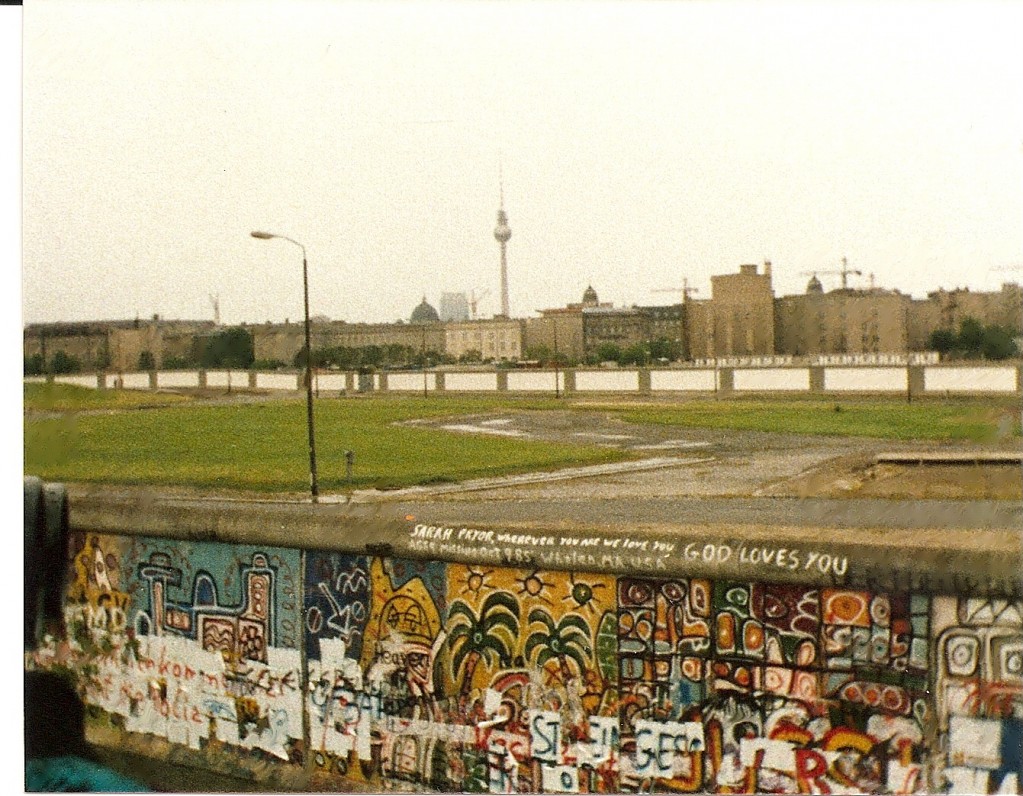
Looking east towards Alexanderplatz and its famous television tower, East Berlin City Center
We are rapidly approaching the 20th anniversary of the fall of the Berlin wall, the most emblematic event of the collapse of communism in Europe, and of its ensuing collapse in the Soviet Union itself.
This will take place on November 9, 2009. The symbolic import, not to mention the material and psychosocial consequences of this event for both Europe and the world, cannot be underestimated. And it will take historians of future generations to clear the debris and construct a viable narrative of the period. One thing is certain however, the events that led up to 1989 and those that followed created the first great geopolitical paradigm shift since the First World War and the October Revolution, ending alignments and misalignments, ending a century of war, both hot and cold and wars of proxy (often fought in the aftermath of decolonization), and provoking the implosion of the 20th century’s two principal economic systems (or perhaps more accurately put, marking the definitive end of one, and the beginning of the end of the other). The interregnum that followed 1989, was short-lived. Communist economic policies collapsed with communism itself; the western free market economic system (partly through its hubristic response to the collapse of the command and control economy of the Soviet Union and the Eastern bloc countries) would take another two decades to burst its bubble. Meanwhile, by 2001, twelve years after the fall of the Berlin wall, a new brand of ideological division on a global scale, one that had been gathering force ever since the Soviet retreat from Afghanistan, suddenly became painfully concrete. Similar to the continuum between the first two world wars, the first Gulf War, predating September 11th, which was followed by the invasion of first Afghanistan and then Iraq should be seen as parts of the same event, the second war arising out of the unfinished business of the first, and, as well, a new interventionist agenda in Washington, which we now know was already in the works before September 11, but became a kind of juggernaut afterwards. The rise of El-Qaeda’s extremist ideology was already beginning to underpin the West’s anxiety over oil. The events of September 11th provided concrete proof, as though any were needed, that we were facing a formidable enemy and tipped us into remobilization in the Gulf. Militarily, President Obama’s recent election, based on a platform of change, has changed nothing. The drawdown in Iraq has been revised several times and still seems more contingent upon events on the battlefield than any firm date set by Washington, and rather than a withdrawal from the region, as though that were even conceivable, what is really occurring is a shifting of fronts and a relocation of resources back to Afghanistan and most likely into Pakistan, as the national governments of both countries continue to crumble and Taliban/Al-Qaeda forces push ever closer to Islamabad. The Thirty Years War of the 21st century looks set to continue. Except in this case it will be financed by China, who owns most of the United States debt, nearly one trillion dollars of it. The British Empire collapsed in similar fashion, as the world’s hired gun, even as it ran out of money to pay for bullets.
All this by way of a short introduction to one poet’s observations on how art functions in times of duress.
***
Roughly two weeks ago (on the 21st of April) I came across an article in my daily newspaper with the following title: O Muro de Berlim vai ser restaurado pelos artistas que o pintaram há 20 anos (The Berlin Wall Will Be Restored by the Artists that Painted it Twenty Years Ago). As a sometime resident of Berlin, and a self-declared Wallist, this caught my attention.
What is a Wallist? This is a term I devised for someone (namely myself) who was obsessed, not with the wall, since it was no longer there, but with the space left in its wake – at the time a sandy, weed-cluttered corridor. In 1992, it was still possible to follow the “death strip” left by the dismantling, a process which was just being completed when I made my first trip to Berlin. As you walked along, West Berlin was on the right, and East Berlin on the left (or vice versa, depending on which direction you took). These were two distinctly different worlds in terms of architecture, mood, and what photographers call “grayscale”, the gradations of which I worked out in my notebook. I would start out from Kreuzberg, where I lived right across the street from the swimming pool and Görlitzer park, where the old Görlitzer Bahnhof once stood, gateway to the East and the principal rail route to Vienna – hence the name of my street, Weiner Strasse. The railway station was bombed into scattered bricks on the 3rd of February, 1945 during raids that left 3,255 people dead or missing and over 119,000 homeless in the surrounding Kreuzberg district.” Görlitzer Bahnhof was re-opened, in makeshift form, by June, a month after the fall of Berlin. Yet, as relations between East and West chilled and it was not longer tenable for a Western station to operate on an Eastern line, it was finally closed to passenger trains by the GDR in April of 1951, although freight still passed between East and West until 1986, where there was a border crossing point on the bridge over the Landwehrkanal at the end of the park.
In 1992, there were no train tracks in the park itself, though it was easy to identify the line they followed. But on the other side of the canal, in Treptow, the adjoining East Berlin neighborhood, the tracks were still there, rusted in disuse next to an abandoned factory collapsing, brick by brick. From my house, I would cross the rickety bridge, or follow the canal into Treptow, where I would pick up the line that the wall had left.
This ghost strip was, for me, a place of the imagination, a nullity so rife with the echoes of postwar history that the air seemed to crackle in distress. I set myself to studying the topographies of this vast, flat, suddenly “united” city, venturing at times into the Eastern neighborhoods, and at other times into the Western ones. I sketched, took notes, photographed. I had already lived in a divided Europe for five years. I pleaded with this gash (pleaded with its random piles of wall rubble, the lonely watch tower no longer watching anything and with the strange cut-off houses) to reveal itself to me. And, as poets do, I became the actor in that slow process of revelation, coaxing secrets out of vanished stone.
Having watched the events of 1989 on television, far away in Portugal, the toppling of the GDR had remained somewhat abstract to me. Now that I was in situ the negated enormity of the obliterated wall began to whisper. The Soviet Union had collapsed only two months earlier. The acrid sting of heating coal was still palpable in the winter air. I had had to learn how to light and stoke a coal fire in one of those large ceramic stoves that occupied a central place in every Berlin apartment, East or West. The city was, of course, still divided. The Germans had a name for this: “Mauer im Kopf”, which means “the wall in the head.” This division was glaringly visible. You could see it most blatantly in the way the Ossis dressed as you took the U-Bann into East Berlin, in the shock that was etched on their faces. Lives in the East were coming undone. Some left for the West as soon as they could, others (my friend Misha, for instance, a painter) escaped to Moscow – though he was soon back in East Berlin. Theirs was a kind of naiveté, the East Germans, and yet that was balanced against a toughness of spirit and the sense of fatality that comes of having been stripped of something essential (in their case, time). They reminded me of the Portuguese in a certain way, geographically isolated and only 15 years past their own 40 odd year experience of dictatorship. All of this was brought into high relief crossing west to east.
The first time a saw the most extensive section of remaining wall was when we were leaving for a reading tour, first to Leipzig, then to Halle and Jena. It was still only about 8:30 in the morning, but Max, my editor, wanted to stop in Alexanderplatz to stock up on supplies for the journey east. I waited by the car (my little Renault), illegally parked, while Max, Misha and Pontus went to get what was needed, which turned out to be a bottle of vodka and a case of beer, some sausage and bread and big bag of potato chips. Once we were on our way, bottles opened, conversation roaring, Max started shouting directions from the back seat as we sped along Mühlenstrasse, which runs along the east side of the river Spree. The wall suddenly loomed into site, covered with mural paintings and graffiti, before ending abruptly about a kilometer and half later at Oberbaumbrücke, one of Berlin’s loveliest bridges, with its red brick turrets.
I learned later that this was known as the East Side Gallery, supposedly the world’s largest open-air gallery. This is the section of the wall that will be restored, according to the article in O Público. All of the murals and graffiti will be removed, the underlying cement reinforced and then the whole strip will be repainted under the direction of Theirry Noir, one of the original West Side wall painters, by the original artists, and then covered with a graffiti proof varnish, an irony which cannot (to indulge in the obvious pun) be varnished over.
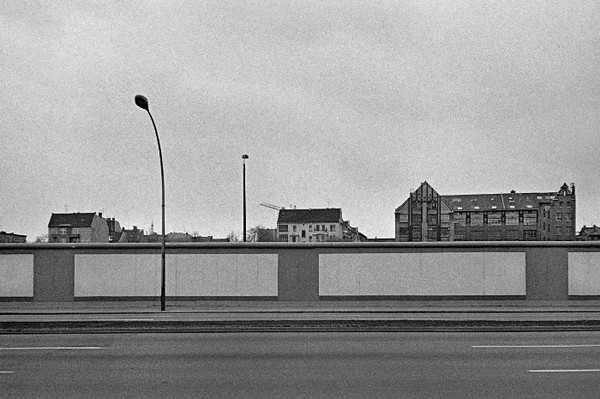
I haven’t been to Berlin for about three years. During my longest sojourns between 1993 and 2005 I lived in East Berlin in Friedrichshain, right off one of its central avenues, Karl-Marx-Allee, on Richard-Sorge-Strasse. When I came across this article in my daily newspaper, I thought back to that first morning in February 1992. What had bothered me was that the murals and the graffiti were on the wrong side. I realized immediately that this seemingly Holy Scripture had been scripted post-89. The authentic writing on the wall had occurred on the other side, the West Berlin side. The East Side Gallery post-dated the Cold War. It was a species of mimicry. This section of the wall should have been grey. Grey with white panels, a page on which it was illegal to write.
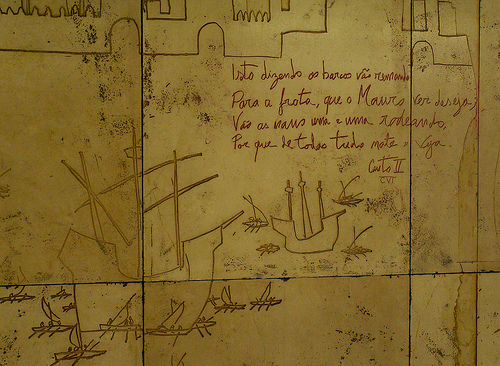
Writing (to be distinguished from proto-writing) seems to have appeared roughly five thousand years ago in Samaria and Egypt. The technology involved stone “tablets”, and later clay, on which business records were kept, such as transactions of property, the sale of grains and the production of beer; the first agrarian societies recorded their relationships with their cohorts on portable (though heavy) pages. Of course, at the time, this practice represented an advanced technology, a very distant relative of cave paintings and other representational art and symbol based inscriptions; imagine the distance between incunabula and hypertext, then multiply it by one hundred. The lives of individuals prospered with the new scripts, the private life (and the legal accumulation of wealth) was being invented with the codification of spoken language.
The day I came across this article, I was just finishing up a translation of a new film, a documentary on the lifework of the Portuguese artist Bartolomeu Cid, a painter and engraver who spent most of his working life in London. It’s a fantastic film, a series of interviews with Bartolomeu, Paula Rego, Helder Macedo and others who worked with them, most of them associated with the famous Slade School of Art.
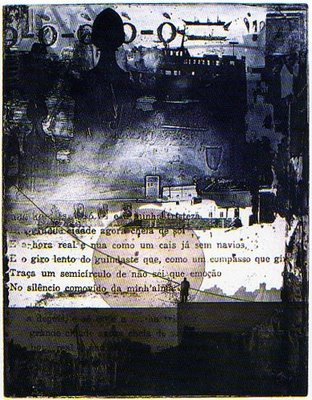
What most struck me about Bartolomeu Cid’s work was how the brute physicality of the process produced such delicate, simple and yet highly articulate results. He would combine drawing with images, poems would appear, by Fernando Pessoa and others, fragmented and half erased. Over time an evolving vocabulary inscribed onto copper plates or stone began to emerge. Many of the finished engravings looked like palimpsests that contained the whole history of writing, from the pictographic to modern cursive scripts and everything in between.
I kept asking myself, as I worked through the seventy-page script, why Barotlomeu might have been drawn towards engraving, away from painting. His own explanation was that it was the influence of one of his professors, the landscape painter William Townsend who, upon seeing his monochromatic watercolors of London street life, life along the banks of the Thames, his river scenes with their tugboats and bridges, told him to go and see Mr. Gross [Anthony Gross], who promptly sent him off to Drury

Anthony Gross
Lane to buy a copper plate, in engraver’s terminology, the “matrix.” “And I bought a plate, which I still have, and went back and made my first engraving. I made it in October of 1956. One of the best engravings that I made during the period when I was a student. It was called “City Lights.” I robbed the title from Chaplin.”
But perhaps Bartolomeu was already predisposed, because of his obvious love of literature. There is something in the engraver’s art that calls up the history of script. It was William Blake who invented relief printing, which runs contrary to the engraver’s instincts by switching the role of the negative and positive aspects of the matrix. Relief printing, according to Lauren Druss, “uses the raised surface of a matrix to create an image (by removing the negative spaces.)” Blake was looking for a way to combine texts with images. Bartolomeu Cid might never have ventured across the channel from France to England were it not for a book he came across in Paris, and his love for the French poet Prévert.
“And I picked out one from among the other books that was called Charms of London, photographs by Izis, texts by Prévert, who was my man at the time. These days no one here knows who Prévert was, but all of us recited Prévert. And it was all black, the photographs were all black and white. And I saw a black city, which played off what I was doing. And it was more through intuition, and I asked myself ‘What’s happening,’ and I told myself really, ‘Paris must be finished, used up, nothing seems new to me,’ but in London, I found the English neo-romantics, Nash, Sutherland, these men of the period, John Piper, in some collections of monographs by Penguin about English Artists. And that interested me. There was a certain aggression, a sharpness to things, and a darkness. And then I see the book by Prévert and I said ‘This is what I want.’ And I picked up the book, and I read the whole thing, and I wrote to Slade.”
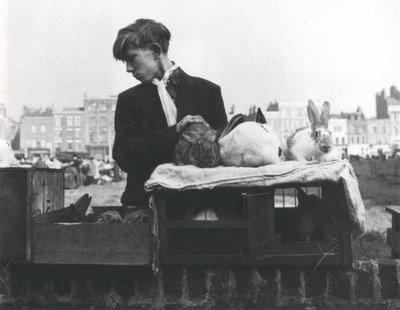
Izis Bidermanas, The Rabbit Seller
Theirry Noir, a young French artist, moved to West Berlin in 1982, attracted by the music scene; David Bowie and Iggy Pop were both Berlin residents at the time, which he mentions in a short biographical article. By the early 1980’s, after work on what is called the “forth generation” wall had been finished, graffiti started appearing here and there, making a mockery of East German ingenuity. Ironically, it was the technological advances in materials, namely the quality of the cement that allowed the graffiti artists and painters to advance their work. Previously, the quality of the stone blocks used in the wall’s construction had not provided the surface needed for large-scale painting. Theirry and fellow French artist Christophe Bouchet started to paint the three-meter high wall in April of 1984. Already the accumulating graffiti around Potsdamerplatz, Checkpoint Charlie, Brandenburger Tor and in Kreuzberg were changing the wall into a tourist attraction. Noir describes the situation in his short article:
“Noir and Bouchet, 2 young French men, who had been living 2 years close to the Berlin wall, felt the need to do something against this boring wall. A sort of physical reaction against the pressure of the daily life near the Berlin wall. The back of their house at Mariannenplatz was five meters in front of the wall. Their house was the first squatted house on December the 4th, 1971. It was called the “Georg von Rauch house” dedicated to the demonstrator killed by the police, the same day.”
Just as with artists and writers working on the other side, and throughout the Eastern Block and the Soviet Union, a degree of stealth was built into the wall painters’ endeavors. Their work was conducted against a backdrop of danger. More than simply decorating a “boring wall”, they were engaging in a highly illegal activity, codified in the statutes of East German law. An often forgotten fact is that the whole edifice was on East German soil and thus belonged to the GDR, even the surface that faced West Berlin. This perimeter, according to Theirry, in another article, had been constructed five meters within GDR territory, which allowed Honecker’s border guards, who followed a shoot-to-kill policy, to climb over the wall whenever they wanted.
In the article noted above Theirry describes just such a run-in. They were all set to screw a large, old and ornate door onto the wall, and a local television station was there to film them. But suddenly, when someone noticed that an East German guard had poked his head over the wall, everyone involved, artists and television crew pulled back. The scene that ensued speaks directly to the high Cold War stakes in place at this time, and encapsulates the danger of making art in certain circumstances:
“And then, sure enough, we saw the head of a GDR border guard just above the Wall. The TV crew stopped filming right away. Bouchet and I took our paint, brushes and drills back to the atelier. After the TV crew had left, four GDR border guards used a metal ladder to climb up the Wall and sit on top. Two of them had machine guns. The third was the boss, and there was a photographer, too. As soon as all four of them were sitting on top of the Wall, they pulled the ladder up from the no-man’s-land in the “East” and set it down on the west side of the Wall. The first to come down from the Wall was one of the guards with a machine gun. He secured the position and was followed by the boss, the photographer and the second machine-gun toting guard. While he was still sitting on the Wall, the second guard had kept his machine gun aimed at the others the entire time. We got the distinct impression that they were watching each other very carefully so as to prevent a possible escape attempt. In other words, it looked like they didn’t trust each other at all.”
***
What first drew these two seemingly unconnected events together in my mind – the film about Bartolmeu Cid, and the newspaper article on the East Side Gallery – had to do with the contexts in which art is made and how the palimpsestic nature of the murals and the writing on the Berlin Wall seemed to share certain qualities with the engravings and lithographs (done on copper plating and stone) of Bartolomeu Cid – the “matrix” was similar. And finally, perhaps more vaguely, it made me wonder about the uses art is put to after the fact of its production.
All of the artists I discuss worked in the shadow of dictatorships. Cid’s early career nearly overlapped the duration of the Portuguese Novo Estado under Salazar, a police state that shared characteristics (though not political alignments) with the East German Regime. Both Cid and Noir were exiled artists whose work confronted the arduous political realities of a Europe that was very much more divided then than it is today. Trying to understand those divisions occupied me fully in Berlin, just as do the traces of the Novo Estado, which live on in the mentalities of the Portuguese and many of the bureaucratic structures of the modern democratic state. Lastly both states, the unified Germany and the EU-integrated Portugal tend to use the art products of earlier periods, whether it was an art of dissent, or art of a more a-political nature (painted, written or sculpted in an atmosphere of state repression, or, indeed, in exile) to mark and memorialize their progress, as states, towards democracy.
The East Side Gallery in Berlin is an obvious pedagogical attempt (Theirry Noir says so himself) by the state to memorialize its past and to educate its citizens in the art of memory. And yet, it is an entirely ersatz version of the real thing, created, as I say above, after the collapse of the East German State and after the elimination of most of the Berlin wall. It has absolutely nothing to do with the original context and the pressure under which West Berlin artists worked, even though some of these artists,
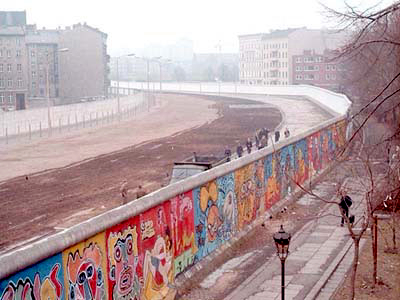
Divided Berlin, looking west to east
Noir included, kept on painting on the wrong side, once they were able to freely cross the border between West and East Berlin. Creating a monument out of the East Side Gallery based, as it is, on a misrepresentation of history is exactly the method that fascist and totalitarian regimes employ to enforce power and to educate through ideology, to create obedience and to stifle questioning. I would prefer that the authorities let the East Side Gallery crumble gracefully into oblivion rather than using it to represent a terrifying period of history in which it played – in its painted form – no part at all.
notes:
http://en.wikipedia.org/wiki/Berlin_Görlitzer_Bahnhof
Midas Filmes – www.midas-filmes.pt (translations by the author).
http://academic.evergreen.edu/curricular/incisiveline/handouts/printresearchpapers/relief%20printmaking%20essay.pdf
http://www.galerie-noir.de/ArchivesEnglish/walleng.html
http://www.be.berlin.de/en/stories/art/stories/thierry-noir/
ibid.
NB: I will try to integrate these notes into the text briefly. To my sources, thanks for your patience.


Fascinating post, Martin. Brings to my mind two stark tangents:
When I was working in a survivor’s clinic in Aceh after the 2004 tsunami there, I came upon a remaining wall that declared in red scrawl: “…this was not a dream, this is a tragedy.” And those words became central to a poem I soon made called “After the end after the beginning.”
Your post also brought a rapid desire in me to reread Edna St Vincent Millay’s “Aria da Capo.” Let’s build a wall, the playful shepherds suggest –
and now…I’ve excerpted on the rereading:
_____________________________________
CORYDON: Besides, this is the setting for a farce.
Our scene requires a wall; we cannot build
A wall of tissue‐paper!
THYRSIS: We cannot act
A tragedy with comic properties!
___________________________________
THYRSIS: Oh, yes. . . . I know a game worth two of that!
Let’s gather rocks, and build a wall between us;
And say that over there belongs to me,
And over here to you!
CORYDON: Why,—very well.
And say you may not come upon my side
Unless I say you may!
THYRSIS: Nor you on mine!
And if you should, ’twould be the worse for you!
________________________________________
…So cold . . . this is a very silly game. . . .
Why do we play it?—let’s not play this game
A minute more . . . let’s make a little song
About a lamb. . . . I’m coming over the wall,
No matter what you say,—I want to be near you. . . .
[Groping his way, with arms wide before him, he strides through
the frail papers of the wall without knowing it, and continues
seeking for the wall straight across the stage.]
Where is the wall?
[Gropes his way back, and stands very near THYRSIS without
seeing him; he speaks slowly.]
There isn’t any wall,
I think.
[Takes a step forward, his foot touches THYRSIS’ body, and he
falls down beside him.]
____________________________________________________
My own hope: let all walls fall. But sometimes, a surface, any surface, serves, as in the words scrawled after the end of the world, in Aceh. Sometimes, any surface will do.
(And having lived in Europe long enough to accept graffitti, which I found insulting at the start, on or near most of the great architectural surfaces of history,a thing that broke my heart for years–the landscape changes, for all its tragedies, and farces, and raisons d’etre. Ainsi soit-il.
best, Margo
Posted By: Margo Berdeshevsky on May 6, 2009 at 2:22 amReport this comment
Martin-
“Coaxing secrets out of vanished stone,” indeed. This is a such a rich meditation on walls. Do you have photos of where the wall stood? I’d love to see them.
And while we’re quoting walls, I’ve got:
“The Walls Do Not Fall” from H.D.
and Frost:
“Something there is that doesn’t love a wall.”
Posted By: Catherine Halley on May 6, 2009 at 12:24 pmReport this comment
Martin,
This piece is rather puzzling to me, in its tone. The idea seems to be that history is an inexorable, teleological progression, already set in stone, and operating according to its own logics: a withdrawal from Iraq is “inconceivable,” an epochal conflict of civilizations is “set to continue,” etc. The consequence, I’m guessing, is that the task of the poet/artist is merely to document such a historical unfolding, without in any way taking sides, as you so artfully and athletically do here. This must be what Ashbery meant when he talked about “a kind of fence-sitting / Raised to the level of an aesthetic ideal.”
But withdrawal from Iraq is not inconceivable, nor is the idea that you push here (and explicitly endorse) that “we” must extend the wars in the middle east–against the so-called “extremist” and “formidable enemy”–into Pakistan by any means a given, however much this seems to be the will of those in power. Not every artist and writer is a fence-sitter, nor is the curatorial preservation of some neutral “memory” the highest task for the poet vis-a-vis history. Not in my book at least.
Posted By: Jasper on May 6, 2009 at 2:32 pmReport this comment
Japser,
Thanks for your comment, which seems directed principally at the introduction to my post. I think to properly respond I would need to know what you mean by “teleological progression”. I am not talking about some divine pattern; I am not speaking of pre-ordained causes or some prime mover, in the Aristotelian sense; nor am I promoting a thousand years of empire. In fact, if you read further into my argument you will see that my description of the Berlin wall exposes the false teleology of the East German State, manifest namely in their building such an abhorrence in the first place, but also in their holding true, against all evidence, to the religion of Marxist historical inevitability, which at the level of communist state policy, required some rather unenlightened practices to prop it up, like citizen containment via walls, secret police and show trials, not to mention the shoot to kill policy of the GDR border guards.
Secondly, I did not say that withdrawal from Iraq was inconceivable, but rather that withdrawal from the “region” (i.e., the Middle East as a whole) was inconceivable. And I think that in my lifetime, and probably yours as well, this is, on a pragmatic level, true, especially in an increasingly interconnected world. Quite frankly, no one is going to be doing any withdrawing in the near future, especially as the whole notion of national borders is increasingly caricatured by the advent of supranational dependencies. I was also very careful not to use phrases like “epochal conflict of civilizations” since they always fall short of complexity, unless, as in Huntington’s case, they have a book and a lifetime of scholarship to back them up.
Thirdly, to continue to take the words out of my mouth that you seem bent on putting in it, I am not explicitly endorsing an extension of wars in the Middle East. Rather I am describing an “extension” that has become “policy” in the new administration. President Obama did not retain Robert Gates on a mere whim. Likewise, you are also re-assigning my use of the word “extremist” for your own generalizing purposes. I was very specific in my use of that word; it was meant to describe El-Qaeda’s ideology. If you have a better word, I’d be happy to know what it is. But it will have to account for the public execution of women in soccer stadiums by Al-Qaeda’s goons on the ground, the Taliban.
Lastly, I think you should look at who is taking sides and who is fence-sitting. Relativizing phrases like “so called ‘extremist’” fall short of the facts: the misuse of fertilizers, cell-phones and commercial aircraft, for example.
Martin
Posted By: Martin Earl on May 6, 2009 at 6:48 pmReport this comment
Martin,
Thanks for your clarification. I do struggle to distinguish between your “pragmatic” claim that continued US destruction in the area is inevitable, or necessary, and a more full-throated ideological justification. Isn’t this just hedging? And what do you mean by “supranational dependencies”? This sounds like bureaucratese for the same old US (and European) domination of developing countries. If I’m misconstruing your stance, please say so. No need to be shy. It’s easy enough to say whether you do or do not support continued military occupation of the region. No need to foist it off on some mythical pragmatics.
I’ll gladly concede “extremist” if you’ll also extend it to the US military, who have killed more people than Al-Qaeda and Taliban by several orders of magnitude. Or is there some categorical difference between, on the one hand, cluster-bombs, white phosphorus, depleted uranium rounds and remote-controlled drones, and, on the other, “fertilizers, cell-phones and commercial planes.” It’s likely to be a distinction I do not appreciate.
The facts are this: the US made Al-Qaeda and the Taliban (the two must be distinguished, as they have different aims: the latter is by no means a front for the former). Even if you think it’s cool to kill people in this region, the chances of success are nil. That such actions will strengthen the hatred of the US and Europe is virtually guaranteed.
Posted By: Jasper on May 7, 2009 at 10:39 amReport this comment
Margo,
Thanks so much for bringing this Millay poem to the thread. I hardly know her work at all, but this one is gorgeous and it makes me want to read more. If reminds me of an early Ashbery poem, “Eclogue” from Some Trees.
I followed your link to your page at Red Room…there’s so much there…the poem at Traffic East, “Whom Beggars Call” is fascinating.
Martin
For other readers, here’s the link to Red Room once again:
http://www.redroom.com/author/margo-berdeshevsky
Posted By: Martin Earl on May 7, 2009 at 8:18 amReport this comment
Thanks much Martin, and for the offer to further reading.
The Edna Saint Vincent Millay one-act play, which I took some small excerpts from to post here, (& which is indeed a long poem, as I read it) is a powerful piece that speaks hauntingly to me of walls and greed and competition and power and tragedy and farce. And, by extension, land grabbing, imperialism, colonialism. the whole ugly ball of wax. But being a poet, Millay did not preach, she wrote a context in which to see it all and end with a soft bang,no whimper. All pertinent to this thread, I felt.
Here’s a link to the whole one act play, well worth the read:
by Edna St. Vincent Millay, 1892-1950
http://infomotions.com/etexts/gutenberg/dirs/etext04/rdcap10u.htm
best, Margo
Posted By: Margo Berdeshevsky on May 7, 2009 at 6:11 pmReport this comment
Cathy,
Thanks for this comment…thanks because I can’t even remember if I was thinking about the Frost poem while I was writing this post. And yet that poem and many by Frost shadow me constantly. What I thought of immediately upon reading your comment was: of course, someone should write a book on the difference between walls in Europe and walls in the United States, especially New England where I grew up. In the states, except for very early on, there’s no sense of fortification. The stone wall, the picket fence, the privet hedge. They perform more of an aesthetic function, or a pastoral one. Of course in Berlin’s case “aesthetics” were engaged against the structure itself. This new phenomenon of the “gated community” is alien to the contemporary US – it seems more like an import from Europe, walled villages and cities, walls that once served real functions but are now mostly tourist attractions and reminders.
Martin
Posted By: Martin Earl on May 7, 2009 at 8:34 amReport this comment
Jasper,
To base your moralizing justifications on body counts leaves out the sad reality that we have to count bodies in the first place and why. To accuse me of thinking “it’s cool to kill” is simply asinine (and I do take offence at such infantilism) and to blame US support for the Afghan mujahiddeen on the present mess leads me to believe you haven’t read your history carefully. That support started thirty years ago, in another century and another context (before, I suspect, you were born) and was initiated even before the Russians invaded Afghanistan, by President Carter. Zbigniew Brzezinski warned Carter that this would provoke a Soviet invasion. And so it did. So if you want to blame someone for creating the Taliban, take it up with the Carter Center, and not with me.
In the meantime, why don’t you get a hold of The Black Book of Suddam Saddam Hussein, by Chris Kutschera. Here’s an exceprt from the introduction by Bernard Kouchner (you know who he is, don’t you?) the French doctor who invented Doctors Without Borders, and the current foreign minister of France:
Hearing the Victims
by Bernard Kouchner
It was Saddam Hussein himself who proved to be his country’s main weapon of massive destruction. For 35 years, he turned brutally on his own people. Right up to the final days of his regime, he conducted an “Arabization” campaign against Kurd-populated areas. Code-named Anfal, or the “spoils” of war, it resulted in nearly 500,000 people vanished without a trace, most of them women and children, and more than 4,500 villages erased from the map. Sadly, victims can’t be identified since the Iraqis lack sufficient DNA testing capability. As of 2005, some 4.0 million exiles still seek to return to their homes. The years of war and military operations have left some 1.5 million wounded and handicapped. Spoils of war, indeed.
Here’s an excerpt from Kutschera:
“For the Iraqis, there could be no doubt about the need to overthrow the Baghdad regime. Weapons of mass destruction? On more than 60 occasions, Saddam Hussein had been the first in human history to experiment their use by the state against its own citizens. His human rights violations? The thousands of villages erased from the map by Chemical Ali in 1988 or the hundreds of thousands of Anfal operation deportees serve as examples, among others. The links between Saddam and al Qaeda? The Kurds, who fought Ansar al-Islam infiltrators from Kabul in the mountain ranges, could see the reality of this on a daily basis, as they watched the regime strengthen its control over Bin Laden’s network. Iraqi national sovereignty? Everybody knows this sovereignty, born of a military coup, relied on a network of corrupt torturers…
Posted By: Martin Earl on May 7, 2009 at 2:05 pm“For these reasons, it is today critical at long last to win the peace in Iraq after the crucial step of successful elections. A legitimate Iraqi government will soon take power. I’m not alone in this belief: the most reluctant European states opposed to the American-British war have changed their attitude towards the United States. Sunni minority dictatorship and Baath party crimes have been stopped: this is progress. Even if America’s war is far from being won.
Even if suicide attacks will continue.”
check it out: here’s the site: http://www.oheditions.com/spip.php?article35
Martin
Report this comment
Martin,
I understand the history plenty well, thank you very much. My claim that the US is responsible for the Taliban, Al-Qaeda and Islamic fundamentalism rests only in a small degree on support for the mujahideen by Carter and Reagan. You keep pointing out that these policies were undertaken by Democrats, as if this were some sort of surprise to me. It’s not. I don’t vote for Democrats, (except the occasional, usually local, respectable one), I have no love for Carter, Clinton or Obama, and I take every opportunity to point out the involvement of Dems in ruthless imperialism of all sorts.
But the argument about US responsibility is a much larger one. There are two reasons why Al-Qaeda came into being, as many commentators have noted, and why it has vowed to destroy the US: 1) the support of the US for the apartheid, colonial settler-state of Israel and 2) the First Gulf War and the continued presence of US troops in region. Now, of course, all sorts of other offenses exist, but these were the original causes, and are still the most important. If the US were to stop sending aid to Israel, and pull out of Saudi Arabia (whose profoundly authoritarian government it hypocritically supports) and the rest of the middle east, Al-Qaeda would wither away.
You can call it moralizing, and you can infer that I have some sort of love for Saddam Hussein all you like, but the open question for you and your ilk is this: after the hundreds of thousands of Iraqis killed by the first Iraq War and the embargo, and after the approximately million or so Iraqis killed by the second, what has been accomplished precisely? How secure, democratic and conflict-free is the region?
Imperial apologists like Kouchner neglect to mention that when Hussein was massacring his own people in the 80s, he was being supported militarily by the US. (Please see this photo of Rusmfeld shaking hands with Hussein in 1983http://www.gwu.edu/~nsarchiv/NSAEBB/NSAEBB82/press.htm). The second time he massacred the Kurds, after the first Gulf War, it was because they expected that the US would support their uprising and the Shia uprising in the south. The US has acted like Ares in the region for half a century, playing all sides, pitting countries against each other, to its own benefit and delight. As such, anybody who still believes the US goals there have to do with the humanitarian canards that Kouchner offers is an even bigger fool than Kouchner (who is undoubtedly smart enough not to believe his own hokum ). The wars there are about access to markets, access to oil, and about assuring countries that might be tempted to buck the status quo that we are not above a military response as a disciplinary measure. But it has backfired wildly, this plan, and it has made the slow decline of the US into a precipitous one. This very fact turns all your implicit claims about the pragmatic necessity or inevitability of such interventions turn to dust. I’m sorry that I implied you enjoyed the murder of innocents in the middle east. I do understand now that you take such matters seriously. Would it be safer to say that, instead, you find it regrettable but nonetheless necessary? Is this what your practicality means? In my house, we call that cynicism.
I am happy, though, Martin, that you’ve decided to come down off your wall of false neutrality and speak a little bit more openly about your politics–aligned with “liberal” and “humanitarian” imperialists like Kouchner, as it seems. (I suppose you’re a fan of Bernard Henri-Levy and Christopher Hitchens, too). You’ve confirmed every one of my implications about your politics. It will make it easier to remember you.
Lastly, since we’re trading reading recommendations, you’d do well to make a study of Richard Seymour’s The Liberal Defense of Murder. It has your number.
Posted By: Jasper on May 7, 2009 at 3:17 pmReport this comment
1st: I love your english, so elegant, so refined;
Posted By: luna on May 8, 2009 at 7:47 am2nd: I don’t know if you took the photos of Berlin, but they are much more than mere sociological/historical portraits; they display an aesthetic quality (whatever that might mean);
3rd: Your narrative is a mix of bildung roman/artistic atlas/portrait of a «wallist» original intellectual eye;
4th: Didn’t quite grasp your position on whether «poetry makes nothing happen», or not. (Is it inevitable that poet and critic should collide?)
L.
Report this comment
martin,
you’re response to jasper struck me the same way as it struck him in a few respects. the received wisdom of these islamo-fascist experts (a field that was invented in the blink of an eye it seems) makes a lot of Iraq’s progress (a free press, elections, etc.) while setting aside any claim of independence (they are completely ‘dependent’ on foreign military presence).
“The wars there are about…assuring countries that might be tempted to buck the status quo that we are not above a military response as a disciplinary measure.”
–this is the classic definition of war as foreign policy as promoted by colin powell for decades.
the fact of a changed europe after wwII and mixed results in eastern europe after the fall of the soviet union (raspad sovetskogo soyuza), though, seems compelling reason to think a project to transform the middle east is not foolish and impossible, or a cover for pure po-co colonialism. a lot of the american engineers of 80s policy had their egos inflated terribly by the success of certain new democracies as a result of (sometimes almost-) bloodless revolutions (in some cases, we were ‘greeted as liberators’) and players like rumsfeld still operate with godlike belief in their ability to exploit and save nations at the same time.
that is all to say, like you always seem to signal–and some your readers are eager to misconstrue for the sake of argument–the machinations of history won’t be divided into dialectics.
it’s a shame jasper wants to badly to pin you down, or that he seems to think bringing up henry-levi is a putdown.
there was a lot of great stuff in there. proof that you’re much more than a mere enthusiast of the european scene, and for me already an invaluable witness to it.
thanks again.
Posted By: james stotts on May 8, 2009 at 5:06 pmReport this comment
let me apologize quickly for all the typos above; i still barely know how to type and so can barely think *while* i’m typing.
the fall of the berlin wall is an important anniversary, and i don’t mind adding that it was the beginning of another colossal population crisis in russia. not famine, and not the toll of war, but mass exodus and land-shed, low birth-rates and low life-expectancies. the crisis right now is bleeding russia dry and foretells a long, slow tragedy ahead. the shadow of russian empire is fainter than ever, and the nation stands to lose all of its international presence soon. just like america, but severely more so, russia is in decline. it’s puny saber-rattling in georgia last year is just a symptom of death throes. and america can expect our own hypocritical overblown nationalist pride to be bruised and slowly deflated over the next couple decades, i suspect.
Posted By: james stotts on May 8, 2009 at 5:21 pmReport this comment
Luna,
Thanks for your wonderful comment (and the encouragement). I wish the photos were mine, and I’m really glad you like them. The only one I labeled was the Izis Bidermanas – that’s London. I’d have to check back through my notes, but I don’t think I was able to identify the other photographers. I especially like the black and white one of the wall looking east to west. I think that’s Mühlenstrasse taken sometime in the early 80s, the site of the present day East Side Gallery. I download a lot of painting and photography from the web.
It’s funny how you refer to Auden’s line. That’s one I wake up with everyday and wonder about.
And your last question, is it inevitable that poet and critic should collide? Can you let me think about this a bit? I love writing criticism, almost as much as I love writing poetry. And I prefer to write criticism about work that I like, but let me think about this, okay?
What about you, do you think collision is inevitable?
One of things about Harriet, is that they get poets to do criticism and commentary, which makes it an interesting laboratory to test these speculations of yours. At any rate, I think it’s healthy that more and more poets are engaging in different kinds of criticism.
The old school of pure critics is almost gone. However, one these masters is still active and writing incredible articles. Frank Kermode. His book Romantic Image is one of my models, worth reading and re-reading. He is so knowledgeable and even-handed, though he tends not to write about contemporary poetry. Some of the best criticism of poetry today, or of literature in general, is buried in biographies. Richard Holmes’ Coleridge is simply breathtaking.
Martin
Posted By: mearl on May 9, 2009 at 7:58 pmReport this comment
Martin,
As I do not believe that neuroscience can illuminate anything about artistic activity (I disagree with the anti-platonic claim that «literature and erudite culture in general, is already well along the road to extinction», i.e. that poetry is about reference, information, neurological stimulus, progress…), I think that criticism does play a vital role in illuminating why poetry does not make anything happen», but instead is «a way of happening, a mouth».
In these lines, Auden does envisage a vital role for poetry (as opposed to political discourse, for instance, but not to Marvell’s ‘An Horatian Ode upon Cromwell’s Return to Ireland’, just to give an example of a highly political poem), a role which has something to do with perception, understanding, to a «self-examined life», to freedom from causality…
Follow poet, follow right
To the bottom of the night,
With your unconstraining voice
Still persuade us to rejoice;
ps. Isn’t Wordswhorth’s prelude and autobiography a way of happening too?
Posted By: Luna on May 11, 2009 at 9:04 amReport this comment
James,
To be blunt, Jasper’s problem is that his arguments fail to take in the complexity of how countries and cultures function. His responses to me are America-centric. He systematically discredits the venom that countries, tribes, sects, factions, war-lords, in short all that is local, reserve for each other. He thinks animosity against the US trumps local animosities and he doesn’t understand the strength of culture at that hard-scrabble level of plots of land, or where a river runs, and what a wall can do (remember Glendower in King Henry IV?…Cousins, of many men…). He’s into the big drama without realizing that the big drama is confected for people just like him. Politics in Iraq, for instance (now that they have politics) are not as dependent, as he would like to think, upon American occupation or influence. In fact, it is not really going as the US had planned. At a political level, it is clear that Nouri al-Maliki’s government is more influenced by the Iranians; troubling, though not surprising. In the West we saw the Iran-Iraq war, the whole eight years of bloodletting, as a war between two countries. A more accurate description is that is was a war between two sects, in medieval terms, a tribal and religious war, a civil war. Saddam’s Sunni dictatorship over a majority Shia population was, for post-revolutionary Iran, intolerable, just as the Shia diaspora was intolerable to Saddam. Saddam got his guns and his money from the US, but Iran had the advantage at the local level, which is why Saddam turned against his fellow Iranians, with chemical weapons, wholesale destruction of villages and communities and Stalinist-style atrocities via his secret police against anyone that disagreed with his kitsch agenda. America was, from their perspective, a bit player. A banking system. In their eyes, we are stupid idealists – something the American left has trouble understanding.
I would really like to here more of your ideas on Russia (poetry, politics, etc.). For the last three winters, each of them harsher for Northern Europe than the previous, manipulations of fuel supplies, have had a serious effect on Central European countries. You say that the shadow of the Russian empire is fainter than ever. And yet, they themselves are not behaving as though it were, and the return, in a kind of post-modern way, to command-control totalitarianism under Putin, which most Russians seem to agree with, tells us that, even without “empire status”, Western Europe and the US need to find a way to relate to and cooperate with the Russian agenda, more on Russian terms, that is without expecting them to behave “democratically”, especially since, these days, we’re not exactly behaving democratically ourselves.
Martin
Posted By: Martin Earl on May 10, 2009 at 7:15 pmReport this comment
Martin, I’ve ignored yr posts heretofore, but this completely untenable defense of the American occupation is too outlandish to let pass without refutation. You rehearse utterly familiar facts as if they revealed that you possess insight, & as if their rehearsal were enough to establish the justice of the American slaughter of Iraqi civilians.
I can’t imagine you really believe that Washington’s “interventionist agenda” really began after September 11 (although “it was in the works” before then; I’ll say!); if you do, then yr grasp of history is even more cartoonish than the embarrassing “introduction” to yr post reveals. September 11 changed essentially nothing structurally; you might have a look at the United States’ interventionist agenda since its inception, but if we just stick to the last forty years, a brief litany should jog yr memory: Vietnam, Laos, Cambodia, Grenada, Nicaragua, El Salvador, East Timor, Israel, Iraq, Iran, Serbia, Kosovo, to name only the most notable countries in whose affairs we “intervened” decisively.
If you want to regurgitate received wisdom & pretend it proves yr mastery of geopolitical history, I guess we’re stuck with it until yr unfortunate tenure at Harriet is up. But no one’s fooled by the charade.
Posted By: michael robbins on May 10, 2009 at 9:43 pmReport this comment
Michael,
Before I return to ignoring your posts, I wish to add that America also intervened in Great Britain in 1776, 1812, meddled with Great Britain’s secret ally the Confederate States of America in 1860, and also invaded Italy in 1943, and Germany in 1944.
Thomas
(now back to ignoring your posts. yea, you better believe it, ignore, ignore, ignore…I’m ignoring you…la la la)
Posted By: thomas brady on May 10, 2009 at 10:14 pmReport this comment
oil, well that is what russia is clinging to, and using like a blunt instrument. oil, arms trade, a large standing army–this is the world-power status formula that keep us and russia ever-anxious and uber-colonial.
it seems to me america’s military’s main mission is controlling oil-supplies, and not necessarily for ourselves. europe’s long, tense, peace is largely a product of our forceful presence. and if the u.s. could just make allies with pipelines and sidestep the messy business of inter-national diplomacy, they wouldn’t bother with embassies.
martin,
but isn’t america a little better-positioned to survive any loss of supremacy in the world-market? comparable mineral resources, more intensely-arable land, and (especially) a growing work-force. plus, borders that aren’t being challenged and eaten away at, even if, and probably largely because, they are so deeply compromised.
economic power is all about growth. colonial-like exploitation is expensive.
maybe i’m getting ahead of myself–i’m not nearly as confident predicting america’s success as i am russia’s decline.
speaking for my neighbors–we are stupid idealists, and buy into the narrative fallacies constructed for us all the time. (sorry, that should be: narrative IS a fallacy, as a rule.) the virtues of democracy themselves are all crudely misconstrued lessons in cause-and-effect, as if the u.s. were founded as a democratic nation, anyway.
but what about russia? what russians accept from their gov’t is more like skeptical resignation. their bureaucracy doesn’t function on such a basic level i think it would be hard for most americans to comprehend, we who are mostly ignorant of our own less-severe dysfunction because of a deep-seated material complacency. corruption and impotence are matter-of-fact assumptions in russian life, which gives putin a very different kind of power than u.s. presidents. democracy, rather than serving as a legitimate check against power, really just requires the powers-that-be to mass-manipulate public will as it operates to gain office. real elections are expensive. we are supremely propagandized. leaders seek power, and move through the organs of power however they can.
the problem poetry tackles, politically, is the integration of tendencies and particulars. it’s not really facilitated by freedom in any appreciable way. sergei gandlevsky, a russian poet who came out from the underground after the fall of the soviet union, has said that poets don’t matter in a democracy. when i asked him whether it was better to be a poet now, when he faces indifference instead of censorship, insignificance instead of persecution, he said it wasn’t better or worse, just different.
poetry is extra-moral, operates outside of morality. it is interested in true rather than supposed values, which is why great artists move so closely with nihilism, and why enthusiasm is a serious danger for a poet, either compromising his integrity or his life-and-limb. a rigorous spherics requires a justification, and want of the latter is always on the verge of ending the former, which is the definition for me of pragmatic experimentalism. experimentation (i.e., problematics) as alternative to suicide.
most of us really are just looking for what’s real.
i don’t know if i’ve really used this platform before to promote boris ryzhii, a russian poet who hanged himself in 2001. as a poet he was mainly concerned with finding a justification of life (which is actually the title of one of his collections, ОПРАВДЕНИЕ ЖИЗНИ). contemporary russian poets have to find a way to understand their new, very-changed status (which coincides significantly with the fall of the berlin wall!) and so confront this issue of morality automatically, and their success as poets, i think, can largely be measured along these lines.
my two cents. thanks for asking.
james
Posted By: james stotts on May 11, 2009 at 12:19 amReport this comment
Deeply agreeing with you, James, regarding America’s unconscionable oil/arms/power greed and global thirsts– and Russia’s lost chance at an optimism it breathed for just an instant in the late 80’s, when I first visited, and now has grievously lost under the neo/resurrgent hungers of Putin and his clan.
I’m remembering how an earlier poet than the ones you cite, Vosnesensky & his “Arrow in the Wall” appeared in ‘87 –apt to this post, again– I just read this short poem from it,which I find good to add to the brew.
I Am Goya, By Andrei Voznesensky
I am Goya
of the bare field, by the enemy’s beak gouged
till the craters of my eyes gape
I am grief
I am the tongue
of war, the embers of cities
on the snows of the year 1941
I am hunger
I am the gullet
of a woman hanged whose body like a bell
tolled over a blank square
I am Goya
O grapes of wrath!
I have hurled westward
the ashes of the uninvited guest!
and hammered stars into the unforgetting sky–like nails
I am Goya
TRANSLATED FROM THE RUSSIAN BY STANLEY KUNITZ
Posted By: Margo Berdeshevsky on May 11, 2009 at 2:15 amReport this comment
ps
Posted By: Margo Berdeshevsky on May 11, 2009 at 3:50 amI should self-correct, james. You did say “it seems to me america’s military’s main mission is controlling oil-supplies, and not necessarily for ourselves.” and that is a fine distinction in your post. the rest of mine- i hope says what else i wished to add, well enough.
best,
margo
Report this comment
Michael,
Why don’t you do me a favor: keep ignoring them.
Martin
ps:
Vietnamlaoscambodiagrenadanicaraguaelsalvadoreasttimorisraeliraqiranserbiakosovo, that’s a pretty long name for a country.
And I was referring to the Bush Doctrine (should have been more specific). Maybe you should move to Alaska. I’ve heard that you can see Russia from there.
Posted By: Martin Earl on May 11, 2009 at 7:19 amReport this comment
margo,
funny, ‘i am goya’ was the first poem i ever read in russian, when i was a kid in school. the bi-lingual edition, ‘anti-worlds,’ came out in ‘67 (my used copy, when i got it probably in ‘97, was already aged to a golden crisp) and had that same kunitz translation. actually it’s the very first poem; it was an early ‘un, and is his certified anthology piece.
that takes me back.
ferlinghetti traveled with voznesensky if i remember right, here and in russia. excepting a few very good poems (and ‘i–am goya’ is one of the best) i always group voznesensky with evtushenko–two poets that i think ultimately failed because of their flat ambition to become poets of the people. both could fill concerts and were incredibly popular, but allowed themselves to moralize with boring results. but, when i think about it, he was a cool poet and did write more good stuff than i’m giving him credit for.
james
Posted By: james stotts on May 11, 2009 at 7:33 amReport this comment
yes, interesting, james. my own experience when invited by the former soviet writer’s union to do a little translation which i was, alas, never, never a good enough russian language person to do at all well) – how-so-ever–my take on those 2 poets of the era was that Yevtushenko was indeed the purple socks and orange tie careerist, while Vosnesensky’s daring to speak out was more morally and poetically brave and less self serving. (babi yar could be said to be Yevtushenko’s great and most admirable exception.)then again, credit them both with making something “happen’ in poetry, in so repressive a gloom that yet filled stadiums. would that someone had been able to fill stadiums for poetry during the Bush years, ach. enuf.
best,
Posted By: Margo Berdeshevsky on May 11, 2009 at 7:57 ammargo
Report this comment
pls. forgive the double post, sticky fingers; for your trouble, here’s info on Millay and the play’s first production–wake of WWI, again adds context.
Aria da Capo was written in the wake of World War I by Prize-winning poet Edna St. Vincent Millay. The play juxtaposes the developed Commedia Dell’Arte form of eighteenth century France with the classical Greek “pastoral” theatrical style, and also exhibits dark absurdist overtones drawn from the modernist theater scene.
Edna St. Vincent Millay (February 22, 1892 – October 19, 1950) was an American poet and playwright and the first woman to receive the Pulitzer Prize for Poetry. Other verse plays include Two Slatterns and a King, The Lamp and the Bell and The King’s Henchman.
margo
Posted By: Margo Berdeshevsky on May 7, 2009 at 6:43 pmReport this comment