
Harriet

Categories

Harriet
Contributors

Archive

Blogroll

Politics

Sadness and Peepers

By Annie Finch

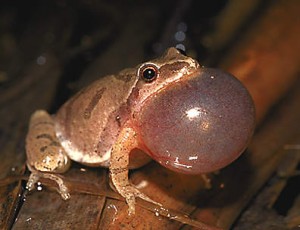
peeper1

I’m in my tent. I woke up hearing peepers and a big bullfrog. I can’t believe there is wireless in this campground. It’s a KOA in Woodstock, New York. I’m here with my daughter for a workshop called “Talking With Plants.”

Around dawn, all the peepers and frogs and crickets were singing in interaction with each other. It was utterly musical, truly a symphony. All one could do was listen. Clearly, they were listening to each other. The rhythms and melodic weavings were perfectly complex. It was awesome.

Then a very loud jet engine came over. I could tell they were all listening to that too, the peepers and frogs and the dawn birds that had been starting, because they altered their sounds as it came, just as they had been altering them in response to each other. But the jet plane wasn’t listening back. It wasn’t interacting. It was only making noise. Very very loudly. And for a long long time.

It threw the whole symphony off. I could hear them trying to absorb it into their music, but it wouldn’t play with them.

Then the cars started in, more and more of them out on Route 32, very loud ones. Before long, the whole symphony had disintegrated into noise, random and confused. It broke my heart.

Poetry’s job, one of the main ones, certainly, must be to help us learn to listen, to become part of the symphony on this incredible planet. Maybe then we will begin to hear ourselves, to hear what we sound like, and to change our activities accordingly.

I keep thinking about Eileen’s silence poems. They are part of this too.

2009-06-06

Comments (36)

  • On June 6, 2009 at 12:27 pm Mary Meriam wrote:

    Maybe silence is a basic human need, or planetary need. You and Eileen seem to be on the same wavelength – I remember one of your earlier Harriet posts talked about listening. In another discussion of women poets, a mother is having trouble writing poems because there isn’t enough silence, with all her children around. One reason I had to leave the city was to find silence. I found lots of silence out here in the boonies. It’s rare to hear any planes, and I’m down a dirt road, far from car noise. Silence is the best part about living here. Too bad, though, I can’t attend Eileen’s silence event. It sounds great.
    Report this comment

  • On June 6, 2009 at 2:33 pm Don Share wrote:

    The poet must mercilessly beat his eagle as well as his frog, if he doesn’t want to spoil his lucidity. – René Char
    Report this comment

    • On June 7, 2009 at 3:03 am Margo Berdeshevsky wrote:

      Best quote of the month Don! thanks.

      (one other I like, near tho’ not quite in the vein: “The wound that comes closest to the sun is lucidity. La blessure la plus rapprochée du soleil est la lucidité. — René Char)
      Report this comment

  • On June 6, 2009 at 3:10 pm Iain wrote:

    But why can’t poetry also help us listen to “noise”, which can be infinitely more complex than any “symphony”?

    I can think of plenty of “noise” that is very positive (any noises that help breakdown the coordinated symphonies of oppression), however, I understand that you are, in this context, mainly talking about the “noise” we create that breaks down nature and life on earth (i.e. our general wastefulness and carelessness as a species). In that sense, I’m on the same page as you as far as wanting poetry to play some role in helping us listen/read/cope/curb this issue.

    However (and this is a question for anyone who thinks that poetry can’t, or “shouldn’t”, be “chaotic” or “noisy”) why can’t poetry imitate noise/chaos in order to help us listen that way. If “noise” is a problem, shouldn’t some poetry be helping us understand that noise. Don’t we have to learn to “read” diseases before we can treat them? Why can’t some poetry study pathology?

    : : :

    Although, a jet engine capable of listening and playing along with frogs and crickets would be pretty badass.
    Report this comment

  • On June 6, 2009 at 4:57 pm Gary B. Fitzgerald wrote:

    .
    On Becoming One With The Universe

    .
    Tree frog on the windowpane,
    lime-bright green on a sunny day
    but tonight, a small black spot in silhouette
    against the kitchen’s yellow light.
    I see my wife inside the kitchen
    making dinner,
    a skillet on the flame.

    A moth rests also on the window,
    another small dark shadow.
    A pirouette and suddenly the frog
    and the moth
    the same.

    .
    Copyright 2008 – HARDWOOD-77 Poems, Gary B. Fitzgerald

    .
    Report this comment

  • On June 6, 2009 at 10:17 pm Christopher Woodman wrote:

    One of the main obstacles to development in the country where I live, Thailand, and indeed in much of South East Asia, is that people don’t read. Really, they don’t read, not even newspapers, not even comic books. And it’s not a problem of literacy either, in Thailand at least, because the schools are good at rote-learning and almost every modern Thai child has mastered the 44 consonants and 28 vowels they need by the age of 7 or 8. My mother-in-law can’t even write her own name, but then she moved into the jungle to escape the Japanese, and her community was too busy hacking rice paddies out of the teak to build schools. Yes, 20 years later my wife had the benefit of a thatched roof shelter with a single teacher for the whole village, but only until she was big enough to go to work in the rice at 11. And yes, she can read and write very well—amazing though, when you think about it.

    On the other hand, my wife had nothing to read, indeed she went through her whole education without a piece of paper–just a soft pebble from the river that left white marks on her slate. Later there began to be some newspaper wrapped around the few manufactured items in the local market her community couldn’t make for themselves, and my wife carefully guarded the scraps so she could read them after work, just before it got dark. There was no electricity until she was 25.

    I’m not off track, I promise you—I’m talking about why some cultures read and why some don’t. Because here in Thailand even the educated don’t read, even my colleagues in the very fine University English Department where I worked for 7 years don’t read–and there wasn’t even a Common Room with periodicals to while away your time between classes. Imagine that, being in a Unversity English Department where you don’t have access even to The New Yorker!

    The Thai government is very concerned about the absence of the reading habit among Thais for the simple reason that it inhibits democratic development. People simply don’t have the incentive to get themselves informed enough to know how to vote, it comes down to that–people just don’t know that’s important. At election time the village decides what candidate is offering the most baht for each vote, say $10.00, and then everybody votes for that person. The money is then distributed to one and all by the village head. If there’s some left over it goes into a big village stereo so that everybody can hear the joy.

    So that’s a serious state of affairs.

    What I didn’t understand about all this for a long time (and still probably get only about 20% after 15 years!) is why it’s so hard to get people in this community to read–anything! And the reason is that the society is built around a number one social imperative that says you must never be alone—and indeed no Thai ever voluntarily goes, does, or is anything all alone. The concept of a room of one’s own doesn’t exist in the culture (they all sleep together), and even an armchair alone with a book would be incomprehensible. People don’t read because they’re too much engaged with each other, eating, laughing, working, relaxing—you do it all together and you do it to have fun. A reader would look like a jerk!

    And then follows the question of Silence, the subject of this thread. It may be hard to grasp but most people in the world don’t like silence. Most himan beings don’t like silence, I’m saying, and avoid it because that’s the territory of madness and ghosts. And that applies to most human beings all over the earth.

    Here in Thailand everybody welcomes the karayoke cranked up, and everybody does it, full volume. People deliberately build their houses as close to the road as they can get, and live in their shops which stay open until they all go to bed because there’s no sense that leisure, what is more silence, might be better.

    And that’s the reality for most people in the world, and I think it needs to be considered in this argument.

    Is it possible we like silence because our world has so contracted? Is it because we’re not aware of anything other? Would that explain the quantum proliferation of “art” in the west in general, and so-called “poetry” in America? Trying to create the illusion of sound when we’re all manifestly deaf

    Christopher
    Report this comment

    • On June 6, 2009 at 10:56 pm Iain wrote:

      This is very fascinating.

      I’ve been trying to understand this obsession with “silence”. This sheds some light on it for me. Thank you.
      Report this comment

      • On June 7, 2009 at 12:17 am Christopher Woodman wrote:

        Thanks to you too, Iain. Because of course it was your preceding post, so unexpected, that got me started.

        I’m thinking of “Contact” again, and of the terrible clutter of noise that those big celestial dishes channel in to us. And the irony is that without all that noise there wouldn’t be any message, or if there were a message it wouldn’t make sense.

        The deafness I mention at the end is no message.

        Being so obsessed with silence is like shutting our eyes because the world is too busy, whereas the world may not be with us enough.

        Christopher
        Report this comment

  • On June 7, 2009 at 4:33 am michael j wrote:

    I listen to nature too sometimes. And wish I could understand what it is they’re precisely talking about. I was speaking with a friend recently and he was talking about how he used to take lizards, trap them in fish tanks, then leave them for the birds to eat. Then, he said, he graduated to shooting them with a bebe gun. He went on to conclude that the lizard had no words, the lizard wasn’t a word.

    It is always a wonder to me how us, as people, are able to speak to one another with this language (not only English, language period) we’ve built. And yet we have a hard enough time understanding one another. Or getting our point across as we want it crossed. And yet we’re so sure what it is animals think, what it is they do or do not know. There is such a certainty… I’ve always known that unless we can jump inside another person’s brain we can never fully know them. Only through their energy and their lifely actions. Same with the other animals. The fact that a dog dreams raises a flag to me that the difference between “us” and “them” is quite minimal, you know?

    I’ve always enjoyed silence. But aren’t humans kind of predisposed to some sort of noise? From the hum of the womb onward? I guess it’s “unnatural” noise which is an issue, that which interrupts and is unable to feedback.

    Talking to a toaster? A microwave? I’ve tried it. Doesn’t work. But I’ve also tried talking to spiders… they are kind of jerks. Birds are sound based creatures and hold the best conversations.

    Quick side note: I once saw a bird perched on my car window, looking into the side-view mirror, moving his head this way and that. I watched him for a good ten minutes, then went over to see what he was up too. He fluttered away. I went inside and came back out twenty/thirty minutes later…. and there he was, looking at himself in the mirror. Quite the vain thing he was…
    Report this comment

  • On June 7, 2009 at 9:30 am Jane Holland wrote:

    Nature is great. Especially frogs. You can get a lot of poems out of frogs, especially if you squeeze hard enough.

    When are you coming home? There are no crickets singing in the new Poetic Justice forum, but there has been a fair amount of barking and grunting here. The call of Nature … how marvellous it is.
    Report this comment

  • On June 7, 2009 at 9:29 pm Annie FInch wrote:

    There are people who do communicate with animals=-and plants–and they do it through intuition, inner listening. I’ve done this myself sometimes; it’s a capacity we all have. It might not be heard as a voice, but as a kind of body-awareness knowledge.

    I don’t think this post is about silence, though it relates to it. At the herbal workshop, I learned a phrase I like a lot which describes the way nature functions and perhaps the way traditional human cultures such as Thai culture function: “dynamic disequilibrium”: different voices and forces that interact and intersect with each other in fertile ways.

    Something different from either noise or silence.

    But when we have so much noise in our culture (which my herbalist teacher, I think, would define as something like the jet plane, a noise that doesn’t change and isn’t dynamic, alive, or evolving) perhaps we need silence to help us balance out back towards dynamic disequilibrium.

    Iain, I think clearly a lot of poetry, and a lot of art (“brutalist” architecture, for example) does seem interested in listening to noise, studying the pathologies of our culture, as you put it. In fact, I would guess that the majority of contemporary art is operating from that perspective. And clearly a lot of people find it worthwhile, so presumably it is performing a ncessary step.
    Report this comment

  • On June 7, 2009 at 10:36 pm Christopher Woodman wrote:

    “Dynamic disequilibrium,” yes indeed, Annie.

    One of the main problems faced by chiropractors is that most mature human bodies have become a mass of contradictions more than of natural, functional harmonies. Every accident we suffer goes into the mish-mash we know of as ourselves, one imbalance crazily hunkered up against another, and if the inattentive therapist removes the wrong crucial knot the whole cat’s cradle can unravel!

    A little like the disintegration of the Soviet Union!

    The key to what you say, Annie, is that “the different voices and forces that interact and intersect with each other” can do so “in fertile ways.”

    That’s profound indeed. That’s alchemy.

    For Thai culture, like most traditional societies, the imperative is a solidarity which discourages the individual from doing anything alone, even reading. Yet for a Thai the pinnacle of human accomplishment is to become a monk–indeed the popular word for a monk, phra, also means a Buddha!

    My little nephew has just become a monk at 11, and when he comes home for a visit his father bows down before him and asks for his blessing. Even more astonishing, the little boy’s mother cannot touch him any more, or she him. That’s one of the key rules of the Vinaya, the discipline that all Theravada monks follow.

    Indeed, being a monk is the very opposite of everything Thai traditional culture takes for granted in daily life. It deliberately imposes loneliness and silence on a person who has been conditioned all his life never to be alone or quiet!

    So it’s all very complicated, what we need, how we grow, what’s healthy. The sickest people I know are on the purest diets, and going organic for most westerners seems to become not only an expensive luxury but selfish!

    So silence is an antidote, or not–depending upon the malady.

    Christopher
    Report this comment

  • On June 8, 2009 at 3:01 pm John Oliver Simon wrote:

    Now I will do nothing but listen.” – Walt. Great lead-in for kids.

    I never heard real silence until I camped in the desert. Walking across the saltflat of Death Valley and up the long alluvial fan into canyons in the Panamint Mountains. Wind, raven’s cry, silence.

    It might be a question we could ask about various poets. Yah, yah, we know their words, but what are their silences like?

    “I heard a fly buzz when I died.” – Emily
    Report this comment

  • On June 8, 2009 at 8:45 pm john wrote:

    John Oliver Simon, thanks for the great Whitman quote.

    Association train (noise noise NOISE NOISE) —

    do nothing but listen –

    Hillary Clinton’s listening tour –

    Bill Clinton’s gift of a Whitman book to the young woman with whom he was having an affair –

    (noise noise NOISE NOISE) — and who complains about that? The Grinch, that’s who!

    Because . . .

    the NOISE can be JOYFUL

    (it’s in the Bible — “Make a joyful noise” — the Psalms — poems/songs — of David, the harpist/King) –

    on my bookshelf, next to Cage’s book SILENCE, another book of music-polemic,

    NOISE, by Jacques Attali –

    and the equation of NOISE and resistance to the ruling class –

    or as Public Enemy said, BRING THE NOISE –

    the story of the middle-class suppression of lower-class NOISE is chronicled in “The Battle of Christmas” too, the middle-class-ization, family-orientation-ization, of Christmas in the 19th century, against lower class noise/revel/wassail,

    which survives, slightly, highly regulated, in New Year’s Eve, Halloween, Mardi Gras –

    but/and it must be said –

    the lower-class noise/revel has a macho vibe — the manly manliness of 19th century urban pop culture –

    I love the desert camping too –

    and the family hearthside fire –

    and the frog chorus (a major tradition of Japanese poetry — books and books — of frog poems) –

    the frog chorus rocks me too, when I am able to come across it –

    (once on Orcas Island, indelible memory, the frog orchestra, and later that night reciting an anonymous 18th century poem around the campfire) –

    once, summer ’85, 2 in the morning, I recorded a duet for harmonica and crickets way out off a country road . . . one of my favorite recordings . . .

    also summer ’85, wrote a song for a herd of buffalo that a rich farmer kept, went to the salt lick with a portable recorder to record it with them, a fence between me & the herd, but at the first sound of the music the buffalo split –

    LISTENING — YES — the Voices of the Animals and the Wind and the Water — YES — but I love the NOISE too,

    (the concerto for car horn and sax quartet by the Billie Tipton Memorial Saxophone Quartet — marvelous) –

    which maybe isn’t too far from what Annie’s saying, with dynamic disequilibrium –

    “No sound is dissonant which tells of life” — Coleridge.
    Report this comment

  • On June 8, 2009 at 11:01 pm Christopher Woodman wrote:

    That’s great, John–real noise pleasure, even in your synapses!

    Paul Winter’s tremendous Missa Gaia. (I heard it performed live in the Cathedral of Saint John the Divine in the late 80s, I think. Is anybody still interested?)

    Or Olivier Messaien.

    Just wanted to say that where I live the women, all beautiful, all smiling, speak in tiny little-girl voices, way up there, and if they did eat butter it would certainly not melt in their mouths.

    In public at least.

    In private they shout, indeed the more comfortable they feel the louder it gets–so much so that I often feel the women are just about to come to macho blows.

    Audrey Hepburn as the Wife of Bath!

    No place that you know is ever what it seems to somebody else!

    Christopher
    Report this comment

  • On June 9, 2009 at 2:28 am Eileen Myles wrote:

    I’m glad Christopher mentioned the family monk because I was thinking, wait, no silence in Thailand, what about monks, what about meditation. I was just reading a book about suffering by Peter Trachtenberg and he goes all over creation looking for how and why people suffer and he talked about some of Simone Weil’s thinking that mirrored parts of the kabbalah where they believed that originally god was an ocean that covered the earth but eventually he receded to make room for people and he receded out of love knowing that nothing could exist in a world in which he was fully present. The idea includes the idea that god would submerge the world again and that the world was in a way waiting for that – I guess god and inundation. When Annie described the planes I was wondering what part of god or nature or music they are. The first time I ever heard Robert Creeley speak he was rambling beautifully about some oil slick in Bolinas and how we had to learn to love it somehow. Some days I can love a jet’s boom but probably not from a tent.
    Report this comment

  • On June 9, 2009 at 3:36 am Christopher Woodman wrote:

    Right spot on there, Eileen–at least you strike all my chords

    In Gravity and Grace Simone Weil says:

    “God could create only by hiding himself. Otherwise there would be nothing but himself.

    Holiness should then be hidden too, even from consciousness in a certain measure. And it should be hidden in the world.”

    But that’s hard, as is everything about her life, and everything she says.

    On a much more accessible but perhaps even more profound level, Louise Glück writes in The Wild Iris,

    We never thought of you
    whom we were learning to worship.
    We merely knew it wasn’t human nature to love
    only what returns love.

    Even the Catholic Mass can astonishingly proclaim, “Oh sacred fault, oh blessed sin of Adam,” and there have been plenty of sects in which Judas is revered as the highest and holiest of the disciples, for without Judas sacrificing himself, his whole soul, his whole life and reputation, the great act of redemption could never have taken place!

    Ouch, but tell me it isn’t so!

    Also, Eileen, did you notice that pronoun in my little thing about the monk in my family? “It [being a monk] deliberately imposes loneliness and silence on a person who has been conditioned all his life never to be alone or quiet!”

    Because in the Theravada (the Hinayana, or southern Buddhism) a woman cannot be ordained as a nun at all, and if she still wants to join the temple and take the monastic vows she has to stay outside the holy space and cook and clean for the men inside. Indeed, it’s felt in the culture that a woman can only make progress toward enlightenment if her son becomes a monk, which many men do just for that reason. Sons do it early in their lives too, otherwise they’d have to share that merit with their wives, and every man wants it all to go to his mother.

    So it’s always the same. Religion may be organized by the men but it’s lived by the women.

    Still, ouch yet again.

    Christopher
    Report this comment

    • On June 9, 2009 at 4:43 am Christopher Woodman wrote:

      I should have said that none of this is in the Sutras, that indeed most of the stuff in which Buddhists really ‘believe’ is not in the Sutras at all. It’s just cultural accretion.

      The Sutras are so bare they’re boring–they just give you a lot of detailed instructions about what to do (be mindful) and not to do (lie), assuming that if you follow these simple instructions you’ll find out all the answers for yourself. Even the question of God is never addressed by the Buddha, and indeed there’s nothing whatever in his teaching to believe.

      Reincarnation was a Hindu belief that never got quite eradicated, yet ‘Buddhists’ all over the world base their practice upon it–”acquiring merit,” it’s called. Same with all those things the Tibetans are so famous for, speed walking, flying–that’s all just old shamanistic hat. The Buddha forbad the development of all psychic powers, period–nothing, he said, develops the ego faster.

      Some Tibetans even feel that’s why 1959 happened, that Tibet had it coming.

      Spiritual egotism, trying to hold a spiritual tradition intact!

      Christopher
      Report this comment

    • On June 10, 2009 at 2:37 am Eileen Myles wrote:

      I’m not sure I’d call that “lived” by the women. I’d say more like accessorized.
      Report this comment

  • On June 10, 2009 at 4:34 am Christopher Woodman wrote:

    Eileen,
    I know exactly how you feel, and it makes me so angry sometimes when I’m visiting even the most beautiful Buddhist temples around me here, so radiant with tranquiity, I just have to stay outside and fume.

    Fortunately not always, but sometimes–when I’m in one of my lesser, more critical moods.

    What we have to do is remind ourselves that there’s another side too, that life really isn’t about fairness anyway–or like I used to say to my children, not fair is not allowed here. Because in the context of a life Mucius Scaevola (sp?) really was freer than the emperor, even pinned and tortured in his barrel. He really was–and would be still.

    Like Simone Weil, who chose the barrel of her own free will.

    Indeed, if you examine the lives of the majority of women in unexamined cultures, I mean the actual lives of the women, what happens in their hearts, in their soul, you’ll find that despite the restrictions their lives are still richer and even freer than the half-life of their galivanting, conscienceless men.

    But I do feel that religions that abuse women aren’t really valid on any human or spiritual level, at least not any more. On the other hand, religions that aren’t difficult enough aren’t worth their salt either, and too much hugging puts me off too. Or too much good blather.

    Oh dear.

    Christopher
    Report this comment

  • On June 11, 2009 at 9:50 pm Christopher Woodman wrote:

    Just read Annie’s original post over to try to figure out how we’d arrived where we’re at. It’s certainly not where Annie was going personally as she wrote it, for sure, and I apologise for my own noisy intrusions.

    So this is for Annie, an apology.

    We human beings are like plants too, we also need a lot of manure to grow.

    Take the lotus, flower of love, flower of compassion. In reality the lotus is a very mean plant–it’s large, aggressive and with very ugly personal habits. It grows best in the most noxious mud for a start, and I mean mud that’s the soak away from cesspits, something we don’t experience in the west anymore, fortunately, but which is normal where I live. (You smell the bouquet everywhere!)

    And it’s pushy, the lotus, prickly and selfish–it juts up out of the mud and overshadows everything else. Indeed, if you want to welcome some beautiful aquarium fish into your pond, for example, or grow some delicate plants, water lilies for example, you have to tear it up first. But it’s a stubborn infestation, the lotus, and takes a number of seasons to get rid of. A lotus never just shuts up and goes.

    And yet, right in the middle of its mess, flowers the best in us.

    Christopher
    Report this comment

    • On June 11, 2009 at 10:47 pm Annie FInch wrote:

      Eileen, I remember gary snyder saying that parking lots are just as much part of nature as anything else–metal and asphalt coming from the earth etc.. I liked that. Also, soemtimes I have felt that machines are interactive with everything else in my life–the times they choose to break down etc.. I definitely do believe they are part of the goddess, if not of god (goddess often being understood as more about what’s immanent and inherent in the specifics of life.)
      Everything is.

      But how much i can allow them in and still protect space for the more natural part of nature is a question. I spent a half hour with a chickweed in this workshop and it touched me in an utterly new way from anything I’ve ever listened to. Definitely different from the jetplane. But I haven’t made that kind of space for a plant before. I want to make more space for the chickweed.

      Christopher, thanks—I’m very very happy where it went! That’s part of the Harriet energy, no apologies needed.
      Report this comment

  • On June 11, 2009 at 11:03 pm Christopher Woodman wrote:

    Thank you for being so generous, Annie.

    I was in Scotland when Findhorn first started, and we all started trying to talk to plants at that time.

    The secret is that we have to be awfully quiet ourselves to hear what they say. Also plants talk a lot more when we’re not there at all, so we have to sort of sneak up on ourselves to overhear them–and certainly never tell anybody else what they say.

    It’s top secret.

    Christopher
    Report this comment

  • On June 12, 2009 at 1:50 pm Annie FInch wrote:

    These particular plants (including chickweed, catnip, violet, White pine, wild lettuce) are, according to our teacher Susun Weed, “blabbermouths”–and mostly they wanted to tell us how we can best use them. She made a convincing case that listening to plants (not trial and error) is how plant uses have always been learned in indigenous cultures. . .

    I guess the Findhorn plants were talking on other topics.
    Report this comment

  • On June 12, 2009 at 7:36 pm Christopher Woodman wrote:

    I was just being clever, Annie, and I’m sorry.

    Christopher
    Report this comment

  • On June 14, 2009 at 3:06 pm Terreson wrote:

    Just now coming to your thread, Annie Finch. It brings up memories perhaps amounting to a slightly different spin on your theme. For 8 years I lived in a deep forest environment (Pacific Northwest). Three of which were spent in the foothills leading up into the north Cascades, close to Mt Baker. There I had a home on the side of Mt Haner, a 3,000 foot mountain, and the area had not been logged over in almost 100 years. Another 5 years were spent caretaking a 50 acre estate on the north Olympic Peninsula and overlooking the Elwha River. The estate was fairly high in elevation and up against the Olympic National Forest. My only neighbor was the old lady who owned the estate with whom I had only rare dealings, she being pretty reclusive. (Demanding too.) My job in those years was with the State of Wa., chasing gypsy moths through out the state. It was seasonal work, occupying me no more than 8 months a year, sometimes less. And so for a good 4 over-wintering months I had only perfunctory human contact, amounting to a trip into town for provisions.

    It was in the first of the two habitats that I noticed something. Hiking up the side of the mountain it seemed to me, and to my suprise, there was no silence. (As I say it was a deep forest environment with forest floor mass so deep I sometimes did not touch the ground and forest composition was such it was starting to return to a climax forest of hemlock and doug fir.) Drawing on the experience in a poem about a hundred year old mining disaster that had occurred in the vicinity, I called it a chorus of girlie voices. But the description is only approximate and I can’t be more exact. Or maybe it was like a chorus of young children, young boys whose voices hadn’t changed yet. I don’t know. I just know I could hear something whenever I was hiking, and over the sound of my own steps. I could hear it on the estate too, but not as sharply. The property abutted a wide clear cut on two sides. While my environment was deeply forested it didn’t extend out as far, which may be relevant.

    I suppose it is possible I was experiencing an auditory hallucination. They say too much solitude can mess with the brain. And, in fact, towards the end of the time a towny friend pointed out to me that my behavior was a little strange. Not irrational, exactly, just a little accentuated maybe. (Herzog’s grizly man movie touches on the subject.) But I still remember that sound, that chorus of voices. It certainly seemed real enough to me then.

    These days I live in a city. The transition produced what I can only call environment shock. Even more so for my girl dog who was born on the estate and knew nothing else for five years. Fortunately, my job takes me out of town, into the parish, to bee yards mostly situated between bayous. But I don’t hear that chorus here.

    Terreson
    Report this comment

  • On June 15, 2009 at 9:50 pm Annie FInch wrote:

    Yes, exactly. Or, as quoth the bard, “the poetry of earth is never dead.” It’s wonderful to read about such moments, whether in Findhorn or the Cascades.
    Report this comment

  • On June 15, 2009 at 10:03 pm Gary B. Fitzgerald wrote:

    It isn’t often one finds a post on a poetry site featuring frogs. It seems only proper, then, that we close out this thread with a poem that has a frog in it. I apologize in advance for being totally off-topic but, hey, frogs is frogs (and, well, who hasn’t been off-topic here?). I also apologize to those of you who are disinclined towards the green and the slimy but, fear not…they’re only a metaphor. :-)

    Besides, I would ask how many of the rest of you even have any frog poems? No? Thought so. I win.

    .
    Evolution
    (Intelligent Design)

    Overwhelming diversity, constant multiplicity,
    extending still complexity, an existential mystery
    yet the polarizing entities are questioning reality:
    an accident of Being or a Being’s creativity?
    Inexplicable Cosmology, quantum relativity,
    omnipotent Holy monarchy or irrelevant necessity?

    A frog jumps and ripples ring the pond.
    A leaf floats up and down upon it.

    .
    Copyright 2008 – HARDWOOD-77 Poems, Gary B. Fitzgerald
    Report this comment

  • On June 16, 2009 at 11:32 am Bill Knott wrote:

    a few froggypoos:

    http://billknottpoetry.blogspot.com/2009/06/frogpo_16.html


    Report this comment

  • On June 16, 2009 at 3:14 pm Gary B. Fitzgerald wrote:

    Toad-ally cool, Bill.
    Report this comment

  • On June 16, 2009 at 9:02 pm Terreson wrote:

    Well, any witch will tell you sure
    there is no one better familiar
    than a frog, not even cat or dog.

    Maybe it has to do with the amphibious,
    a step between me, you, and fish brains.

    I met a lady one night, a retiree,
    this was down in St. Augustine.
    When it came time for me to go
    she pointed to her garage door.
    You know the scene: back door’s strategy.

    There on the floor were hundreds, maybe
    tens of hundreds of frogs, all
    facing the suburbanite’s main exit.

    Oh, she smiled at the sight of them.
    I smiled too and never saw her again.

    (A bit of spontaneous doggerel for one of the few Texans I like.)

    Terreson
    Report this comment


Posted in Group Blog, Politics, Uncategorized on Saturday, June 6th, 2009 by Annie Finch.