
Harriet

Catherine Halley

Do Non-Poets Buy Poetry Books?

poetry_books

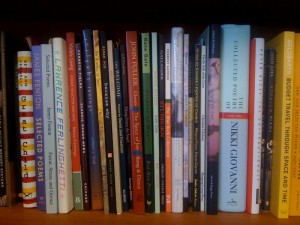
Do you know any non-poets who buy poetry books? If so, what books do they buy? Anthologies? Books by particular poets? What influences their decision to buy those books? I ask because there was an interesting discussion going on about this over at WOMPO–the Women’s Poetry Listserve.

Bookmark and Share

27 Comments for “Do Non-Poets Buy Poetry Books?”

  1. The constraint-based book Eunoia by Christian Bök went on to be the bestselling book of poetry ever in Canada and made the top ten bestseller list in the UK on a list headed up by Barack Obama. While the reception of Eunoia was acclaimed in academia, it was more beloved amongst the general population, finding its way into thousands of homes of readers who would more likely have a volume of Donald Hall on their shelves than Pounds Cantos.

    Posted By: Kenneth Goldsmith on August 10, 2009 at 10:32 am
    Report this comment
  2. Well, at least one does. I’m a 52 yr old Episcopal priest. I do not write poetry, but I do read it. Latest purchaces (and actually some reading done within them): Oxford Book of Latin American Poetry; Ray Gonzalez’ Faith Run; and Suzanne Gardinier’s Dialogue with the Archipelago. I’m pretty much inclined to buy anything that Copper Canyon, New Directions, Ecco, and Archipelago Pr. publish; more selective for university presses as well as the big publishing houses–Norton, Knopf, FSG, but still buy a lot of their stuff as well…Seidel’s collected springs to mind.

    Posted By: Grant on August 10, 2009 at 12:37 pm
    Report this comment
  3. For my friends, the two things that gets them to buy is:

    meeting the poet, and being intrigued to see what else they have to offer…

    to support what they want to know more of: love poetry books or social justice books.

    Posted By: Mozart Guerrier on August 10, 2009 at 8:48 pm
    Report this comment
  4. I do know non-poet buyers/readers: doctors, lawyers, dentists, realtors, priests, & Indian chiefs. & people whom I sit next to on airplanes :) But a common denominator is they mostly “wish” they were poets.

    One curious difference–in Paris there is an annual “marché de la poésie” – an open-air square of book stands in front of a famed church, filled for late spring days with sellers and buyers of small hand made editions, often illustrated, as much art-objects as books, published in France & elsewhere in Europe. This market has always impressed me that there are buyers for poetry that is not a business, in the American sene. The editions are significantly small, & no poet who publishes feels diminished, or aspires to be Collins or Oliver. These are publishers, editors, & poets, who do it for love, not Amazon or academia. (I don’t believe it’s the only way, certainly. I can admit hope to be read, if possible, across a few spaces. But this scenario has always reminded me what art for the art is.I never hope to ignore that.)

    margo

    Posted By: Margo Berdeshevsky on August 11, 2009 at 2:20 am
    Report this comment
  5. Margo, your mention of the Paris affair brings up another point. The sizes of poetry books. (If this has been discussed already, I apologize.) The common large sizes are unnecessary, and, I imagine, intimidating to the general public. Why must books of poetry be 100 pages long? My idea of a perfect book of poetry is “Like a Bulwark” by Moore.

    Eleven poems in a handsome hardcover. About 20 pages with lots of white space. A brief collection that allows one to have a sense of the horizon as one moves along. It welcomes the general public. It looks like a children’s book. But it delivers something else. It is a little jewel that you hold in your hand.

    100 pages of Ashbery? Sheesh. (And I like him quite much.)

    Posted By: Dermot on August 11, 2009 at 6:42 am
    Report this comment
    • Sure Dermot, good things can/may come in small packages…by small editions I wasn’t referring to book size so much, tho that can be a way to make a specific treasure–, but to print runs. Less emphasis on numbers, more on the treasure.

      & just a thought to Sina & Daisy–re good/bad theatre/poetry/fiction – all the same, really, to me–like the girl with a curl, when she’s good she’s very very good & when she’s bad, she’s horrid. (Back as far as Hamlet’s hope for the “play’s the thing wherein I’ll catch the conscience of the king,” one can hope for the play or the poem or the “art” in its best sense, to do its job. When/if it does, no matter the size…it’s a good day.

      margo

      Posted By: Margo Berdeshevsky on August 11, 2009 at 11:15 am
      Report this comment
  6. If you read poetry they say you’ve at least tried to write it, or want to, or wish you are a poet. I imagine the same is true for listening to music–you sing, or you want to.

    I do think non-poets buy poetry. They just have to find their way to it. I don’t think the poetry biz does a great job of getting outside of its circles. As Kenny points out in his recent post, the UK edition of Christian Bok’s book sold out days after an interview (BBC? Something like that?).

    Extreme case, but yes, they found their way to the poetry.

    Which is why I love those How Poems Work columns that occasionally appear in newspapers: they get poetry to unsuspecting readers. And often with great results.

    Posted By: Sina Queyras on August 11, 2009 at 7:03 am
    Report this comment
    • I was talking to some playwrights up in Provincetown last week–we seemed to talk about the same kinds of things–that if you don’t grow up seeing plays and reading poetry, and if you don’t begin forming adult taste by picking and choosing among what you like early on and continuously, you’ll end up without taste, and therefore without a way in to encountering new kinds of work. So people do want to see contemporary plays (not just Broadway musicals), and they do want to read contemporary poetry (not just xxxxxx fill in the blank for your fave contemporary love-to-hate poet) but they don’t know where to begin or what might appeal to them. They haven’t gotten into the habit of encountering contemporary art. Of course, too, plays are expensive. Poetry not so much.
      Daisy

      Posted By: Daisy Fried on August 11, 2009 at 8:44 am
      Report this comment
  7. Agreed, Daisy. I love the theatre but I don’t love sitting through a bad show. Nothing quite as bad as that–you can’t put it down, you can’t walk out, and sometimes you can’t breathe.

    Sadly, I guess this is why book prizes have become so important–it’s one way to wade through the slush pile. But it’s not the best way. What would one think of theatre if they only saw plays that won a Pulitzer?

    A non-writer friend once told me poetry was a much better investment than fiction or theater: unlike theatre you take it home, and unlike a novel every time you pick a book of poetry up, it’s different.

    Posted By: Sina Queyras on August 11, 2009 at 9:12 am
    Report this comment
    • Sina Queyras-
      I recently moved across the country, and sold the majority of my books. Not the poetry. Not one volume of it. I think you’ve hit on something quite true–poetry has staying power.
      Of course, some fiction does too. I hung on to my four different editions of Djuna Barnes’ Nightwood, my Lorrie Moore and my Graham Greene too.
      Albertine

      Posted By: albertine on August 11, 2009 at 9:46 am
      Report this comment
  8. I know two, but one used to write poetry, and the other is a songwriter.

    Regarding prices:

    1. I miss small paperbacks! Kenneth Koch and Ashbery used to come out with books that size — I love them because they fit in an inside jacket pocket. Ever since Penguin classics followed the lead of Stallone, Springsteen, and McMansions, and needlessly bulked up their reprints, they’ve become less attractive and more expensive for no reason other than mirroring an era of conspicuous largeness.

    2. Theater Oobleck in Chicago (of which I was a co-founder) charges “pay what you can.” In 25 years they’ve produced 66 original plays (or evenings of short plays), almost all of them to rave reviews, and few serious theater people outside of Chicago have ever heard of them. It’s like a local band with 66 original albums, or a poetry collective with 66 books — a sad indictment of the state of national cultural awareness that they’re so obscure. None of them make a living from it, though they do get some grant money, and even before grants came in, for many many years the gate paid all production costs; they’ve never lost money to pay for rent, props, and sets.

    Anyway, Daisy, theater in Chicago isn’t all expensive. Check them out next time you visit Poetry HQ.
    http://www.theateroobleck.com/index.html

    Posted By: john on August 11, 2009 at 9:38 am
    Report this comment
  9. Catherine:

    Do Non-Poets Buy Poetry Books?

    Based on the numbers I’m seeing and notwithstanding the encouraging exceptions noted by others, my short answer is no.

    Some of my non-poet friends have a few of the classics in their library but admit they haven’t read them in their entirety. None are quick to discuss contemporary poetry, let alone buy it.

    Insofar as my poet friends who do purchase the occasional book are concerned, it is usually because they’ve met the poet, often after having been dragged to a poetry reading. My experience echoes Margo’s:

    But a common denominator is they mostly “wish” they were poets.

    For what it’s worth, I suspect that this may always have been the case. Even in poetry’s heyday, when newspapers and non-literary magazines included it in their pages, I’d wager that most of the readers were frustrated/aspiring poets. Also FWIW, I believe that book sales may have been the third most lucrative source of income for professional poets in general, after (in both the chronological and quantitative sense) public appearances and magazine/newspaper royalties. Think of the poets who never published a book during their careers! Alas, in this era when NFL Network mentions poetry more often than PBS does, book sales (and teaching salaries, of course) have become the only potentially significant return we can measure.

    Best regards,

    Colin

    Posted By: Colin Ward on August 11, 2009 at 12:40 pm
    Report this comment
  10. I love reading poetry, and though I have written poetry, I’m not a poet. I buy, read, and share books of poetry and individual poems torn from the pages of The New Yorker with other non-poet friends. For some of us, reading Mary Oliver (for example) is a spiritual experience, bringing peace and comfort, a sense of greater mystery, a respite from the chaos of the world that is “too much with us.” I read Billy Collins because he makes me laugh and John Donne when I want to spend time the language. I have one large bookshelf dedicated to books of poetry, everything from anthologies to several volumes of Adrienne Rich.

    I bought and read poetry long before I became an English major, and my notes on poets and poetry go all the way back to junior high school. I have a few non-poet friends who have a similar background and similar bookshelves, and I know this isn’t typical. I wonder if there might be a gender difference in the answers to your questions.

    I love the question, and it’s been interesting reading the answers. Thanks.

    Posted By: Verna Wilder on August 14, 2009 at 4:21 pm
    Report this comment
  11. Well, I guess it depends on what you define as a ‘non-poet.’ Both myself and many of my friends have studied poetry, write the occasional poem for private consumption and buy poetry books – but I’m not sure whether that make us poets in the formal sense? I believe that many people are poets without ever realising that they are, let alone being published. Many people I know buy and enjoy poetry books – mostly anthologies, comic poetry plus some of the classics i.e. Shakespeare. What influences their decision to buy? The literary canon, cut price book deals, books that are recommended by friends.

    It would be interesting to see what responses you’d get through a non-poetry related poll for comparison…

    Posted By: Lucy Morris on August 15, 2009 at 12:28 pm
    Report this comment
    • Verna and Lucy,
      Nice to hear from you both. Verna, you say your notes on poetry “go all the way back to junior high school…” I’m intrigued by this. Most readers don’t respond directly to the work. Have your thoughts on poetry changed over the years? I am also interested in your statement that you are looking for poetry that takes you out of the world already “too much with us.”

      I hear you on that, but hesitate to thin that poetry should only be solace, or lament, or any one gesture. What about poetry that helps us be in the world differently?

      Best,

      Posted By: Sina Queyras on August 16, 2009 at 10:00 am
      Report this comment
  12. Speaking of the size of volumes lately, I would absolutely agree that books of poetry have become laughably large, and take up a useless amount of space. Big white pages that stretch well beyond a poems’ end, font sizes for the near-blind, and gaping gaps between lines take away that which I most love about poetry: their portable presence. When I read poetry, I am celebrating for a short moment of reading something which can lift me up, again if only for a short moment, at any time, in any circumstance. Poetry that can be carried around at all times provides a magnificent source of comfort to which one can turn whenever necessary-and many more times in gratuitously fun reading. Having said that, I have found that there is a German publisher by the name Reclam who prints books (and some in English) in very readable font, yet at roughly the size of the palm of your hand. Poetry for your pocket is absolutely necessary-I have a copy of about 150 Shakespeare’s sonnets which I carry in my back pocket and love every line of it.

    Posted By: Zach on August 15, 2009 at 2:45 pm
    Report this comment
  13. Lucy and Verna,

    The question is a funny one — “are you a poet?” is a question of identity, and I understand why you answered as you did even though you both write or have written poetry. “Do you write poetry?” is less vexed and vexing a question — it asks what a person does instead of asking them to define themselves by what they do. I wrote a lot of poetry in college and then thought I had stopped, but always kept buying books; but now since I’ve started writing more regularly again (inspired by the internet — thanks, Harriet! [and others]) and am talking with an artist friend about doing a book together, I realize that I had never completely stopped; and that I still wouldn’t call myself a poet. I don’t hesitate to call myself a musician, even though I’ve never made a living from it (”semi-pro” is a term I’ve romanticized from sports); and I’m always interested to know whether anybody I meet plays music too, being a big believer in amateur music-making.

    Thanks for your answers — very interesting!

    Posted By: john on August 16, 2009 at 8:56 am
    Report this comment
  14. Thanks for the opportunity to add zest to my life, among the many other avenues! So much to read, and so little time! Thanks be to God for all the individual He created!

    Posted By: Sandy Kirkley on August 16, 2009 at 7:51 pm
    Report this comment
  15. Who is poetry
    What is it
    Do you write
    Do you love?

    Are you full
    Are you empty
    Do you sing
    Do you speak?

    Is poetry success
    Is it being asked
    Do you feel it
    Does it flash by?

    It may be
    being alone
    wishing and remembering
    writing the first thoughts
    and leaving them for others.

    Posted By: Howard Partch on August 23, 2009 at 6:34 pm
    Report this comment

Comments for this post are closed.

CONTRIBUTING WRITERS

Thom Donovan
Bhanu Kapil
Fred Moten
Craig Santos Perez
Sina Queyras
Sotère Torregian

STAFF WRITERS

Cathy Halley
Michael Marcinkowski
Travis Nichols
Fred Sasaki
Don Share

About Harriet

RECENT COMMENTS

  • Yay, Janet! MORE »
    Mary Meriam | 03.20.10
  • @Sina: I have not heard of an opera singing poet, ... MORE »
    Colin Ward | 03.20.10
  • Mr. Robbins! You're back. That was my exclamation mark quota for the year. MORE »
    Sina Queyras | 03.20.10
  • >>poetry–because of it’s oral traditions, has remained largely and mostly immune to all of the ... MORE »
    Robbins | 03.20.10
  • Yeah, thanks for that, Kent—it's always an honor to have you explain to me what ... MORE »
    Michael Robbins | 03.20.10

Beyond Careerism? (Redistributing Poetic... (31)
On the matter of career (40)
To Sonnet, to Son-net, Tuscon Net (55)
All sides now: a correspondence with Lisa... (4)
Graphic Poetry Spotlight: Jai Arun Ravine’s... (3)

RECENT POSTS

MONTHLY ARCHIVE

CATEGORY ARCHIVE

PREVIOUS WRITERS

Subscribe to the RSS feed.
What is RSS?

IN THIS ISSUE: March 2010

Poetry Magazine

A selection of new work from Dorothea Grossman; new poems by Lavinia Greenlaw, David Yezzi, A.E. Stallings, Gerald Stern, and Dan Gerber; translations of Carlo Betocchi, and Mahmoud Darwish; an Editorial on Ruth Lilly; an exchange between Ilya Kaminsky and Adam Kirsch; an essay by Chen Li; and a review by Daisy Fried.

CHICAGO EVENTS

Poetry Off the Shelf: David Baker

Poetry Off the Shelf: David Baker Fri, March 26th, 6:00 PM
Open Books
213 West Institute Place
Free admission

MORE EVENTS »