
Harriet

Barbara Jane Reyes

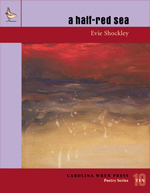
Evie Shockley, ‘a half-red sea’ (Carolina Wren Press, 2006)

[Hello all, I realize this book review is about three years too late, but better now than never!]
evie-shockley-book

Evie Shockley’s got a brave and firm grip on history; her first full-length collection of poems, a half-red sea, Harryette Mullen describes as “navigating against prevailing currents.” Indeed, Shockley skillfully navigates, pointedly assesses, and calls our acute attention to the prevailing current of the Middle Passage and of rivers, their historical and contemporary effects in shaping American world views on race and gender.

While the Middle Passage cannot be unmade, Shockley seeks instead to populate with real human lives and voices this Middle Passage, in which human bodies, her ancestors, “named and unnamed,” have been effectively commodified, “traded for victuals.” These prevailing currents are the movement of commerce and capital, apparent in “unbelievable sale!” Here, Martin Luther King Jr. Day has been stripped of its progressive possibilities, and reduced to a profit making opportunity, as befitting American consumerist culture. Shockley moves us backwards in history, beginning with the twentieth century white flight from the “trash” and “crime” of urban areas into the “safe” luxurious suburbs, and the subsequent gentrification of these same urban areas by the descendants of this white flight.

Back through time she continues to guide us, through a “cross-country subway,” better known as the Underground Railroad, and a “trans-atlantic cruise,” again, back to the Middle Passage. Her (not so) quiet parenthetical reminds us of the economic reality which deemed black bodies as 3/5 of a human body, a mere fraction of human. Shockley’s speaker is the travel agent who is rabid for her commission, and in this ironic, satirical voice, she reminds us of the relationship between race, agency, and movement. Those who “need a tan,” control the movement of capital, and therefore have so much freedom to flee and to return, whereas “customers with a natural tan,” are the commodity, risking their lives in flight, or being moved against their own wills and wishes.

“a thousand words” is the fold-out centerfold of a half-red sea. There is nothing sexy about this centerfold; it’s pornographic and obscene, a word-dense and impenetrable naked portrait of torture, in which Shockley’s relentless free association of potent words links the historical and current states of violence in this country and in the world: “torture hooded bagged stacked stripped wired leashed cuffed smeared objectified what’s wrong with this torture…”. “a thousand words” concludes the book’s first section, “passage.”

Located in the middle of the book’s second section, “rafts,” is the poem “ode to ‘e’,” which seems the crux of this collection, as the speaker (presumably Shockley herself) is “named for a poet who never in her lifetime / published.” Shockley reminds us of the hard fates of the women, named and unnamed, who preceded her. Many of these women’s lives were tightly hemmed within the domestic, and without the ability to articulate openly their grievances: “i need—a dozen eggs / —a tub of lard—loaf bread—fatback—and rat poison / for the rat who sleeps in my bed.”

These are formalistically tight poems, as Shockley inserts herself into the intersecting traditions of her ancestors, of letters, and of song. She imagines Phyllis Wheatley and Sally Hemmings knocking back scotch whiskeys together, as they “think on rivers and rafts.” Here, Shockley’s foremothers recall Mark Twain’s boys on a raft in Huckleberry Finn, of which they both approve, especially as recommended reading for “sally’s kin,” presumably her mixed blood descendants with Thomas Jefferson. We are reminded also of Langston Hughes’ poem, “The Negro Speaks of Rivers” (1920): “my soul has grown deep like the rivers,” conduits for the commerce of African bodies.

Gwendolyn Brooks’ sonnet-ballad appears to be the model for “ballad of anita hill,” in which Shockley’s effective use of the Shakespearean sonnet’s rhyming end couplet succinctly and definitively sums up the reductive and conflicting American public opinion of Ms. Hill, and by extension, of the black woman in America, rendering invisible their professional and educational achievements: “you are a queen-bitch-jezebel-matriarch-whore, / destroyer of black manhood, and so much more.”

Consider that Wheatley, Hemmings, Hill, Hughes, Brooks, and “e,” are rafts upon these rivers, floating however tenuously upon the prevailing current. Shockley has relied upon them to remain afloat, and ultimately, she becomes as those before her, hence, “pull,” the third and final section of a half-red sea. In “— shall become as —,” whose title indicates the speaker’s (Shockley’s) transformation into a “raft” upon which others may rely in order to stay afloat — “you / put this knife in my // hand. we pull. we / meet as oceans come // together, heaving / against and clinging // across our salt watery // boundary.” I think of the act of pulling, drawing, as in, “for what you need draw from the river like it is well with my soul,” which appears a statement of her poetics.

There is much to be admired in this collection of poems. In addition to the sonnet-ballad form, she employs the pantoum and the acrostic in very smooth and revealing ways. As well, Shockley’s Harryette Mullen-esque word play on cliché — “good as guile,” “what’s in a shame,” “the freak shall inherit the mirth” — as if in mimicry of standard American English, is both playful and critical, in uncovering the darker implications of such conventionally throwaway phrases. It goes without saying that Shockley’s work is political, in language and in content. And this is quite satisfying to me as a reader constantly seeking intelligent, well-crafted, historically relevant poetry which is located in the world, tempered and telling urgently of real human lives.

Bookmark and Share

Tags:

13 Comments for “Evie Shockley, ‘a half-red sea’ (Carolina Wren Press, 2006)”

  1. Barbara,

    Thank you for this review. I loved “A Half-Red Sea” and am a fan of Shockley’s work. So nice to read your review and have more attention to Shockley.

    Julie

    Posted By: Julie R. Enszer on August 20, 2009 at 4:17 pm
    Report this comment
  2. I’m glad you’ve reviewed this work; I must admit I haven’t read the book, but I am a fan of Shockley. I’m particularly glad you call attention to her formalism, and love the “cliche” puns you cite!

    Posted By: Adam Strauss on August 20, 2009 at 4:43 pm
    Report this comment
  3. thanks for this wonderful review b! i love this book & pretty much everything i’ve ever read of evie’s (we published some of her work in an achiote press issue)!

    and evie has good taste: she chose carolina wren’s contest winner: Tiffany Higgins’and Aeneas stares into her helmet. tiffany is bay area! whatwhat–check her website here: http://www.tiffanyhiggins.com/.

    roots,
    c

    Posted By: csperez on August 20, 2009 at 5:08 pm
    Report this comment
  4. Hi all, Thanks for your comments. For those who want to read more Evie Shockley, she also has a couple of poetry chapbooks that I want to check out: THE GORGON GODDESS, also from Carolina Wren Press, and a collection of prose poems from Belladonna Books, which I think are still available here: http://belladonnaseries.org/books.html

    Craig, are your Achiote issues still available?

    You can also hear her at the From the Fishouse website: http://www.fishousepoems.org/archives/evie_shockley/

    Posted By: Barbara Jane Reyes on August 21, 2009 at 11:29 am
    Report this comment
  5. Your take on “a thousand words” reminds me of the poems in your chapbook “cherry”. Shockley just approaches the content differently in terms of using the page and the word “torture” as a frame for the scene the poems conveys.

    I also appreciate Shockley’s poems that find language for interracial relationships toward the end of “a half-red sea”, especially because she always seems to be asking “Who is looking?” and “Who (or what) are they looking upon?” These are some key questions in shaping the form and diction, which is one of the things I admire about her work.

    Posted By: Tara Betts on August 21, 2009 at 1:25 pm
    Report this comment
    • Thanks Tara, I don’t have her book in front of me but just looked at the poems, “apples and oranges: an allegory” and then “á table” at the Fishouse website, with “apples and oranges…” as the black and white, and “á table” as the more in depth, nuanced version of the former? I think the language for interracial relationships to which you refer ends up being surprisingly straight forward: “they love him and i was with him,” and “they taught me // how to be a part of them, who are a / part of him, and i am replete with / kith and kin…”

      Posted By: Barbara Jane Reyes on August 21, 2009 at 1:51 pm
      Report this comment
  6. Barbara Jane,

    Many thanks for this lovely review of my book! Words this kind (and insightful!) can only ever be right on time… : )

    And thanks, all, for the supportive comments, as well. You inspire me to try to make the next book even better!

    Peace,
    Evie

    Posted By: evie on August 22, 2009 at 9:19 pm
    Report this comment
  7. “I have to rethink my previous prejudice about poetic forms like the acrostic as “hokey,” because she really makes them work.”

    Hi, I hope this doesn’t sound rude–I’m just curious–how can you even read Harryette Mullen if you think something as holy as the acrostic is hokey? Abecedara, N + 7, lipograms, homolinguistic translations (sometimes of her own work)–I mean, H greases the sacred gimmick (and the sacred gimmicks are sacredieu!)

    Posted By: Galen on August 23, 2009 at 5:47 pm
    Report this comment
    • Hi Galen, thanks for your question. I am really referring to acrostics I’d read in the past when I was much younger, and even some I’ve seen in Hallmark greeting cards. So that’s the context for my previous prejudice, certainly (for me) not the best context for reading and appreciating poetry.

      You are right, of course, about Harryette Mullen and Sleeping with the Dictionary, though I actually can’t say too much about this collection, for it’s the one collection of hers I have spent the least amount of time with.

      Thanks again.

      Posted By: Barbara Jane Reyes on August 23, 2009 at 10:17 pm
      Report this comment
  8. Oops –abecedaria–sorry, King David

    Posted By: Galen on August 23, 2009 at 5:51 pm
    Report this comment

Comments for this post are closed.

CONTRIBUTING WRITERS

Thom Donovan
Bhanu Kapil
Fred Moten
Craig Santos Perez
Sina Queyras
Sotère Torregian

STAFF WRITERS

Cathy Halley
Michael Marcinkowski
Travis Nichols
Fred Sasaki
Don Share

About Harriet

RECENT COMMENTS

  • Great stuff! Always inspirational for us aspiring poets. Thanks! Sarah Allen (my creative writing blog) MORE »
    Sarah Allen | 02.09.10
  • @CSP: I know, didn't mean to be annoying. I just find it all beyond me ... MORE »
    Peter Greene | 02.09.10
  • @ johannes: yay i'm glad you commented! this is actually the second time i quoted ... MORE »
    csperez | 02.09.10
  • thanks you for commenting, john. i am serious about the strike, but it seems most ... MORE »
    csperez | 02.09.10
  • thx for your comment bscg. i think that openness is a wonderful quality in a ... MORE »
    csperez | 02.09.10

B 3.1 (11)
A Rambling Post on Common Readers, Classes... (2)
Contemplation is Mourning: Tim Lilburn (12)
“The only thing I’d really like... (10)
BURN THIS (23)

RECENT POSTS

MONTHLY ARCHIVE

CATEGORY ARCHIVE

PREVIOUS WRITERS

Subscribe to the RSS feed.
What is RSS?

IN THIS ISSUE: February 2010

Poetry Magazine

A selection of new work from Robert Hass; new poems by Martha Zweig, Joshua Mehigan, Robert Vandermolen, Patty Seyburn, Robert Bly, Bob Hicok, Spencer Reece, Eleanor Wilner, and Kay Ryan; a translation of a Durs Grünbein essay by Michael Hofmann; and reviews by Fiona Sampson.

Chicago Poetry Tour

CHICAGO EVENTS

Poetry on Stage: Lysistrata

Poetry on Stage: Lysistrata Sun, February 21st, 7:30 PM
Mon, February 22nd, 7:30 PM
Victory Gardens Studio
2433 North Lincoln Avenue
(773) 871-3000
Tickets $20; $10 for students

MORE EVENTS »