


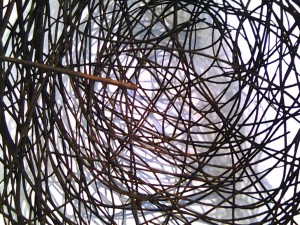
Some further thoughts coming out of Alison Collins’ series of nests:
The show began with one hundred nests, but I think there were closer to eighty by the time the show closed. Collins was, as I understand it, giving them away here or there, perhaps selling a few. There were neither prices nor even a catalog of any kind at the installation. I saw no sign out for the space, and there wasn’t a single name on the wall anywhere inside the space on 37th St. or even on the big storefront windows. It was about as un-art world as a show in New York City can get, though I remember thinking some very meticulously stacked piles of rocks in a then-vacant lot on the Brooklyn side of the East River about ten years ago made for a pretty great show too. That artist went and hid in the nearby weeds if you tried to come around while he or she was working.
One theme amidst all the nests by implication is working with seriality – I take the term serial in relation to an artistic practice to be bound up with form and process at once while attending either implicitly or explicitly to an on-going life experience – in Collins’ case that experience being pregnancy and childbirth. It can often feel, I think, like an extended work is growing in several directions simultaneously when one is working in a serial manner – you’re investigating a particular shape (which may or may not be tangible), you are not bound to a chronological sequence and, to borrow a bit of phrasing from Robert Creeley (writing in his intro to The Holy Forest by Robin Blaser) attempting to define the “progress” of the work or create “a skillfully accomplished enclosure” is really beside the point. Working serially is like being in the middle all the time while hopefully coming to understand the contours of the space and materials you’re working with, or at least that’s been my own experience. The final arrangement, such as it may be, may point away from its making despite wearing it.
And so a nest can be viewed as capable of serving as an enclosure until the service is no longer necessary, or until raided, or until abandoned or broken down by the elements. Its security is necessarily transient, and in Collins’s steel nests, which are not without their aspects of vulnerability despite the materials (I have no idea what the “new vulnerability” might be, by the way, though I’ll look it up), the transformations they bespeak take place off stage. They are known and unknown as well as continuous. All of this points to poetry for me, if not to poetics, which I barely understand unless they’re in motion and I’m not being asked to do something like reflect or judge or ponder relevance.
In using the term serial I don't mean to conjure up the kind of story that is done in sections printed weekly or monthly somewhere, but say the word enough and I inevitably recall hearing my stepfather and his brother talk about reading serial adventure stories in Britain in the forties wherein one section would end with the protagonist in an impossible scenario involving being tied to a pole in the middle of a lake with alligators closing in and the first sentence of the next installment would be “and with a great leap she was free!” That’s quite a bit different than sculpting one hundred steel nests or writing one hundred and forty poems each titled “Have A Good One”, though the feeling of entering a new piece or segment is a bit like that of a freeing leap to find a new set of traps to enter or a set of shining bars to swing from.
While the relationship between the abundance of steel nests and Ovid’s Metamorphoses – Collins’ point of inspiration in making the nests in the first place – is not up on the surface of the nests themselves, the connection is going to be evident to any one who has read Metamorphoses and has a sense for that work’s handling of transformation as practically incidental to daily life, even that depicted through myth, which I suspect was no more abstracted from reality for Ovid than a list of cuckoo news items I see everyday on the aol news page I have to get through in order to check e-mail is for me. That said, you don’t have to have read the Ovid in order to connect with the work and 20-ft. long snakes are indeed taking over the country.
The “in their own terms” portion of the previous post’s title is borrowed from Fairfield Porter’s book of selected art criticism, Art In Its Own Terms: Selected Criticism 1955-1975. I tend to turn to Porter when I have to write prose. Partly because I adore the writing, partly because Porter, a painter himself, championed artists whose work was radically different than his own, and partly because he wrote the sentence “Criticism should tell you what is there.” That’s helped.
Also, the title “Currency of Fashions” from a few posts ago is also the title of a poem by Jim Brodey, a kind of reverse litany in which nearly every line ends with the word “nothing,” including the line “I am a princess of bubbly nothingness and mean nothing.”
Author of eight books of poetry and numerous chapbooks, Anselm Berrigan earned a BA from SUNY Buffalo...
Read Full Biography