The Principles of Concealment

By David Wagoner b. 1926 David Wagoner
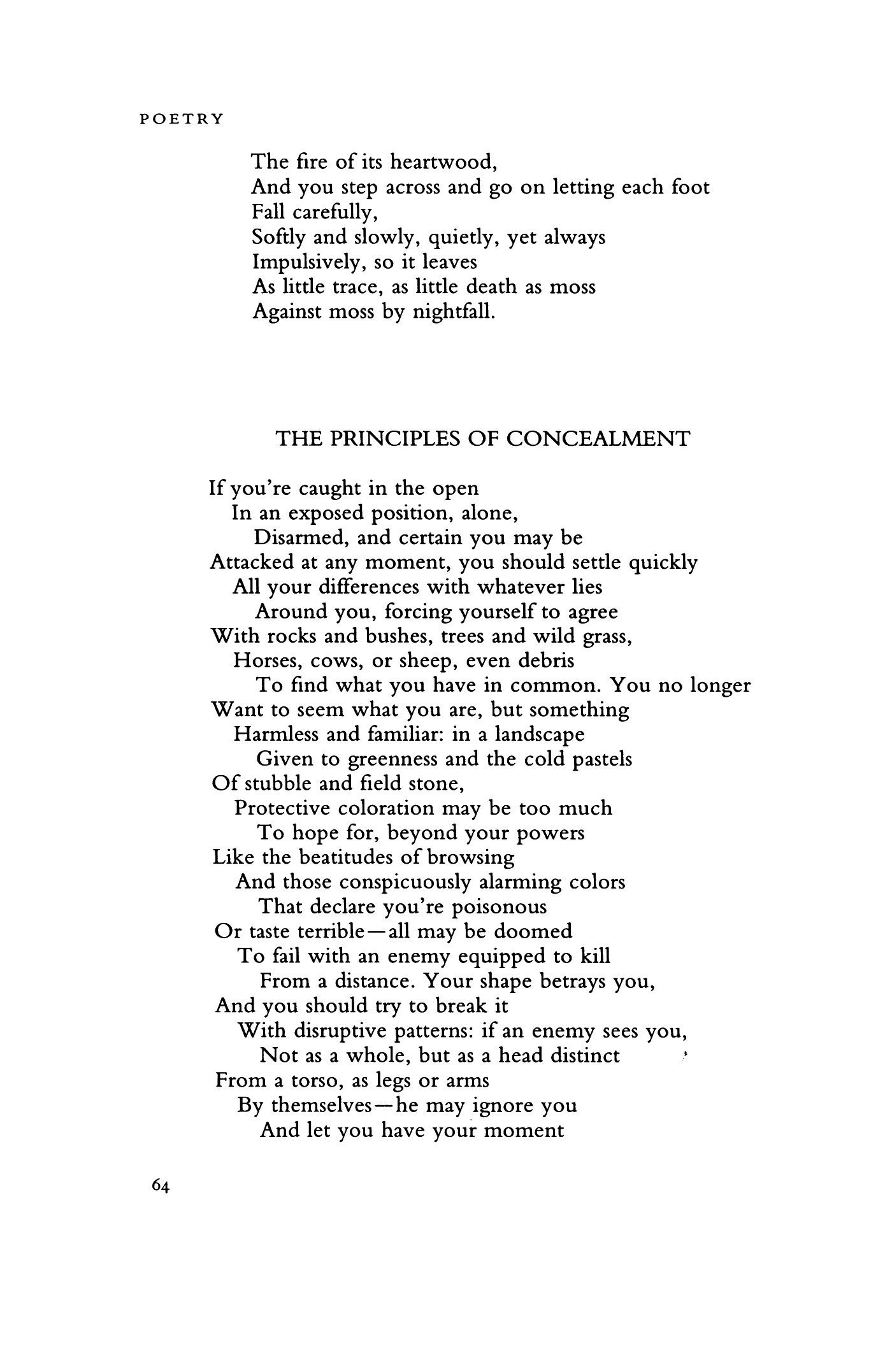
If you’re caught in the open
   In an exposed position, alone,
      Disarmed, and certain you may be
Attacked at any moment, you should settle quickly
   All your differences with whatever lies
      Around you, forcing yourself to agree
With rocks and bushes, trees and wild grass,
   Horses, cows, or sheep, even debris
      To find what you have in common. You no longer
Want to seem what you are, but something
   Harmless and familiar: in a landscape
      Given to greenness and the cold pastels
Of stubble and field stone,
   Protective coloration may be too much
      To hope for, beyond your powers
Like the beatitudes of browsing
   And those conspicuously alarming colors
      That declare you’re poisonous
Or taste terrible—all may be doomed
   To fail with an enemy equipped to kill
      From a distance. Your shape betrays you,
And you should try to break it
   With disruptive patterns: if an enemy sees you,
      Not as a whole, but as a head distinct
From a torso, as legs or arms
   By themselves—he may ignore you
      And let you have your moment
In the sun as an abstraction gone
   To pieces, as a surface mottled and dappled
      Ambiguously by intercepted light
Like a man cancelled. But all these efforts
   Will come to nothing if you move: one gesture
      May catch all eyes. If you stand
Still then, or stay seated
   If you’re sitting down, or go on lying
      Down if you’re lying, an easy solution
May occur to you, cheek to cheek
   With the hard facts of inorganic life:
      That you have no enemy,
That no one is hunting you,
   That all your precautions were a waste
      Of attention better given to more rewarding
Evasions and pursuits. If so,
   And you take your place again
      As a distinct departure
From your foreground and background,
   You should know it’s possible
      For you to feel, after all,
At the first step, at the first crack
   Out of the box, that lethal impact,
      That private personal blow marking your loss
Of the light of day, the companionship
   Of the night, and the creature comforts of home
      As you become a member
Of that other civilization spreading itself
   Around you, ready and able and still
      Called the natural world.

Source: Poetry (May 1998).

MORE FROM THIS ISSUE

This poem originally appeared in the May 1998 issue of Poetry magazine

May 1998
 David  Wagoner

Biography

David Wagoner is recognized as the leading poet of the Pacific Northwest, often compared to his early mentor Theodore Roethke, and highly praised for his skillful, insightful and serious body of work. He has won numerous prestigious literary awards including the Ruth Lilly Poetry Prize, two Pushcart Prizes, and the Academy of Arts and Letters Award, and has twice been nominated for the National Book Award. The author of ten . . .

Continue reading this biography

Poem Categorization

SUBJECT Sports & Outdoor Activities, Nature, Activities

POET’S REGION U.S., Northwestern

Poetic Terms Imagery, Free Verse, Metaphor

Report a problem with this poem


Your results will be limited to content that appeared in Poetry magazine.

Search Every Issue of Poetry

Originally appeared in Poetry magazine.

This poem has learning resources.

This poem is good for children.

This poem has related video.

This poem has related audio.