


Meet 2025 Ruth Lilly and Dorothy Sargent Rosenberg Poetry Fellow Aris Kian
Aris Kian utilizes poetry as performance and a tool for community organizing, abolition, and liberation.
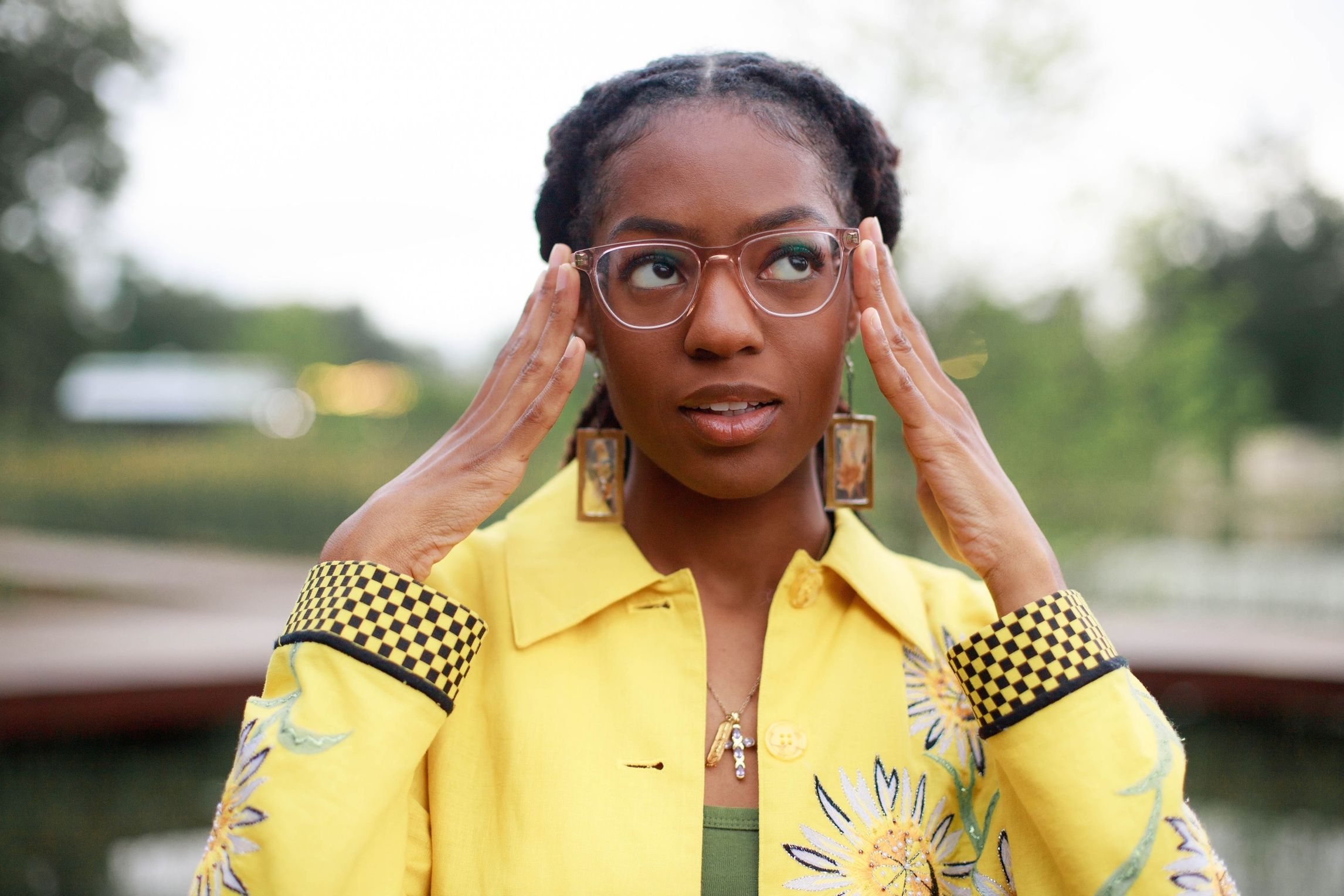
Photo by Keianna Molina (@shotbykeianna)
Leading up to the 2025 Ruth Lilly-Dorothy Sargent Rosenberg Poetry Fellows' reading in Miami on Friday, April 10 as part of O, Miami's Poetry Festival, we will feature profiles of each of the five fellows. We are excited to continue introducing you to and celebrating these outstanding young poets.
“Poetry is a tool to be immaculate with your words. To be honest about the world around us. To articulate what is necessary for the liberation of all oppressed people.” To Aris Kian, poetry is not just a literary art form–it is a performance, and it is an opportunity. Kian is based in Houston, Texas, a city that she is examining in the full-length manuscript she is using her Ruth Lilly and Dorothy Sargent Rosenberg Fellowship to work on.
Kian works with organizations that focus on climate justice, Houston’s housing crisis, and re-entry, among other causes, which shape the way her work engages with the world. In her work, she considers the relationships between opposing beliefs about Houston: the mythological version that outsiders and city officials see, and the version that its constituents want and make for themselves. She has transitioned from providing more traditional poetry readings to offering her work to community centers, protests, rallies, and liberation zones. “I think really, really intimately about how my work is in service of community organizing, and vice versa,” she says.
Kian became interested in poetry due to her background in theater. After she stopped doing theater, she joined a poetry slam team, CoogSlam, in 2018, and found there was a similar energy around evaluating texts and rehearsing together. Through slam, she found an interest in poetry, and started performing slam and writing individually as well.
She is inspired by poets like Ayokunle Falomo, Vievee Francis, Patricia Smith, and Ebony Stewart. Her poetry is often informed by her work as a community organizer, and she describes herself as a “Houston enthusiast and a student of abolition.” She supported efforts against gentrification in Houston in 2019, then worked in mutual aid organizing in her city after the 2020 George Floyd protests. “So much of my work is interested in thinking about what it looks like to abolish the systems oppressed people exist under, and how we build new systems to liberate ourselves,” she says.
Kian’s writing process consists of a lot of “sitting and thinking.” She says that the ideas and origins of her poems are slow and mostly thought-oriented. Once they’ve been thought through, her poems are written in one sitting using The Most Dangerous Writing App, which requires the user to write continuously for a given amount of time, otherwise it deletes everything. She views poetry as “an opportunity to clarify what has not quite been uttered.”
Kian’s favorite place she has visited is Dublin, Ireland. She was in awe of the transit infrastructure in the city–the wide sidewalks for walking, the multimodal streets, and the easy access to public transit. She went to local shows in a nearby park that were funded by the state. “We need more investment in art that people can passively and actively engage with.”
Kian encourages other young poets to remain open to inspiration from new experiences and new writers. “There is a poet that you are inspired by. You just might not have found them yet,” she says. She became interested in eco-poetics while studying poetry, but found that the writers she was learning about were writing about cities that didn’t connect with her, or thinking about landscape in ways that didn’t resonate with her as a Black person in the United States from a concrete city. “Allow yourself to be open to poets you haven’t read yet, or haven’t seen yet,” she says. “There is somebody who is writing work that is what you are writing, or that can inform what you’re writing, that can inspire what you’re already writing.”
Roma Uzzaman (she/her) earned a Master of Arts in the humanities, with an English and creative writing focus, from the University of Chicago. Uzzaman was the summer 2025 Grants and Awards Intern at the Poetry Foundation. Previously, she worked as an assistant with Shakespeare in the Arb. Uzzaman earned a BA in English and psychology from The University of Michigan, where she was awarded the Virginia...