


It Matters if You Want It to Matter
Robin Becker on her fifty-year career.
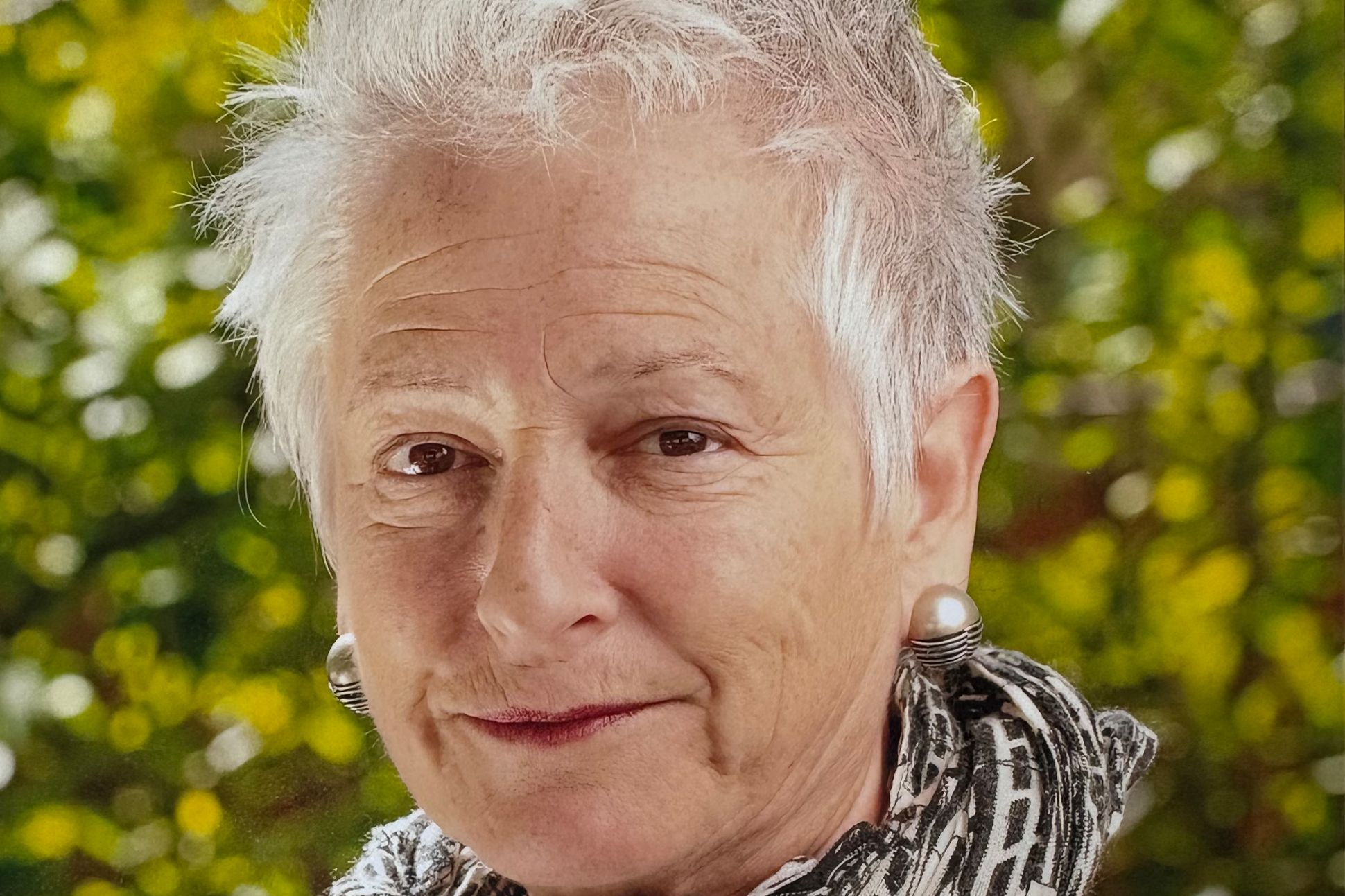
Photo by Miriam Goodman.
In 2007, reaching to a high shelf in Boston University’s Mugar Memorial Library, I found the book I wanted: the poet Robin Becker’s newly released Domain of Perfect Affection (2006), her sixth of eight published collections. I was a junior in college, committed to an English major; I stood a lawn away from the department’s ivy-coated brownstone where I took my writing classes and where—thirty-plus years earlier—Becker had studied with Anne Sexton and, later, Maxine Kumin.
One of my professors had guided me to Domain of Perfect Affection—a likely casual recommendation from her that nonetheless changed my life’s trajectory, leading me back home to Pennsylvania after graduation. I don’t know whether this professor saw something in my early poems that spoke back to Robin’s, or if it was our respective biographies that connected us in her mind as two Jewish, queer poets from Philadelphia (though back then I was out only to myself, nodding alone in my apartment bedroom as I read poems like “A History of Sexual Preference” for the first time). In 2008, I became Robin’s graduate student in the creative writing program at the Pennsylvania State University. I caught her in the final few years of her four-decade teaching career, begun across the river from BU at the Massachusetts Institute of Technology and, seventeen years later, continued at Penn State. I remember the curated order of her basement office: the books and literary magazines shelved floor-to-ceiling, many on rotating loan to students; the dog bed positioned beside her desk—and, often, a steadfast gray poodle curled snout-to-tail upon it, snoozing.
In that office, she exhorted me to develop a regular writing practice and to defend it vigorously against the pull-and-push demands of daily life, especially those I faced as a woman. At 25, I couldn’t imagine anything mattering more than writing; at 40, I hear her voice each time I return my divided attention to the notebook, despite whatever else I must ignore.
In February, the University of New Mexico Press released Midsummer Count, Robin’s long-anticipated New and Selected Poems. The release coincides with Penn State’s acquisition of her personal and professional archives: fourteen brimming boxes of papers slated to anchor a new LGBTQIA+ collecting initiative at the Eberly Family Special Collections Library. Robin’s poems are inquisitive, yet affirmative, and always forthrightly queer and Jewish; their largely lyric engines examine joy in all its facets, even in moments of profound struggle for her speakers. We spoke as spring turned to summer to unpack the boxes, in a way—to examine her legacy, now anthologized by Midsummer Count, as a poet, a feminist, and an educator. This interview has been edited for clarity.
You wrote eight collections before Midsummer Count—that's hundreds and hundreds of poems in individual books before shifting into a collected works. What is that like, both practically—going from the big pile to the edited collected, and then also emotionally—were you looking to tell a single story with the collection, or was it just “start date, end date?” Or “here are my favorite poems?”
I put off the project of compiling a New and Selected for a long time. Some poets start thinking about doing this after book four, but I kept kicking it down the road until book eight, and when I asked myself why, I realized that, like the rhythm of the academic year, I like the rhythm of finishing a manuscript and having some new poems in the works, and having the momentum carried by moving towards the next book. I wasn't drawn to pausing that cadence.
To undertake the process, I had to ask a bunch of questions. Should I disregard the individual volumes and create a new book altogether from poems I was going to pick and choose? Should I put all the childhood poems at the beginning and try and tell a chronological story? I spoke with other poets and heard a lot of opinions.
I had in mind Michael Waters’s wonderful New and Selected, called Parthenopi (2000), in which he did a combination of the two. He took his books, and he ordered them from childhood. Did we read that book together in class?
We did, we did all those years ago.
All those years ago. And I remember that poem called “Horse,” in which the child touches the horse, and I was so delighted by Michael's organization. However, I had just sold my archives.
Yes!
And the acquisition commitment altered my thinking some. I decided to keep the individual volumes intact to showcase the fifty-year arc of the writing life of somebody starting with Personal Effects (1976), which I published when I was 25, to Midsummer Count, which I'm publishing at 75.
So, through the sale of the archive, I rediscovered the cultural importance of documenting a 20th and 21st century Jewish lesbian feminist poet’s oeuvre. The archive included everything from handwritten journals, all my rejection notices that I saved over the years, correspondence with editors and friends, papers from conferences, drafts of poems. So, like the archive, I realized that my New and Selected could also be read as a historical record of a period.
To choose the poems, I paid an editor friend and poet to read through my eight books and make a list of the poems that she believed to be the best, but then I wondered, what did I mean by the best? I asked her to be unsparing and to select only the poems that had for her compelling language, theme, and subject. I wanted the book to be under 300 pages, so she had to be kind of merciless, and when she was finished, she handed me the list, and I sat down and worked from there, adding and subtracting.
That’s a big gift of trust to give to an editor.
It was. And in revisiting the poems, I walked down paths that I couldn't have mapped after writing just a couple of books. I found subjects surfacing from the very earliest books—like from 1976, a poem about my sister’s epilepsy—very different from one I’m publishing in this book.
All the years of writing ekphrastic poems, and early love poems to women, anticipating the struggle to find my place as a queer person in the world, poems about Jewish identity—and I saw, too, for example, in All-American Girl (1996), how my perspective enlarged when I started going to the [American] Southwest, and I could also document, looking back, my own wrestling with couplets and quatrains and sonnets and sestinas and villanelles.
Of course, sadly, like everyone who puts together a New and Selected, you must leave some poems out.
Yes.
So for example, from Domain of Perfect Affection (2006), I left out the poem “Orienteer: The Childhood Drawings of William Steeple Davis.” It was 70 lines, and I decided that I could sacrifice that poem to have several shorter poems—and that happened with several longer poems.
I'm so drawn to the fact that you’re thinking about this process as an educator and historian—when you said the cultural importance of documenting a 20th and 21st century Jewish lesbian feminist poet’s oeuvre, using the third person. It’s powerful to think that part of the work to create a New and Selected is to capture a moment in history for posterity. Your identity as a poet, your identity as an educator—do you see them as separate or braided? “In the summers I am a poet, in the academic year I am an educator?”
Early on at MIT, I learned that I worked well leaving where I lived and going away during the summers to write, so I started that pattern in the late ’70s.
During the academic year, I could write book reviews, but the quality of attention I needed to write poems I could only have when I didn't have other obligations on either end of the hour, or the afternoon, or the day. I had friends who could go from having a conference with a student, working on a poem of their own, going back to writing comments on student work, having another student come in for a conference, then returning to the poem. I did not have that kind of brain, and I envied those people, because they were able perhaps to make better use by threading the day full of different types of activities. But I compartmentalized the calendar year, so that when I was teaching, I was teaching, and if I was writing anything, I was writing book reviews. Then I would submit my grades and get on a plane, or in my car, and I would travel for the summer and work on poems—which is why when I look at my poems, I see that many of my poems are set in the summer.
Yes, and they’re so inflected by those other places, which is this happy accident of life, that we can't help but let the world seep in when we are writing.
All those summers I spent in New Mexico became a kind of image horde for me. The southwestern imagery became the data that filled the poems, became the geography of the poems.
When I was rereading your poems anew in Midsummer Count, I felt the presence of these places, and also the figures that make multiple appearances in your work. Your sister and your parents appear in nearly every collection—and Maxine Kumin also appears in several poems in Midsummer Count. What was Maxine like as a mentor? What was it like to build such a close friendship with another poet?
Once, when I was a grad student in Anne Sexton’s class, I arrived at the poetry workshop with my poem—you know, twelve copies to distribute—from which I had carefully deleted all pronouns, because I didn't want to reveal my being gay in the poem.
I arrived at class, and Anne Sexton was not there, in her place was a sub: Maxine Kumin.
No!
I did not know who this person was. All I knew was that I had bravely brought my poem, and we didn’t have the regular teacher, so I distributed the poem. My classmates talked about it, and in the end, Maxine said in her very clear voice, the problem with this poem is that it doesn’t have any pronouns in it. We don’t know if the poem is about a man and a woman, two women, or two men.
Whoa.
I asked her if it mattered, and she said, clearly, It matters if you want it to matter.
Years later, I came to know Maxine and [her husband] Victor when I was teaching at MIT, and she was hired to come down from New Hampshire and teach a poetry writing workshop once a week, so we started having lunch, and then she invited me up to her horse farm, and soon I was spending a weekend every month helping with chores, and we started sharing poems.
Maxine had lost her great friend Anne, my former teacher, to suicide. So Anne’s life and death was another point of connection for us, as well as our shared experience of suicide, Anne’s and my sister’s. And there was the frank joy that Maxine and Victor took in their lives—Jewish intellectuals living in tiny Warner, New Hampshire, breeding and raising horses, keeping lambs for slaughter, growing most of their own vegetables, contributing their time and money to progressive causes. I had never met people like this.
Max, who was a master gardener, loved to can her vegetables and make gallons and gallons of tomato sauce and jam. Their kitchen was a buzzing hive of activity, and tacked to a farmhouse beam was Victor’s weekly list of chores, with items crossed out.
What a rich way to live.
I just loved being a part of their world, with poetry journals and magazines and drafts of poems piled around the rooms—and I felt like I belonged, you know, helping to muck out the stalls and to drive the dogs to their vet appointments and harvest the vegetables, and in and around [this life] was swimming naked in the pond they made, going on long trail rides, evenings of books and movies.
Sexton and Plath were two celebrated women poets, but they were women whose lives I did not want to emulate. And here was Max, relishing every day.
Kumin’s life was so—physically lived, it wasn’t just the life of sitting at a desk and creating poems, it was covered in equine amniotic fluid, from bringing horses into the world.
Yes. She showed me that a woman could be a poet and a deeply engaged, humane person who could bear her tragedies and her losses and still love her life, and I needed that example.
Sexton studied under Robert Lowell at Boston University, where you earned your master's degree and Kumin taught—and you also mentioned Plath, a fellow student of Lowell’s. Together they’re some of the banner-holders of the American confessional poetry movement. I’ve often seen you described as a confessional poet, though I’ve never heard you use the word for yourself. I think part of that is your connection to these other poets, certainly, also how often you invoke real people in your work, how often you write about your queerness and Jewishness—but I don't want to stick “confessional” on your shirt and move away without interrogation.
Exploring raw and personal subjects in the 1950s and ‘60s had a taboo about it. People didn’t write about mental illness or trauma or sexuality or broken families until, you know, Lowell, Plath, Sexton, Snodgrass, and that style was really breaking with academic modernism in a significant way. By the time I came along, I was able to benefit from that work that these other people had pioneered. You know, Sexton titled a poem “In Celebration of My Uterus,” and that was shocking at the time—but now we're not shocked by that kind of language.
The confessional poets helped make possible the explosion of feminist poetry in the ‘70s, so that people like Audre Lorde and Susan Griffin and Adrienne Rich and Alicia Ostriker and Diane DiPrima and Shirley Kaufman—the list goes on and on, that explosion of women poets that I feel like I came out of, we certainly had the benefit of the confessional poets breaking those barriers.
I don't mind the appellation. It’s kind of a quaint term now, it has a historicity—but then I think about Elizabeth Bishop, who never wanted to be in all-women anthologies, and though her relationships with women were open secrets, she never really identified as a feminist. But now the subjects associated with confessional poetry—mental illness, suicide, trauma—don't surprise contemporary poets in the same way.
One of my favorite poems of yours is “A History of Sexual Preference,” and I first read that poem probably twenty years ago myself, thinking about what it means to be a young queer person setting out on a journey of discovery. The speaker dons this Founding Father-esque butch drag, she’s unbuttoning her collar by the end of the poem.
Yes—I was toying with the sartorial attitudes of American men trying at the time to emulate European aristocracy.
I can’t help but connect this speaker to your poem “Dyke,” and I’m struck by how both poems construe queerness, but specifically butchness, as a revelation, but one that’s not received the same way in each poem. The speaker of “A History of Sexual Preference” is on this voyage of discovery, right, having made love for the first time, to a woman, in a hotel room in Philadelphia.
But “Dyke” has a fearful edge to it—the line I remember is the speaker describing with “dread and desire / the dangerous butch striding through Kenmore Square, uncamouflaged.” They're both striding, both emerging, but the butch in “Dyke” is dangerous, and the speaker in “A History of Sexual Preference,” I don't sense danger in that poem, I sense bravery, a first full step forward.
Where does that leave your relationship to butchness, in your work specifically, but in your life also—how has it changed?
For me, this begins with lesbian bar culture in Harlem in the 1920s. Language [from “Dyke”], like bulldog, bull dagger, and bull dyke, was used to describe masculine lesbians, and this was at a time when, in the ‘40s and ‘50s that followed, lesbian couples were very clearly butch and femme, distinctly feminized or masculinized as couples, and “butch” represented a kind of queer masculinity that challenged gender conventions and spoke to often working-class lives—so that was my understanding of butchness as a young lesbian going to gay bars in the ‘70s, I saw these older women hanging out, and, and I was afraid of them, their short hair, their shirt-sleeves rolled up.
On this continuum, I saw myself as a soft butch, or a baby butch, in khakis and blazers and loafers and or low boots, and when I was teaching at MIT, my image of an assistant professor was of these young men in their tweed blazers and their khakis, and it was much easier for me to imagine myself looking like them than to imagine myself dressed in dresses and skirts like the handful of women who taught at MIT at the time—so I emulated these men, thinking that that was my way of belonging to this culture.
In “A History . . .”, you’re right, the speaker was not afraid, the speaker was playfully wanting to embody a frock coat and a vest and a fitted waistcoat and knee-length breeches and square-toed leather shoes with silver brass buckles. There was something about the playful dress-up that made the khakis and the blazer accessible to me—that I could put on his power with his clothing.
The model for the character in “Dyke” was a member of Dykes on Bikes, an organization that formed in 1976, and the first gay pride parade in San Francisco was led by that group—and now, of course, it’s a national organization, and they’re everywhere.
You mentioned earlier that Midsummer Count covers a fifty-year span. Do you find that your poems resonate differently or anew with new generations of queer readers?
I think first of the gender-nonconforming poets out there who perhaps felt as I felt as a young writer—people who perhaps felt that their poems didn’t have an audience or didn’t have a place—I want them to know that they do.
When I was starting to write, both as a Jew and as a lesbian, those topics felt hot to me. They felt somewhat novel, writing as an out lesbian when there were fewer poets doing so, and over the years, of course, that landscape has changed dramatically—so that my recent poem, “Woman in a Landscape,” that appeared in the New Yorker, has a much wider audience, and the poems no longer contend with the surprise of their subjects. The poems more contend with diction, image, line, tone, voice in a way that doesn’t foreground the subject in the same way that the earlier poems did.
Oh, that's fascinating. It’s a shift at the level of the construction of the poem itself, that the heat is different.
Exactly.
If you aren’t playing with heat, how do those other elements feel to the touch now? Or, when you say you're focusing on these other areas, are there areas that feel more useful now?
I would say that the prosodic elements are much more my focus. The subjects are whatever the subjects are, but they don’t have the urgency that they once had. A poem like “Woman in a Landscape” is a retrospective poem, looking back at a time in the speaker’s life when she hated her body, and wished that she had another body, and looks to another woman’s body as beautiful: a meditation from the present in which the speaker wishes that she had more compassion for her younger self. It’s a lesbian relationship that the speaker’s talking about, but it doesn’t have to be. The subject of the poem is really having compassion for your younger self, no matter what.
When I was your student, you were learning the Suzuki method on the violin, always with your dog. How do these other practices, music, travel, inform your writing practice? In retirement, is life more liberated from schedule—are you able to write on your own terms more?
I took violin lessons intensely for ten years, from 50 to 60, and the same way I had the routine of leaving every summer and going off to write, I had a routine of practicing the violin every day, and there’s something about the regularity of routine that I find very satisfying. I could get myself to practice the violin for half an hour every day, and now, when I’m in New Hampshire, I sit down every day and work on poems.
I’m thinking of what Annie Dillard says—how we spend our days is how we spend our lives, that’s the line that everyone quotes, but the line after is the one that always stays with me: A schedule defends from chaos and whim. It is a net for catching days. It’s Victor Kumin’s instructions for his day tacked to the post, right? That’s what allows us to leap from the desk into creativity—and I’m very much like you. I’ve never been able to catch a muse in passing, I must summon them at the desk, and I learned that discipline from you.
The shape of the day must lend itself to spending part of the day at the desk. And when you have a dog, as you know, you have to take the dog for two long walks every day, so there’s something about these patterns of activity that to me lend themselves to the discipline of writing practice.
And remember, too, Rachel, what Mary Oliver said. If you sit at the desk every day, eventually your mind and your rear end make a date with each other.
Rachel Mennies is the author of the poetry collections The Wolf (BOA Editions, 2027), The Naomi Letters (BOA Editions, 2021), and The Glad Hand of God Points Backwards (Texas Tech University Press, 2014). Her poetry has appeared in The Believer, The Kenyon Review, Poetry, Jewish Currents, American Poetry Review, and elsewhere.
Mennies took over for Robert Fink in 2016 as the series editor of the Walt...