


Gifts From Forgetfulness
Michael Ondaatje is best known as a novelist, but his poems attest to his career-long instinct for invention.
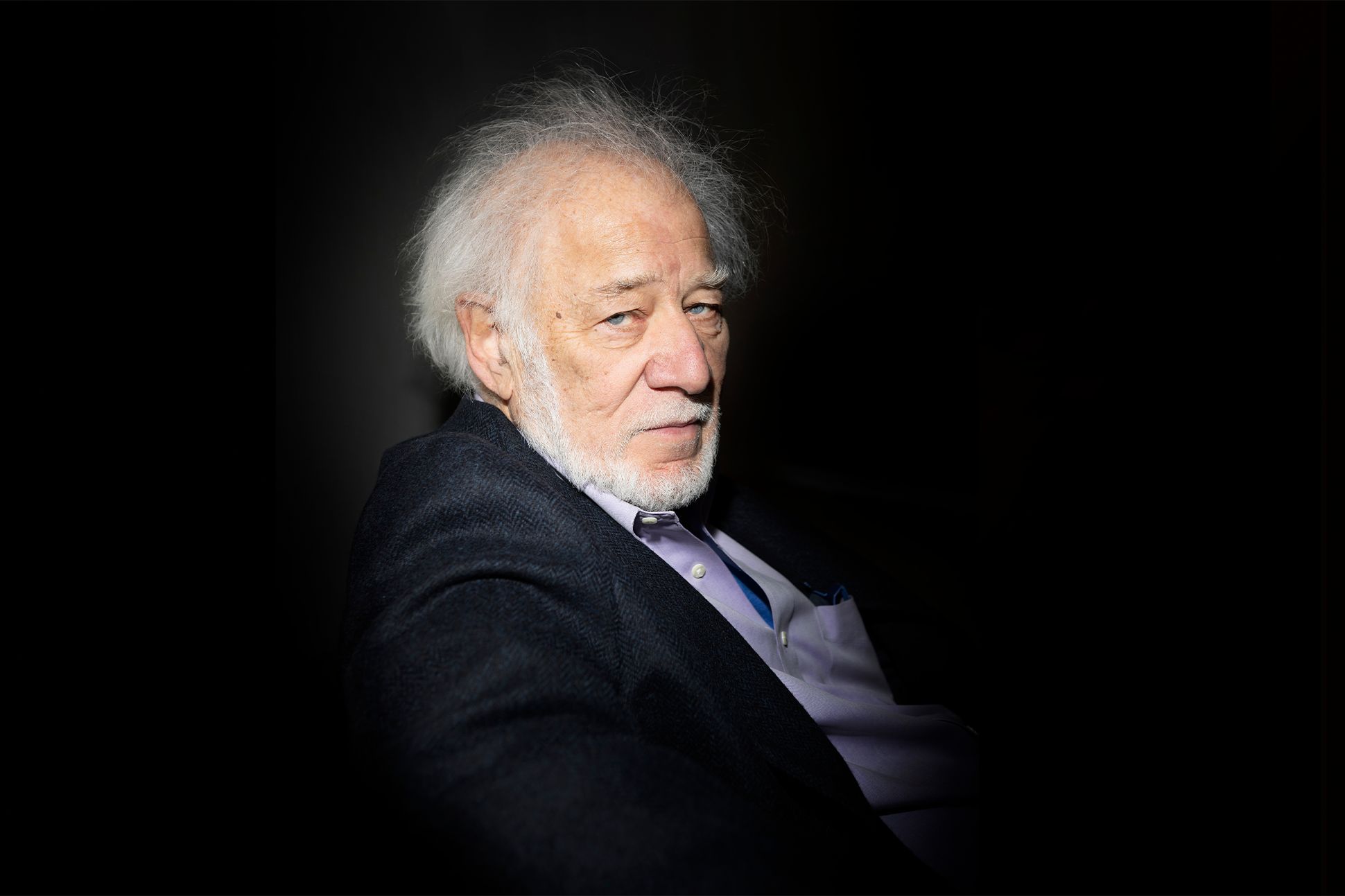
Michael Ondaatje, 2026. Photo by John Packman.
Years ago in the Sri Lankan highlands, Michael Ondaatje’s Aunt Christie, only 25 years old, volunteered to have “a total stranger in the circus profession” shoot an apple off her head. “That night,” Ondaatje writes in his sometimes fictionalized memoir Running in the Family (1982), a man named “T. W. Roberts was bitten in the leg by a dog while he danced with her. Later the dog was discovered to be rabid, but as T.W. had left for England nobody bothered to tell him. Most assume he survived.”
This complex little anecdote is a perfect Ondaatjeism, a distillation of a narrative style and variety of drama that permeates his writing: a memory made into lore, an eccentric relative made into a character, an incident with a wild animal, a stranger who flits in and out of contact as if he only ever existed for that moment, a vital message never sent, and two non sequitur scenes that are nevertheless jammed together. His works have often reveled in one or another of these modes or interests, but rarely are they brought together so pithily as here. Only when his six-decade career is collapsed into a single volume can the totality to which they point emerge clearly.
The curatorial sensibility of Ondaatje’s latest book, The Distance of a Shout: Selected Poems (Knopf, 2026), delivers a shot of contrast dye to the blood vessels that branch across his poetic work. This is a welcome development for those familiar with Ondaatje’s poetry, which is poorly known outside Canada compared to his fiction and which has passed through several seemingly incongruous styles or modes. We can see more vividly, in this latest volume, how the same blood flows from one book to another. Some of these connections reaffirm the catholicity of the Ondaatjean preoccupations known even to those who have read only his most famous work, the Booker Prize-winning The English Patient (1992): the visceral-ness of flesh and bone, the fright of desire, the pictorial quality of memory. What’s more, those same readers, who might have found that novel somewhat ponderous or self-serious, will discover that these affects—his tendency always to be “grappling with angels,” as the critic Ian Rae puts it—have their origin and their justification in his poetry, which is better able to handle self-seriousness than the novel.
The principle of selection that undergirds The Distance of a Shout also reveals motifs in Ondaatje’s work, including a few imagistic fixations, that his readers might never have noticed before. I once attended a Monet exhibition consisting only of his paintings of bridges, spanning more than 40 years, and discovered to my surprise that he was the foremost bridge painter of his age, if not of all time. In a similar manner, here we encounter, as if for the first time, the poet of rivers, the poet of doors unopened, the poet of being always at the end of something. What the Canadian scholar Douglas Barbour once called Ondaatje’s “modern bestiary” is now evident across his career, from his earliest collections, including The Collected Works of Billy the Kid (1970) and Rat Jelly (1973), to the more recent A Year of Last Things (2024). His frequent recourse to “violent mini-plots,” as Margaret Atwood calls them, is revealed to belong not only to the youthful Billy the Kid, wherein “300 of the dead in Boot Hill died violently,” but to an enduring poetic sensibility, such that over half a century later we find that “Molière, severely ill, was made up to look the picture of health. / They carried him coughing blood from the theatre to his home.”
Where other artists have made use of the retrospective occasion to posit a career-long logic of ruptures, or else of progression, Ondaatje alights on a different framework, one that can have the effect of obliterating time: continuity. His poetic work is sometimes seen as having progressed from the high-modernist tradition of Wallace Stevens (emphasizing symbolism and closure) to that of Ezra Pound (emphasizing collage and fragmentation), the latter leading him to peak postmodernist moments like Billy the Kid, which reads like a dime-store Western whose components have been shattered and rearranged. But The Distance of a Shout works to smooth out this periodization, such that even his latest work seems ever under the spell of Stevens and his crystalline koans. In “5 A.M.” for example, first published in 2024, the speaker, summoning up remembrance of a time past when he would dance with his friends in an old barn, comments: “It arrives all at once tonight, / not as memory, but like a gift / from forgetfulness, / as a desire can wake you.” The poem is among the last in a carefully arranged volume full of such gifts from forgetfulness, each a kind of time machine that not so much escapes the present, as many late stylists are wont to do, as transforms the past into a present experience—something both Stevens and Pound might happily be accused of themselves.
***
“I am a mongrel of place. Of race. Of cultures. Of many genres.” Ondaatje’s own assessment of his output provides an apt context for those trying to figure him out and skips the less-helpful cliché that he “evades categorization,” as Atwood has said. His unwillingness to stick to the rules of genre (including those designed to be bent or broken), even within the confines of a single book, has always been evident. The success of Billy the Kid is probably owed to its “mongrel” hybridity; vivid, free-verse poems—including a few selected for The Distance of a Shout—tango with sections of rhythmic, diaristic prose. The continual trading off of modes prevents the book from settling into a fixed style, as if Ondaatje’s literary priority is simply to keep things interesting. Even in his novels, one senses an incurable allergy to the mildest dictates of narrative, though it is clear Ondaatje wants a plot. He himself has called his novels “cubist,” and the critic Louis Menand has compared them helpfully to “a Cornell Box or a rock garden or a floral arrangement.” There is a scene in The English Patient in which the thief Caravaggio, sneaking through the pitch-dark of a bedroom in an Italian villa, is suddenly glimpsed in mid-stride as the sweeping light from a car turning around in the gravel drive passes through the window. Naked, frozen to the spot like one of the many marble statuettes that adorn the room, set off against the glinting gold and silver ornamentation of the cluttered décor, he appears to us as an iconic image, meant to evoke an entire backstory and character study. Ondaatje’s method is to create a vast canvas of such glimmering scenes, leaving the reader the task of constellating them into plot. Even as a novelist, he writes like a poet.
Born in 1943 in Ceylon (colonial Sri Lanka) to a family of mixed Tamil and Burgher descent, Ondaatje lived under the sign of decadence and its romantic feeling for decay from his earliest days. This is most evident in Running in the Family, a fanciful testament to the narcotic effects of inherited privilege, alcohol, and tropical heat, especially when taken together. His father, Major Mervyn Ondaatje, was a colonial functionary and a drunk. He is alleged, among other things, to have commandeered a train at gunpoint before stripping naked and hiding in a tunnel. Ondaatje’s mother, Doris, was a socialite and raconteur. The pair combined their traits as supreme party hosts known among their servants for making a spectacular mess. Ondaatje called them “hams of a very superior sort,” and credits Doris, who had “a sense of the dramatic, the tall stories, the determination to now and then hold the floor,” for his own lifelong habit of hamming up every story that flows from his pen, fact and fiction alike. After his parents divorced when he was a toddler, Ondaatje moved with his mother to England, where he spent his school years, before moving on to Quebec for university. He has lived in Canada ever since.
Ondaatje’s “mongrel” relationship to race, ethnicity, and language is equal parts the source of playfulness and anguish in his poetry. In Ceylon, the Burgher class was a privileged, English-speaking minority with a mixture of Dutch, Sinhalese, Tamil, and Portuguese ancestry going back centuries. There are salient class distinctions between the Dutch and the Portuguese Burghers, stemming from the colonial supremacy of the former, but they share the fate of never quite belonging to the Sinhalese majority nor the significant Tamil minority. Ondaatje has said that “Ondaatje was probably a Tamil name,” but that he is ultimately “not much of a Tamil.” And his verse attests to an equal, melancholic fascination with the two major languages of Sri Lanka, as in “The Last Sinhala Word I Lost,” which was “vatura / The word for water. / Forest water. The water in a kiss.” That he does not quite belong to his place of origin accounts for the lack of side-taking in an oeuvre that often holds up a mirror to a country that has been riven by factionalism. In Anil's Ghost (2000), a novel set during the devastating Sri Lankan civil war that killed over 100,000 people between 1983 and 2009, the narrative explicitly rejects a singular focus on the ethnic conflict. One character notes, “The problem here is not the Tamil problem, it’s the human problem.”
In this way, Ondaatje has never been your typical postcolonial writer of the immigrant experience or the diasporic condition. On the one hand, as the critic Mrinalini Chakravorty writes, he “dismantles . . . the programmatic human rights discourses of selfhood that for the West focalize civil war, ethnic strife, and genocide as a problem of the East.” But on the other, he indulges in the literary canon and conventions of the West as a source of inspiration, even a birthright. In the early poem “Dates,” the speaker laments: “It becomes apparent that I miss great occasions. / My birth was heralded by nothing / but the anniversary of Winston Churchill’s marriage.” Yet he reverses this a moment later, pointing out that while his mother “sweated out her pregnancy in Ceylon . . . / Wallace Stevens sat down in Connecticut . . . / and on the back of a letter / began to write “The Well Dressed Man with a Beard.” So Ondaatje (if we consent to conflate him with his own speaker) emerges into the world alongside an American poem, a great literary occasion, that begins, “After the final no there comes a yes / And on that yes the future world depends,” and that ends, “It can never be satisfied, the mind, never.”
The idea of a never-satisfied mind pervades Ondaatje’s work. That he emerged from an environment of endless fabulation, in which one expected “tall stories, gossip, arguments and lies at dinner,” is perhaps the starting point of his restlessness, which has feasted on biographical details, family photographs, and the gamut of the last century’s literary genres. And the invocation of the yes, the affirmation that comes only after a long chain of negation, as if produced by it, is where Ondaatje’s preferred poetic posture—his speakers’ frequent position of being too late, relative to that which is spoken about—begins.
***
As in any good Künstlerroman, Ondaatje’s coming-of-age as a writer depended upon a move to the big city, where his artistic impulse could at least be connected to the possibilities of expression newly presented to him. That city was Toronto. “Everything was new,” he told the New York Times in 1987, after the publication of his novel In the Skin of a Lion. “There was a sense here that you could try anything.”
Ondaatje is known to most as one of our great contemporary novelists. The English Patient alone has sold millions of copies and was adapted into a major motion picture, and Anil’s Ghost and the more recent Warlight (2018) have cemented his status and his place on college syllabi. But in Canada, he has always been understood as a poet, because that is how he began his career, and that is how his more famous peers, including Atwood, received him into the literary world. It is thanks to his poetic career that his writing, including his novels, bears frequent comparison to poets more so than novelists, among them Stevens, Rainer Maria Rilke, and Phyllis Webb. His earliest efforts in this vein were supported by Coach House Books, an independent press founded in 1965 by the artist Stan Bevington (one of The Distance of a Shout’s dedicatees) and known for its experimental and avant-garde disposition. (Many of Canada’s most renowned writers have, at some point, passed through Coach House, including Atwood, Christian Bök, and Lisa Robertson.) His first breakthrough came with The Collected Works of Billy the Kid, which critic Dwight Garner aptly called “a black-powder mix of poetry and prose, history and myth.”
The book attests to the postmodern craze that characterized the literature of its time, delighting in pastiche and the elevation of the pulpy Western to high art. In nonchronological, free-verse vignettes, it tells the story of William Bonney (better known as Billy the Kid) and his nemesis, Sheriff Pat Garrett, against the backdrop of the Lincoln County War between 1878 and 1881. The book opens with an empty square where a photograph should be, captioned with a credit to the photographer L.A. Huffman, inaugurating a negativity—the first “No” in the chain—that will culminate in the book’s “Yes,” its “carefully casual bricolage of disassociated moments,” as Barbour notes in reference to another of Ondaatje’s works, that invites the reader to become a co-creator of the text. Beyond reveling in the quirks and speech habits of the Wild West (“Garrett? I aint love-worn / torn aint blue I’m waiting / smelling you across the room / to kill you Garrett going / to take you from the knee up”), Billy the Kid is also early proof of Ondaatje’s interest in the visceral aspects of existence, the flesh and blood that not only form the wrapping of our lives but also connect us metaphorically to inorganic objects, which is why the speaker “can watch the stomach of clocks / shift their wheels and pins into each other / and emerge living, for hours.”
Coach House subsequently published Rat Jelly and The Long Poem Anthology (1979) before Ondaatje was picked up by a number of larger American houses. But The Distance of a Shout does not exactly reproduce the true chronology of these collections, nor the original order of a given collection’s poems. “Pig Glass,” for example, originally appeared before “The Hour of Cowdust” in his collection There's a Trick with a Knife I'm Learning to Do (1979), but in this selection appears after. And the opening poem, “Light,” is taken from Year of Last Things. What announces itself, then, as a quasi-autobiographical collection that tracks the progression of Ondaatje’s life and work is, upon closer inspection, organized more subtly according to a different pattern, one attesting to that which has remained unchanged in the 60 years he has been writing.
In the twilight of their years, writers often adopt a melancholic and nostalgic bearing with respect to their experiences. What emerges into highest relief in The Distance of a Shout is that Ondaatje wrote with this bearing from the start, as if always anticipating the moment when he would like nothing better than to go back, to experience what, when he lived it, was merely a passing moment. Through this lens, every event is made into a memory even as it is happening. “Eventually the room was a time machine for him,” he wrote in “Burning Hills” at the beginning of his career, referring to a cabin “in the burnt hill region / north of Kingston,” where “he came to write again.” Indeed the act of writing in both his poems and novels has always seemed akin to sifting through a box of old photographs. The speaker of “Light” is doing exactly that, each image sparking his memory of a member of his “laughing, crazy, and vivid” family. But rather than indulge in the worn notion that the past is merely past, “Light” asserts that, whenever the past is accessed, it becomes stitched into the present. These memories, for this reason, “Haven’t moved an inch from me.” In this sense, Ondaatje’s speakers often bear a striking resemblance to the titular English patient, whose memories return to him in flashes that sear into the narrative with an urgency surpassed only by the horrific burns that cover his body. Perhaps Ondaatje’s whole career has tended toward this condition of late collection, of a memory that lacks a story, and sustains itself only on sensoria and images. In “A Cricket in Oplontis 79 CE,” “only insignificant things survived / the Vesuvian lava and ash.” The task, then, is to make the insignificant significant, to behave “as if these might be the only memory / of ourselves when we are gone.”
Ondaatje’s focus on late memory and on the recollection that, finally, appreciates what was only ever experienced in passing—on the yes that comes after a lifetime of no—is modulated by a fixation on aqueous imagery, of waters and rivers, that permeate the full run of poems. The book’s titular poem observes with awe the “Monks from the north” that came “down our streams floating.” Rivers seem to carry wisdom and serenity, but they also tug at the living, attempting to carry them to another realm, along with all they have lived and remembered. In “Lock,” the speaker latches onto “those torn lines” that “remind us / how to recall,” the essential poetic act—perhaps the only one possible—“until we reach that horizon / and drop, or rise / like a canoe within a lock / to search the other half of the river.” And in the collection’s final poem, “Talking in a River,” the canoe reappears, not as a vehicle for exploring the river of life and afterlife, but as the vessel that bears us all, and that floats at the mercy of the current. Thus, “on certain nights the river will rise because / of a released or altered lock a mile north of here / and the canoe that rests on rock will rise / with the water and float away, untethered.”
The boat, like the human body, is only a “borrowed” one—the way the “skin boat” of the uterus, which the speaker of an earlier poem kisses, is borrowed by the fetus—and by the time you have fully “sensed your way east,” Ondaatje warns us, “You forget the river’s name you came to.” It is fitting that Ondaatje invokes the river Lethe, which the Ancient Greeks believed produced forgetfulness in the souls that passed over into Hades. The Distance of a Shout reveals his oeuvre as one “swims into the evening,” with the past ever “more distant, more alive,” along with its author, who may nevertheless have years of work ahead of him. It is this motion that allows Ondaatje to retrieve those “small recalls of this and that / before our walk up the staircase into the dark.”
If there is one development that marks Ondaatje as a different poet now than he was in 1967, when he began, it is in the agent that lies at the origin of this riverine motion into oblivion. If once he felt himself the bearer of memories, the archivist raising an old photograph before the light, the boatman who holds the oar, he now wants to become the memory that is carried, the being that is borne. The most touching poem in the collection, “November,” asks: “Where is my dear sixteen-year-old cat / I wish to carry upstairs in my arms / looking up at me and thinking / be careful, dear human.” The cat, whom once the speaker carried, becomes a harbinger of what is to come, for “only now do we see the horizon / where you paused two or three times / then slipped into.” After all these years, the speaker doesn’t feel that he can go it alone. “Take me back where the past can again enter / those early remembered rooms,” he beseeches his departed companion. “Lift me upside down in your arms, I cannot stand it / I need a journey too.”
Ben Libman is the author of The Third Solitude (Dundurn Press, 2025). He lives in Paris.