


Making Each One a Little Bit Special
An interview with Jack White.
The first time I heard Jack White was in 2003, in College Station, Texas, at a place called P.O.E.T.S. Billiards—a strip mall joint sandwiched between bad Chinese takeout and a nail salon that didn’t inspire confidence. This was Southeast Texas, where grackles covered roofs and lampposts during migration, and the occasional tumbleweed wandered through the parking lot from somewhere near to nowhere far. P.O.E.T.S. stood for “Piss On Everything Tomorrow’s Saturday,” and from the smell, it seemed like someone had taken that first part as a challenge.
I was playing pool at P.O.E.T.S one Tuesday, chain-smoking yellow American Spirits, lighting each one off the last and trying to avoid going home, when “Ball and Biscuit” came on. I barely noticed it at first—I was too busy lining up a shot I’d go on to miss—but then Jack White sang, “It’s quite possible that I’m your third man, girl / But it’s a fact that I’m the seventh son,” and that was it. After that liturgical pronouncement, I lost the game, spilled beer down my shirt, and got my first real introduction to The White Stripes, whose electrified grooves soundtracked my time in Texas.
It was in that moment—chalking my cue, lining up another iffy shot—that I realized Jack White reminds me of Jimi Hendrix. Not just the shared, bluesy panache, but the self-awareness, the clarity, the half-smile of self-deprecation. The way it’s easy to get lost in the guitar pyrotechnics and miss the casual elegance of the lyrics slipping by beneath.
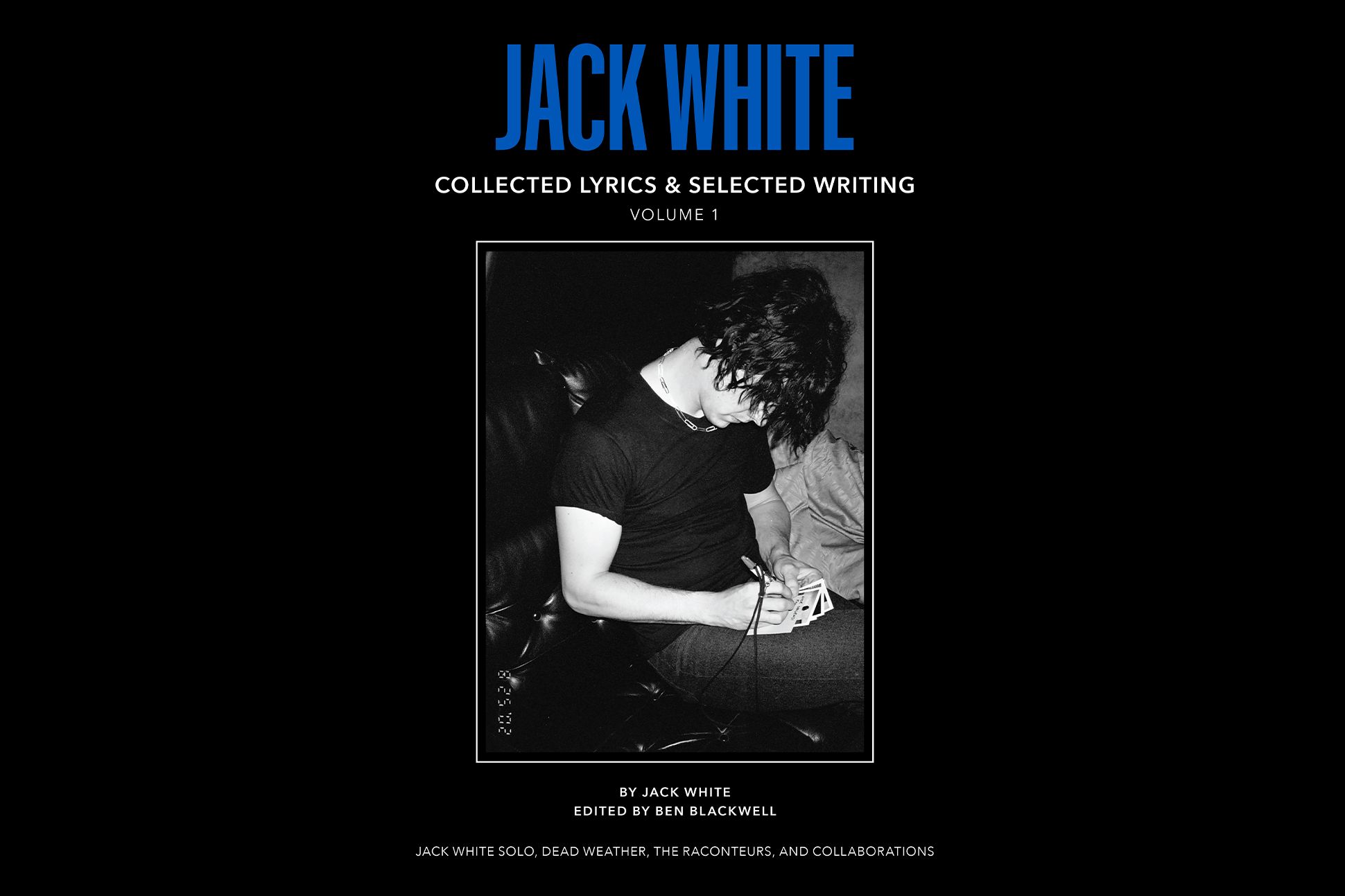
Both musicians share an elasticity of storytelling, and the ability to build a narrative moment without sacrificing the language’s poetic impulses. That lyric fluency comes, in part, from the fact that Jack White is a poet, and it’s a poet’s job to squeeze meaning from a handful of words. I recently spoke with Jack about poetry, songwriting, and his new book, Jack White: Collected Lyrics and Selected Writing, Vol 1, which compiles new poems, along with lyrics from his various solo albums and collaborations with The Raconteurs and The Dead Weather. The interview has been edited for length and clarity.
I'm the kind of person who writes something down and comes back to it later. And when I come back again, a year later, I might show it to my friends then because time away gives me perspective. Is that how your songwriting works? Or is it something that is more spontaneous and immediate?
I've tried every different kind of way to write. And I never settled on one thing. It seems like the things people resonate the most with are things I do very quickly. And maybe the simplicity of the White Stripes musically—that simplistic, boxed-in approach—resonated with people. It still surprises me. I can't believe people care about that band that much. Or those songs. Other things I've spent months crafting and trying to make more interesting and layered are sometimes met with a shrug, you know. There may be writers, poets, or songwriters that can work longer and more diligently and get better results. If I was going to pick one way of doing things for the rest of my life, it would be to be do things very quickly without thinking too much about it.
Song lyrics are the place where language goes straight from the ear to the heart in a kind of way. People need that immediacy. And they respond to it, too.
I jokingly say to people that my subconscious is way smarter than my conscious. And I talk to myself a lot. I say things out loud. Like, I'll be making coffee and look at the coffee grounds or something, and I'll say, “Well, that's gonna spill everywhere.” And two seconds later, it does. If you would ask my conscious mind right now, “Is that going to spill?” I would probably say no, it's fine. So, I'm always like, damn, my subconscious is so much smarter than me. And maybe when you do things quickly, you let the subconscious take more control. I've never gotten fully into stream-of-consciousness writing or psychedelic drugs to influence creativity. I've never delved into that stuff. If I were to sit down and think of something quickly, that seems to get closer to my heart without my brain getting in the way and ruining it.
Maybe the subconscious is where poetry lives—the place that is beyond our control. I got to talk to Patti Smith a few years ago, and I asked her about how she incorporates poems in her shows. She said, “All my song lyrics start out as poems.” Have any of your song lyrics started as poems? Or has anything that you thought was going to be a song turned into a poem?
You reminded me of a funny moment. Meg White [Jack's former bandmate] and I went to meet Patti Smith when she was signing books at a coffee shop in Detroit. We were like 19 years old. I was pretty naive. I didn't want anything signed. I was anti-autographs. I don't think I've ever asked for an autograph in my life. I was dumb enough or naive enough to ask her to read one of my poems while she's at a desk full of 100 people waiting to get their book signed. And she smartly said, “I don't have my glasses.“ But I had a page next to the poem that I had written quickly, in 30 seconds, as if it was written in some alien hieroglyphics. It was all just shapes and things. And she goes, wow, I really like all these shapes. It was kind of a telling moment that she was responding to something I did in 30 seconds.
My take about singing has always been it feels like a cop-out. Oh, here I go again, I have to sing this poem for people to pay attention to it. It's not a cynical thought, it's just a funny thing about human nature that if you put out a spoken word album or a written book of poetry, it's going to have a certain appeal to a certain amount of people. But if you put a beat and a melody to it, it's going to increase its appeal massively. People might not even think of it as poetry anymore. They think of it as lyrics, and then it enters a realm of wide acceptance. Some people say Jim Morrison was a poet, other people are like, “Are you kidding? That's laughable. What do you mean? There's no way you consider him a poet.” What's the debate—because he added melody to it?
I love that you brought Jim Morrison up. My senior high school thesis was about Jim Morrison as a poet. I would sit in class and listen to The Doors on my headphones and act like listening was important to writing the paper. He had a book of poetry called Wilderness, and all I remember is a line that was something like, “I let the rats play pool with my eyes.” And 17-year-old me thought that line was the coolest thing ever.
I'm so glad you said that today. I'm working on this sculpture out back right now. I have this pool table component, and I found these giant jawbreakers online. I bought 50 of them. I'm trying to figure out whether they're candy, but they're also planets, but they're also pool balls in this sculpture. So I'll be thinking about that line all day.
It's so cool that you're working on sculpture. As a one-note kind of guy, I’m jealous. I've always wanted to make three-dimensional things. Is visual art part of your practice?
Yeah, I have worked on sculpture since the ’90s. And I've never done a show or sold a piece or anything like that. When I opened my upholstery shop, I did sculpture and furniture in the same room. But I had no clue about what artists are supposed to do, especially in a town like Detroit. I'm like, “How do you have a show? How do you put on a thing?” I wanted to make films as well, and I couldn't crack that code in that city. I think if I'd grown up in LA I'd have five friends who were like, “Oh, yeah, let's go. I know a guy who has some lights. Let's go start filming.” I didn't have the connections or know what to do. Whereas with music it was like, “Whoa, I have a tape recorder, I have a drum set and guitar, so I can do that.” It’s easier to have an agent or connections with galleries in sculpture to show your work. I didn't know how to do that.
It’s a strange thing to make art in different mediums, and I've had to make peace with that over the years, especially with Third Man. Third Man is like a university. Paul Simon came to Third Man one time. He says, “It’s such a dangerous thing you're doing, mixing art with business.” And I said, I've had this problem since day one, when I had my upholstery shop. Upholstery is how we paid the bills. At the same time, I really didn't think about any of it. I considered all the upholstered pieces sculptures; the whole thing was art in my brain. And it was very confusing for other people. They would come into the shop and see all this upholstery and sculpture and think, “This guy is a lunatic. If he's trying to make money, he's being really stupid about it.” That kind of continues to this day.
Do you see a conflict between art and commerce? From the outside it seems like you’ have found a nice balance at Third Man.
We’re involved in a lot of beautiful things at Third Man that most people would say are not good business moves and should be X’d out for something that makes more sense. But when the dust settles, hopefully there's some kind of marriage between art and business. I had to stop thinking it's embarrassing to have a business attitude. Is my business attitude good? No, because I think if it was it would be lucrative. It's not a lucrative kind of success. It's the kind of business success where people get something out of it. They come, they're inspired by it, and some art happens. It doesn't make money though. So it's a funny little specialty in my head that I had to make peace with and let happen and not be so cynical about.
Is it true you used to put poems in your upholstery?
I did. It started off with poems, and then it got to be lots more complicated things inside of people's furniture. I was working at other upholstery shops as a teenager and thought, wouldn't it be nice if we upholsterers put jokes in here for each other, so that when we opened the furniture up, we’d see something only we would get? Like: “This customer was an asshole. He never paid me for the fabric.” So I started writing a couple of words. And then I wrote a line. And then I filled up a hole inside of an arm with writing, and it got more and more complicated. To this day I think there are these beautiful things—I think they’re beautiful—inside these pieces that nobody can see and are completely hidden.
Have you ever done poetry readings? Or gone to an open mic?
I used to do it at coffee shops in Detroit when I was a teenager. I read poetry at some readings and played folk songs at a lot of little places back then. But it's been a long time since I read. There'll be things I read on stage between songs, a lot of making up stuff on stage, but it's been a long time since I actually read.
These days, people tell their children, “What you're doing there is artistic, what you're doing there is creative. What you're doing and what you're feeling is inspiration.” These things were never told to me. Nobody said, “What you're doing is interesting, and you should continue doing it.” Now people are instantly supported, which is great. But it's funny that I didn't really know the word inspiration. I had been sort of trained to think that when I watch somebody do something artistic and get excited and want to do that too—I want to get on stage and play with that guy, or I want to pick up a paintbrush right now—I thought that was 100 percent jealousy. I did not know that was inspiration. Nobody defined that word for me. So I kind of thought that feeling was a bad thing. Don't tell people that you're feeling that feeling because they'll think you're being petty and negative. Let that person do their thing; it's not about you or whatever. It took me until my mid-20s to know that inspiration and jealousy were not the same thing.
Years ago, I got to read with my favorite poet, Yusef Komunyakaa. He won the Pulitzer Prize in 1994. I got to read with him and another Pulitzer-winning poet, Natasha Trethewey. I’m up there with these two incredible poets, and I threw everything I had into this reading. As I was coming off the stage, Natasha was walking up, and she gave me a hug and said, “So it's going to be like that.” And then she got up and gave this sweltering reading. And the whole time Yusef was kind of looking at us and nodding his head. And when it was his time to get up, he looked right at both of us and said, “I'm just going to read two poems.” And then he read the two most amazing poems in the world. The room was mesmerized. It was my first introduction to poetry as cutting or playing the dozens. Everyone took inspiration and challenge from the previous poet. I wonder if you’ve had an experience where you were playing music with somebody like that?
You're describing the best feeling in art, the best situation, and it's so rare. Because even when you set up a poetry slam, or an open mic night, or a bill of bands together, or whatever it is, you might not have those moments. People might go up and read and it's just dry. But when it does happen, whatever those things are, they're not negative, they're not jealousy, or indignation, or pettiness, or one-upmanship. You could use a word like “competitive,” but people are trying to build each other up, if they’re good people, even if they're trying to one-up. That's when an embracing of ego is a good thing, and an embracing of the innate talents that can only happen in an ad-lib, off-the-cuff situation. It’s beautiful because you would not have that moment sitting by yourself at home with a pad of paper or an instrument. I've had that happen many times, but it's never enough. It’s the kind of thing you wish would happen on tour. I want that to happen every day. Maybe another band will play and maybe they're really good. It inspires me to the point I want to go out and say, “This is what we're doing. All right, let's do this.” I heard Dustin Hoffman say something like you can get a lot of inspiration from someone telling you that you can't do something. It's empowering. I'm a parent, and whenever my children are doing something creative, I want to be supportive. But, also, I'm making up for the people who weren't supportive to me. At the same time, there's another part of my brain saying: don't be too supportive. Because if you make the situation too comfortable for them, they'll lose interest. The table is set, the carpet is rolled out, you know, and the sunlight is lit just perfectly. That's not the best scenario for interesting art to happen.
I hope you don't mind me asking something specific about your Collected Lyrics & Selected Writings. I heard some of the poems in the book are really new. I would love for you to talk a little bit about that.
I asked Chet Weise [editor of Third Man Books] and Ben Blackwell [co-founder of Third Man Records] if I could send some new things right before going to print. I wanted to have the freshest things from my brain in the mix, as well as things from way back in the day. I’ve got this poem here called “Pyrite,” and I'll read it:
THE BRICKS THAT CONSTRUCT IT
THE CEMENT THAT SUPPORTS IT
THE FOUNDATION THAT LIES UNDER IT
AND THE EARTH THAT SURROUNDS IT
THE HOLE IN THE GROUND
THE CAVE
THE SHELTER OF STICKS AND LEAVES
THE TENT, THE CABIN, THE BARN,
THE SHED, THE TURRET, THE NEST.
A ROOF
A LEAN TO
A BANANA LEAF HUNG OVER
A SET OF ROPES AND A TARP
MUD AND STONES
CONCRETE AND MORTAR AND BLOCKS.
WOOD CUT INTO PARALLELOGRAMS
AND NAILED, GLUED AND SCREWED TOGETHER
WINDOWS PLACED, AND SILICONE SEALED
SIDING HUNG PAINTED, BARN RED, NAVAJO WHITE, AND TEAL
SHINGLES MADE IN FACTORIES FAR AWAY
AND SHIPPED TO YOUR DOOR TO BE PLACED IN ROWS.
ARTIFICIAL FIRE AND ARTIFICIAL SUN
ARTIFICIAL PLANTS AND ARTIFICIAL CLOTHES.
PLASTIC AND PLASTIC
NYLON SEWN WITH ELASTIC
CELLOPHANE, URETHANE, BAKELITE, VISTALITE,
LUCITE, CELLULITE, HEMATITE, PYRITE
A BATHROOM WE HAVE TRAINED OUR SPECIES TO USE
LUXURIES WITH TEMPTATION TO ABUSE.
ABSOLUTELY UNNATURAL AT EVERY TURN.
HAVING LEARNED SO MUCH
WITH SO MUCH TO LEARN.
Pyrite
I wrote that in probably three minutes. I wanted to write quickly again and go to the smarter, subconscious part of my brain. I want to get into the idea that when we build houses—actually, other people build the houses we end up living in—it's compromise after compromise after compromise. Most people don't build their own shelters. At one time, everyone probably built their own. And people still do in places obviously, and in certain scenarios. But a large percentage of the human population lives in boxes that somebody else created. We will never know the budget for the construction or the taste of the designer and the architect who drew up the initial plans. Maybe he worked for a corporation that was making hundreds of these places. When you go to a Midwestern city and see 1920s homes—maybe three of them in a row—they're very similar. But when you look at them, one dormer is a little bit smaller. And then this window is not in the other home. And then the porch extends a little bit farther on that one. For what reason? I don't know. But I would love to think that it was the people involved saying, “Oh, we got to make each one a little bit special.” The beauty of that, you know, is construction guys caring about something that they don't need to. I think there's something really interesting there.

Jack White. Photo by David James Swanson.
You have a magnificent sense of how to create an image that makes sense to people in multiple sensory ways. I’m thinking about moments like “artificial plants and artificial clothes, plastic and plastic nylon sewn with elastic, cellophane . . .” It hits you in the ear and the heart like we talked about earlier. What was the last poem you wrote, and do you have any plans to publish a book of poems?
I think that was the last one I wrote pen to paper. I would really like to put out just a book of poetry without any of my other art attached to it. Including poems in this book sort of tests the waters. I should have done this a long time ago, so it doesn't look like a pretentious move on my part, to all of a sudden drop a book of poetry after all these years. The shitty thing about getting well-known about an aspect of your creativity is, if someone writes an article about me, they'll say, “Rocker Jack White did blah, blah, blah.” And I think, wow, I would never describe myself as rocker Jack White. It feels like an insult in a way. It doesn't matter how much I love rock and roll, or how much they think that applies. You don't want to be labeled in any way. If you call me carpenter Jack White, I'd be like, well, hold on now, it's not just about the wood. But when people know you for one thing, it’s complicated. It's hard for people to let an actor also be a painter. It's hard for people to let a comedian also be a sculptor.
Being able to show a history that proves it's not performative or fake is a good thing. There are actual photographs of writings in the book from throughout the years. They're still occurring. I'm glad I wrote new things right before we printed. And it's also a book that shows if it takes the trick of a melody to get someone in, that's great. That's a fine MacGuffin to have to get some stuff in the back of the book.
I think we all laid on living room carpets, looking at liner notes, looking for something more from a band or an artist we love. We need to bring that back. I want to make a plea to the music industry right now, specifically these streaming services: can we please make it easy to see all the liner notes of these records that people are streaming and see who played on them and where it was recorded? And we should be able to know instantly whether the person singing wrote the song or if there was another songwriter. It would spur more talk and more interest. If you're reading a book and discover this person also wrote other books, it might spur you next time you go to the bookstore to talk to somebody there about the author. And that leads you to more beautiful things, right?
Yeah, I love that discovery. And you just reminded me of laying down on the floor when I was a kid. My biological father had 3,000 jazz records, and he'd post up whatever we were listening to. Sun Ra was one of his favorites. And so I'd sit there and read Sun Ra's liner notes in second grade. All this Afrocentrism and Egyptian mythology, what we call Afrofuturism now. Reading the liner notes added a different dimension to the music while deepening the texture. Liner notes invite people into a larger part of the story.
Can you talk briefly about the experience of putting together your collected lyrics?
Well, I owe a lot of the book’s existence to Chet and Ben piecing it together for me. It’s kind of a spoiled position. For the first time in my life, I'm not the one sitting there with an X-ACTO blade and a pen, putting it all together in my kitchen. It's nice that we have an organization where Chet does this in the other room. I don't know the first thing about laying out a book like Chet has done so many times. So, what a beautiful thing to take advantage of in our own building.
It bums me out a little bit that my younger self didn't know how to do this or that, and didn't know how easy certain things could be if you would just peek through the bushes and get the clouds out of the way. Right now, I almost want to go to some teenage kids and say, “Hey, man, like that kid over there by his locker, he plays bass. And this guy over here, he paints. Give me a weekend. You paint an album cover, you come up with some beats, you write down that poetry you've been scribbling on your notebook. And let me help you put this together. And if you guys came out and wore fluorescent green plaid suits on top of it, minds would be blown. You guys would be warming up for bands within three months because nobody's doing that.” My brain thinks in that way. If I could go back and show myself, I would have saved myself so much more time. We all kind of think that as we crack these eggs and crack codes, as we get older, how easy would it be to go to high school with the knowledge that we have now. It was so stressful and full of anxiety, and you worried about what people thought and cared about what you're wearing. You could get a 4.0 and not even be that smart of a person. Because you just know what's important and what's not important, what to worry about and what not to worry about. I guess that's the beauty of youth being wasted on the young.
Adrian Matejka was born in Nuremberg, Germany, and grew up in Indianapolis, Indiana. Matejka served as Poet Laureate of the state of Indiana in 2018–19, and he became the editor of Poetry magazine in 2022.
Matejka is the author of several collections of poetry, including: Be Easy: New & Selected Poems (Liveright, 2023); Somebody Else Sold the World (Penguin, 2021), a finalist for the 2022 UNT Rilke...