


Before You Go There Is Something I Need to Tell You
Two poetry collections reckon with the grief of losing a mother.
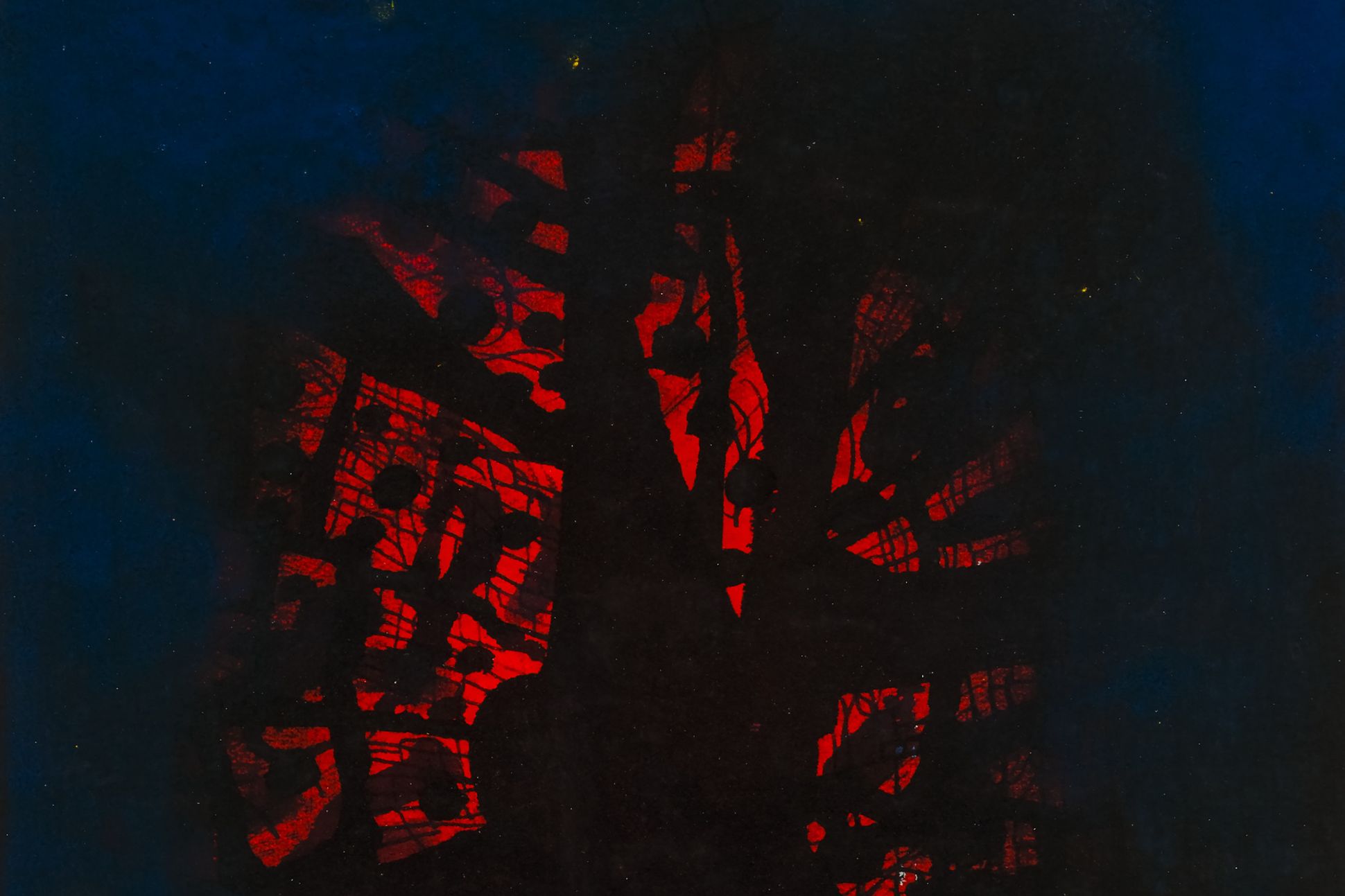
Yayoi Kusama, Deep Grief, 1954 (Detail). Courtesy Smithsonian American Art Museum.
The first sentence of Patrick White’s novel The Aunt’s Story (1948) seems to exhale: “But old Mrs Goodman did die at last.” Theodora, the beleaguered caretaker, recognizes a shift in the silence one morning that signals her mother has died. Into that silence she projects a future that might now be allowed to unfold. The narrative is what follows the mother’s death.
Mothers dying are essential to fiction: in the emptiness that they leave, plots thicken. The child, ideally an orphan, sets out to make their fortune, unencumbered by debts to the mother or the past. It is an opportunity for differentiation. “You look just like your mother, God love you,” people kept saying to me when my own mom got sick in late 2024. This annoyed me, because I wanted to resemble only myself and be free of her fate. “Parents make us earth, and souls dignify / Us to be glass,” John Donne wrote. I wanted my glass smoked, tempered.
But here I was, under clear glass framed on my mother’s walls: a pudgy baby, and she younger then than I am now. I was—we were, though I’ll try not to speak for others here—caring for her closely, because I loved her, because there was nothing else to be done, and because I wanted my own children not to reject my earthly body someday. And caring for her didn’t feel like the start of a narrative but the close of one that I would never know in its completeness. I experienced what Robert Creeley describes in his elegy for his mother as “the mouth’s sluggish- // ness, slips on / turns of things / said, to you, // too soon, too late.” Even when my mother was only weeks from dying, my mouth was too sluggish to form the questions that might fill the gaps in her narrative.
My mother’s death was not a story I could tell at first. The idea of writing poems about it seemed violent, an infantile insistence on my priority and continuation. Still, each night, I wrote out what had happened that day, filling a notebook with the fragments of my vigilance: found text and speech, meals cooked, medicines administered, diagnoses conveyed, messes cleaned, what the air and light and earth had been doing while her body dissolved and she did her loneliest work. I was in the mode Anna Kornbluh has identified as immediacy, but which might also be called trauma: too busy, too sad, for reflection on the mediations of genre and form. I tried to avoid figurative language. Objects stood in for feelings. But my notes were undeniably aestheticizing. Choosing where to put a line break, or describing the color of my mother’s bruises, or personifying the house as it leaked and crumbled in sympathy with her body, I aimed at more than just an accounting. I was trying, even then, to make art.
Still, I felt guilty, just noticing what was in front of me: Her shrunken frame hunched in a rocking chair, so small I didn’t see her when I first opened the door. Lawns quivered in unnatural autumn heat, decorated for Halloween with headstones and shrouded skeletons holding placards that said freedom. Later, her poor body—not enough flesh left to keep warm—was almost invisible in a mountain of blankets as she went to sleep; my strong body walked out into the winter’s thinness, got captured in the forest’s last brassy square of light, broke through, and trampled thin tiles of ice with the ecstatic knowledge that I was still alive. On the car radio, Tommy Dorsey sang “everybody wants to go to heaven but nobody wants to die.” Finally, in the bitterness of February, candy-orange koi shivered in a pool in the hospice garden. Her last night on earth, she gave us her final gift: snow.
In The World After Rain (2025), written in what Canisia Lubrin calls “anticipated grief” for her mother Anne, the poet wonders “if the poem must close, if hollow things must float / if some might say, after this wilting, you must be mad to write / any poem at all . . .” Anne is in the late stages of a long illness caused by an injury sustained during surgery for stomach cancer a decade earlier. As Anne slips away, Lubrin channels both her grief and her anger—particularly at the medical racism that caused the injury—into poems shaped by the intimacies of her mother’s illness. “Pressing our wide ego to the sexless pages / where we impress a future tense,” Lubrin’s poems show how the guilt of surviving into that future without Anne becomes entangled with the guilt of betraying her privacy by writing about her. Lubrin has said, “I didn’t actually want to publish this book. It was not an intention to give it a public life as a publication.” Poets worry about extracting aesthetic capital from a mother’s suffering—about claiming what is absolutely hers, her death, for ourselves—but we do it anyway.
Many elegies dwell on this guilt. Derek Walcott worries over “the veiled figure / of Mamma entering the standard elegiac”; Reginald Shepherd loses his mother “among the spaces / inside letters, moth light, moth wind, / a crumpled poem in place of love.” During my mother’s sickness, I asked myself: Are you really going to write about what happened to her body, which—archaic intuitions to the contrary—is not yours anymore? About her fear and pain, or the threshold between life and death where you saw her stop and cling fast, then sink into quietness, and go over? As if you’re the only one it happened to? With your ars longa pieties and narcissistic fantasies about cheating death with savage ink? Yes—because poetry is a form of thinking you rely on to make sense of what can’t yet be thought. And doubts like these turn elegies for dying mothers into a struggle with poetry itself: its means, motives, justifications, and language; its obscurities and disclosures; and how much you really believe in metaphor as you watch your mother’s body turn to liquid and stone.
***
Conventional elegies for mothers, which is to say most of those written up until the last century or so, are full of gratitude: for life, education, love, the gift of language incorporated with a mother’s milk. The poem repays that gift by polishing language to a high shine. But contemporary poetry replaces idealization with ambivalence and antagonism: it no longer feels possible just to praise the dead. My own poems transmute the checkerboard Mother Goose rhymes my mother read to me into weird avant-garde verse she wouldn’t understand. The texts I wrote about her as she was dying were no less obscure. I would use them to differentiate myself not only from the relationship she had to language, but also from the degradation of her body, the place I knew was my origin but whose fate I couldn’t accept as my own. Continuing to write while I cared for her was a way of insisting: I survived you. I’m sorry. I’m glad.
I had learned to write poetry as a way of escaping my mother, closing myself off to her and opening instead to a public, in the space of authorship that is alienated from the childhood world whose limitations made the writing of poetry a necessity in the first place. By design, my poems were a bit of a mystery to my mother, but she read them. In her copies of my books, pages are marked, and phrases that refer to our history together are underlined in shaky pencil. I see her looking for herself, or for some revelation of my inner life, despite the fact that my poetic opaqueness was in part a fortification against her. I could not disclose my feelings to her, but I could wrap them in wool and glitter for readers whose acuity, I imagined, exceeded her own.
Disclosure is a word, along with astonishment, that arises repeatedly in Lubrin’s poems for Anne. Lubrin wrote the book in 16 hours straight, an outflow of sorrow and anger and love for her mother’s “life of quiet astonishment.” Anne was born in St. Lucia (then a British colony) in 1939. She had only “a grade level education” and worked as a farmer, baker, and seamstress. But she found ways to live creatively. She passed on to her children a love of music and theater—she was the first Queen of Creole on the island—and Lubrin says that “‘being in her orbit was a constant reminder of how miraculous life can be.”
The poem celebrates her life, grieves its ending, and worries about the ethics of disclosure. “The house grows fat with nondisclosure,” Lubrin writes. Nondisclosure is a triple negative: life closes in on itself; disclosure opens outward to the world, and is in turn antagonized by the (k)not that refuses to let go, of her body, or these words. Lubrin’s poem addresses Anne as
woman from fine-print time—if I disclose to the world:
all the patrons of rank primed for astonishment…
you said, “all I have for you sé pwiyédyé, la vie sa la tête anba,”
if cowardly, I said, “I need nothing else,”
if soberly, I could say, “give me your cloudburst courage,
the waters of your life sloughing on always,”
and in whose currents none drown, not me or any of my sisters
In Creole, the mother warns the daughter to be careful: life is turned on its head. “I need nothing else,” the daughter answers, but the poem insists otherwise. She also needs to turn her mother’s life into something that can be kept—something like time. The book keeps grasping at “motherlike” time: “I am keeping time, mama,” “time worshipping time is a mother-image,” time leaning against “the whipping work of conclusion.” Poetry turns finality into time, and trope is what does the turning. Grief becomes rain, rain becomes “the thing you least expect will mother you.” Anne’s courage is a cloudburst, her life the ceaseless waters. Amidst the brutal materiality of illness and death, figuration won’t cease: “metaphors unmake the too-made, closing at the height of my life / as if to say to you, I’ll be literal when I’m dead.”
Death is the end of all conditions, yet the poem’s imagined final conversation with the dying mother is fiercely conditional, barricaded with “ifs” that postpone certainty. If such a conversation were possible, then “I might clear all love from the roof of this world.” The phrase is cryptic. Is love what’s left when everything is cleared away, or is love cleared away so that the world in its lofty certainty remains unencumbered by obligation? This ambiguity veils Lubrin’s grief across the book. It is in keeping with her two earlier books of poetry, Voodoo Hypothesis (2017) and The Dyzgraphxst (2020), which prefer complexity to personal disclosure. Lubrin has said that she read the poems to her mother, who can now no longer speak but responds with a tear, a smile, or a sigh. Anne’s voicelessness is overcome in the poem, however, where the daughter’s poetic conditionals merge with the mother’s speech in “deux voix, together, one through one,” such that “your mouth opens my own / whirring to anyone who will listen.” Finally, Lubrin attests to the value of writing poems as her mother slips away: “even if you’ll never meet me in these incongruous lines / even if this poem is merely abbreviated water from a shared sky . . . / as if there was only reading, on the imperfect hole of my dim imprint.”
***
“How to leave the poetry alone and let the silence in before it, too, is too late, and turns meaningful, for good,” asks Keston Sutherland in Meditations (2024), a collection about his mother’s death by suicide: “what good will come of doing it”—poetry–“to you again”?
Sutherland’s book is addressed to a mother who found her son’s poetry bewildering. Like Lubrin’s mother, who is pictured “in that cook’s uniform, floral-brown, trade-white / winds mapped in the sweat of your decades,” Sutherland’s mother, Suzanne, was a “trainee housekeeping team member on nights and early mornings in the same week at a Premier Inn thirty odd miles away, in your late sixties, with back problems, chronic arthritis, neuralgia and undiagnosed PTSD.” She “never read a single thing I wrote. Everything I write is impossible for you to read.” But he is “thrilled that it will mean nothing to you,” and so takes “meaning nothing to you to the next level, and [purifies] the nothingness, with such rare skill, that nothing will ever mean anything ever again.” The mother’s absolute incomprehension produces the poem’s wild brilliance. Their dynamic is set out midway through the book:
Before you go there is something I need to tell you. It will not be easy for me, because you won't understand. The best I can hope for is that it will make us both laugh, not at the same thing, but more or less in the same way, a kind of manic, baffled flirtation with hysterics, a washing our hands of meaning, an honest exasperation with the futility of trying to communicate that leads to a little hatch that springs open the instant you are provoked to tell me how stupid I am, but that you love me anyway, through which each of us can extend a finger, tenderly, for the best.
As he tells, she misunderstands. They laugh, she tells him to stop, and asks “why I can't talk normally, like everyone else,” and shouts, and gets annoyed, “and sometimes play at going along with not communicating, acting as though you have had enough of exasperation and futility and you are prepared to wait it out, unruffled, and not really listening, until I have got rid of it all and I am ready to say something that makes sense.”
Sutherland calls this a “parody of communication,” but it is also a poetics. The child adapted to the painful limitations of the relationship with his mother by speaking gibberish, sometimes doing “a credible imitation, for a moment, of someone talking to you with the intention of sharing things,” and the mimesis of sharing matured—or otherwise—into a poetic practice. It drove her mad, his “studiously malfunctional, fiendishly stupid rondels of downright drivel, that were not like being talked to by a human being, let alone being allowed to have your say.” But this mode—call it a game rather than a parody—was a poem from the start, and her bafflement led him to play it.
The mother in this book could never respond adequately to her son, and now, in the silence of her death, she resists him absolutely. The book continues to chase her down, harrying her with dialogues and apostrophes, trying to make sense and nonsense of her ending. Sutherland’s poems express regret for failing to read poetry with his mother, failing to listen to her “say it in your own words in your own time. And I never did, because I was so eyeless with rage, and so incapable of trust, and as incapable of simply letting you go as a banned dog’s jaws.” The book also can’t simply let her go. Meditations carries on making poetry out of the malfunctional speech that tormented and bound him to his mother: bees, treasury tags, “lava blancmange,” Xerxes, “acquainted squids dry-humping in a hoover bag full of egg whites.” Readers of Sutherland’s poetry are familiar with such comic assemblages; now we can see how they arose from the game he played with Suzanne. The poems continue to hold onto her, to address her with their “fiendishly stupid rondels” and “credible imitations” of someone disclosing something true. Of course, the poems aren’t really stupid or false—but then neither was the game that nurtured them.
Finally, this virtuosic nonsense gives way to a terrible lucidity. “I didn’t know what to say. So I just stood there, and held your hand, and waited for it all to end. And, as we both know, it did.” We don’t “both know” anything, because Suzanne—my mother’s name too—is gone. Death makes syntax absurd, as when my Suzanne bravely said, “well, we just have to get through it.” In the process of getting through it, “we” will come apart.
In the months before she died, my mother received many letters. They made her cry; everyone was saying goodbye, but she was the only one going. The poems I wrote in private felt like an assertion that, as Teju Cole said, “the abyss is remote for us”: a refusal to admit that what she was enduring, the hard and lonely work of dying I could feel under my hands when I touched her, would come for me too someday. “So this is what a human is: a body distributed among many who finish it for you,” I wrote. But I was being arrogant; she would finish it herself. Her courage and gentleness revealed that death is not just dissolution, but poiesis, a making of something mysterious and essential from the shell of the body. When she was gone, poetry would have to hold this truth for me, in silence.
Andrea Brady is the author of eight books of poetry, including The Blue Split Compartments (Wesleyan, 2021) and Desiring Machines (Boiler House, 2021), as well as a nonfiction study, Poetry and Bondage: A History and Theory of Lyric Constraint (Cambridge University Press, 2021). She teaches at Queen Mary University of London.