


The Hours Rear Up Like Flames
José Emilio Pacheco, one of Mexico’s most celebrated poets, rejected nostalgia even as he remained transfixed by the passage of time.
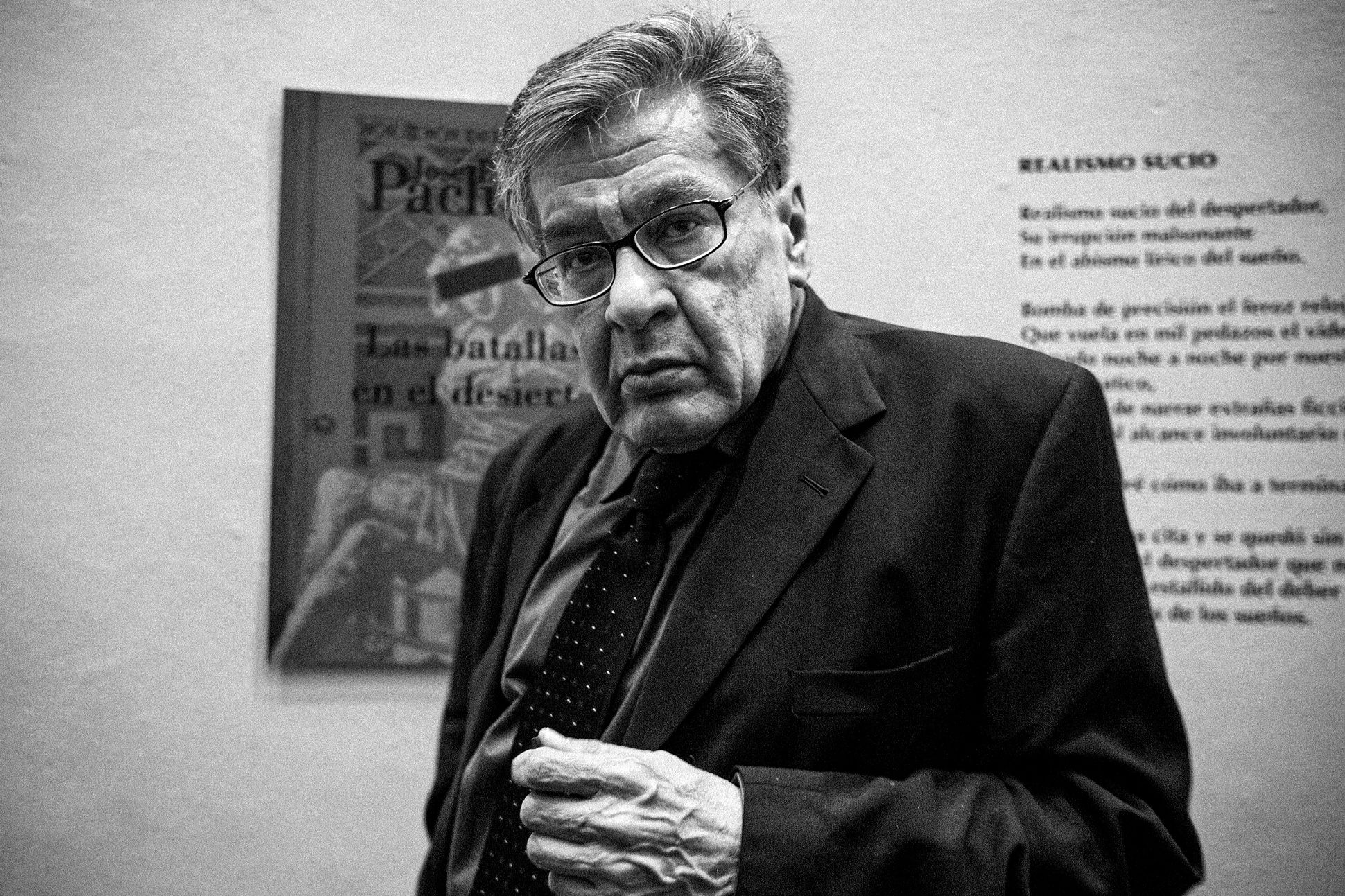
José Emilio Pacheco. Photo by Octavio Nava / Secretaria de Cultura. Courtesy Wikimedia Commons.
In the 1980s, a young American student named George B. Moore sent an extensive telegram to José Emilio Pacheco, one of Mexico’s premier poets, hoping to interview him. Telegrams were expensive—typically priced per word—but Moore sent question after question anyway. Pacheco later claimed the message ran to about 10 pages, which might have cost thousands of dollars to transmit. Instead of answering directly, Pacheco responded with the now-classic “Letter to George B. Moore in defense of anonymity,” a poem that doubles as an ars poetica. In it he writes, “I don’t know why we write, dear George . . . Strange, this world of ours: it’s interested more in poets / and less in poetry.”
Although he was a central figure in Mexican letters, Pacheco was shy and humorously self-effacing. Like Jorge Luis Borges, whom he greatly admired, he understood that the writer’s task is not to speak as a unique, divinely inspired being, but to intervene in an infinite network of texts—often stealing, translating, or rehashing ideas from the past. For Pacheco, the writer is nothing more than a reader: as he wrote in his poem to Moore, “we don’t read others, we read ourselves into them.” But unlike Borges, who constantly mythologized his origins, Pacheco pushed this self-effacing principle to the extreme. His poetry—recently reissued in a selection by New Directions, edited by George McWhirter—tends to downplay the personal voice and foreground a philosophical obsession with the passage of time. These poems project images of catastrophe, ruin, and decay onto everything they touch: foreign places, animals, the natural world, Mexican history, Spanish-language literature, and even canonical Western emblems such as the Venus Anadyomene, Goethe, and Heraclitus.
Pacheco was born in 1939 to María del Carmen Berny Abreu, the daughter of a businessman from Veracruz, and José María Pacheco, a military man who had participated in the Mexican Revolution and later turned to the practice of law. An only child, Pacheco was raised in a literary middle-class household where he read widely, from the Latin American canon to Jules Verne and Oscar Wilde, whose De Profundis he would later translate. He briefly studied law at the Universidad Autónoma de México, a modernist campus in southern Mexico City, but soon dropped out to dedicate himself to writing. Alongside notable figures of his generation, such as Sergio Pitol and Carlos Monsiváis, he took up editing cultural magazines, and eventually created one of the longest-running columns in the country, "Inventario," which was dedicated each week to a different literary or cultural topic.
In 1963, his career took a decisive turn with the publication of the short story collection El viento distante and the poetry book The Elements of the Night. The latter was a particular success and received a glowing review from future Nobel laureate Mario Vargas Llosa, whose verdict could then make or break a career. “A poet’s debut is usually a selfish testimony of an individual history,” Vargas Llosa wrote, “but The Elements of the Night showcases a perfectly formed creator.” Citing Pacheco’s “lucid vision” and “extraordinary gift,” Vargas Llosa argued that the 24-year-old deserved a place in Mexican letters alongside heavyweights such as Alfonso Reyes and Octavio Paz.
The Elements of the Night is an impressive debut and, in many ways, contains the principles that would define Pacheco’s poetry for the rest of his life. With a characteristic erasure of the poetic self in favor of a wider-reaching, almost impersonal voice, Pacheco renders the natural world in lush, sensory detail while still maintaining a philosophical distance. Formally, The Elements of the Night moves between traditional meter, prose poetry, and free verse while drawing on both Latin American and global literary references—an epigraph by the Romanian poet Tristan Tzara, for example, or a satirical qasida, a genre of Arabic poetry also taken up by Jaime Sabines, one of Pacheco’s key influences. At a time when many Mexican poets were preoccupied with nation-building and local color, Pacheco instead gravitated toward universal concerns, aligning himself less with his contemporaries than with figures like T.S. Eliot, especially works such as Four Quartets and The Waste Land.
Owing in part to this early influence of American and British modernism, The Elements of the Night is most remarkable for its obsession with time, rendered through what Eliot famously called “a heap of broken images.” The title poem offers a clear example. Composed of four stanzas, it moves from minimal evocations of passing time—“Beneath this small, dry empire summer has whittled down”—to vast images of rubble and decay— “In the last valley / destructiveness is glutted / on conquered cities, affronted by the ash” —and finally to stark reflections on life amid that devastation: “Nothing is restored, nothing gives back / that glowing green to the scorched fields.”
The poem traces an arc that typifies Pacheco’s lyrics, moving from the trivial to the existential, from the everyday to the apocalyptic. Objects appear as if newly encountered, unveiled through something like a phenomenological experiment. “Sand Garden,” for instance, exemplifies his method in three simple stanzas. It starts with a seemingly small observation invoking time and nature: “When the eternal rains are halted in the river, minuscule and swift, shod with a thousand pronouns— / the hours rear up like flames.” Then, in a second stanza, this perspective is amplified: “Come to the coast, then, where the sea grows, / this garden ploughed by waves, / this spray-lit daybreak.” And then, in the ending verses, we no longer have a philosophical observation but the assertion of a worldview: “The world is all for you / You are that world. / You are water, you are the sun, the earth / and the wind, trailing behind it like a shadow.”
In “Tree between two walls,” Pacheco similarly extrapolates an entire ontology of nature from the quotidian image of a tree:
Across the ages and the sky it strains,
against this sun that never dies when it goes down:
a harp string on which the air strums slow erosions;
a sign sunk under moss and water;
great tree flowing
through the mobile vein of its sap;
twilight wall where the world lets go our names
entwined
hearth floor
where fire face down feeds on its own embers
Part of this obsession is doubtless metaphysical. Much of Pacheco’s poetry is conceptual, staging philosophical questions in verse and approaching them from multiple linguistic angles, even as language itself proves insufficient. As he writes in “Stanzas,” “There is only silence. No poem / will pick up this lament in its cold echo.”
Pacheco was deeply engaged with Heraclitus, whose thought informs his second collection, The Resting Place of Fire (1966). The title alludes to Heraclitus’s notion of fire as archē, the fundamental principle underlying all things. In his fragments, the philosopher writes: “Through strife all things arise; the birth of water is the death of fire, the death of water is the birth of earth, etc.” Drawing on this framework, Pacheco explores transformation, instability, and cyclical destruction, as in “The Gift of Heraclitus”:
And the only rest for fire lies in taking this shape
with full power to transform.
Air afire and the loneliness of fire
at setting off this fire air is.
Fire—the world’s lighting-up, its going-out
always (it was ever) lastingly
A second, related obsession emerges in The Resting Place of Fire. After two sections that, much like The Elements of the Night, dwell on unlocalized images of time, relics, and disaster, a third turns toward Mexican history. It is as if Pacheco’s elusive speaker moves from portraying human history as a single, undifferentiated catastrophe—“Nothing alters the disaster: the wealth / of hot blood transfuses the air with its grief”—to confronting a specific historical wound: the Spanish conquest of Mexico and its enduring aftermath.
Part III, then, begins with an eerie fact: Mexico City is built over a lake and what was once Tenochtitlan, the island capital of the great, if violent, Aztec empire. After the death of the Aztec leader Moctezuma II in 1520 and the conquest of Mexico, the Spanish drained the lake and built their capital on top of what Pacheco calls, fittingly, a “Dead Lake in its casket of stone.” The specter of Tenochtitlan with its underground waters remains a strong, evocative image in Mexican literature and its collective unconscious to this day, and Pacheco immortalizes it as a kind of curse: “Under the ground of the city the waters gather / thick and putrid green/ to scourge the conquered blood.”
The Resting Place of Fire interweaves Pacheco’s impressions of a changing city with its colonial, and still haunting, past. The speaker laments the loss of a familiar urban world: “In these past years the city has changed so / it isn’t mine, anymore—the footfalls / echoed away into its vaults never to step home. // Echoes footsteps memories all wreckage.” At the same time, he mourns what the Conquest has wrought, turning on the colonial order with cynical bravado:
What have they done
with all those gardens, the decks swept bare
of flowers, what have they done with them all? . . .
They filled them with shit, paved them over
to make way for the weight
of the new lords in their carriages.
This final section is dense with images of destruction, death, and ruin, grounding the more abstract meditations of The Elements of the Night and the first two sections of this book in a specifically historical and political reality. The closing lines grow shorter and freer, as if slowly veering toward an uncertain, shaky future: “Today, in this dark night, I am joined / to everything that’s lost, and what is to come / no less.”
In a 2009 interview with Mexican poet Hernán Bravo Varela for Letras Libres, Pacheco declared his interest in history and testimony, in understanding what the passage of time does to humans, societies, and letters—while rejecting nostalgia. “Nostalgia is the invention of a false past,” he said. “And it’s opposed to a critical view. I am completely opposed to idealizing what we’ve lived, but totally in favor of memory.” Even though images of ruin often pervade Pacheco’s work—he dedicated his collection Miro la tierra to the 1985 earthquake that shattered Mexico City—there remains a sense of positive engagement with the world left behind. In the poem “Counter-elegy,” from the 1969-72 collection And So You Go, Never to Come Back, he claims:
My only theme is what no longer exists
And is the name of my obsession
My piercing cry is nevermore
And still I love this perpetual change
this shifting from second to second
because without it
what we call life
would be stone
***
One source of this overarching thematic concern in Pacheco’s poetry lies in his extensive engagement with poets of ideas, extending beyond the Mexican authors he admired—Jaime Sabines and Octavio Paz—to the English-language poetry he translated. Like Ezra Pound and Delmore Schwartz, Pacheco frequently incorporated his translations into his own volumes, not claiming strict fidelity but cataloguing them under the title Aproximaciones (Approximations). He regarded translation as a creative act and devoted decades to producing a brilliant rendition of Four Quartets.
In the years following these landmark collections, Pacheco remained committed to his earlier interests while broadening his scope to new subjects amid the turbulence and cultural revolutions of the 1960s and ’70s. Beginning with Don’t Ask Me How the Time Goes By (1968), his subjects quickly diversify. He dedicates poems to Rubén Darío, the Nicaraguan modernist who fundamentally changed the literature of the region: “We are ephemeral . . .” Pacheco recalls, “So now a hundred years have passed: / we can pardon / and call down Darío.” He evokes a Turner landscape: “No one can / keep a few seconds of this afternoon / to light them through the winter,’ and even Pompeii: “Our Bodies / fused with the rock: / endless petrified spasm.” The subjects of other poems run the gamut from aging and love to history, the Bible, and Marianne Moore-like observations of animals. Don’t Ask Me How the Time Goes By gives us the impression of a more playful, humorous Pacheco, a writer who no longer takes his subjects so seriously. In a poem about Rome, for instance, he finishes by claiming: “Possibly our verses will last as long/ as a 69 Ford/ (and certainly not as long as a Volkswagen Bug.)”
Similarly, in his subsequent collections—And so you go, never to come back (1972), Since Then (1978), and The Labors of the Sea (1983)—he examines time through the lens of history (on an Olmec head: “Vestige of what / beheaded god”), literary tradition (“here, your steps stretch on / into these anonymous footprints”), photography (“a snapshot is a terrible thing”), and nature (“dunes are mountains for a day. They oppose fixity with their plasticity, permanence with motion”). In The Labors of the Sea, he becomes transfixed by images of marine wildlife, crafting playful odes to an octopus (“No blood wells from its lips; night bursts— / pitching the sea into mourning”), a crab (“Of all the immortalities I believe in / only yours, friend crab”), a sea stack (“They shall not pass / says the earth/ repeatedly to the greedy, overflowing waves”), and the Odyssey’s Circe (“Circe, sweetheart, / what serenity and peace we learn at last / being little more than pigs”). This is an older, almost ecological Pacheco, who laments not only the ruins of his city but also the desecration of land by industry. In “Badland,” he writes:
This was the city of mountains.
From any corner you could see mountains.
They were so visible you didn’t
notice them. We only truly realized
the mountains existed when
the dust of the dead lake,
industrial wastes, the cruel toxin
from the incessant millions of vehicles,
the shit in atoms
of the many more millions of the exploited
brought down an unbreathable curtain
and the mountains were no more
Pacheco passed away in 2014, and although the popularity of poetry has declined throughout Latin America in favor of more prosaic pleasures, his work remains widely read in Mexico. Today, he is better known as a fiction writer, particularly for his novel The Battles in the Desert (1981), which was loosely based on his childhood in Mexico City’s Colonia Roma (and which might have inspired Alfonso Cuarón’s film Roma).
Throughout his career, Pacheco remained a writer and poet who could move from the material to the philosophical, from the vast history of letters to the intimate influence of his literary heroes. Like Walter Benjamin’s Angelus Novus, Pacheco’s Selected Poetry reveals a potent voice shaped by the tension between the detritus he witnesses and the past he projects onto it, a yearning to understand the passage of time coupled with a refusal to surrender to melancholy. Although he declared himself against nostalgia, a certain bitterness surfaces and recedes in a symphonic tension that animates his entire oeuvre. In a poem from The Labors of the Sea written to Juan Rulfo, one of Mexico’s most revered short story writers, Pacheco begs:
Tells us if you see the country we deserve,
if there is any hope
to set against our pains.
Julia Kornberg is the author of the novels The Parties (Astra House, 2027) and Berlin Atomized (Astra House, 2024).