


Extraordinary Cases
For Bruce M. Wright—a lawyer, judge, and poet who lived through Jim Crow—words held worldmaking force.
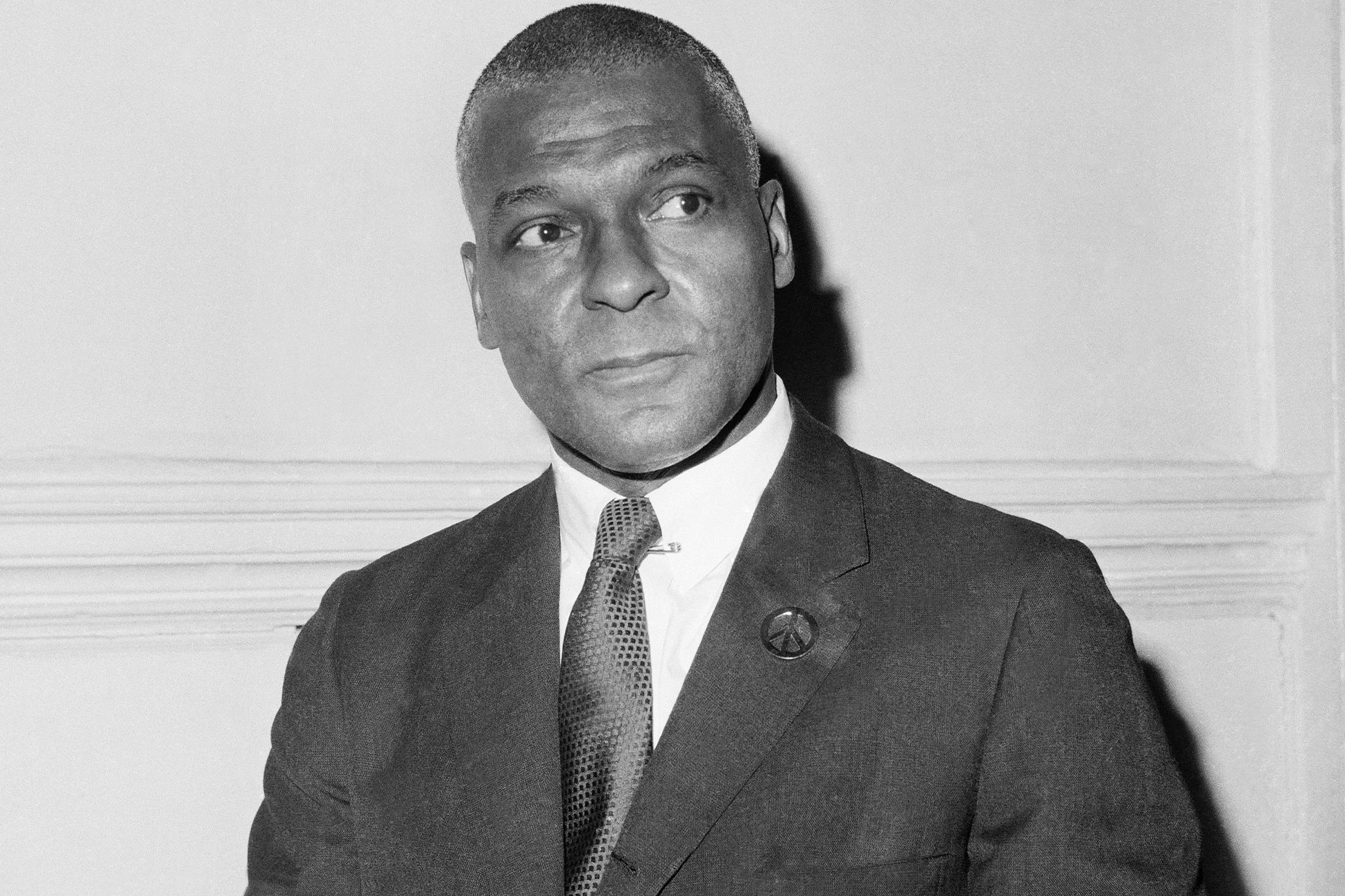
Anthony Camerano/AP.
Ordinary language breaks down in extraordinary cases.
—J.L. Austin
There is tenderness only in the coarsest demand: that no-one shall go hungry any more.
—Theodor Adorno
The lawyer-poet—or put more precisely, the working poet formally trained and accredited in the practice of law—is an understudied figure in US literary history. Consider this brief accounting of 20th and 21st century bards who fit the bill: James Weldon Johnson, Martín Espada, Evie Shockley, Archibald MacLeish, Monica Youn, Edgar Lee Masters, Reginald Dwayne Betts, Wallace Stevens. On one hand, this constellation seems to encapsulate the American tradition’s sheer aesthetic breadth. In another, more expansive sense, it reminds us that our desire for poetic language—like our dedication to the language of laws broadly construed, be they religious, physical, or otherwise—also constitutes a striving toward a more precise vocabulary for human and nonhuman activity alike at every level: from the cosmic to the microscopic, the ethereal to the mundane, and all their points of intersection and entanglement.
But what is the essential bridge between poetry and law? Is it the belief that language is not solely a carrier of meaning, but a mechanism for deducing some deeper reality beyond what is readily visible? A means through which we might illuminate what remains shadowed across time and see how the past constrains what we hope to one day become? Where the poetic and the jurisprudential collide is where the chorus of history awakens to clarify and complicate our current state of affairs: the voices of the living and dead gliding across a citational chain to set precedents and parameters, shaping the limits of the present day. These appear to us as edicts, cases, lines of verse: the collective memory of our civilizations enfolded in amber, if not etched in stone.
The 20th century poet, attorney, and judge Bruce M. Wright is an anomaly even among the ensemble of authors I have already mentioned. He represents a historically noteworthy case of the lawyer-poet in more ways than one: rather than his legal training serving as foundational support for a life dedicated to the art of crafting poems, for example, something like the inverse occurred. His work as a freedom fighter was energized, at every turn, by his vision as a poet. His legal scholarship, as well as his public speeches, were clearly products of a deep education in the literary arts and an investment in poetry as a means through which we might deploy “heightened language,” to use the critic Christopher Caudwell’s phrase, to navigate the distance between reality and illusion, delusion and the more beautiful, future world that words might help us make. Wright embodied the best of what the practice of poetry offers us: both the inspiration to go against the grain of the present world and the instruments needed to reshape that world, remaking it each day through the ritual reinvention of our shared language.
Wright’s early life was enshrouded in mystery. A question as deceptively simple as where he was born and raised has quite different—though invariably overlapping—answers, depending on your source. Some biographical texts say that he was born in Baltimore in 1918 and raised in Princeton, New Jersey. Others that he was born in Princeton and raised in Harlem, or else born in Princeton and raised there too. Archival documents I’ve studied for the past several months mention a house belonging to a Wright family alongside a group of African American households once based in what are now called the Institute Woods: a nature preserve located next to the Institute for Advanced Study in Princeton.
When I think of Wright, this is one of the first images that comes to mind: a boy with his father’s name coming of age in a segregated college town, trying to make sense of the landscape around him. It’s important to note that Wright’s last name, according to some sources, came from his mother, Agnes Thigpen Wright, who was white, rather than his father, Bruce Alleyne Summers, who was African American. Perhaps the documents in question, pulled from the IAS archives, misrepresent this reality. It is also possible, of course, that Bruce M. Wright grew up in Princeton with a double, living in the woods, who shared his name. The philosopher Giambattista Vico says that the forest is where our ancient ancestors first derived their sense of metaphor, hearing peals of thunder in the distance. They needed words to describe what they heard but could not see.
Here’s what we know for sure. Bruce M. Wright began his career as a published poet in 1944 with a collection entitled From the Shaken Tower. The book was edited by Langston Hughes, who would also collaborate with Wright on Lincoln University Poets, an anthology of college-aged poets from their shared alma mater that featured not only Hughes but since-canonized writers like William Waring Cuney (author of the classic Harlem Renaissance poem “No Images”) and Melvin B. Tolson. Wright landed at Lincoln University, an HBCU located near Philadelphia, after a series of disappointments. First, Virginia State University revoked his scholarship after he published a controversial headline in the college newspaper (one that, rather fittingly, hinged upon a bit of wordplay, where he replaced the word “week” with “weak” when describing a series of on-campus events). Then, Notre Dame rejected his application explicitly on the basis of race. Wright was offered a scholarship to Princeton, which he accepted, returning home to complete his undergraduate education.
Upon discovery of Wright’s racial identity, however—on the first day of orientation, no less—Princeton rescinded his offer of admission. Wright enrolled at Lincoln University later that year. He intended to study medicine, but an encounter in a freshman year biology course clarified that he had no future as a surgeon (an in-class assignment to cut open a rabbit cadaver put him off immediately) and he chose to pursue law. After graduating in 1942, he was drafted into the US Army.
Wright’s first months in the armed forces were marked, as his early life had been, by the harrowing, material effects of anti-Black animus. Such as the night when the Black soldiers in his company were awakened and ordered to extinguish a fire accidentally started by a nearby white artillery unit. Wright vocally protested this order, and spent almost three months in the stockade as a result. During this period, he wrote letters to the New York Times and to Congressman Adam Clayton Powell, Jr. describing the mistreatment that he and other African American soldiers experienced at Camp Rucker. He also formally requested a transfer. These messages were intercepted in advance and never reached their intended audience.
After basic training, Wright volunteered for combat duty and was part of the third wave of soldiers to reach Omaha Beach on D-Day. For his valor in combat, he was awarded a Bronze Star and a pair of Purple Hearts. For writing letters criticizing the treatment of Black volunteer soldiers after the defeat of the Axis powers—a number of whom were relocated and sent to dig sewage trenches alongside now-imprisoned German soldiers—he was accused of trying to incite a riot and placed on laundry detail. Rather than accept this punishment, Wright—ever-fugitive in one way or another—went AWOL. He was quickly apprehended and incarcerated, serving his sentence in an army prison before boarding a troop ship home, medals in tow. During the voyage, he was harassed by a white officer and went AWOL a second time once the boat docked. While on the lam, Wright made his way to Paris, where he met the Negritude poet Léopold Sédar Senghor and was “introduced to him as an American poet." Which, in his own words, was “all [he] ever wanted to be in life.” The army later found the young writer once more and sent him back to the United States in chains.
Now returned to everyday life on American soil, Wright attended night classes at New York Law School and graduated in 1950. Over the years, however, numerous publications incorrectly claimed that he earned his JD from other institutions, including Yale, NYU, and Fordham, where he attended for several months but did not complete a degree. After graduation, he began working at Proskauer, Rose, Goetz and Mendelsohn as a legal clerk. Though he would go on to represent some of the most visible Black artists of the 20th century—Billie Holiday, John Coltrane, and Miles Davis among them—Wright was told during his time at Proskauer Rose that it was simply not the right time for an African American attorney to be made partner at the firm. Clients wouldn’t accept it. He would have to test out his career prospects elsewhere. Like another one of his famous clients, Malcolm X—whose childhood teacher, Mr. Ostrowski, once advised him to relinquish the dream of becoming a lawyer on account of his racial identity—Wright learned early on and often about the social limits imposed on the ambitions of the marginalized.
For years, he seemed to be caught in a world-destroying recursive loop: either his words caused alienation and outsized punishment (as with the case of his lost college scholarship at Virginia State and the army’s response to his letters), or they were powerless, even when he proved himself competent, to merit his fuller inclusion in society (as with his being turned away that day in Princeton or discouraged by the partner at Proskauer Rose). Words were everything and nothing at all. They showcased his rare promise, and nonetheless placed him in positions of peril. What he said, or wrote, only seemed to matter if it led to his exclusion from the social wealth others readily enjoyed.
Through it all, Wright remained true to his vision. Over the next 17 years, he made his name at a range of Black-owned law firms, and in 1967 was named counsel to New York City’s Human Resources Administration, before Mayor Michael V. Lindsay appointed him to the bench of the NYC Criminal Court in 1970. Here, Wright became notorious as a vociferous opponent of cash bail—claiming the US Constitution as the foundation for this stance—and drew the ire of the NYPD as a result. Beginning in the early 1970s, they referred to him as Turn ‘Em Loose Bruce, an insult that almost sounds, to the poet’s ear, like a kind of divine command—a petition from on high, across the ages, to break every chain.
There was truly no moment in his adult life, as far as I can tell, when Wright wasn’t trying to shake up the world. He spent the latter part of his career—including 12 years as a New York State Supreme Court justice—composing legal scholarship infused with lines from William Shakespeare, T.S. Eliot, Pablo Neruda, and Benedict Spinoza. This broader ethos spanned multiple genres: legal criticism, memoir, public speech, and of course, verse. His citational practice and rhetorical style further clarified the unbreakable bond between the art of crafting poems and the form and function of the law, which is established and enforced through poetry’s materials and techniques: the centrality of public oration, the desire to deploy the precise sequence and selection of words needed to move an audience of listeners (whether they are fellow poets, opposing counsel, or a jury), and the interplay of nomos and narrative (to use the legal scholar Robert Cover's phrase). This overlap is also evident in the power of speech-acts, in both poetry and law, to reorganize reality. Just as the ancient poetry of communal ritual is believed to hold the power of life and death, sickness and health, to summon the divine or curse the living, the utterances of those who wield power within the courtroom mold our world. Freedom is reclaimed or stolen away. The lines of nations are drawn. Kinship bonds of every kind are split apart, forged anew.
Wright understood this. And his foundation in writing poetry—as well as his early experiences with Jim Crow in Princeton and beyond—helped animate his conviction that words hold worldmaking force. Once arranged in a certain order, the nature of one's material circumstances, including the state of society at large, can fundamentally change. In recovering his legacy, and that of freedom fighters like him, we recall something crucial about the social and political role of poems, which are, invariably, mental models of the world as we know and dream it.
Here is a section from Wright’s poem “Four Primitive Elegies”:
Who now lies close by edges of a pool,
lies beneath the depth of root.
Here was dug the dry grave,
without the wasted wilt of flowers,
without tears in flood or printed rite.
Who once witnessed the Our Father
words spoken out to speechless angels,
can now pace the steps away from
all the granite ghosts,
from all the un-sung hymns
and turn, before turning once again
to where arrested footfalls pause
as though on sunken sands of every sea,
beyond the cause of every cause,
where songs and silences recede.
These lines are taken from the third section of “For My Father (1889-1947), Who in His Eldest Son, Has Discovered That Primaeval Adam Remains the Same/in His Loves and Hates. His Aches and Pains.” Appearing in Wright’s collection Repetitions (1980), it is characteristic of his poetry from this period: rich in religious imagery, marked by a sense of pessimism that is nonetheless infused with a deep belief in the strength of human will. He knows what the world has taken from his father, and from his beloved people. He devoted his years to tending those wounds: as a judge, attorney, and lifelong poet, committed to cultivating a very different story about his place in the universe than the one that was mapped onto him at the start. There was no rest on this earth for the man with whom he shared a name, face, and legacy. No paradise to be found. So he conjured another life in the language they shared. One where a freedom once unthinkable might finally be made real.
Joshua Bennett is a professor of literature and distinguished chair of the humanities at MIT. He is the author of five books: Spoken Word: A Cultural History (Knopf, 2023), which was named a New York Times Notable Book of 2023; The Study of Human Life (Penguin, 2022), which won the Paterson Poetry Prize and was longlisted for the Griffin International Poetry Prize and The Massachusetts Book Award;...