


This Is a True Story
Gray Barker helped create UFO mythology from his home in rural West Virginia. In his poems, he channels the repression and paranoia that stalked postwar America.
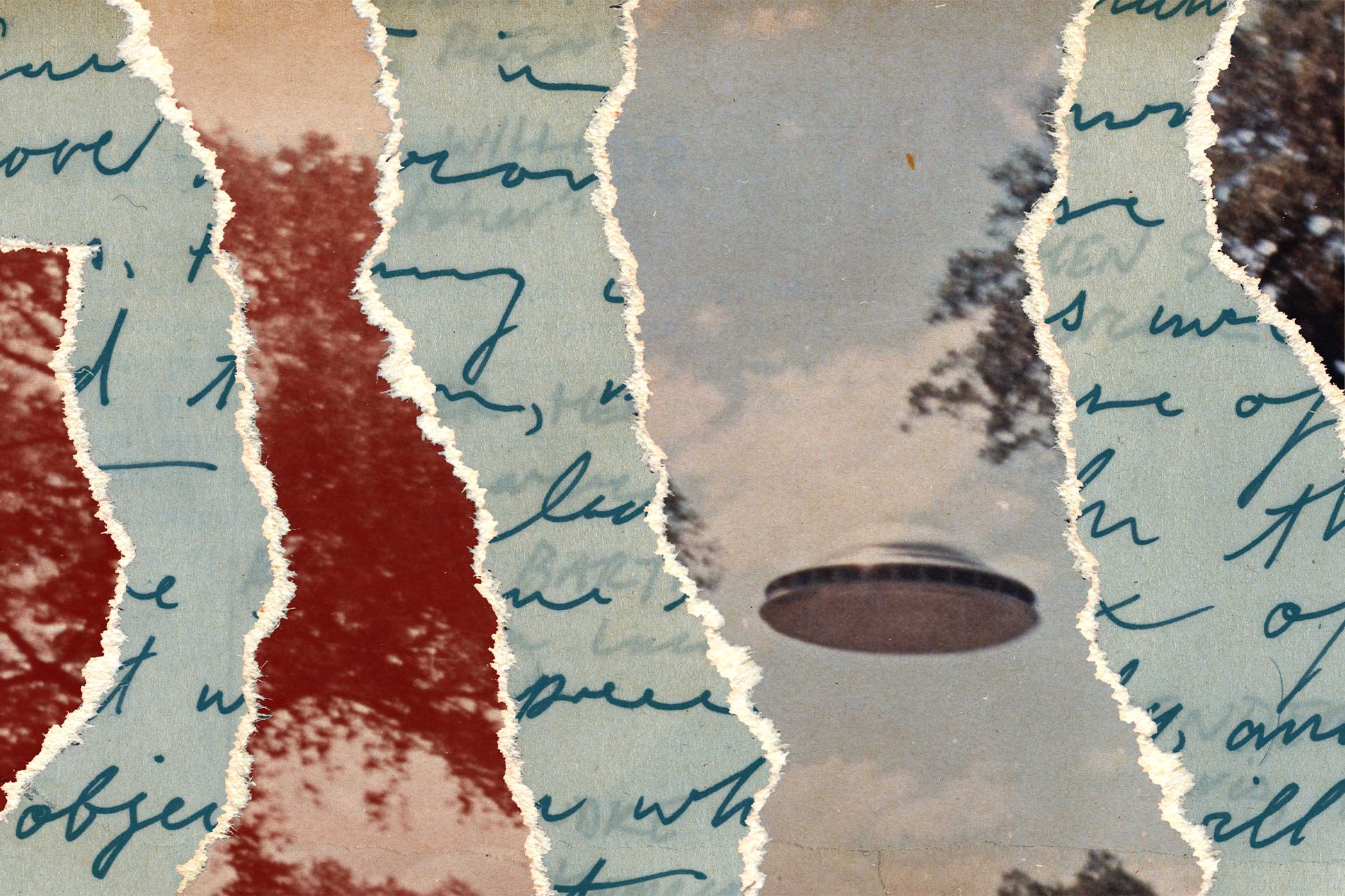
Art by Anthony Gerace.
Ufology has always been fundamentally about authenticity: the video, the photograph, the classified text—the document, the actual thing. The search for extraterrestrial life involves scrutinizing blurs on images, assessing the credibility of witnesses, and peering through hoax, fabrication, psyop, and counter-psyop to get to the verifiable and undeniable. The real.
This is why Gray Barker’s legacy in ufology remains unstable at best. On the one hand, he sits at the crossroads of nearly all of the major UFO stories of the second half of the 20th century: the Men in Black, the Mothman, the Flatwoods Monster, the Philadelphia Experiment. Even if you’ve never heard of him, his work was the source material for a great deal of the popular culture you’ve consumed. On the other hand, while he dedicated his life to proving that UFOs exist and searched for such proof, he also concocted a number of hoaxes and passed off fiction as documentation.
Behold the Behemouth: The Collected Poetry of Gray Barker, edited by Gabriel Mckee (who also published last year’s excellent biography The Saucerian: UFOs, Men in Black, and the Unbelievable Life of Gray Barker), offers a new way of looking at the inherent unreliability of Barker’s work. Poetry, almost by definition, sits as far as possible from documentary and its obsession with untrammeled realness. Poetry is a genre of artifice, construction, and craft—of the deliberate shaping of language. If Barker’s prose often presents fiction as fact and vice-versa, in his poetry it all bleeds together: a slurry of affect and longing and coarse humor, the detritus of a fringe culture’s fringes.
Barker’s lifelong friend Jim Moseley once described Barker’s poetry as an “expression of his very private hell.” But it’s possible to read his oeuvre differently. As Shelley suggests in A Defence of Poetry, poetry is a “secret alchemy [that] turns to potable gold the poisonous waters which flow from death through life.” Barker swam in those waters throughout his decades in postwar rural West Virginia, and in his poetry, he tries—however imperfectly—to transmute them. What emerges is something distinct from the documentary culture of ufology and a different understanding of authenticity altogether.
***
Barker was born in 1925 and spent nearly all his life in West Virginia. In 1946, during his last year at Glenville State College, he assembled an unpublished booklet of poems titled Who Knows (only one of his poems was published in a literary magazine during his lifetime; most of the rest appeared in privately circulated UFO zines, were mailed to Jim Moseley, or were found by Mckee among Barker’s papers). Who Knows is replete with the kind of juvenilia you might expect from a precocious but bored 21-year-old: fatuous and ironic one-liners, simple jokes, observations that don’t quite reach profundity. But Barker was already developing his knack for compression, evoking images through brief, fragmentary lines, as in “The Precentor”:
The precentor strikes the pitch
And breaks the large fork on the
Altar.
The file marches past.
The place is only a lot of cobwebs now.
Barker is often at his best in spare lines that strip a scene to its essence. This gift for minimalism sometimes sits at odds with his grandiose self-conception; at 21, he already imagined himself on the verge of greatness. In “Gray Barker Writes a Play,” for instance, he is carried out of the theater on the shoulders of cheering throngs.
Barker was on the verge of something, alright. In 1947, a man named Kenneth Arnold was flying his two-seater near Mount Rainier when he saw nine flying objects cruising at high speeds, a sighting that launched the modern UFO era. Barker was then working as a film distributor, and by the early 1950s was finding success with science fiction fare like The Day the Earth Stood Still. His own entrance into UFO research came in September 1952, when the Associated Press reported that seven people in nearby Flatwoods, West Virginia, had seen a glowing fireball descend into a nearby hilltop. Barker drove out to interview the eyewitnesses, writing up a report—embellished with numerous fabrications—and sending it to Fate magazine. Encouraged by the reception, he launched his own publication, The Saucerian, whose motto was: “Keep your head in the stars—and your feet on the ground.”
When his friend Albert K. Bender abruptly dropped out of the UFO investigation business, claiming that he’d been approached by a trio of men in black suits who’d urged him to back off for his own good, Barker saw his chance. His 1956 book They Knew Too Much About Flying Saucers chronicled Bender’s saga and introduced the country to UFO paranoia: specifically, the idea that the government (or perhaps aliens themselves) were actively working to suppress information, a narrative that became an enduring theme of the UFO canon.
Through Barker and the various people in his orbit, America came to understand that we were on the cusp. Of what exactly was never quite clear—the appearance of extraterrestrials, sure, but what form that was going to take perpetually shifted, as did popular perception of the government’s involvement.
Despite his centrality in all of these narratives, Barker remained on the edges of these fringe communities, primarily because of his reputation as a hoaxer. True to his name, he seemed to understand early on that you need more than just facts to get people’s attention—you need a carnival barker’s allure. He forged letters, faked footage, pranked fellow researchers, and published outright fiction as fact. In the late 1960s, he and journalist John Keel came to Point Pleasant to investigate another West Virginia cryptid, the Mothman. Each ultimately produced a book about the creature. Keel’s The Mothman Prophecies (1975) strives to report accurately the strange sightings that preceded the Silver Bridge collapse of 1967, while Barker’s The Silver Bridge (1970) is, at times, pure invention. “I asked him then what sense of mischief was driving him and why he presented a novel as nonfiction,” Keel later said. “He answered me with jokes.”
In poetry, questions of fact versus fiction, hoax versus document, tall tale versus reportage fade away; the work here by nature blurs and bleeds. The poems in Behold the Behemouth are a scattershot mix of all of Barker’s tendencies and often exhibit his multiple modes in the same few scant lines. While Barker’s magazine was called The Saucerian, it’s the name of Moseley’s magazine, Saucer Smear, that I think of when reading these poems: here, so many layers of postwar culture, Appalachia, UFO subculture, literary references, and Barker’s own personal life (to say nothing of poetic styles and approaches) blend together. A saucerian smear.
***
In gathering Barker’s poetry, Mckee gives us a fair amount of chaff with the wheat. In addition to the juvenilia of Who Knows, scatological references abound. “John 3:16” and “There’s a Big One Coming Out” are long, drawn-out affairs about, respectively, a toilet and a fart. Many of the early poems are duplicated; the book’s second section, The Early Poems of Gray Barker, is a collection that Barker assembled for Mosely as a Christmas gift in 1960, and it repeats a number of poems from Who Knows verbatim.
In The Early Poems, Barker is once again at his best when he is briefest. At the end of the collection, he includes a number of extremely short excerpts from They Knew Too Much About Flying Saucers, here recast as poetry. Decontextualized, they function as enigmatic fragments, as in “Dinner Engagement”:
He invited me out to dinner.
“Order anything you want,” he offered.
I had steak.
By adding line breaks, Barker defamiliarizes what might otherwise be mundane prose; once isolated from the rest of the narrative, the passages suddenly invite heightened scrutiny. It’s the literary equivalent of a UFO photo, an image that constantly teases significance: is that blur in the sky a revelation, or just a smudge on the negative? Is there something there—or not?
Barker’s poetry often ricochets between brief, elusive fragments and self-consciously arch, grandiose passages. In one longer, incomplete poem, “Seven Sagas,” he writes of the “basic song of life and love and death,” which, if sung, would “shake the spheres.” Though the song is heard only once in life, Barker professes to know it, and announces he will sing it: “Listen now for crack of doom comes nigh— / Listen to the strange symphony of the horns.” What follows is several pages of dadaist gibberish, an onomatopoeic orgy of “Poomphs” and “Fawfs” and “Baws” that does nothing but undercut the pomposity of the opening verse. As in “There’s a Big One Coming Out,” the build-up to revelation is ultimately just farted out.
Barker’s nonfiction breeds paranoia; his poetry, by contrast, veers into silly exuberance. Still, beneath the silliness lies the sense that he has something important to say—and yet, at the last minute, can’t quite bring himself to.
***
Aside from his reputation as a hoaxer, the other thread running through Barker’s biography is his sexuality. In March 1962 he began sending Moseley “chapters” from a novel-in-progress titled Mulberry Place, which portrayed gay cruising in Clarksburg. Alternately frank and filled with euphemisms, the book describes various men as either having “a definite Marxist look” or a “John Birch aura about them.” Sex itself is called “Communist Indoctrination” or a “lecture” on the “decadent bourgeoisie.” Such activities were dangerous business; that November, Barker and his roommate Don McCulty were arrested and convicted of homosexual activities deemed “against the peace and dignity of the State.” As part of his probation, Barker was forced to see a psychiatrist for conversion therapy, while McCulty was briefly institutionalized.
The poems from this period, which Barker collected under the title A Portfolio of Psychotic Verse written while drunk and sent to Moseley in the early 1960s, reflect his experience being gay in West Virginia at that time, with all its isolation, frustration, self-loathing, and longing. In “I Take a Researcher to Dinner,” Barker writes of a “price made” and “agreed upon” between himself and a “researcher.” As the researcher leaves, thanking Barker for dinner and telling him, “The crabs were very good,” Barker ends the poem:
And as I sit here,
Picking the crab lice off me,
I feel terrible.
No longer structured around the build-up and feint, Barker’s fragmentary poetry now reflects a shattered self looking for coherence. Missed connections abound. In “An Odd Request,” a confidential doorway meeting with a man who identifies himself as a Communist, homosexual, and Catholic appears to be leading to sex; instead, he hits up Barker for money. In “I Met a Spaceman,” an encounter with “a spaceman from a spaceship” whom Barker contacts in the “oft-suggested way” involves a series of complicated and failed communications, but just when the spaceman begins to grunt as though interested or even pleased, he suddenly assaults Barker before flying off. This isn’t the only overt connection between sex and violence. “The Revolt of the Boys” recounts an incident in which men that Barker and McCulty “Indoctrinated” subsequently broke into their apartment.
Even the “Dinner Engagement” incident from The Early Poems is reconfigured into a new poem, “Late at Night”—expanded from an elusive fragment into the more explicit narrative of a pickup. Barker, having taken a friend home one night, sits with him “nervously” in his car outside his house. When Barker begins to say there’s one thing he’d like to know, the friend breathlessly interrupts him to finish the statement:
“You want to know if you can have
Anything you want?”
“Yes,” I replied.
“Anything you wish,” he agreed.
“I’ll have steak,” I said.
Scholars sometimes see Barker’s UFO work as an expression of—or perhaps even a cover for—his sexuality. As UFO researcher and historian David J. Halperin muses in the documentary Shades of Gray (2009), “My guess is that for Barker, the idea that there is something so explosive that it cannot be revealed—and that if you speak about it you get into trouble—was something that echoed for him.” David Houchin, the curator of the Gray Barker UFO Collection at the Clarksburg-Harrison Public Library, agrees, suggesting that in smalltown West Virginia, cultivating an image as a UFO kook may have been a means of developing an “acceptable” marginality: “in small town life,” he says, “it’s better to have the UFO tag than the dangerous sodomite tag.”
It’s too simplistic to read Barker’s interest in UFOs as simply a metaphor for his sexuality. But a poem like “Dinner Engagement” also makes clear that a subtle queerness runs through all his paranormal writings and that these two parts of his personality often overlap in his work. (As Mckee notes in The Saucerian, one of Barker’s descriptions of an alien approaching Albert Bender—sitting first behind him in a theater and then beside him—is unusual for alien encounters but quite common for pick-ups.) Both parts share that pulsing desire for something else, anything other than this world, this landscape.
But isn’t that why we believe? We believe in UFOs because we believe in the deus es machina, the god from the flying machine, the thing that arrives abruptly to change everything, to reduce all we know about existence to nothingness, to usher in an entirely New Age. If extraterrestrials are real, then nothing is the same. Religion, politics, nations, races, genders: all that falls by the wayside, all the categories by which we make sense of the world evaporate. We start fresh. That’s what a belief in UFOs offers, and that’s why so many of us cling to it, despite all evidence to the contrary. It’s why, as the poster for The X-Files has it, we want to believe.
Barker certainly felt this, but perhaps not only this. In the early poem that gives the collection its title, Barker suggests that writing about UFOs has another purpose. We shout things like “Behold the Behemouth,” he writes,
Because things like this
Sound like they do strange things
to people when they say them.
At the end of the day, Barker seemed to believe that heralding the UFO was as much about the changes brought about by its arrival as it was about the changes elicited in the herald himself. He devoted his life to the saucer not just as a documentarian, but in order to change himself, to make himself anew. This perhaps explains his penchant for hoaxing: as much a way to imagine a new world as to transform himself in the process.
Despite the singular nature of Barker’s biography, the figure that emerges in Behold the Behemouth is an avatar of postwar America: its longing, its repression, its paranoia. Writing largely for an audience of himself and one close friend, Barker could be uninhibited in these lines, and in doing so captured a wider spectrum of experience than his published books could. One of the repurposed passages from They Knew Too Much About Flying Saucers in The Early Poems reads
“This is a True Story”
This may have nothing to do with flying saucers.
It is a tale of abominable stenches and eldritch bangings in the night.
It is a true story.
In the context of the original book, these lines are an annoying feint, the wink of the trickster. But here they read more as a confession. This is what poetry offered Barker. Here, he could write of UFOs without ever having to address their authenticity. Here, he could write of the reality of his private life without ever having to name it. And here, every word of it might be true.
Colin Dickey is the author of Under the Eye of Power: How Fear of Secret Societies Shapes American Democracy (Viking, 2023), The Unidentified: Mythical Monsters, Alien Encounters, and Our Obsession with the Unexplained (Viking, 2020), Ghostland: An American History in Haunted Places (Viking, 2016), Afterlives of the Saints: Stories from the Ends of Faith (Unbridled Books, 2012), and Cranioklepty: ...