


This Have-Not Province
In Karen Solie’s poems, Canada’s poisoned lands become theaters for searching moral questions.
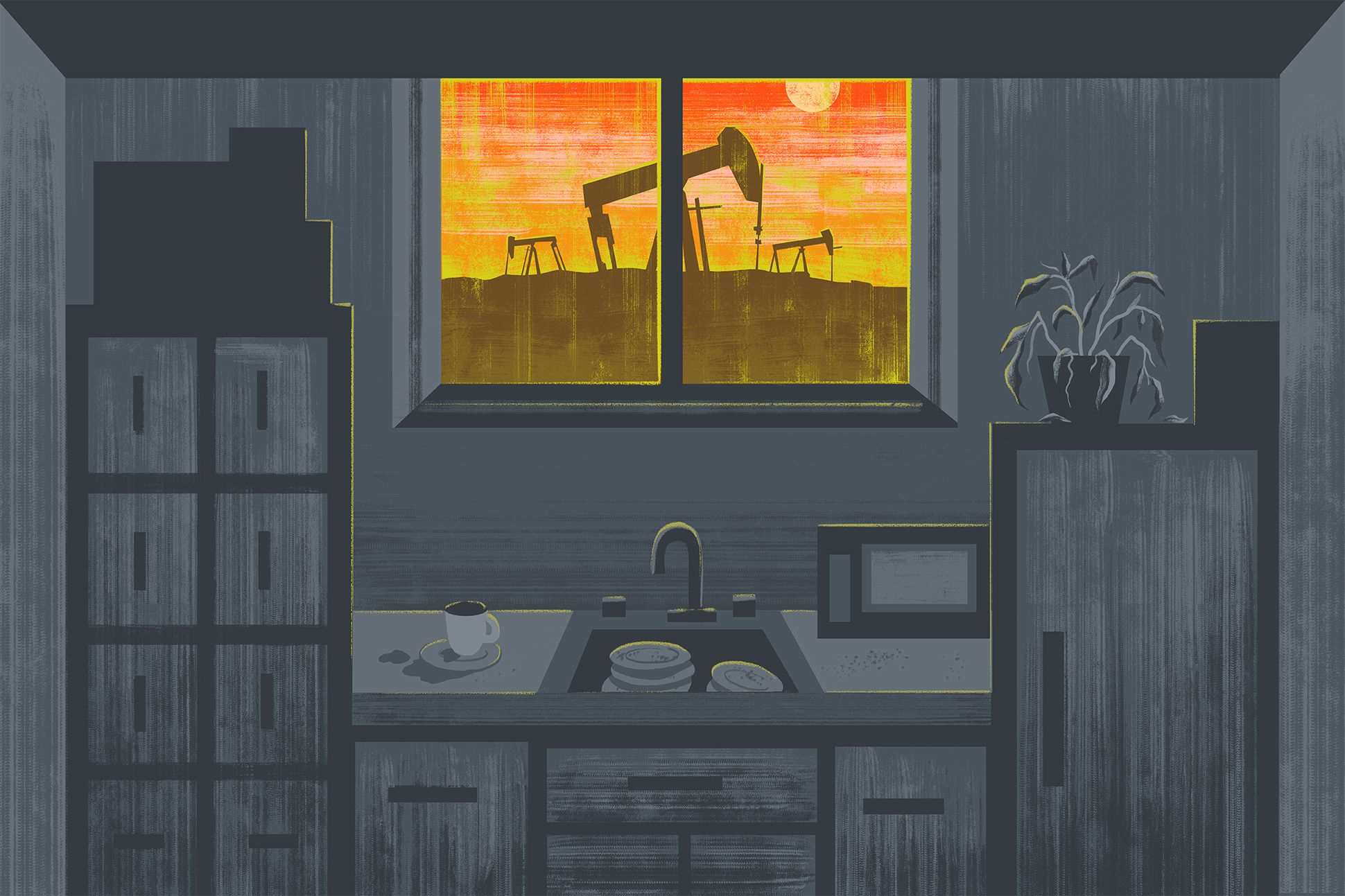
Art by Chloe Cushman.
One of poetry’s great pleasures is the associative feeling a body of work evokes in the mind of the reader. Oeuvres become little biomes of consciousness, replete with weather, local color, accomplices, acts of god, and the daily news. Particular words and effects signal that we are in some recognizable place, like creaking boards in a familiar room. It is perhaps another way of looking at poetry: the process of making images habitable. When reading the poet Karen Solie, I experience this in a remarkably vivid way. My personal Solie-verse is a pungent composite of associations: Trans-Canadian car rides, motel rooms, dead-end jobs, the rattle of prescription drugs, and beautiful, desolate bars. To read her work is to partake in the beleaguered freedom of the wanderer or lowlife, out of luck and money, but rarely short on perspective: “The honourable life / is like timing. One might not have the talent for it.”
Born in Moose Jaw in 1966, Solie is arguably Canada’s most celebrated contemporary poet. Her work is at once richly varied and powerfully monochromatic, rarely straying from the highways and farmlands of her native Saskatchewan, a province ravaged by oil extraction. She spent time as a farmhand, food court barista, and newspaper reporter, and her work contends with an emergent industrialized monoculture. How to describe the hazardous wonder of her poems? They are generally about a page long and achieve a cumulative effect of dilation, an opening up and out into states of menacing ambiguity. They feature figures of frank, disreputable charm, as if characters from a Denis Johnson novel had found their way into a refinery break room. (Johnson provided an epigraph to Short Haul Engine, Solie’s 2001 debut.) Her profundities are nested within topical reportage—fracking, health insurance, construction, domestic violence—and a fulsome local despair. One comes to await the reversals that surprise and enliven, making resolution best regarded as provisional. A given Solie poem seems to rise above itself, approaching a larger stance or philosophy, before delivering its grounded volta, as in the chastened terminus of her long poem, “Norway”: “It seems I send my thoughts out to someone on a distant shore / who doesn’t exist. It keeps me company. / There’s no harm in it.”
Short Haul Engine marked Solie as somehow fully formed upon arrival, a mordant poet of disaster skirting the edge of the new millennium. Dark, wry, and shot through with bursts of exhilarating apprehension, the book is capable of longer transports of meaning than its title would suggest. (A favorite poem, “Design Flaw,” is an early example of Solie’s draw toward the machinelike and the automated, our capacity for feeling and expression in the electric mesh: “The city settles into its grids and gears, / repeats through a mouthful of wheels the distance / from my house to yours. Between them, / men and women are trying to be happy”.) The speakers of “this have-not province” float through their bad luck to wonder at the exposed beams of reality, falling back on old habits and addictions, never expecting much. Here suicide is seasonal (“Fall is the time for it. / Harvest done, / insurance paid up”) and one hears in passing of “a cousin / who sold a kidney for a gambling debt.” Their recklessness is a means of persisting, at least for a while.
Solie’s middle period made her name: awards and accolades, fellowships, a gaudy list of enthusiastic exegetes. (Take Ange Mlinko: “Solie would deny she works miracles. I beg to differ.” Or Michael Hofmann: “If I wanted to show someone—an agnostic—what a modern poem can do, I would show them something by Lawrence Joseph, or Frederick Seidel, or Karen Solie.”) She averages three to four books per decade, a steady but not superfluous output. Each remains an event, a sculpted hundred-or-so pages in which devotees might wander amid sorrow and risk. My favorite thus far, the Griffin Prize-winning Pigeon (2009), expanded Solie’s remit, implicating ever larger forces in our shared catastrophe, as in the deadpan sloganeering of “Four Factories”: “Our industry’s future remains / secure. Additional openings in rendering / and hides. Animals are not our friends. Sign / on the highway, Always, 100 jobs!”). Solie offers pessimism without bitterness here. Cool, expeditious, and critical, she always remains a step ahead of nihilism, looking back at it even as she begins her next scouring observation.
Then an abrupt change, unanticipated and somehow alarming. The Caiplie Caves (2019) decamped from Solie’s usual thematic redoubt toward a new narrative project. Here she inhabits a persona inspired by Ethernan, a seventh-century Irish missionary, as part of a larger history of the Fife Coast. It is a beautiful, strange, and accomplished book, weighing the worth of one’s own voice in times of change or struggle. (Ethernan’s weaknesses and incongruities—he performs no miracles, for instance, and needs very little to survive—render him a bona fide Solie avatar.) Still, I couldn’t help but feel a diminishment in the application of this framing device: there is a feeling of chafing, as of something resisting its bonds, longing to get out under a bigger sky, or take a longer road home. As good as The Caiplie Caves is, the arrival of her newest collection, Wellwater (FSG, 2026), has raised the stakes—for this reader, anyway. We have seen in Solie’s preceding oeuvre cosmic bewilderment, pastoral anguish, and a conceptual impulse, among much else besides. Where, one wonders, could Solie go anew in Wellwater? As it turns out, the answer suits her material splendidly: she begins underground and ends up in the firmament.
***
The book’s first poem, “Basement Suite,” serves as its overture, a subterranean clarion: “In the basement one is closer to God because / closer to consequence, to creatures no one loves / but the specialists.” (After which comes a taxonomy of weevils, unloved diggers, eminently Soliean.) We open the book, then, with the heavens inverted, a potent reversal Solie gestures at (“It’s not the underworld for Christ’s sake”), but leaves open to suggestion. Here stillness is gained in descent, but so too is isolation and separateness. What is outside the house—what is, for the poem’s purposes, aboveground—is both feared and desired: “On the surface again, if we can bear it / after so long sheltering / in place.” A pandemic poem, it seems, at least in part. (And who doesn’t remember the strangeness of the interiors we couldn’t leave: “The house tries to forget we are here,” Solie writes, and we understand immediately.) But that hanging conditional—"If we can bear it”—does not leave one on edge. They will bear it, because they always have, there being no other choice. Surfacing again is a matter of managing disorientation, as a weevil might, baffled and dismayed by light.
This incredible opening is somehow eclipsed by the book’s second poem, the eponymous “Wellwater.” It finds Solie engaging in a register of conflicted nostalgia not often seen in her work. “I didn’t know what I had,” it begins, describing a trip she once made: driving a water truck to a local well as a young girl. There is irony here—how much could one miss “glyphosate on the wind, our malathion, / dust of gravel roads that bore vehicles / of gas well company agents”?—but it serves as caustic contrast rather than poetic engine. The tone is not bittersweet, per se; there is too much of the mordant observer in Solie as she looks over her teenaged self. (“I descended to start the engine / so the radio wouldn’t drain the battery— / a mistake I’d made and lived to regret, / which is the only way I ever learn anything.”) But there is something almost incidentally epiphanic here, a kinship with the rock and the deep water—we are once more underground—even as we realize it cannot last. Solie builds toward a crescendo, only to prick the balloon of feeling with a final line, reminiscence brought up hard against the merciless now:
It took 75 minutes. The things you remember.
My last act before closing the tap
to take the hose by the neck and drink,
taste the cathedral’s rock and temperature,
the water hard and the table high.
The water then, you could still drink it.
Solie is our primary elegist of the poisoned land, a roving eye amid Anthropocene debris, her poems full of belching machinery and scrapped vehicles (“rows / of wrecked cars in the junkyards, / hoods open like a choir”), poker-faced asides (“Those nitrogen and sulfur oxides erupting like personality / into the environment signalled the birth of something useful”), refinery shorthand (“Altec, Softcom, Norcan, Cancore”), missives from the edge of extinction (“The endangered Banff snail on its last legs”), and acts of wanton destruction (“two foals dumped at a gas well site by the only / animal who kills from a distance, noise for a voice / and noise for a home, for whom all places are alike”). That it should be unbearable is precisely the point, though her lyric facility with grasses and alluvial banks and floodplains enables an imperiled beauty to emerge, maimed or coated in grease or simply presented as a foil to greener memory.
The immense waste and degradation of industry is inextricable from the great northern plains where Solie was born. Her landscapes are perfectly calibrated moral questions. Are you looking hard enough? Do you see some part of yourself disappearing with the prairie? Questions, any number of questions, but also statements of sagacious clarity. Nothing I’d previously read of her work prepared me for the immensity and sweep of “The Grasslands,” an ecstatic map of the plains stretching backwards and forwards in time, a registry of grandeur, memory, and ruin. Solie begins in a bit of downplay, a setup perhaps (“Not much of a place for a holiday, not much to do”), before a sublime enumeration begins. There are lists of dispossessed native tribes (“Gros Ventre / Cree, Assiniboine, Blackfoot, Lakota Sioux”), small towns (“the East Block to Rockglen, the West / / to Val Marie”), creatures and co-travelers (“pure-bred irritable bison”; “rattler, coyote, black widow spider”), and threats to traversal (“quicksand and sinkholes”), before opening up and out, no longer underground, but rising over the grass into lushness and rapture:
On the northern mixed-grass prairie
The kingdom of grass is the kingdom of means:
the silvery, slender, rough
needle-leafed, wavy-leafed, cut-leaf, thyme-leafed
wild, false, tufted, and procumbent,
fringed and nodding, the long-bracted, shaggy,
pleated, brittle, the creeping and the smooth,
panicled and pale, common
and endangered
The poem converts to a veritable floating ark on the sea of grass, with creatures joining, singly or in pairs (“the swift fox, sage grouse, burrowing owl, / black-footed ferrets / reintroduced, so much else taken”). The Parks Canada map she describes earlier in the poem becomes pure signal, a kind of relayed transmission: “seed heads broadcasting from high-broken country / south of the Trans-Canada Highway / a live on-air silence.” And lest we think we will learn or grow or change within this beauty, that it offers some form of easy understanding, Solie carefully estranges, repositioning its prospects for meaning:
If not convinced
of your purpose
the grass will not convince you
What you need to hear you must tell yourself.
Under the darkest night skies on Earth
An explanation is not forthcoming.
Solie’s poems rarely offer explanations. Rather, they are theaters of bafflement and resignation, inhabited by the down and out, those at odds with themselves as much as each other, whom Solie calls “unfortunates, poor earners, procrastinators, / the criminal element.” (This from “Medicine Hat Calgary One-Way.” Solie is great at titles, little marvels of narrative concision and readerly fascination: “Holiday at the Wave Pool,” “Jesus Heals the Leopard,” “Eating Dirt,” “Parables of the Rat.”) Her poems’ characters read more like figures from a novel or short story, engines of pique and unpredictability, their dissatisfactions driving them into the arms of delusion or self-destruction or merely the business of everyday living. They offer a range of voices and tones, from violent enthusiasm (“I love you Bret / now finish him off!”) to domestic menace (“Open the fucking door”) to mild annoyance (“We don’t all know each other / for Pete’s sake”) to koan-like inscrutability (“But you weren’t there, she said to me / in my dream. Not if I don’t remember you.”) Solie is a powerful ventriloquist of the mystified, the bored, and the hungry, mouthing the hard-up voices one hears in drugstores and bars, before school or after church.
That sympathetic ear for the sounds of human difficulty and longing takes new form in this collection, particularly when they address the poet’s own recent loss. “The book is dedicated to my father, who died while it was being finished,” Solie has said of Wellwater. There is a different kind of vulnerability at play here, an expression of pain less brittle, reinforced as it is by great love. Take the ending of “Starcraft,” in which Solie watches a storm move through a neighbor’s trees, its force seeming to displace some fundamental quality of existence, inviting in things lost and unseen:
…It would mean
you aren’t gone, just out of frame, and might explain
this halfway sense of being neither here nor there:
where maybe, Dad, you and I, on the lake at dawn
when the fish jump, in the 14-foot aluminum Starcraft
and our contentment of few words, drift on water
calm and grey as a room risen into just before
it brightens, and I’m no longer frightened.
Given how often her work is grounded in life’s terrible preponderance of dislocation and disorder, I found these concluding lines truly remarkable. I do not want to say that they are “earned” or “deserved,” as that is beside the point, and I think Solie would dislike that sort of sentimental tack. I found the poem incredibly moving precisely because of the precarity of hope and comfort in Solie’s oeuvre. It is like the closing of a psalm, the speaker having moved through the valley of death (and derricks) to discover her peace, at least of a sort.
“Starcraft” is the collection’s penultimate poem. The last, “Canopy,” an instant classic, again involves her father, this time in a memory of him and Solie making a picnic fire beneath cotton trees on a road allowance. They see owlets peering through the canopy: “It was the same, Dad said, / when he was a child.” Something has been preserved here, “time eddying / deep in the shelter of the cottonwoods / where demands of the yard and fields couldn’t enter.” The area has not been spared from development, though the cottons suspended in her memory live on. It is the bedrock hope of all Solie’s extraordinary work—underground, in the prairie, or out in “the five zones of heaven”—that things might yet possess the grace or good fortune to endure:
The heavy equipment passes
beneath them more often now,
edges of the widened road approach
yet they are there still, in excess
of their average lifespan
and function. In spring
they champagne the air with cotton.
Dustin Illingworth is a writer based in Northern California.