


There Is No Hope of Freedom When We Are All Walls
On war, revolution, and the lyric as a tool for survival.
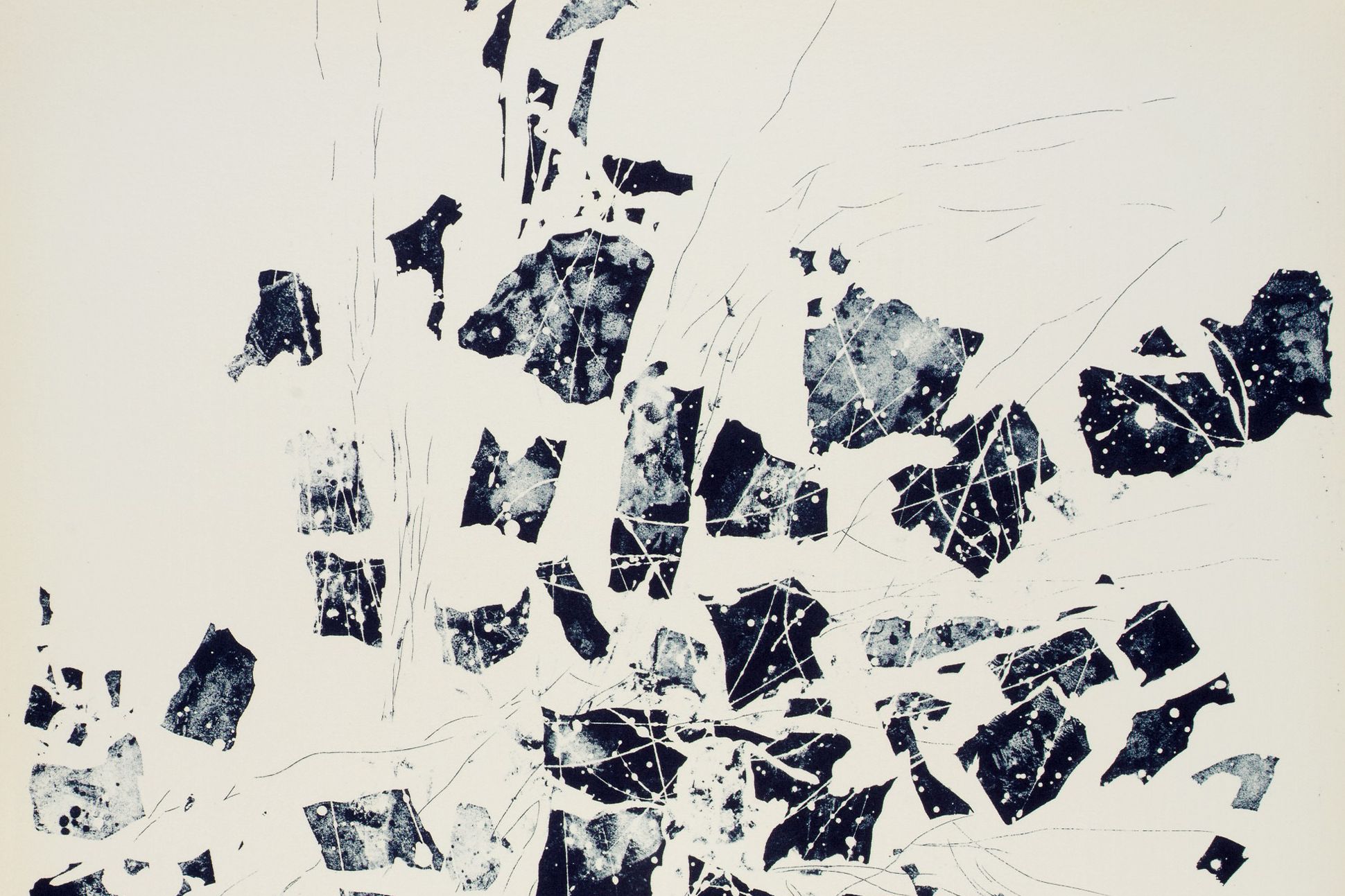
Garo Antreasian, (Fragments, portfolio), 1961. Smithsonian American Art Museum.
I was born in June 1983, during two wars. The first was waged against Iran by Saddam Hussein and his allies. It lasted eight years and claimed at least one million lives on both sides. On our kitchen table, rationed bread sat next to a small radio that blasted rallying cries all day: “The army of the Twelfth Imām, get ready, get ready / For a relentless battle, get ready, get ready.” These were the refrains that invaded my three-year-old ears.
That war ended in 1988 when Ayatollah Khomeini was finally forced to drink “the chalice of poison” and accept a ceasefire.
The other war was waged by the Islamic Republic against its own people. The weapons were firing squads and gallows; the battlefields were prisons, universities, and the streets. This war claimed thousands of lives and purged Iran of its most brilliant poets and intellectuals, forcing them underground or into exile.
After the Cultural Revolution, which lasted between 1980 and 1983 and enforced Islamization of the universities, my 24-year-old mother decided to resume her education. She did not want to end up a housewife after toiling for years to escape poverty. When I was eight months old, she left me with my grandmother in Mashhad so she could return to the capital and complete her bachelor’s degree in law at Tehran University. For her, the sirens were routine. The sky would open without warning, and she would wish for only one thing: to hold me in her arms once again. She counted her breath by the sound of missiles. She could tell how close the blast was by the delay between the flash and the explosion.
I learned that our livelihood depended on ration cards kept in drawers beside the cutlery. Sugar, oil, milk, rice—everything was stamped, sealed, and distributed to citizens. Nothing was wasted, and nothing was expected to last long. My childhood dreams were rationed, too, by small calculations and broken promises from adults struggling to make ends meet. One afternoon, I asked my mother for an accordion—the instrument a peddler had conjured into our street, its tunes pouring a strange mix of joy and pain into my small chest. She pressed into my hand, instead, a fragile old doll—a hand-me-down from my cousin. She promised me an accordion soon, but the price of music was always out of reach. The accordion never came.
A few months before the war’s end, while ceasefire negotiations were underway, I overheard my grandmother talking with a neighbor. The neighbor—a middle-aged woman swathed in a battered white chador with faded flowers—was weeping in the courtyard. I was watering the roses and the grape vines when I first heard the word execution (E’dām). I had seen Keyvan before. He spent most afternoons outside with his plastic ball, playing soccer by himself. He was 17 when he was killed in the mass executions of political prisoners in 1988. On his way back from high school, he was arrested with dissident leaflets in his bag. Kayvan’s body was never returned to his mother. She was left with a sack of his clothes and a small handwritten note he scrawled an hour before his execution: “Mamān, I love you! Please forgive me (Halālam kon).”
He was buried in a mass grave near the grand cemetery of Mashhad. From then on, I understood it was no longer permissible to speak certain names aloud: the names of those buried in the cursed lands (la’nat abād).
A year after Keyvan’s execution, Khomeini died. His meticulously orchestrated funeral was broadcast on national TV. I was waiting for my favorite cartoon, Pinocchio, when I saw on the screen images of Khomeini’s body, wrapped in a white shroud and displayed in a large freezer with fans blowing beneath to keep the corpse cool in the June heat. A massive crowd of mourners surged toward his coffin. Suddenly, his shroud unraveled and his naked corpse jostled before the camera as people angled to carry him on their shoulders. That was my first encounter with death.
After the burial, Ali Khamenei was named the second Supreme Leader of the Islamic Republic. On his appointment day, he initially declined to assume the role formally, saying, “One should cry blood for a nation whose Supreme Leader would be someone like me.” When he seized power, the repression intensified, thanks to the prolonged “War of Holy Defense”—the state’s name for the Iran-Iraq war—that allowed hardliners to take center stage in politics. Under Khamenei, revolutionary terror became systematic and inescapable. The dress code for women became more draconian. Those who resisted were seized by the hejab patrols. Newspaper columns were scoured for subversion; censors grew fat on banned books and blacklisted movies. The ghosts of war commanders lingered over the city, immortalized in spectral murals and in the pages of school textbooks.
***
Before—and after—his rise to power, Ali Khamenei was a failed poet. He fawned over and tried to befriend prominent poets, but his overtures were rebuffed; the pre-revolutionary literary establishment never accepted him. After his rise to power, eager to claim cultural legitimacy, he began hosting his own poetry gatherings and sought to draw those same poets into his orbit. When Mehdi Akhavan-Sales, a renowned independent poet whom Khamenei deeply admired, declined—“We are against oppression, not for oppression” (Mā bar solteh’im, na bā solteh), he said—the consequences were severe: he was beaten in the street and dismissed from his job at a radio station, a stark demonstration of how dissident poets would be punished in years to come.
After the victory of Iran’s 1979 revolution, during which the monarchy was overthrown and the Islamic Republic was instituted, the same acclaimed poets and writers who had supported the revolution were brutally persecuted, censored, killed, or forced into exile. In 1981, poet and playwright Saeed Soltanpur was kidnapped from his wedding ceremony and executed a few months later at age 41. During the 1980s, Houshang Ebtehaj and Siavash Kasraei—two influential leftist poets—were arrested during the crackdown on intellectuals and the Tudeh Party. Others, such as Ismaeil Khoi and Nemat Azarm, were arrested and then forced into exile. Amid surveillance and an outpouring of state-sponsored verse, official poets of the new regime deployed the ghazal, one of the oldest classical forms in the Persian poetic tradition, to parrot war slogans. The prominent poet Ahmad Shamlou, who was critical of the war and the regime’s ideology, turned to lyric free verse to expose the revolution’s broken promises. In “In This Blind Alley,” written just a few months after the revolution, he writes:
They sniff your mouth
lest you have said “I love you.”
They sniff your heart.
Strange times, my dear.
And love
is lashed at the checkpoint.
It must be hidden
in the backroom of the house.
Strange times, my dear.
Shamlou’s lines capture the claustrophobia of a world where both public speech and private life are monitored. In such a climate, the Persian lyric expanded beyond the traditional ghazal. The lyric was no longer just a mode of expression but an act of quiet defiance—and a refuge where intimacy and dissent were preserved against the suffocating reach of the state.
The lyric poem’s innate ambiguity allows it to harbor what the state seeks to expose or erase. When love itself must be hidden “in the backroom of the house,” the lyric shelters those forbidden emotions and memories, carrying them forward in language that evades total policing. Through its very insistence on the private and unutterable, the lyric becomes a means of survival—a way to persist, remember, and refuse erasure under the most repressive conditions.
Although state-sponsored poets co-opted the ghazal after the revolution, it remained a subversive form. Some poets reclaimed it, using its familiar cadences to echo the same sentiments of longing and opposition found in Shamlou’s work. Hosein Monzavi, for example, wrote a ghazal, “We are Weary of Whispers, We Are Sick of the Clamor”:
The whispers weary us; the loud roar breeds mistrust.
We cannot bear our silence, nor speech among us.
Amid this wreck of confusion, where can we now flee?
In this bewildered hour, whose hands can we trust?
I have blocked your road, and you have blocked mine.
There is no hope of freedom when we are all walls.
Simin Behbahani, who adopted a humanitarian, anti-war stance during the conflict, used ghazal to offer a counter-narrative to the prevailing cruelty and violence on both sides in “I Can Not Bear to See”:
I cannot bear to see him cast so low
Though the “wise” say this is the enemy's lot.
Even if he ruins my life, God knows,
I have no heart to kill him — such is my faith.
In the aftermath of war and the new regime’s consolidation of power, the private lives of citizens were increasingly subsumed into a narrative of collective sacrifice, martyrdom, and perpetual vigilance. The language of the state—its slogans, legal codes, and commemorations—became omnipresent and overwhelmed the daily speech of longing, grief, or protest. Memory itself became contested, as official histories replaced the fractured truths that friends and families shared. What could not be spoken in public found uneasy expression in private, but even there, words were incriminating; even silence could be dangerous.
The role of poetry changed. It was no longer a medium for public celebration or mourning in the traditional sense but a subtle, often encrypted, form of resistance and survival. The lyric turned inward, retreating from state-sponsored platforms to the margins, from the declarative voice of the national anthem to the fractured, disillusioned whisper. Yet this retreat also became an act of endurance: what was unspeakable in the language of the state could still be uttered in the language of the lyric, however broken or oblique. Hafez Mousavi’s “A Little Craft” stages precisely such a poetics:
We know a little craft
with it
we set rivers on their course,
keep forests green,
and ask the grasses
to bow before the wind.
A little craft
it doesn’t always work.
some refuse it,
resist it so long
they bring themselves down.
A little of the craft
one example of it
is here before you.
When the state turns on its own, the battlefield moves inward. The lyric inherits what the citizen loses: privacy, coherence, breath. During this interior siege, the reclamation of the ghazal became crucial for poets of my generation who had endured censorship, persecution, and exile. Form became more than an aesthetic discipline; it was a fragile architecture whereby what could not be spoken might still be shaped. The counternarrative of ghazal does not mimic violence but bears it. Its rhymes and refrains, repetitions and discontinuities, were no longer stylistic indulgences but techniques of perseverance. The ghazal’s couplets do not rely on one another; they exist apart, each autonomous and self-sufficient, like rooms in a house already half-destroyed.
On June 17, 2009, at the fevered peak of the Green Movement and the state’s crackdown on activists and intellectuals, after five days in hiding and my then-partner’s abduction by security forces, I fled Iran alone, suitcase in hand, never to return. Two years into my exile, I turned to the ghazal:
When they broke down the door, I was in your arms
Like a freezing cold lullaby curled in your ear
When they broke down the door, you gripped me tightly,
I was the clothes on your body, on that night filled with fear
Beneath their kicks and their curses, you were naked, and I was naked
I was your body, dripping blood, unconscious, my dear
You fell, and your calm gaze faltered and failed,
As though I were something you’d forgotten, year after year
When they took you, I was a grief-stricken cry,
A silent sea where your fabulous creatures appear
I was a sadness cracked open, calm in the midst
Of your file that was folded now, smudged and unclear
And though they have hanged you, in memory’s
Image, I see myself there, in your arms, my dear.—(Translated from the Persian by Dick Davis)
In Persian, the first two lines, then each subsequent couplet, end with the refrain “I was” (“بودم”). I was there when Keyvan’s schoolbag was returned to his mourning mother while his body faded in a mass grave; I was there when Khomeini’s air-conditioned corpse lay rotting on TV; I was there during the Green Movement, when hundreds of thousands of peaceful protesters filled the streets of the capital after a rigged presidential election, demanding the return of their votes; and there, in the refrain of the ghazal, all that I was and witnessed was safely sealed.
Years later, under the ominous shadow of another war, exile has taken on a new, more absolute shape. I watched the breaking news of this war from thousands of miles away, when even the fragile thread of a phone call or a message was no longer possible. With the state’s digital blockade, I could only witness the war unfold from afar. Every attempt to reach my family dissolved into static, messages sent and lost in the void.
Again, I turned to the ghazal, not only as a tool of survival but as the only refuge. It became an address to those I cannot reach, a mode that persists when every other form of connection has been severed. In the recursive return of the line, in the repetition of sounds and words that refuse elimination and denial, I have always found a way to remain. The ghazal makes a form of presence possible: one that endures blockade and blackout, a voice echoing in the absence, a refusal to disappear:
Let me write of the homeland, of us, exiled and mute,
Crippled by the wounds of distance, like scorched wings butterflies
Let me write of the homeland, of war, this cursed tale,
Of Iran’s steadfast name, of the phoenix destined to rise.
Form is not the opposite of chaos; it is chaos held in pattern. It is the only order that doesn’t pretend the world is whole. The state, by contrast, demands continuity: laws that link cause to effect, narratives that justify punishment, archives that flatten voices into “cases.” The state is obsessed with sequence and linear stories that legitimize its violence. The ghazal form challenges that demand. It interrupts the smooth flow of the file, the report, the confession. It replaces the linear with the recursive, the declarative with the echo.
The ghazal does not build toward a climax or closure. It moves through moments of equivalence, in which sorrow, love, and terror coexist without hierarchy. In a world where violence sorts lives into those worthy and unworthy, the ghazal’s autonomous couplets insist on an equality of feeling. Each couplet is equally weighted, equally grievable. An ethics is built into the form. And the refrain—always returning, unprocessed—echoes the compulsions of trauma. But repetition here is not only a symptom; it is continuance. To repeat is to remain.
Born in Mashhad, Iran, Fatemeh Shams earned her doctoral degree from the University of Oxford. Her poetry collections include Hopscotch (2024), When They Broke Down the Door (2016), Writing in the Mist (2015), and 88 (2013). Her work has appeared in Kenyon Review, Michigan Quarterly Review, London Poetry Magazine, and Penguin Book of Feminist Writing, among others. Her poetry has been translated into...