


Conjuring the Future Phrase by Phrase
Joshua Bennett's prophetic We (the People of the United States) is an American pastoral fully aware that our relationship to the land has been more tragic than idyllic.
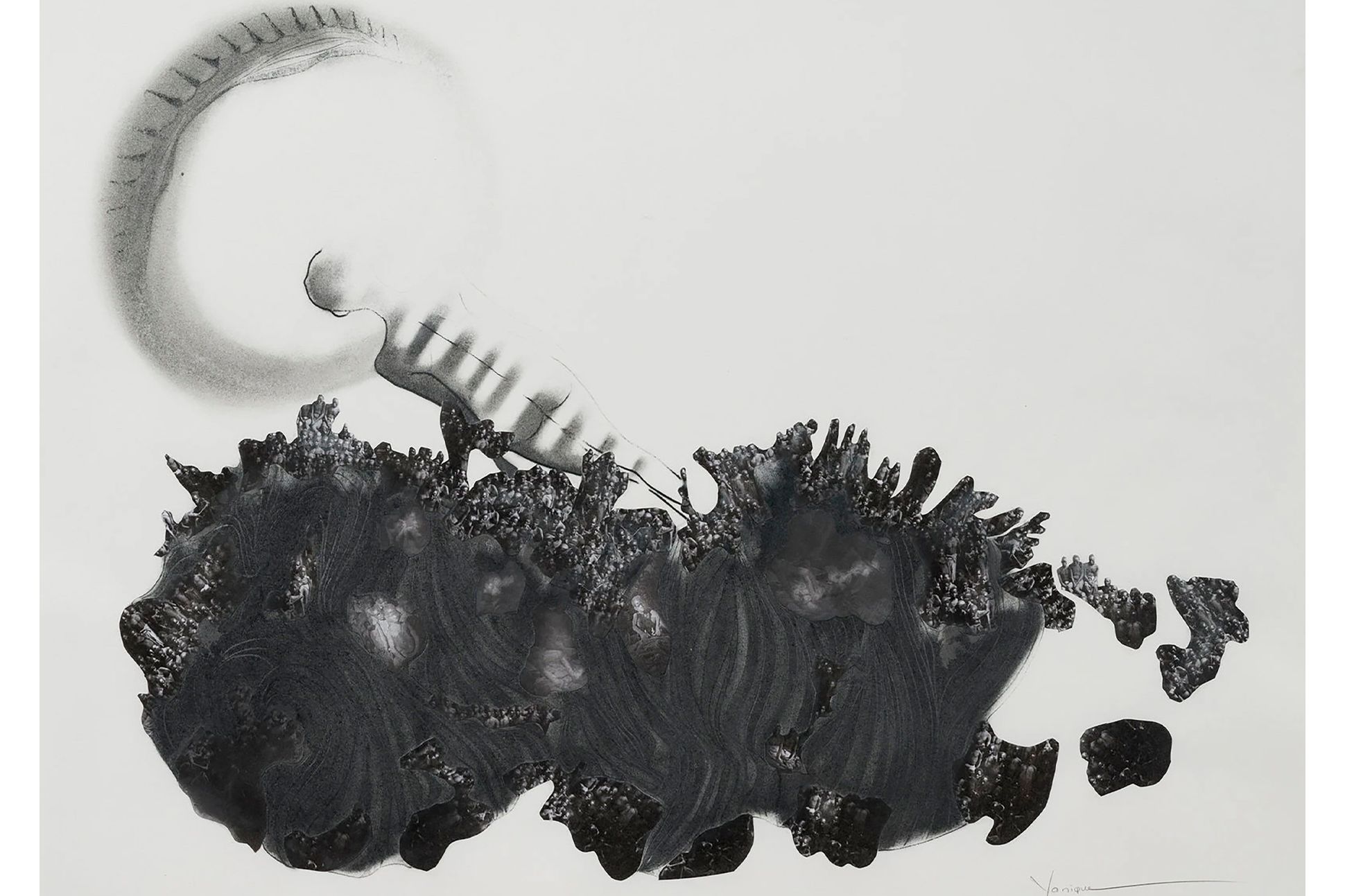
Art by Yanique Norman, Middle Passage (2010). Image Credit: Mike Jenson
“An exile,” says Aeneas in The Aeneid, “I took to sea with my men, my son, and the great gods of my country and home.” An epic of nation-building, Virgil’s poem turns on that classical trope of translatio studii et imperii: the belief that not only power but knowledge itself migrates from culture to culture, so that ever westward runs the course of civilization. “If life lasts, I’ll be the first to return to my country, / bringing the Muses with me,” Virgil bragged, signaling a faith that poetry and inspiration were planted in western soil by men such as himself.
Nearly sixteen hundred years later, another displaced people arrived on western shores. Unlike Virgil’s imagined Trojans, however, these travelers did not cross the sea as founders but as captives. They were, in the words of Joshua Bennett, the “newest iteration of human / forged in a land already / marked by conflagration and blood,” as he writes in the poem “St. Paul’s Parish, South Carolina” from his remarkable new collection We (The People of the United States). Rome itself had been a composite—Latins, Greeks, Etruscans, Sabellians, and, if Virgil is to be believed, Trojans. America, too, was composed from many nations, though its founding mixture included the Igbo, the Wolof, and the Yoruba.
Virgil imagined himself as the poet who brought the muse to Italy, but the American muse arrived in chains, shackled in the abyss of a slave-ship. Her transit was not across the wine-dark Mediterranean but through the holocaust of the Middle Passage. In Bennett’s poem “Detroit, Michigan,” the aftershock of that crossing appears as “traces of this historical accelerator of African American / erudition, where the songs of a people traveling epic distances / across the ash, in the wake of a great inferno following.”
Troy, Carthage, and Latium mark Virgil’s geography of destiny. Bennett’s map is drawn elsewhere: Decatur, Alabama; Eatonville, Florida; Yonkers, New York. Yet the deeper story remains another chapter in the same long movement of translatio studii et imperii: the transplantation of culture under improbable conditions, the sprouting of a new tradition “honed in the midst of unthinkable constraint, a sound perfected / as we shaped a refuge just above the shadow of the Veil.”
A professor at the Massachusetts Institute of Technology and the author of five previous books, Bennett has now produced the most prophetic collection of political verse since Terrance Hayes’s American Sonnets for My Past and Future Assassin (2018). We (The People of the United States) braids the personal and familial with the political and the cosmic. The book is divided between a shorter section of first-person lyrics with the presumed speaker being Bennett himself —the “We”—and a broader, at times oracular, meditation on the national story, “The People of the United States.” Together these two registers, the intimate and the civic, form a kind of double chorus—the private voice and the republic speaking at once.
As a divine guide through the question of America’s traumatic patrimony, in this 250th year of the nation’s existence, Bennett invokes Virgil—not the imperial bard of The Aeneid, but the rusticated pastoralist of the Georgics. From Joel Barlow in the 18th century to Frank Stanford in the 20th, Americans have envisioned jealously and anxiously a poetic epic commensurate with their own land. Bennett’s genius, however, is to return to the land itself, recognizing that a continent-sized nation whose history is rooted in bloody soil may be better served by a poem about agriculture and husbandry than by another Aeneid. Bennett writes in an ambivalent idiom of planting and harvesting—a work produced by a descendant of those forced to do exactly that—resulting in a song-cycle clear-eyed about the degree to which the achievements of American culture are inextricable from the cultural genius of Black America.
There are precedents for the use of classical themes to illuminate the New World experience. Bennett himself notes how “Gwendolyn Brooks updates The Iliad / so it speaks to the everyday explosions held inside a Bronzeville / kitchenette,” and how Homer’s The Odyssey finds new life in the Caribbean landscapes of Derek Walcott, “its tercets full of coral & lime, salt & / schooners weighted by the songs of ghosts,” as Bennett writes in “Talbot County, Maryland.” Many of the geographically focused poems in We (The People of the United States) are paired with lines from Virgil’s Georgics, replanting Virgil’s poem of viticulture and apiarists in American soil. Through this act of poetic grafting, Bennett imagines Brooks’s own dialogue with antiquity revealing a message from a “long-buried bard / who speaks with her now, only // through language we call dead as a matter of specificity.” Bennett’s is an expansive geography, spanning small towns and major cities, the North and the South, but what connects it is this through-line of the American experience, a counter-canon which Bennett constructs through primarily (but not entirely) the Black experience.
If America’s tale is best told through the pastoral—through seeds carried westward on winds not of their own choosing—then it must be acknowledged that this nation is no Arcadia of uncomplicated leisure and repose. Antebellum plantations had no role for the shepherd and shepherdess Strephon and Celia. Their ploughing was consensual; in America it was compelled. Beginning the poem “Lynchburg, Virginia” with a line from Georgics—“Before Jupiter’s time no farmers worked the land”—Bennett offers a skeptical revision of that halcyon myth. Instead, he writes, we must
imagine scores of poets honing songs
in sugar fields, underground, held
within the belly of ships, prophets
of an age before our inner worlds might
manifest on paper, and the sacred
bard behind the words survive.
Adept at deploying pauses that resolve only after the line break, Bennett’s verse unspools like a weary liturgy, its semantic hiccups unsettling the pastoral’s expected ease. This is not the rural romance of classical and Renaissance imaginings; there is no Arcadia in the antebellum South, and the American world is fallen. Yet there is genius still—there is the Muse. Those “scores of poets,” forced into the fields or confined to the belly of a slave ship, were already shaping songs that imagined how their psychic worlds might one day be preserved in words more enduring than bronze. What We (The People of the United States) ultimately enacts is a kind of Georgics for the griots: not an American epic, but an American pastoral fully aware that our national husbandry has always been more tragic than idyllic.
And yet what emerges throughout Bennett’s collection is triumph rather than its opposite. In “Anchorage, Alaska,” he writes of his desire to resurrect those figures
obscured from the record until one dares
to inscribe the names of our champions into the grand American
Mythos with exactitude and grace, and thus catalog their footprints
in the mud, and the grass, and the show of History, refusing to
relinquish what we are everywhere assailed for remembering.
Published at a moment when the present regime has erased official recognition of Black contributions to American life, removing historical markers and striking names from memorials, Bennett instead restores figures such as James Weldon Johnson, Paul Robeson, and W.E.B. Du Bois, who in “Lynchburg, Virginia” “all / drink and dance, conjuring the future phrase / by phrase.” Elsewhere he invokes Black scientists and teachers— Benjamin Banneker, Lewis H. Latimer, Mary McLeod Bethune, George Washington Carver, Arturo Alfonso Schomburg, and Mae Jemison—whose names appear in “Decatur, Alabama.” This is not merely a Whitmanesque catalog. Bennett’s figures demonstrate the possibility of striving for Canaan even within Babylon, of “imagining / other ways of organizing human life, visions enshrined in song / and text by friends and strangers alike,” as he writes in “Philadelphia, Pennsylvania.”
Nor does We (The People of the United States) concern itself exclusively with Black life—there is, for instance, an illuminating and incandescent poem about that most white-bread of pop groups, the Beach Boys—yet any honest accounting of American cultural achievement must remain attentive to the community most historically disenfranchised. In keeping with the contention of We (The People of the United States) not being a tragedy but a pastoral haunted by the tragic, Bennett’s work is one of utopian intimation. His poems offer crystalline moments that gesture toward a better world, studded like diamonds through the dross of national reality.
In “We,” Bennett describes a “disco spot downtown, where working / people went to let the stress of day, // last shift’s weight evaporate. We / knew the cool ambrosia of hydrant // water,” where the communion of dancing, and the relief of illicit water, become reminders of heaven amidst ordinary life. In “Detroit, Michigan,” among the most beautiful lyrics in a collection full of beautiful lyrics, Bennett recalls his childhood love of Motown: the “Temptations’ philosophical musings / on the distance between our flesh and the transcendent . . . these halcyon / voices engineered in small, carpeted rooms in midcentury / Detroit,” including the Supremes, Frankie Valli and the Four Seasons, the Dynamic Superiors, the Chi-Lites, and the Jackson 5. America may never be utopia, but it has, at least occasionally, allowed utopia to be broadcast over the radio.
Bennett writes about such moments of lightness in “Decatur, Alabama,” extolling the feeling of freedom “when we heard Whitney Houston sing, / or saw on TV in briefest flashes of stars / millions of miles beyond our own, // but more palpable now, so close you / could almost grasp them, almost hold / them there, in your palm, like a promise.” One hears in this the echo of Langston Hughes’s deferred dream, though even in the deferral the dream’s possibility remains potent. For poetry that imagines a “world without // debt, or early death, or stress so heavy / the mind must be lifted elsewhere / / to bear it and yet persist” must, in some sense, merge theory with praxis. Any verse that entertains the possibility that how we live now need not be how we always live, must, in its particulars, be beautiful.
On that score, Bennett achieves his aim. Though the poems in the collection are political, they are hardly didactic; in their very aesthetic, a politics of liberatory potential emerges. Consider the arresting domestic imagery from “First Philosophy,” where the poet describes “This soft blue house in Massachusetts, / my hand against the Japanese maple / outside to better hear its wisdom.” Elsewhere, sonic pleasure animates the verse, as in the staccato spondaic alliteration and internal rhyme of a line invoking
the Holy
Spirit, Hot 97, our gut’s drum
major signaling whether to run
left or right when a bullet's ricochet
cracked the nighttime air. Jokes
about our hair; Mama’s weight;
our place in the great graph.
Any collection that aspires to greatness must ascend that peak by treading on that language carefully beneath its feet, and Bennett does so repeatedly. Thus, he can write that the “war runs in / my father’s blood like arrows / / through elk . . . The prison runs in my / brother’s blood like language / / through an era . . . We arrive / in this life with so much already // inscribed,” or distill an entire philosophy in the aphorism, “The money of the mind is attention, maybe.” That characteristic pause before the end-stop—a gesture of studied ambivalence—transforms what might have been cliché into something like wisdom.
Such language is fundamentally psalmic. As Bennett writes, “we’re already here now, using the language / of care and economy, though God-talk was truly / my first way in.” The collection is therefore suffused with the theological. Bennett repeatedly combines the personal with the transcendent, the concrete with the abstract, so that the “God of the glint in the dark which is not / a blade, but a lover’s eye reworking the castaway / threads of our solitary moon,” as he writes in “Yonkers, New York,” exists alongside the “God of fauna, fences, horsemint flower shards / thickening the wind in spring; God of future / tenses forget-me-nots, fourth birthday wishes.”
A God of “future / tenses”—those words themselves divided by enjambment, just as the present is separated (if only momentarily) from what is yet to come—is a remarkable concept. This is not necessarily the God of orthodox Christianity, but a God of potentiality: a divinity we must imagine together, a millennium toward which we move step by step. There is also in Bennett’s imagery a trace of the Afrofuturist. In “Decatur, Alabama” he invokes the eccentric jazz visionary Sun Ra and his dream of an interstellar “escape pod arching / through a seamless indigo. Fleeing Saturn for Earth.” Another intimation of perfection appears in that “seamless indigo,” where the “very cosmos could belong to us, the darkness / of our skin, our hair, our eyes, was shared / with that shimmering infinitude.” The implication is that the same boundless cosmos contains “the possibility that we too might / one day take flight, achieve the weightlessness / we had only felt in dreams, or heard.”
There are laments in We (The People of the United States), but it is not a book of lamentations. Bennett’s is not a jeremiad for the past but a manifesto for the future. In imagining himself on the Starship Enterprise as a boy, the speaker
dreamt
of gliding through the incandescent
blackness of the great beyond,
smooth as a scimitar, even
in hyperdrive, me & my intrepid
crew, cruising at light speed
toward the promise of another life.
A variety of mysticisms thrums through the collection, “calling us toward the infinity we perceive, / if only in part, from this corner of the cosmic scatterplot,” as Bennett writes in “Rolling Fork, Mississippi.” These utopian instants, distributed amongst continual fallenness, signify a question of “what it means / to amplify the life.” Bennett confronts the oppressive past and present of our nation, invoking the weight of seeing “the boy in chains” while nonetheless recognizing “there is an endlessness in him / the present obscures.” A profound and abiding humanism emerges here: the soul rendered equivalent with reality itself. In “We,” the speaker asks, “Where does my influence, my aspiration, end, and the child / begin?” and seems to answer—ambiguously—“Who refashioned the cosmos with his laughter.” The missing question mark leaves the line hovering between inquiry and declaration, simultaneously echoing T.S. Eliot’s daring to disturb the universe while affirming that salvation, in some sense, rests with the coming generation.
As much as We (The People of the United States) is about the past, it’s equally—perhaps more so—about the future, haunted not only by the specters of America’s brutal history but also by “whatever / our species is soon to become.” That line appears in “Eatonville, Florida,” a poem dedicated to Zora Neal Hurston, whose novel Their Eyes Were Watching God (1937) concludes with the nightmare of a massive hurricane. In our own moment, more hurricanes, wildfires, droughts, and floods loom. No serious work of literature written today can ignore the Anthropocene, the apocalyptic reality of climate change. Perhaps this is the teleology toward which Bennett’s collection was always headed: the same economic, political, and social forces that inaugurated modernity with the transatlantic slave trade now threaten the tender ecology of our planet. How could a modern Georgics, dedicated to the pastoral, not reckon with the Anthropocene?
Bennett imagines figures like George Washington Carver, born enslaved and once compelled to work the earth, later nourishing it with his own agency and love: “whispered / psalms to the soul & experimental science echoed back. / New plans for cultivation, a strategy through which this / devastated earth might be restored, replenished, implored / to share its mineral wisdom.” From the horror of slavery to that of climate change, Bennett asks for restoration of humanity, of nature. He observes a deeper wisdom in the cadences of the earth: “orders the fields / should share in the black earth’s blessed bounty . . . but the rhythm too, / the grasshopper’s emerald soloing, wave after wave / of cicadas swaying in their timeless tempo,” as he writes in “Boston, Braintree, Cambridge, Massachusetts.”
This vision of ecological and humanist hope finds its fullest expression in his garden imagery, with intimations of Andrew Marvell’s cultivated paradise: a “greenness gathered over months / in the planet’s subconscious, that gallant greenness / of newly discovered love, an imagination at work, like a tide // of green cascading up the cliffside, the green tendrils / & shoots & roots expanding their shadowed network.” The health of the planet and the health of the soul are intimately braided: “the way the green / in me depends upon the green of the multitude for its strength // & proper form, consciousness an ever-expanding grove; / leaf, mud & stone’ this slick, green infinity we hold, & keep.”
In a nation devoted to cancerous individualism, Bennett urges a refusal of the “I” in favor of the “We,” in favor of the “Us,” for the slick, green infinity that is life. In that georgic wisdom—attuned to the tempo and temperature of the earth, to the tilling of fields, the cultivation of bees, and the husbandry of sheep—a fulfilled promise emerges.
Ed Simon is the Public Humanities Special Faculty in the English Department of Carnegie Mellon University, a staff writer for Literary Hub, and the editor of The Pittsburgh Review of Books. A regular contributor to several publications, his most recent books include Devil's Contract: The History of the Faustian Bargain (Melville House, 2024), Relic (Bloomsbury Academic, 2024), Elysium: A Visual History...