


Friday and Death
I Was Bonnie & Clyde, the new collection from Laura Kasischke, cements her reputation as poetry’s queen of domestic hell.
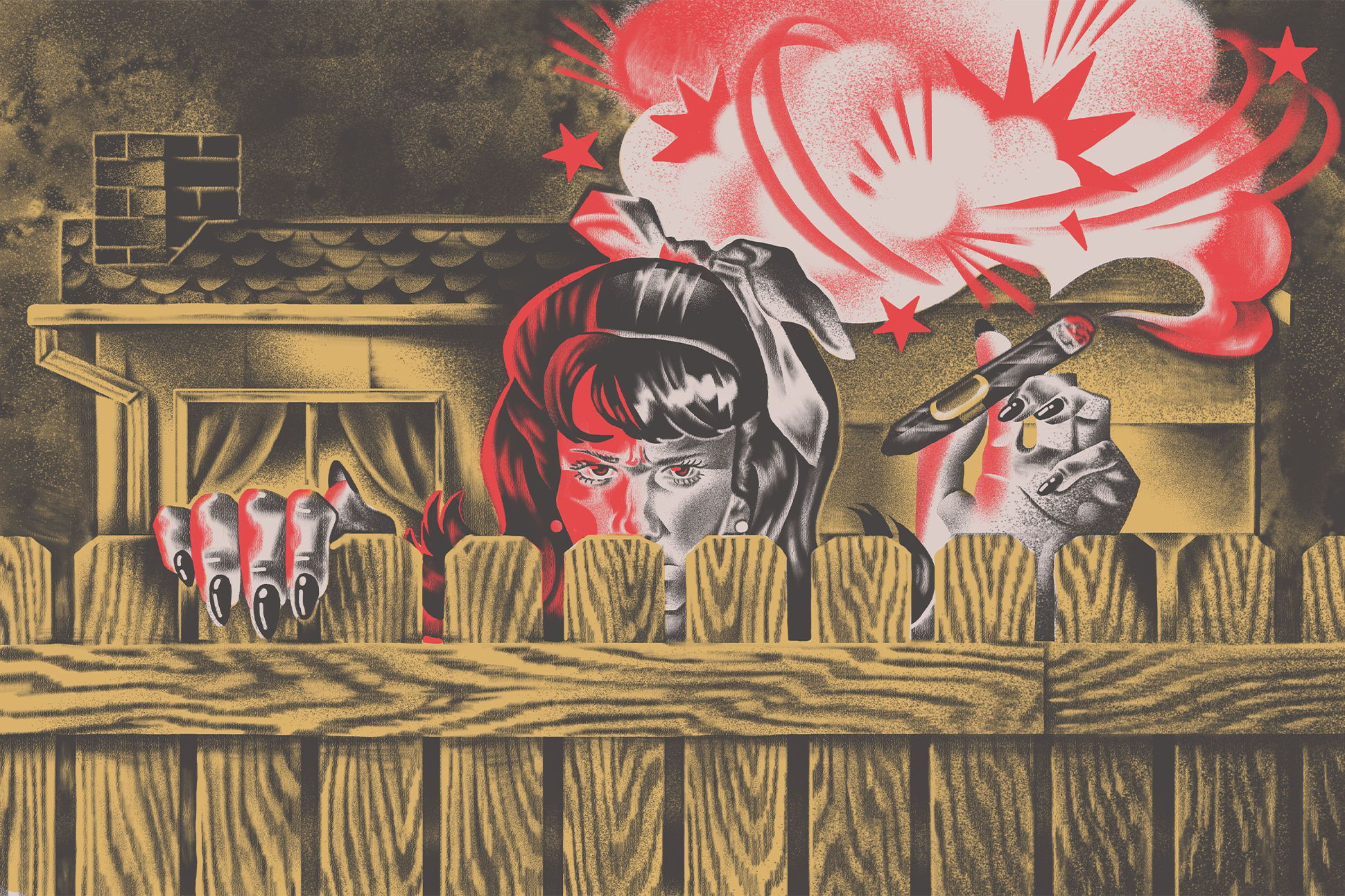
Art by Ricardo Diseño.
Laura Kasischke is the poetry queen of domestic hell. Countless writers have exhausted this terrain, but Kasischke’s work is unsparing and singular. Across her vast oeuvre—a dozen books of poetry, nine novels, and one collection of short stories—her cutting derangement and wild pessimism about the nuclear family is enough to unnerve even the most prodigious tradwife.
I Was Bonnie & Clyde (Copper Canyon, 2026), her latest collection of poems, expands her focus beyond the family to trace the violent myths that prop up American identity. The book takes its name from Bonnie Parker and Clyde Barrow, the notorious Depression-era outlaws who rejected a life of wage labor, marriage, and child rearing in favor of serial robbery and casual murder. Inspired by legends about the couple as much as by historical fact, Kasischke’s poems channel the brutal, liberatory fantasies of American youth culture and the fiction that one can outrun gender and class categories on the open road.
For Bonnie Parker, escaping these roles was tied to a performance carefully staged for the camera. There are two photographs of her in which she playfully subverts traditional femininity. In one, she smokes a cigar and holds a pistol. In another, she points a shotgun right at Clyde’s torso. Drawing on the duo’s chaotic energy, Kasischke’s titular poem scrambles the connection between the I and you, repeatedly defining and redefining it, exposing identity as unstable and relational: “You were Friday & Death. / I was Jekyll & Hyde,” “You were God & Satan. / I was Jesus & God,” and “I was Lost & Nowhere. / You were Single & Hot.”
The word “nowhere” echoes Bonnie Parker’s line in the quasi-biopic The Bonnie Parker Story (1958): “All I ever met were punks, coming from no place, and going nowhere.” Nowhere is a vibe but also a metonym for anywhere. It could stand for the tiny, impoverished towns in Texas where Bonnie and Clyde were from; the suburban neighborhoods in Michigan that populate Kasischke’s work; or the bleak, generic terrain of late capitalism, where she notices “the wild swans of / the business office complex, swimming in the man-/made pond on the other side of the parking lot / / across the street // from Discount Wedding Gowns,” as in her short poem “Look.” Here, nowhere is both a place and the condition of alienation from the self and the natural world rendered as a warped pastoral of corporate America’s beige topographies.
After a crime spree that lasted almost two years, Bonnie and Clyde were gunned down in a police ambush in 1934 at the ages of 23 and 25 respectively. Public fascination with the pair, evident in the crowds that gathered for their funerals, transformed them into folk antiheroes who struck back at the forces that produced their dispossession. But Bonnie Parker was not a passive participant in criminal behavior: she was also a self-mythologizing poet who sent her verse and photographs to newspapers to fashion the narrative of the Barrow gang’s lives on the run. For Kasischke, Bonnie’s complicated subject position further splits the lyric “I” between victim and agent, “& I was the blood on my hands // & I was My Hands in My Hands. / & I was His Cigarette Stub,” as the lived experience of shame and damage becomes the material of mythmaking.
The lyric “I” speeds toward maximum velocity when the poet introduces Ham, the chimpanzee that NASA sent into orbit in 1961, a figure of science and spectacle: “& I was Ham (the astro- / chimp) & I was launched / into space.” Ham is also a nickname for the Eastham State Prison Farm in Texas, where Clyde Barrow was incarcerated in the early 1930s. This historical overlay links the fantasy of escape to the reality of confinement. By the end of the poem, Ham is relegated to the “National Zoo,” signifying the triumph of capture and surveillance. 1961, the poet’s birth year, becomes another point of identification. Like Ham, who is monitored and exhibited, Kasischke’s speakers are launched into myth and desire, only to be returned to the domestic and institutional structures that restrict them: marriage, the suburbs. American myths of freedom foreclose quickly as Bonnie Parker grimly predicts in her infamous poem “The Ballad of Bonnie and Clyde,” which she supposedly mailed to the Dallas Morning News the year she was killed: “The road gets dimmer and dimmer / Sometimes you can hardly see / But it’s fight man to man, and do all you can / For they know they can never be free.”
Kasischke’s poetics emerged from a literary sphere steeped in countercultural politics, small press networks, and a lineage of 20th century women poets who transformed private life into feminist discourse. In 1969, the Detroit poet and activist John Sinclair was jailed for marijuana possession, drawing national attention; Allen Ginsberg came to town to raise funds for his defense and stayed with Ann and Ken Mikolowski, whose Alternative Press published broadsides by major Beat poets including Anne Waldman, Diane di Prima, and Amiri Baraka. When Kasischke arrived at the University of Michigan as an undergraduate in the early 1980s, she entered this extended orbit. In a 2016 interview, she recalls that Ken Mikolowski, her teacher, “knew Allen Ginsberg . . . and he knew all these beatnik or sort of political ’60s and ’70s poets,” and that poets like Waldman came to read on campus. (If you’re curious what Waldman was up to in 1982, watch her splendidly weird music video Uh-Oh Plutonium!)
In the same interview, Kasischke cites Sylvia Plath and Anne Sexton as formative alongside Diane Wakoski, Alice Notley, and Carolyn Forché. These influences distinguish Kasischke’s poetic style: a loose, Beat-inflected line combined with the compressed, high-strung lyricism of Plath and Sexton, the syntax slackening even as intensity builds. Her poems are brief, rarely exceeding two pages, and move with a casual, offhand drift while accruing energy that renders the minutiae of daily life strangely dreadful and dreadfully strange.
In “St. Joseph’s,” for example, a frantic and desperate speaker cuts up her car’s upholstery “with a plastic knife” to find a pill she “might have dropped.” The car’s interior shifts from getaway vehicle to a sealed space, mirroring the tense enclosures of the domestic sphere that run throughout Kasischke’s sprawling Where Now: New and Selected Poems (2017). Dance and Disappear (2002) contains a series of poems about spontaneous human combustion. In one, a wife waits for her husband in the kitchen with a “cup of coffee, slice of chiffon pie.” The language of the poem seems to simmer inside a suburban housewife’s pressure cooker; you get the feeling the words might combust at any moment from pent-up rage. When the husband walks in, we find that he’s on fire. “A thing like this can happen,” the speaker finally shrugs, “to anyone, anywhere.”
“Exploding Homes,” from Housekeeping in a Dream (1995), features yet another man ablaze. The poem tells the story of a father who “kept a pretty daughter in a trailer” deep in the woods. Nothing good can come of this setup, and nothing does. The daughter, who works at Woolworth’s, is implicated. At her workplace, “whole dull families of brightly / colored felt coats” are “laughing,” the garments themselves seeming to mock her. Even as the patriarch burns, the family reappears in capitalist form at the point of sale, reconstituted through low-wage labor and cheap commodities: “One / coat is a man’s. One is a woman’s. / One will belong to their child.” What appears to be a display is a production line, the nuclear family flattened into a set of coats, arranged and priced.
Consumer logic also organizes “Happy Meal,” from Gardening in the Dark (2004), where mass-produced commodities become mediators of intimacy between mother and son. The McDonald’s toy is “issued” to the poet’s son “from the womb,” as if to train him from the earliest age to associate care and nourishment with the circulation of junk. The word “happy” is used in provocative irony: “O Happy Meal: even happier, the happiest / meal of our lives! No / / end of the world / No horizon on fire,” to distract from larger world disasters. Likewise, a poem titled “Barney” name-checks the anthropomorphic purple dinosaur from the long-running children’s television show as an “excited imbecile.” The piece includes the sardonic epigraph, “I love you. You love me,” the opening two lines of the show’s theme song, strategically omitting the third: “We’re a happy family.” She creates a vapid loop of compulsory affection, where love is rehearsed as a script and the family appears as an ideological fantasy, its conflicts smoothed into a performance of joy.
In “Physical Education,” from I Was Bonnie & Clyde, the performance of femininity comes into question. The speaker looks back at outdated beauty rituals like “bleaching / the hairs” on her upper lip and “eating / nothing but cottage cheese for weeks” to get ready for the beach as “the confusion of the past,” something “as fireproof as ash.” As women, the scripts we inherit about selfhood, sex, propriety, the good and the bad, are already incinerated before they reach us. The future is equally fraught; it is “as bulletproof as water.” The image of bullets echoes Bonnie and Clyde, whose flesh shatters the fantasy of invulnerability, reminding us that bodies, like water, are never bulletproof. Rather, they harm and are harmed.
Bonnie Parker also rides shotgun in “On Giacometti’s Woman with Her Throat Cut,” which references the 1932 Surrealist sculpture, its insect-like form frequently interpreted by feminists as the scene of the rape and murder of a woman. The poem is an argument against the artist’s aestheticization of gendered violence, linking the artwork to a range of women’s bodies and social positions from “the nurse // who attended to the raped,” to “the prostitute strangled in the parking lot,” to “Jane Doe in a drawer at the morgue.” Even the seemingly innocent image of “Marilyn Monroe on a sewer grate” from The Seven Year Itch belongs here, her white skirt lifting as she loses control of her own body.
From the anonymous victim to the iconic celebrity, the text maintains that status is no protection against misogyny. Bonnie Parker and Amy Winehouse are figures in this continuum, Winehouse elevated as a kind of secular saint “who lived & died for us.” Both women are often cast as “bad girls” because of their rebelliousness, and both embody the fatal consequences of their nonconformity. Winehouse’s defiant lyric “they tried to make me go to rehab, but I said, ‘No, no, no,’” makes that explicit. But being “good” is no safeguard either. “How to be the Perfect Hostess” juxtaposes verbatim advice from a 1960s handbook, “Beware of subjects like politics or religion!” with lines of brutality against women, “the scream of the victim, the bridge.” The implication is clear that being “bad” like Bonnie or Amy or “good” like the generic 1960s hostess has no bearing on whether a woman will wind up a victim.
For Kasischke, then, you might as well be bad, because at least it’s more fun. “Too old to care / what you think” of her, the poet drops the social performance which gives way to some of the most hilarious I-don’t-give-a-fuck moments in the book. In “My Tragic Flaw,” for example, she tells off nostalgia to make room for her new, bad self:
I went to the mirror for all my
fondest memories (forgotten) and all
those old best
friends I used to have before
I told them all (by
text) to just go fuck themselves
Perhaps this is what freedom looks like for a woman in a youth-obsessed culture that expects her to recede politely into invisibility once she reaches a certain age. There are moments when the poet revels in her witch-like ugliness. In “What Have I Done?” she points the reader not only to the wart on her chin, but also “the wart’s whisker.” Her lips are thinned “with dis- / ingenuousness & gin.” These sly rhymes and sheer bravado read like a feminist Frederick Seidel, if he were writing from a Walmart parking lot and not an apartment on the Upper West Side.
As the desire for likability disappears, a fierce and funny subjectivity takes hold. “No Loitering” openly embraces the pleasure and destruction of excess: “I have hastened the shame of my aging with / cigarettes & vodka & Adderall & vaping.” Yet, Kasischke’s speaker is not ashamed. Remember, she’s bad now. There’s something darkly comic about picturing the poet vaping and taking Adderall, habits coded as adolescent. Carpe diem? Wisdom? Maybe a little bit of both in taking pleasure in sin: “things end and expire, go out of fashion, catch on fire. // But they also delight and inspire.” This couplet, with its Renaissance-like elegance and wit, infuses her poem “Gray Girl” with a mischievous flair. At the end of the poem, a “mind reader” knocks on her front door, inquiring “Are you Laura?” She stays silent and then asks, “why / give it away / as it floats away?” Like Rimbaud’s famous claim “I is another,” the question turns inward, locating poetry in a productive estrangement from the self.
“Lady Godiva,” from I Was Bonnie & Clyde, recasts a foundational myth of female self-sacrifice. The speaker’s “gray self-portrait” has hung for a century in “your museum”—the second person indicating institutions that curate women’s images—yet she nailed it there herself. Agency and subjugation are inseparably bound, which is how gender operates in the original myth and the poet’s reimagining.
The poem’s recurring shadows—“my / sparrow’s nervous shadow / in a mirror,” “shadows / trapped beneath / the tepid water” suggest a self that eludes the patriarchal demand to be visible. Stripped of grandeur, Godiva’s ride turns surreal: a naked woman moves through “the shadow of a horse” into “the shadow of a small / Midwestern town.” Even representation fails. A “disposable camera” appears to photograph the shadow of a needle in a haystack, a symbol of domestic labor already reduced to near-invisibility. The camera, cheap and impermanent, can only record that loss.
Poetry, like life, is a “physical education,” from the humiliations of an eighth-grade gym class to the aches and pains of old age. Our “demon DNA” works endlessly “breathing, swallowing, pumping, hunting, fall- / ing in & out of love / & drinking vodka,” until we die. To get any understanding of life, any shot at wisdom, it must be experienced and embodied fully, which requires both damage and joy. The poet who relinquishes life’s templates and myths, Kasischke argues, is already freer; this ratcheted-up wildness and fearless nerve is what it means to be both Bonnie and Clyde.
Sandra Simonds is the author of eight books of poetry and a novel, including Assia (Noemi Press, 2023), Atopia (Wesleyan University Press, 2019), Orlando (Wave Books, 2018), Further Problems with Pleasure, winner of the 2015 Akron Poetry Prize, Steal It Back (Saturnalia Books, 2015), The Sonnets (Bloof Books, 2014), Mother Was a Tragic Girl (Cleveland State University Poetry Center, 2012), and Warsaw...