


Between a Star and a Boat
Fanny Howe’s posthumous This Poor Book is a collection that repurposes and remixes previous work, challenging our notions of revision while also serving as a guide to getting lost.
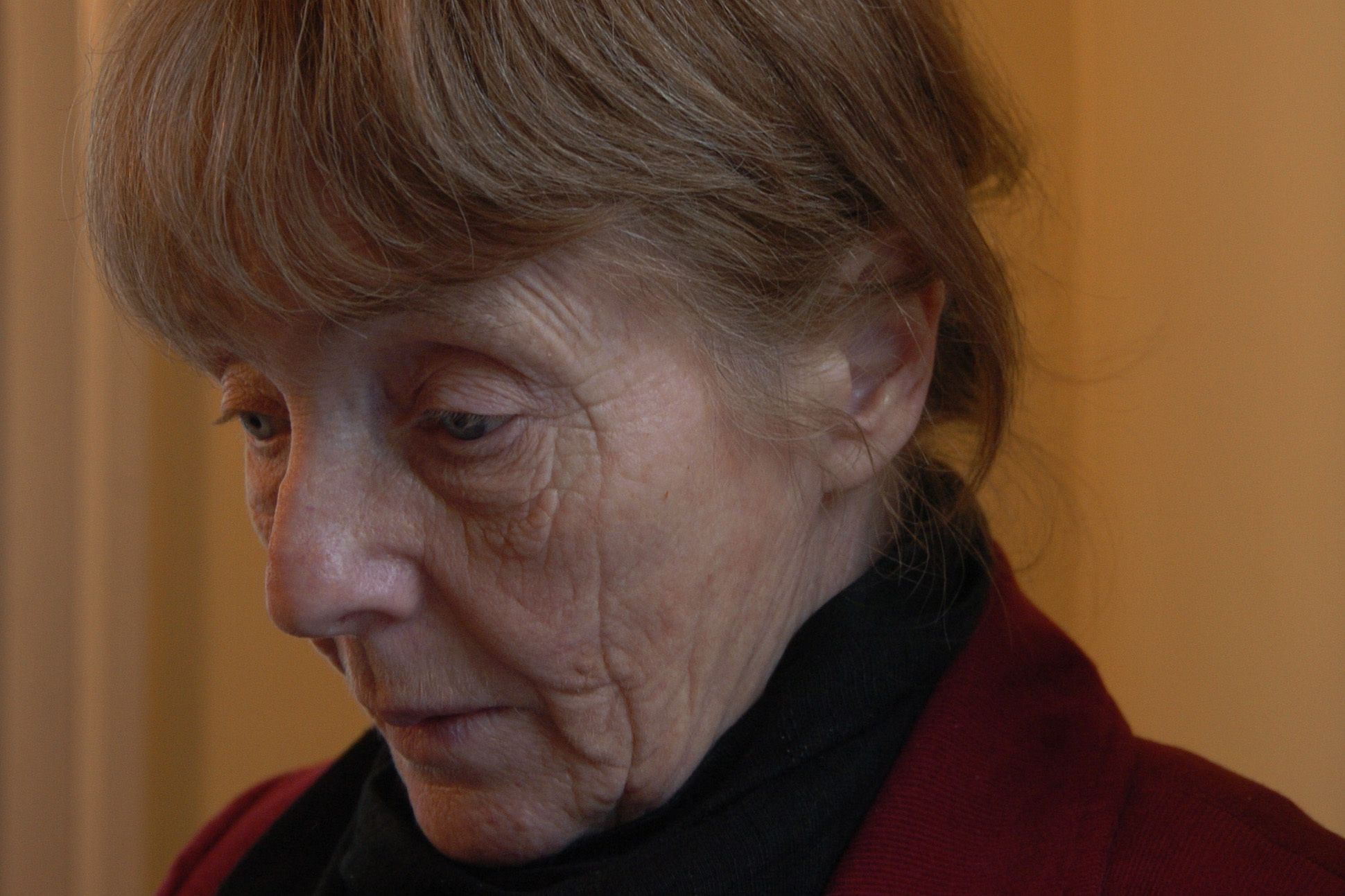
Who are poetry’s true believers? Its evangelists profess poetry’s power to change us, usually without specifying how—a claim familiar from book-jacket copy. Poets are devoted to their craft, of course, but for most, any question of the spiritual, much less a word as weighty as the divine, is fleeting. Like the rest of the world, poetry is now largely secular. A few religious poets still abide in their cells, but they are an exception, a curiosity that reminds us how the sacred once felt, maybe, if only we ourselves could believe. In “Dear Master,” an essay collected in Night Philosophy (2020), Fanny Howe offers her own condensed prose translation of Friedrich Hölderlin’s poem “Bread and Wine,” torquing an old classic to express her feeling of the present. It begins, “We’ve come too late to know what the gods were, only that they live in another sphere, way off in the universe now, passing sometimes like the sound of thunder.” To take the disappearance of the gods seriously, one had to have taken them seriously in the first place.
In the same essay, Howe recalls how she would “scrawl [poems] all over the place as fast as I could, by hand, and then come back to the fragments and try to organize them as if they were spoken or a letter to someone and I knew what I was saying.” She was prolific in that “scrawl,” publishing more than 20 books of poetry and prose, much of it written after the age of 45. Toward the end of her life—Howe died last year, at 84—she declared that she was done writing. But what to do with a still-living creative impulse at life’s end, even when it feels like there’s nothing left to say?
A convert to Catholicism in the 1970s, Howe was a religious poet who remained subversive, never content with orthodoxy. In her work, she sometimes refers to the “apophatic” tradition of theology, which seeks to define God through the negative: because we cannot know God, we come closer to him by discovering what he is not. As in Hölderlin, it is not that the gods don’t exist, but that we can no longer reach them. Howe’s poetic style can be thought of in similar terms: at once hermetic and plainspoken, drawn from life yet abstract, politically committed but unafraid of affairs of the heart. She is a mystic materialist, composing hundreds of poems while always evading the reader’s final understanding. As she writes (or rewrites) in her posthumous collection This Poor Book (Graywolf, 2026), “Every thought condensed into a death before dying. / Then a shout: who?”
This Poor Book is an unusual creation: a work assembled entirely from earlier poems, particularly the long sequences of Howe’s later career, whose sections are rearranged and fused into a single book-length poem. It is both a new work and an old one—a selection of key passages and a reinvention through editing, a kind of self-collage that suggests how poetry might be reborn after its slim volumes are published and shelved in university libraries. Unlike many of her previous books, there are no numbers or obvious demarcations between sections, only larger and smaller fields of white space, as if thought were moving freely through its own reconfigurations. One might think of Stéphane Mallarmé’s unfinished (and impossible) magnum opus The Book, which sought to synthesize all his thought into one perfect volume—or, more modestly, of a rosary: a sequence returned to again and again, its stations felt in the hand by muscle memory.
This Poor Book begins with a child, and childhood is the signature motif of Howe’s later poetry and prose. The very old and the very young are traditionally linked: those who have seen too little, or too much, and who have scant power over the world’s affairs (this was, at least, once true of the very old). One might also think of Corinthians 13:11: “When I was a child, I spake as a child, I understood as a child, I thought as a child: but when I became a man, I put away childish things.” The passage is about charity and the need to renounce our so-called adult beliefs and trust instead in God, as we see only “through a glass darkly” while we’re on earth. From the beginning of This Poor Book, Howe explores the possibilities of that innocence:
I see a child
between a star and a boat.
It is a silhouette
and there is the child again,
now attached to the boat.
All black.
Look at the weather,
the futile wipers beating!
I see the child on dry land,
now with his granny.
Like the boy in a story
he sees fire in wood and words
in smoke and he is good, too good
to be far from anyone old.
This is also the opening of the sequence “The Eye,” from her earlier collection Come and See (2011). Howe often spoke about her love of fairy tales, and a deceptive simplicity is one of her great strengths. The child is on a journey, but no one can say to where, exactly. Toward adulthood, perhaps, but the stanza also contains a soft ominousness: the child is “attached to the boat,” the attempt to drive away the rain is “futile,” and the repetition of “too good” underscores the sense of obligation. Is the child there because the rules say he mustn’t stray from his parents, or rather because the grownups themselves are weak, dependent on something the child provides?
Howe has used this repurposing technique before, most notably in Night Philosophy, which recombines essays, sections of her novels, and other writing to produce new juxtapositions. A radical edit can give even a single line a different charge. In Come and See, “The Eye” spins its hazy fairy tale for two more sections. Here, however, the quotation ends: “Let’s pull down the shade then. / Open this poor book and read.” In the original, the line reads, “Let’s pull down the shade then. / Open the book and read.” The difference is slight, but it gives the collection its title. “Poor” marks a turn toward modesty: these rearrangements matter, but they do not claim to be final. They are a humble offering, asking to be seen anew and accepted on their own terms. In that sense, the title carries a faint echo of the Sermon on the Mount—the poor, after all, are blessed.
In invoking the child, the autobiographical is never far off, and Howe’s own life was more interesting than most. She was born into a family of distinguished pedigree: her mother, Mary Manning, was an Irish writer and dramaturge who moved in avant-garde circles. With friends including Edward Gorey and William Carlos Williams, she founded the Poets’ Theater in Cambridge in 1950, which staged plays by Bertolt Brecht and John Ashbery, as well as the first reading of Dylan Thomas’s Under Milk Wood. Her father, Mark DeWolfe Howe, came from Boston Brahmin lineage, taught constitutional law at Harvard, clerked for Oliver Wendell Holmes, and later became the justice’s biographer. Running alongside all this is the influence of her older sister, Susan Howe—a prodigy and an acclaimed poet, still perhaps the more widely recognized of the two.
Howe felt that she lived in the shadows of this intellectual and cloistered sphere. Left to her own devices, she became what she later called a “free spirit” in her Paris Review interview, marked by but moving beyond the intensity of her family life. She struggled in school, dropping out of Stanford (where her father had managed to enroll her) multiple times, and ultimately became involved in the bohemian and politically conscious milieu of San Francisco at the turn of the 1960s. For the rest of her life, she would be involved in political causes and organizing: she joined the Congress of Racial Equality and was thrown out of a meeting of the House Un-American Activities Committee. Her second and defining marriage was to the writer Carl Senna, a Black intellectual with whom she had a “tumultuous” relationship. An interracial marriage was out of place in a Boston on the cusp of the bussing riots of the 1970s, and Howe was alienated by her family’s unspoken disapproval. Money was tight, and she would raise her three children while working odd jobs, scribbling poems and novels in the margins.
Howe’s life suffuses her work, though the relationship is never strictly autobiographical. Her earliest writings were pulp novels for money, but her true literary debut came with a book of stories, Forty Whacks (1969), and a book of poems, Eggs (1970), in quick succession. Howe’s fiction writing developed its own idiom: poetic and often fragmented, but always containing a plot that progresses in some traditional narrative sense. Her best-known works of fiction are the five novels collected in Radical Love, spanning 1988 to 2000. They do not recount her life, but are perhaps its dark mirror, drawing from the emotional landscape of Howe’s complex childhood, her connections to Ireland (where, for many years, she went to write in a convent), the prospect of interracial love, and the difficulties of marriage and desire. As much as any writer of our time, she moves fluidly between genres; later in her career, the boundary between fiction, essay, and poem increasingly dissolved.
Howe’s political commitments are as central as her spiritual ones, and her work returns insistently to art’s relation to the moral world—above all, the defense of the defenseless. In this sense, she comes close to Liberation Theology: belief is not merely otherworldly but bound up with the feeding of hungry mouths here on earth. In a passage from Love and I (2019) in which class politics are in full effect, she wonders, “What is one life worth without money? // This is the question of the century.” Elsewhere, she writes,
We are stamping on the bosom of Satan, boot-boot
We are sure of the origins of evil
Ice-chop. Man and soil
Which came first? The robin or the worm?
Burst a well, das kapital, sell, sell
A strain of mischief keeps Howe’s verse from turning leaden or self-serious: Satan collides with Marx, wrapped in a nursery-rhyme riddle. This Poor Book is often disorienting, if consistently fascinating. The serial poems from which it is drawn are already highly associative, leaping between images and scenes; in their recomposed form, that openness only deepens, making it difficult to fix what Howe is finally after. But disorientation is part of the point; it is not necessary to understand everything, but to be open to unexpected contrasts. Consider The Needle’s Eye (2016), which also moves freely between poetry and prose, meditating on the Tsarnaev brothers, perpetrators of the 2013 Boston Marathon bombing, while also recounting the life of Saint Francis. The comparison might seem odd, but Howe’s restless mind looks for insights into the meaning of strange human behavior. As she writes in This Poor Book, “Having mercy on someone is easier than forgiving them.” Nor is she afraid of blasphemy, writing elsewhere, “Patch up the cracks in the Catholic church! / It’s falling down.”
Another section of Night Philosophy’s collage is the reappearance of a much-cited essay titled “Bewilderment,” drawn from The Wedding Dress (2003). There she writes of bewilderment as a “a poetics and a politics,” a way of preserving openness as the poet’s essential task. She describes her practice of seriality: “The serial poem attempts to demonstrate this attention to what is cyclical, returning, but empty at its axis. To me, the serial poem is a spiral poem.” By contrast, “An aesthetic that organizes its subject around a set of interlocking symbols and metaphors describes a world that is fixed and fatally subject to itself alone.” The serial poem, then, is an aid to getting lost, a kind of knowledge we undervalue. If something resists the reader’s expectations of what a poem should be, it may not be extraneous but a guide to what has not yet been recognized. The openness of the form, its generative possibility, is also a way of reaching outward: a necessary imperfection that brings the poem closer to the imperfect world. Take, for instance, this section from This Poor Book (itself taken from Second Childhood) that shapes the speaker’s life into a monk’s journey:
I have to pass through the estuary
to investigate breakdown as a trail of nerve-endings
at the beginning of everything.
Scrapes like threads seeking holes.
It’s a strange textile that serves as a road map.
This one did:
its blue led to the edge.
Where could a fabric begin and end except as a running woman
who sews and passes it along?
So I ran with it in my hands.
What kind of journey is this? It shifts its aspect in nearly every line, from the physical world of the estuary into the mental space of “nerve-endings,” and then on to the metaphysical “beginning of everything.” The search is then recomposed as sewing, both classic “women’s work” and a timeless metaphor of artistic creation. Then the textile is a road map, and so on; there is a ceaselessly protean energy in Howe’s form, pushing onward by intuition and leaving clues behind for us to pick up. The sections that bookend this passage also are jumps—they don’t directly connect, but they offer more correspondences, and a change of pace into something more visceral, such as “There was orange vomit on a large cape over a large woman.” Such contrasts and detours, in Howe’s words, preserve the “stench of the real” and avoid the poem’s becoming an “astral corpse.”
This Poor Book has a mystic bent, but these allegiances to a complicated reality are always at hand. Howe’s poems remain grounded in the difficulty of understanding visible life as it unfolds. Close observation is useful, as when Howe’s speaker sees young people on their phones, bringing together the mundane and the otherworldly with great delicacy:
Some kids concentrate
On plastic and metal
As if on threads and a red
Pin cushion, the snow
Falling like pepper
On the tar outside.
The letters in color
That have messages
Stuck to each other.
Listening to hip-hop
With their keypads clicking
They pierce the veils
Of material
To see the other side.
They’re practicing transcendence.
Howe is no stranger to revision. As she writes in her book of essays The Winter Sun (2009), “Revision is the path taken by an autodidact like me. In revising you teach yourself. You find your own information buried in your body. It is still alive until you are not.” Is there, then, another kind of revision that survives the writer, left for the reader after death? We tend to think of revision as a paring away—in Howe’s words, “By slashing the curtains of words, I might finally glimpse the words behind the words and the silence behind those.” But there are limitations, too. Intriguingly, Howe also writes that revision is the opposite of religion. It is useful for approaching a certain kind of truth, but it never quite reaches all the way to the unspoken. Revision is endless, but it can never be final. Seeking God, or else just that silence behind everything, requires a more radical approach to understanding the word. By re-editing and only revising sparingly in a conventional sense, This Poor Book also challenges our idea of what revision can be.
Howe writes that she “did not believe in the unconscious but in correspondences. This made me old fashioned.” It is an idea she returns to often, favoring patterns of relation over the explanatory frameworks of psychoanalysis; poetry, for her, emerges through associations that feel older and more elemental. This Poor Book can be read as a late extension of this practice, an attempt to generate correspondences from the material of a lifetime’s work. The book is not just a selection or a reckoning with her life in poetry, but an offering to the reader: an invitation to look again, even if answers remain elusive. Howe asks us to take poetry, and maybe all language, as something radically fungible. The connections drawn from word to word, line to line, are fragile—at the same time, their power to be reconstituted in different ways repeatedly is something mysterious. Few poets, even dedicated revisers, are strong enough to risk this reassembly once the poem is “finished.” It’s simple, dangerous, and profound—in the same way the communion wafer, in Catholic practice, becomes the body of God every weekend.
Howe’s poetics also resist a culture of constant production by insisting on the value of attention rather than output. Because poetry requires few resources beyond language itself and tends toward compression rather than accumulation, it can ask us to do more with less. After decades of writing, Howe returns us to uncertainty, suggesting value in forms of attention not measurable in conventional terms. In The Winter Sun, she writes:
Often a poet will use repetition by not repeating the same word in one poem. Instead the poet will almost repeat or rhyme a sound but not quite. Almost suggests there is a margin of uncertainty around your thinking. It reminds you that there are echoes that bounce up and away and all is wildness.
This is a repetition that is not quite repetition, not quite compulsion. It is an attempt to accept things beyond our understanding.
In the last 20 or so pages of This Poor Book, “Wood”—another section, or perhaps a new poem—closes the book. It rearranges another Howe poem, “The Passion,” from Gone (2003). What initially appears as another free-floating sequence is anchored subtly by this origin: however diffuse, it remains a retelling of the Passion of Christ. Howe’s earlier account has been pared to its barest materials: the cross is simply wood. Here, revision takes on theological weight. In one instance, “Love is the movement toward perfection” becomes “Love is the movement towards pity.” Perfection falls away. What remains is receptivity: a turning toward what arrives and a willingness to let language come toward us, rather than mastering it.
This Poor Book can be read as a condensation of a life spent writing in freedom while remaining attuned to suffering in the world. In the classic Christian conception, it is Christ who bears the weight of sin; Howe makes no such grand claims for the poet. The task, instead, is modest: to recombine what already exists in language, in the hopes it might open onto something beyond itself. Ending the volume, Howe turns toward the penitent’s final interlocutor:
He couldn’t answer
Between my brain and this silence
time lifted and measured
There was no more reason to die
“Time lifted and measured” is a suspension that also does not lose its scrutiny of the world. We do not know why we die, and we can never know. There can be only an attempt at understanding and a small record of our presence on earth. Like the gods we yearned for, we too fall away and leave few traces behind.
David Schurman Wallace is a writer in New York. His work has appeared in the New Yorker, the Nation, the Baffler, and other publications.