


I Type for Myself, in Search of Liberation
Nellie Wong, who died this year, leaves behind a formidable legacy as a poet, activist, and champion of the working class.
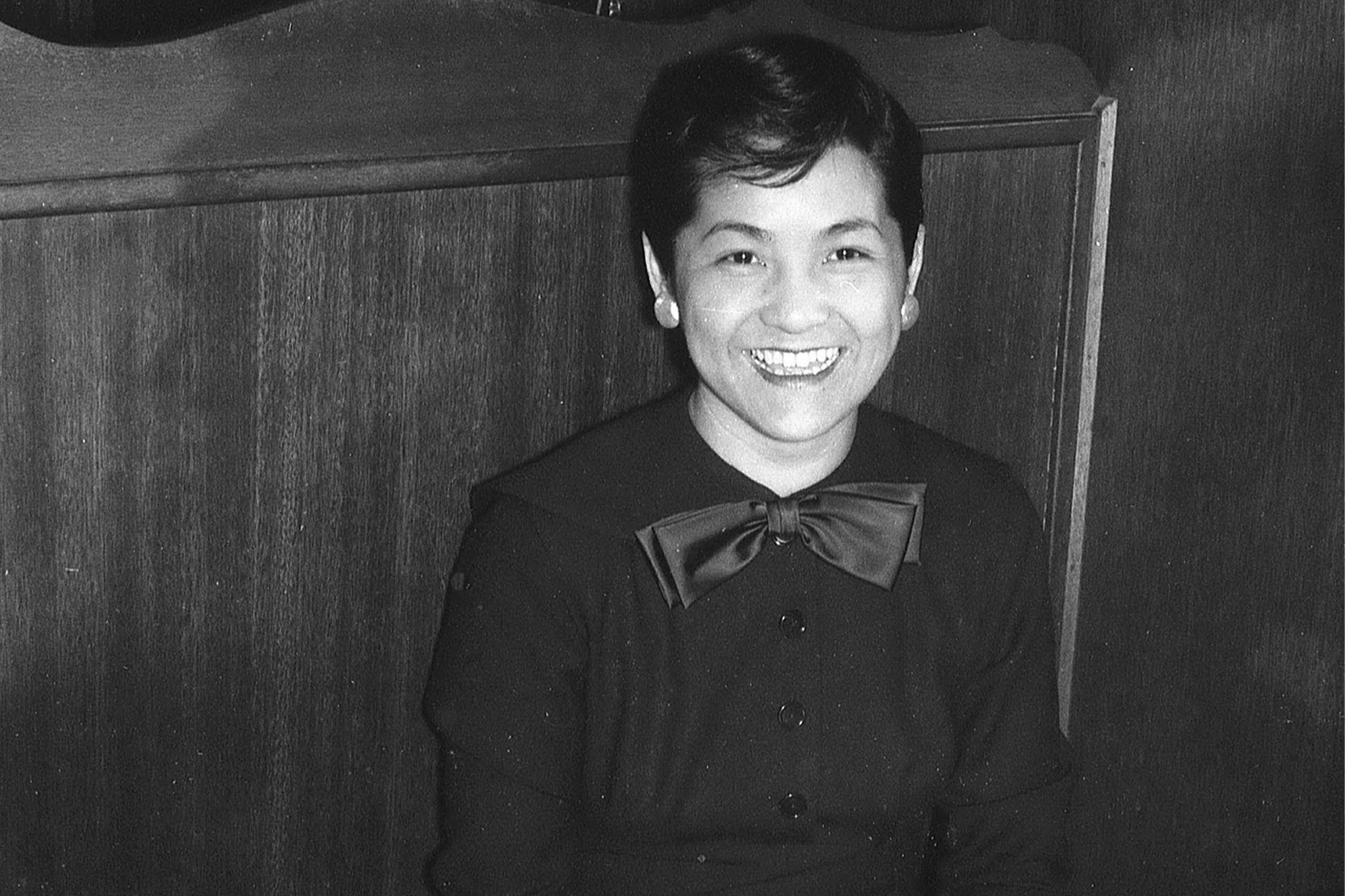
Nellie Wong in a booth in her family restaurant, The Great China, in Oakland's Chinatown, circa 1950s. Courtesy Nellie Wong Archives.
In January, the writer and activist Nellie Wong passed away in Oakland, aged 91. Born in 1934—fittingly, the year of the San Francisco General Strike—Wong spent her entire life in the Bay Area. She started writing in her mid-30s, while taking night classes. Coming to socialist and feminist politics through her writing, she organized with various leftist groups and published five books over a half-century, one per decade: Dreams in Harrison Railroad Park (1977), The Death of Long Steam Lady (1986), Stolen Moments (1997), Breakfast Lunch Dinner (2012), and Nothing Like Freedom (2024). She read and wrote and spoke in the Bay and around the world: at demonstrations, on picket lines, in writing groups, schools, libraries, museums. A building was named after her at Oakland High School; a poem is engraved on a platform of the F-Muni streetcar line. She was, as the flyer to a memorial reading at a local bookstore put it, “icon, neighbor and friend.”
***
The fourth of seven children, Wong was the first in her family born in the United States. In the 19th century, Chinese immigrant labor built the US Transcontinental Railroad. In response, the US introduced the 1882 Chinese Exclusion Act, banning most Chinese laborers and denying others the right to become naturalized citizens. The 1924 Immigration Quota Law added further restrictions. Chinese men were prevented from bringing over their wives, in a moral panic around migrants that’s all too familiar today. Migrating from Guangdong Province, Wong’s parents had to pose as brother and sister in order to escape these restrictions. In turn, Wong’s mother, pregnant with Nellie, faked marriage to a man named Sheng Wong—an episode recounted in “It’s in the Blood” from The Death of Long Steam Lady:
We told no lies, only the truth
as we were forced to.
My three older sisters were supposed to be my cousins.
My father was supposed to be my uncle.
My mother was supposed to be my father’s sister
Wong’s parents gave her the English name Nellie. A teacher at the Chinese school she attended after her classes at “American school” renamed her Nah Lei, which translates to Where or Which Place. Her parents countered with Lai Oy, or Beautiful Love. In “How A Girl Got Her Chinese Name,” Wong writes:
I giggled as I thought:
Lai Oy could also mean lost pocket
depending on the heart
of a conversation
Naming, Wong suggests, opens multiple paths, multiple challenges. One of the tasks of poetry is to bring these together. “Now I search,” she writes, “for all the names that gave me life.”
When Japanese American civilians were interned as enemy combatants in the Second World War, Wong’s family had to distinguish themselves to survive white racist ignorance, as she recalls in “Can’t Tell”: “Our Japanese neighbors vanished / and my parents continued to whisper: / We are Chinese, we are Chinese. // We wore black arm bands, / put up a sign / in bold letters.”
The postwar period was supposed to be one of greater “integration,” the days of the “model minority,” per the phrase sociologist William Petersen coined in 1966. These hopeful narratives put the lie to the racism that still structured American society. Self-conscious from childhood eczema, Wong was keenly aware of racist beauty standards within American society. “When I Was Growing Up,” she writes, “I longed to be white . . . fitting in, / belonging, getting in line.” One of her first published poems, “We Can Always,” retells racist, anti-Asian jokes from the TV, radio, and newspapers. “[A]nd if we can’t laugh / at ourselves,” Wong sardonically ventriloquizes, “we can always / go back.”
Wong’s working life began at age 11, with shifts at the restaurant her parents opened in Oakland’s Chinatown in 1943. When she graduated from high school, her parents could not afford to send her to college, and so, still a teenager, she began a career as a secretary: first at Oakland High, then at United Grocers, and finally at Bethlehem Steel. At work, Wong spent her days typing the words of others. She later recalled this as a period of “punishing my body / by starving the mind.” “I murdered myself,” she wrote, “believing there was no self, content to ride the tide of obliteration.”
But there were words within her, waiting to get out. Her younger sister, the visual artist and poet Flo Oy Wong, detected a talent for writing in the humorous family newsletters that Wong dispatched. At her encouragement, Wong took fiction writing classes, first at Oakland Adult Evening School, then, at the urging of her teacher Kathy Manoogian, at San Francisco State University (SFSU), where she enrolled in 1973.
“My very first poems were skinny poems, written in a shorthand notebook from work,” Wong recalled, “just playing with words.” Now she began “writing feverishly,” “women’s poetry . . . a bridge to my then-unarticulated life.” When a male professor criticized Wong’s work for its “anger,” Wong’s fellow students, Sukey Durham and Karen Brodine, came to her defense. Brodine prompted her to write about her working life, and suggested she send a manuscript to Kelsey Street Press. “So I found out what a manuscript was!” Wong later recalled.
Dreams from Harrison Railroad Park appeared in 1977 and swiftly became the press’s bestselling book. Slim at 45 pages, the collection is dedicated to Wong’s late parents and pays tribute to the forgotten lives of her family and others like hers, in the hard route from China to Chinatown. For Wong, lineage enables survival, yet it also passes down inherited shame. Grandmothers whose feet were bound in China scrub a young girl until her skin bleeds in the US (as in the poem “Like the Old Women Suggested”). In China, young women sold for a bride price are forced to perform unpaid labor for their new family (as in “Grandmother’s Song” and “On Thinking of Photographing My Fantasies”). In the US, there is dog-whistle racism and the Chinatown version of Miss World (see “Drums, Gongs”).
“From a Heart of Rice Straw” retells a central story of Wong family lore. In 1939, when Wong was five, her father was shot and almost killed by a cousin whose lottery funds he had embezzled to support his family; he was saved by a watch in his breast pocket. Wong’s mother furiously chased the would-be assassin into the street, risking her own life. This is a story of family loyalty and betrayal, of violence turned into a punchline. As the scholar Amy Ling remarks, “A lifetime’s tension is here resolved and yet unfilled.”
Wong’s mother’s actions represented a moment of heroism that is also a moment of abjection: a moment of pride and shame, of solidarity with those you love and of having your own kin turn against you. Frustrated by her lack of options, Wong’s mother often lashed out at her children. When she died many decades later, she was caught between gendered expectations that made her resent having five daughters and only one son. She was taught to believe her ultimate worth lay in getting married and having children. The last, impossible request the poem makes is also a resolution, to honor that legacy, whatever contradictions one sees in it: “Ma, hear me now, tell me your story again and again.”
Dreams ends with Wong having a picnic at her parents’ graves. “[W]e three / . . . promise each other nothing / . . . for it is not our time to be fenced in.” What could not be said in life can now be said in the poem. This is ongoing work. “If I worship the dead,” Wong writes in “Day of the Dead,” “it is because / I hear my parents whispering / through the marrow of my bones / to be fed.”
In October 1979, Wong, Merle Woo, Canyon Sam, Kitty Tsui, Genny Lim, and Nancy Hom formed the poetry-performance collective Unbound Feet, which took its name from the traditional Chinese foot-binding practice which immobilized women in the interests of a distorted ideal of female beauty. Foot binding, Wong argued in a profile for the Oakland Tribune, gave “an understanding of what our foremothers went through,” serving as a metaphor for the way women were still trapped by the “stereotypes forced on them through all facets of the culture.”
“I don’t want to forget,” she continued, “and I don’t want Americans to forget, that Chinese are ex-slaves, that Chinese women were brought over here to be prostitutes, for Chinese as well as for whites.” Though many older migrants saw uncovering the past as “hanging out dirty laundry,” Wong insisted that intergenerational trauma could not simply be wished away: “it’s our history that’s given to us.” And that history struck a chord: some 600 people attended the group’s final reading in 1981. The group’s title poem, co-written by Wong and Lim, is a declaration of independence:
I am unbinding my feet.
I am a woman who writes.
I am a woman who works.
I am a woman who makes her presence in the world.
***
In 1975, an SFSU graduate student named Sukey Durham (today Sukey Wolf) was denied the opportunity to study the work of writer Tillie Olsen, who—as a both a woman and a socialist—was deemed doubly suspicious. In response, a group of students formed what became the Women Writers Union (WWU). At a time of right-wing backlash, the WWU expanded beyond the university, participating in campaigns for Cassandra Peten, a shipyard worker who had shot her abusive husband, and against Hollywood’s attempt to revive the racist 1930s serial Charlie Chan. Wong and her new comrades—“sister-poets,” as she called them—became intensively involved in the WWU, and, in turn, the Bay Area branches of the socialist feminist organizations Freedom Socialist Party (FSP) and Radical Women. Wong would remain a member of the latter until her passing, and the group remained central to the way she understood the world.
“To go public with change is to begin,” she wrote in a poem dedicated to Merle Woo in 1979. In 1981, Wong spoke at the Left Write! conference, a coalition-building event inspired by groups like the 1930s Anti-Fascist Writers League; appeared in the groundbreaking This Bridge Called My Back: An Anthology of Writing by Radical Women of Color; and was featured in the documentary Mitsuye and Nellie, Asian American Poets alongside Japanese American poet Mitsuye Yamada, with whom she maintained a friendship until her death. (Yamada is currently 103 years old.) Wong was also involved in the successful campaign the FSP mounted to reinstate Woo after the university refused to renew her teaching contract.
In 1983, Tillie Olsen invited Wong to join to a delegation of twelve American women writers, including Alice Walker and Paule Marshall, on a visit to China, her first time in her parents’ homeland. Wong persuaded the group to make a detour to her ancestral village in Guangdong Province, where she met distant cousins. It was her encounter with Chinese writer Ding Ling, however, that provided the trip’s abiding memory.
The author of more than 300 works, a one-time friend of Mao (who dedicated a poem to her) who had been attacked at different points by both the Kuomintang (KMT) and the Chinese Communist Party, Ling had belonged to the Chinese feminist and communist movements since the 1920s. The Communist Party helped her to escape to Yenan after she was kidnapped by the KMT in 1933. In 1942, a speech she gave on International Women’s Day criticizing the patriarchal attitudes still prevailing in Yenan saw her censured, along with other members of what scholar Gregor Benton calls the “Yenan Literary Opposition.” Communists fighting for a revolution in China, these writers nonetheless sought the freedom to criticize bureaucratic and misogynist tendencies that they saw as reproducing old feudal structures.
Ding’s fortunes waxed and waned. She won the Stalin Prize in 1952, yet a few years later was expelled from the party and sent into exile. But she survived both this purge and the Cultural Revolution. When Wong came to visit her, she was on the eve of official rehabilitation. Years later, Wong wrote a poem about their meeting “in a modest apartment, in Beijing,” where Ding startled the visiting writers by declaring: “I am not a feminist.”
You of the west, she scolded in her soft but clear
voice, affixed that identification upon my work of the conditions of women,
daughters wet nurses fishers
herbalists slaves
mothers prostitutes cooks farmers
actors warriors doctors maids embroiderers
The list of women and their occupations splits the poem open on the page, the blanks between words at once spaces of erasure and possibility. Ding’s Mandarin was, Wong admits, “lost to me, more American than Chinese.” But the poem commits to the idea that we can meet in difference without giving up our principles or commitments; that we can learn from such encounters dialectically.
A quotation from Ding’s speech “Thoughts on 8th March” provides an epigraph for The Death of Long Steam Lady. “Women who are fully aware of the present moment have to know how to shed every rose-colored fantasy,” Ding writes. “Our joy is a battle within a storm and not playing the harp under the moon or reciting poetry in front of a flower.” “Long Steam Lady,” or “blabbermouth,” is the nickname of a “talkative, crazy old lady who fed pigeons in the park,” regaling listeners with tales of being a dancer. She joins Sui Sin Far, one of the first North American writers of Chinese ancestry; the Greek Communist poet Yannis Ritsos; the poet’s family; and all the anonymous women who worked and struggled before and alongside them: “women / who knew no poems / but their own lives,” “maids tidying / beds,” “grandmothers / who don’t see me, their granddaughter writing and singing / their joys and sorrows,” “each woman, man and child still fighting / to eat and live on this our inherited earth.” Like Ding Ling, like Tillie Olsen, like Ritsos and others struggling to articulate the suffering and resilience of people seeking to build a better world, Wong’s book asks as many questions as it provides answers. How do we measure a life? How do we measure dreams fulfilled and unfulfilled? What social structures might give space for such experiences? As Sondra Zeidenstein wrote, for Wong, “the immediate and everyday . . . evoke compassion and an unself-conscious desire for social justice that seem as necessary and natural as appetite or breath.”
***
Speaking at the Poetry Center in 2017, Wong emphasized the importance of learning not just through formal institutions but through worker solidarity and opposition to the class hierarchies within universities: hierarchies that divide teachers and students from cleaners and secretaries. “I really learned from the ground up being a worker,” she recalled. Wong worked for Bethlehem Steel for eighteen years until she was laid off in 1983. As well as visiting stints teaching poetry at Mills College, playwriting for the Asian American Theatre Company, and women’s studies at the University of Minnesota, she worked for fourteen years in the affirmative action office at UC Berkeley, representing University Professional & Technical Employees as a delegate to the San Francisco Labor Council (AFL-CIO).
As a teenager, Wong had typed for writer Frank Chin, a friend of her brother. As a working woman, she typed for her bosses. “Now,” she wrote, “I type for myself, in search of liberation.” Her third collection, Stolen Moments, is dedicated to Karen Brodine, “comrade, sister-poet and friend,” who passed away in 1987 and first encouraged Wong to write about her working life. In the title poem, revised from its first publication in Freedom Socialist in 1979, the secretary imagines herself storing away fragments of language—“newspaper headlines, radio commercials, / hallways conversations, bulletin boards”—like “sacks of long grain rice . . . store[d] . . . in the bins of my body,” stealing, not physical objects, “but moments, . . . moments / that no job can steal from you.”
Wong’s poetry collects hundreds of those moments: stolen from the office hour, from the flash of encounters, sights, sounds, and smells across the city. Wong celebrates music, cinema, and food, moving through the city she lived in her entire life: at a party for a work colleague; on a silent march to save a women’s shelter; celebrating her 62nd birthday at PJ’s Oyster Bar while reflecting on cuts to welfare and impending strikes on Iraq. “Behind each celebration,” she writes in “In Search of Song,” is “the noise, the unsaid.”
Wong had visited Tiananmen Square in 1983, trying to absorb its history, “to live the lives of all the martyrs and heroes of the 1949 revolution,” as she put it in a journal entry. Watching the uprising of students and workers in the Square, crushed by the state in June 1989, “grief froze my pen. My poems would not come.” Instead, she wrote a speech for an FSP rally outside the Chinese Consulate. “Our party’s analysis was my expression,” she writes. “The pain I felt was not personal. It was collective.” For Wong, a world-historical event such as Tiananmen cannot be written about in just one way. Instead, it must be written about from every angle: a speech, a journal entry, a series of poignant haiku for the students “facing death, singing / the International[e].”
Wong always saw herself as living in history. In 1934, when she was born, fascism was on the rise: Mussolini’s invasion of Ethiopia; Franco in Spain; the Chinese Civil War and the war against Japanese fascism, a war in which 20 million would die. Wong was well aware of the rightward turn of today’s world. As her comrade Norma Gallegos wrote the day after her death: “While it was tough to wake up today, I did it knowing she wanted me up and at the protest of the US bombing of Venezuela.” Wong cast her lot with strikers, migrant workers, with those who protest, envisaging campaigns of international solidarity in a world where people are encouraged to identify with flag rather than class. “This world belongs to every body,” she writes in “Fourteen Line Poem on the World.” “Where else can we go? / Where else can we go?”
Wong retired from her job at UC Berkeley in 1998 but continued as an FSP activist, traveling to Australia and meeting Assata Shakur in a 1997 delegation to Cuba. In 2019, nearly forty years after the demise of Unbound Feet, she joined another collective: The Last Hoisan Poets, formed as a way to reclaim the rural dialect spoken by Wong’s parents. Hoisan-wa, also known as Taishanese, is characterized, in the words of Eddie Wong (no relation), by “slippery syllables, guttural stops and the lilt that sounded like laughter.” At Wong’s memorial reading, Flo Oy Wong remarked: “Nobody respected us because they said we spit. They didn’t respect us because we weren’t high-falutin’ like those who spoke in Beijing or Shanghai or wherever else. And I didn’t give a damn because I wanted to honor my mother and father.” Her sister, too, relished the opportunity to play with Hoisan-Wa, slipping in and out of the two languages. Flo Oy recalls Nellie working on poems up to the end of her life, calling her late at night to ask her for Hoisan words.
The Last Hoisan Poets gave public readings at libraries, schools, and museums, often working with the Del Sol String Quartet. In July 2025, 100 years after Wong’s parents and three elder sisters had been held there on their way to the US, the Last Hoisan Poets read at the Angel Island Detention Barracks museum:
Language is the boat that delivers me from the homeland
I’ve never set foot on the country I call home
(“Haw Meong Suey / Good Life’s Water”)
Wong’s final book, Nothing Like Freedom, appeared to celebrate her ninetieth birthday in 2024 through HoongHoongLookLook Press, a press she set up with her friend, artist, and educator Andi Wong. The range of these late poems is at once cosmic—catalogues of living and dead heroes, as in the poem “Angels on Earth,” with its gathering of Anna Akhmatova and Karen Brodine, Pat Parker and Yannis Ritsos—and specific: historical facts, family stories, remembered places. Wong writes of the deaths of migrants, the bombs dropped over Baghdad or the heads of Palestinians, the fate of migrant workers in China or those under Taliban rule. She writes of the pleasure of cooking, as in the food poems of her fourth collection, Breakfast Lunch Dinner (2012); of the domestic labor of ironing, in a text dedicated to Tillie Olsen’s famed short story “I Stand Here Ironing;” of the ticking of a clock as materialist figure for the movement of history and time. Above all, she manifests the notion of solidarity: the humble and unashamed capacity to feel for and with the living and the dead, the known and unknown, and to act for and with them, to protest, to organize.
As her brother William Wong notes in her obituary: “Nellie wrote up until the last days of her life, working on a forthcoming book, December Sonata, composed of poems she wrote after learning of her terminal illness.” An individual writer’s work makes a contribution toward something whose contours will exceed those of their own life. “You will not survive the work that still needs to be done,” Wong wrote back in 1981. “You will be gone when the questions of the future arise like wildflowers on the plains of this earth.” To write is to live, but also to accept death. Wong’s late poems reconcile themselves to transience in the belief that human struggle might build a better world. As she wrote in “Under Our Own Wings” in 1979:
If you begin I begin
If you sing I sing . . .
In death our bodies regress to the innocence of bones.
In love we work to live in America under our own wings.
David Grundy is a poet and scholar based in London. His books of poetry include Relief Efforts (2018), To The Reader (2016) and The Problem, The Questions, The Poem (2015). He is also author of the work of criticism, A Black Arts Poetry Machine: Amiri Baraka and the Umbra Poets (2019). He previously studied and taught at the University of Cambridge and is now a postdoctoral researcher at the University...