


Fellowship in Exile
This folio presents ten contemporary poets from nine countries, all of whom faced persecution, war, or genocide, as well as threats to their safety because of their writing.
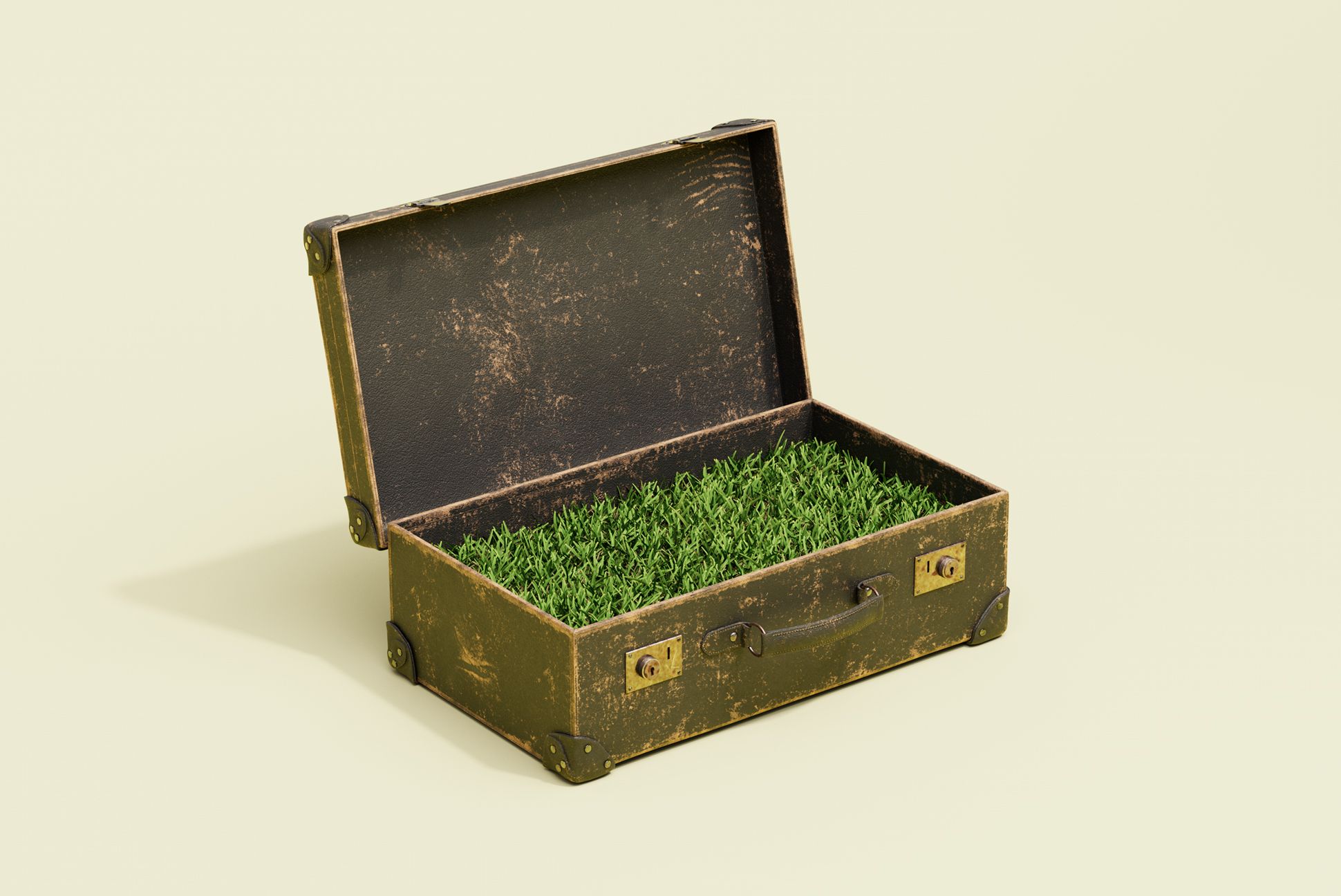
Art by Ricardo Tomás.
Going into exile requires a strength both ordinary and superhuman. It’s a process composed of mundane, bureaucratic steps that follow the loss of one’s home: learning an unfamiliar transportation system; finding a school, a doctor, a place of worship; trading one’s mother tongue for another language; exchanging the expertise of one career for whatever work may be available; replacing primary relationships with new acquaintances who, if you’re lucky, may many years from now become chosen family. The sum of these tasks is both nebulous and existential—a state of being that may be best expressed in the slanted, broken lines of poetry.
This folio presents ten contemporary poets from nine countries, all of whom faced persecution, war, or genocide, as well as threats to their safety because of their writing. To read these poets’ work is to encounter a contemporary language of exile typified by gallows humor, absurdism, motifs of reanimation and resurrection, and visceral, angular meditations on prisons, graveyards, and even bathrooms.
There’s Nada Al Khawwam, who fled Iraq after the 2003 invasion and finds the self in “what hung on to my fingers from the grass.” There’s Ashraf Fayadh, a Palestinian refugee imprisoned, lashed, and sentenced to death in Saudi Arabia for apostasy, who writes of a soul that is “homogenized ... fermented ... kneaded ... baked/and sold at stores that violate health codes.” There’s Kerima Tariman, the revolutionary Filipina poet who was killed by the military in 2021. In prison, she wrote about pinching words “between thumbnails, like head lice” in a poem whose translator, Amanda Socorro L. Echanis, was jailed at the time she translated it.
Most of the poems have appeared only in limited runs or independent magazines; some appear in English for the first time here. Platforming exiled writers is part of our work at City of Asylum/Detroit, whose mission is to offer two-year safe-haven fellowships to writers and artists in exile. We’ve supported fellows from Gaza, Haiti, Nigeria, and Angola. These fellowships are meant to give writers and artists the stability they need to remain connected to their practice while adjusting to a life in exile.
In the past decade, the number of refugees worldwide has tripled and the number of asylum seekers has more than quadrupled. About 304 million people now live outside their country of origin, almost twenty percent of them displaced by conflict or disaster. There is no way to measure the staggering loss of cultural output wrought by the growing crisis of displacement, but the consequence of that loss is less abstract: where creative expression is suppressed, authoritarianism grows.
From the magazine:On the Grass of Exile
on the grass of exile
Picking up the deliberate fallout
of …
From the magazine:A Sadness Made of Dough
and your sweat ... and your remains…
From the magazine:June 12, in Prison
the back and forth
doesn’t even span five meters.
I suppose I’m lucky
the windows are a little bit big…
Travel bans have forced us to reconceptualize the fellowship beyond US borders. We recently awarded a fellowship to Tareq Hajjaj and Taimaa Salama, a writer-artist couple who’d fled the genocide in Gaza and were stranded without papers in Cairo. Despite overwhelming community support and nearly a year spent facing down onerous bureaucracy, their prestigious, talent-based visas were granted—only to be revoked just before they were set to travel.
To have that effort erased by the whims of a faceless person behind a desk was devastating, but it forced us to rethink what a City of Asylum fellowship can and should look like. We decided we would not abandon Hajjaj and Salama. If they couldn’t get here, we would bring our program into exile to meet them.
This was the first iteration of our Fellowship-in-Exile, which we now offer to artists and writers who qualify to be hosted by City of Asylum/Detroit but can’t travel to the US because of visa restrictions or the threats they would face here. Two of our Fellows-in-Exile, Hajjaj and Aaiún Nin, are featured in this folio. There is also an honesty—a clarity of mission—in working this way. It has allowed us to transcend borders and create new opportunities both for our fellows and for our organization, while challenging the assumption that the West is a “safe haven.”
Exile ruptures, excises, and casts out. But exile also rebuilds and embodies. One becomes a patched-together version of one’s former self, the future bandaged over the past. The exiled poet brings awareness and texture to this physical and metaphysical instability, a double existence marked by uncertainty and loss but also by possibility and humor. We gathered these poems because we believe exile writing creates a new, urgent framework for conceptions of belonging. In a world increasingly defined by fluid boundaries—of gender, between the human brain and AI, between human emotions and those of animals—the slippery alienation of exile feels decidedly at home.
This essay is an introduction to the folio “Broken Lines: A Gathering of Exiled Poets,” curated by Laura Kraftowitz and Edward Salem. Read the rest of the folio in the July/August 2026 issue of Poetry.
Laura Kraftowitz is the co-founder of City of Asylum/Detroit, a nonprofit that provides safe-haven fellowships to exiled writers and artists under threat of persecution.
Edward Salem’s second poetry collection, Intifadas (Sarabande Books, 2026), was selected for the Kathryn A. Morton Prize in Poetry and was a finalist for the National Poetry Series. He is also the author of Monk Fruit (Nightboat Books, 2025). Salem’s fiction won the 2022 PEN/Robert J. Dau Short Story Prize and BOMB’s 2021 Fiction Contest. His writing has appeared in Granta, The New York Review of ...